
Fantasy basketball managers need to peak at the end of the season. For most, that means mid- to late March, and with a flurry of action taking place around the NBA trade deadline, those who best navigate these murky waters will thrive. Deadline evaluations can reshape the landscape overnight, creating sudden opportunity shifts, while sharp managers who identify emerging post-deadline sleepers often gain the edge that decides championships.
James Harden, Cleveland Cavaliers
This deal was put on our radar seemingly out of nowhere, and the pieces came together in a hurry.
It’s a high-impact trade in NBA circles, but for fantasy managers, I’m not sure the impact is too high. The long and short of it is simple: Harden’s value ticks up thanks to the supporting cast, Donovan Mitchell’s value should remain elite, and Evan Mobley is the piece I expect to decline.
This article has the details, including a player whose stock is on the rise that your competition may not have front of mind for a trade involving this level of star power.
Anthony Davis, Washington Wizards
In theory, the move of Anthony Davis to a young team like this should allow him to walk into heavy usage while the pieces around him round into form.
That’s only theoretical.
At this point, the almost 33-year-old Davis is a health risk whenever he takes the court, thus making an increase in responsibilities difficult to get excited about. It’s a finger injury that has him currently on the shelf, and we aren’t expected to get much before the end of the month.
Why would we expect him to come back for a team whose present is being sacrificed for the future?
With the injury status, you have the luxury of stashing Davis on your IR and praying. That said, if the injuries are racking up and impacting your ability to stream enough volume week to week, we aren’t looking at a must-hold.
This trade makes it less likely that we see Davis play 25-plus minutes again this season, and asking him not only to get healthy but to work in with a new team in time to truly matter during your postseason is something I’m not close to comfortable with.
Jaden Hardy, D’Angelo Russell, and Dante Exum will join Davis in Washington, with Khris Middleton, AJ Johnson, Malaki Branham, Marvin Bagley, and five picks going back to Dallas.
Middleton is the name you know, but a 34-year-old who is making only one-third of his triple tries this season and joining a team with a logjam of similar skill sets means there’s really nothing to see here.
If I had to pick a Maverick to benefit from this move, I think Naji Marshall (17.5 PPG on 54.3% FG in January) is here to stay. That’s not big news, but this clears the path for his usage to sustain through the end of the season, and that holds value.
Max Christie is averaging a career-high 13.1 points this season, and the 3-point shooting looks legitimate with his catch-and-shoot numbers remaining consistent. That said, with 60.7% of his shots coming from distance, adding another perimeter option hampers his ability to sustain what he’s given us of late.
Marshall is more aggressive off the bounce, and next to the thriving Cooper Flagg, that’s what I want.
Nikola Vučević, Boston Celtics
Wheels up!
Nikola Vučević should enter the Boston starting lineup once he is up to speed, and this 3-point-oriented offense is geared for a big like this (37.6% from 3 this season, 1.5-plus made per game in three of the past four seasons).
His rebound rate has been trending downward over the past few seasons, and that’s natural given his age (35 years old, 1,020 career games), but this is the seventh-best rebounding team in the NBA and is likely to ask him to help close possessions while starting the break.
The rotation with Neemias Queta will be something to watch, but I’m comfortable betting on this team prioritizing its new piece in a significant way. My concern here is leaving a top-five pace team for a team that ranks at the very bottom of the league in that regard.
I’ll say the range of outcomes from game to game is greater now than it was before, and while that can be frustrating, I’m happy to take on some risk, understanding that the upside is there.
Anfernee Simons heads to Chicago on the outgoing side of this deal and is a 26-year-old who offers per-minute upside. That said, I’m not too interested in throwing darts when it comes to the Bulls’ backcourt.
Over half of his shots for his career have come from distance, and while he’s been consistent over the long stretch of his career, we’ve seen peaks and valleys (30.7% in December was difficult if you had to stomach it).
For me, Chicago is playing the lottery, hoping one of these backcourt tickets cashes in. I’m happy to take a wait-and-see approach.
Jaren Jackson Jr., Utah Jazz
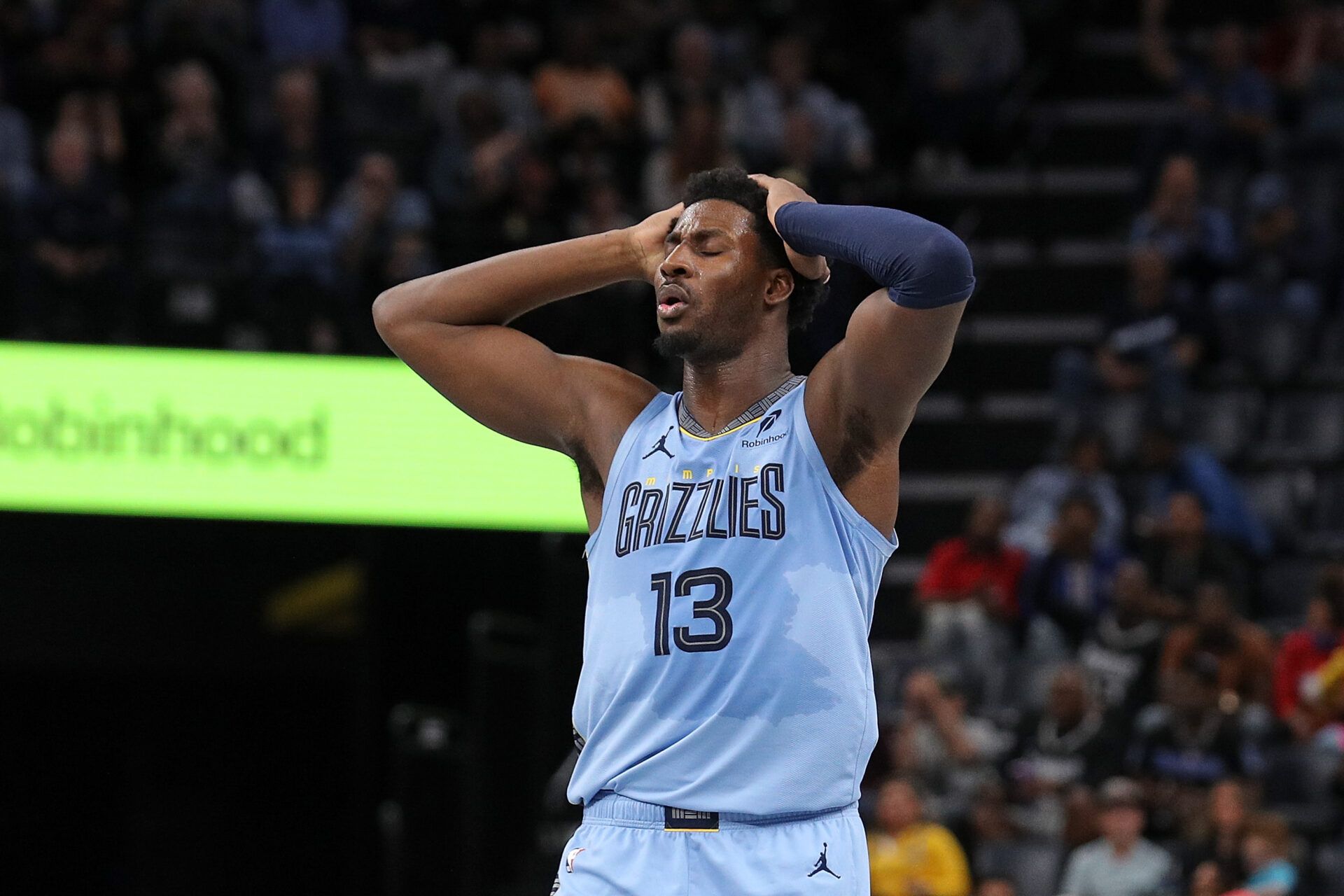
The first domino of the impending Memphis rebuild was Jaren Jackson Jr. The profile — a shot-blocking big with volume from distance — is more appealing than the production has been from the 26-year-old, and it’s hard to think that changes in a major way with the Jazz.
The 6’10” forward has averaged 6-plus rebounds in just one of his eight seasons (2023). That means he needs the ball in his hands to produce the type of numbers we need, but is that going to happen with Lauri Markkanen dominating usage?
I don’t think so. Jusuf Nurkić is a viable traditional big, so expecting much growth on the rebounding side isn’t reasonable.
Jackson is under contract for another four seasons, and that has me leaning toward his role looking much like it has up to this point, though a learning curve is possible. This is a net negative in my eyes for redraft managers.
One more scoring threat should allow Keyonte George (ankle) more room to work when healthy, and it makes Isaiah Collier a specialist with staying power.
The second-year guard handed out 22 dimes in Indiana on Tuesday night, and while that’s not what we are going to see nightly, he has the potential to benefit from increased usage moving forward for a team looking well beyond 2026.
You can count on Collier for assists and steals, but you need to understand that jumper limitations prevent him from leveling up over the final two months of the season.
As a part of this deal, Jock Landale’s contract was on the move and eventually landed in Atlanta. He had back-to-back double-doubles in mid-January, and while I’m not locking him in as an asset right now, this is something of a fragile frontcourt, thus opening the path for Landale to provide value in time.
Walter Clayton Jr. is the player to watch on this side of the deal (three future first-round picks help, too, but not for our purposes). The Grizzlies pretty clearly aren’t worried about the remainder of this season, and that means they are in a prime position to give the 2025 March Madness hero a chance to impress down the stretch.
League winner? Probably not. A nice bump in value that deserves our immediate attention (68 points in 18 minutes per game this season with Utah)? Certainly.
Jared McCain, Oklahoma City Thunder
Do the Thunder really need depth?
Probably not long-term, but every matchup matters, and McCain could have some short-term value with Shai Gilgeous-Alexander out through the All-Star break with an abdominal strain.
He’s not going to assume the reigning MVP’s usage, obviously, but with Ajay Mitchell (also an abdomen issue) banged up, there are minutes up for grabs, and we know McCain can produce when given the opportunity (33 points, 6 assists, and 9 3PM in 47 minutes over a high-usage two-game stretch late in January).
Kevin Huerter, Detroit Pistons
I expect this deal to have a greater real-life impact on us than anything else.
Kevin Huerter is a career 37.1% shooter from distance, and that extended sample allows me to overlook the eyesore that has been this season to date (31.4%).
I like the move for Detroit’s chances to win the East this season, as Jaden Ivey clearly wasn’t going to be extended, but who is to say that any specific game will be a Huerter spot? There’s a lot of skill duplication with Duncan Robinson, which means we are likely looking at a hot-hand situation that frustrates on a nightly basis.
Think of it like your least favorite NFL backfield. His minutes are likely to fall below the 32.6 he was averaging in Chicago but remain ahead of Ivey’s 16.8.
Speaking of Ivey, I still think there is something here when fully healthy. Maybe that time is 2026-27.
When a competitive team like Detroit is unwilling to unleash an upside player like this and then deals him to a franchise more focused on the future than the present, it’s naturally a red flag.
Coming out of college, I thought Ivey could be a version of Russell Westbrook in terms of skill set. With some of the recent shooting returns, I do think there’s a future fantasy asset in this profile, but he’s lost the benefit of the doubt health-wise, and this situation is too crowded to rely on him accessing much of a ceiling this season.
That said, if the Bulls commit to letting him play his way into form, things could change. It’s possible Detroit was being overly cautious, and that at least needs to be considered. I’m not suggesting he is likely to explode, but we haven’t heard of any setbacks, which leaves the door open for increased work for a team planning for future seasons.
Coby White, Charlotte Hornets
Collin Sexton joins Ivey in Chicago, with Coby White taking his talents to Charlotte. The players in this trade are interesting, but the situation is less so.
White, less than two weeks from his 26th birthday, is averaging more than 18 PPG for a third straight season, and prior to this year, durability wasn’t an issue (74-plus games played in each of the previous three seasons).
There’s a lot to like here, but with the Hornets showing signs of development, where does his usage come from?
If LaMelo Ball gets hurt, that’s one thing, but their Big Three (Ball, Kon Knueppel, and Brandon Miller) has shown this city upside it hasn’t seen in years, and the remainder of the season is likely to be spent fostering that growth.
White is a good player and will be part of the long-term picture, but this is a downgrade for the next two months for a player who was pacing toward a career-high usage rate.
As mentioned, Sexton is walking into an unclear Chicago rotation, and that leaves him off my radar for now. Josh Giddey continues to battle a hamstring injury (four games played in January), and if we get an extended timeline on him, you could make the case that the freed-up shots go to Sexton (17.3 points and 5.5 assists in his highest-minute games this season).
But anything short of that leaves me no more interested in Sexton today than I was a week ago.