
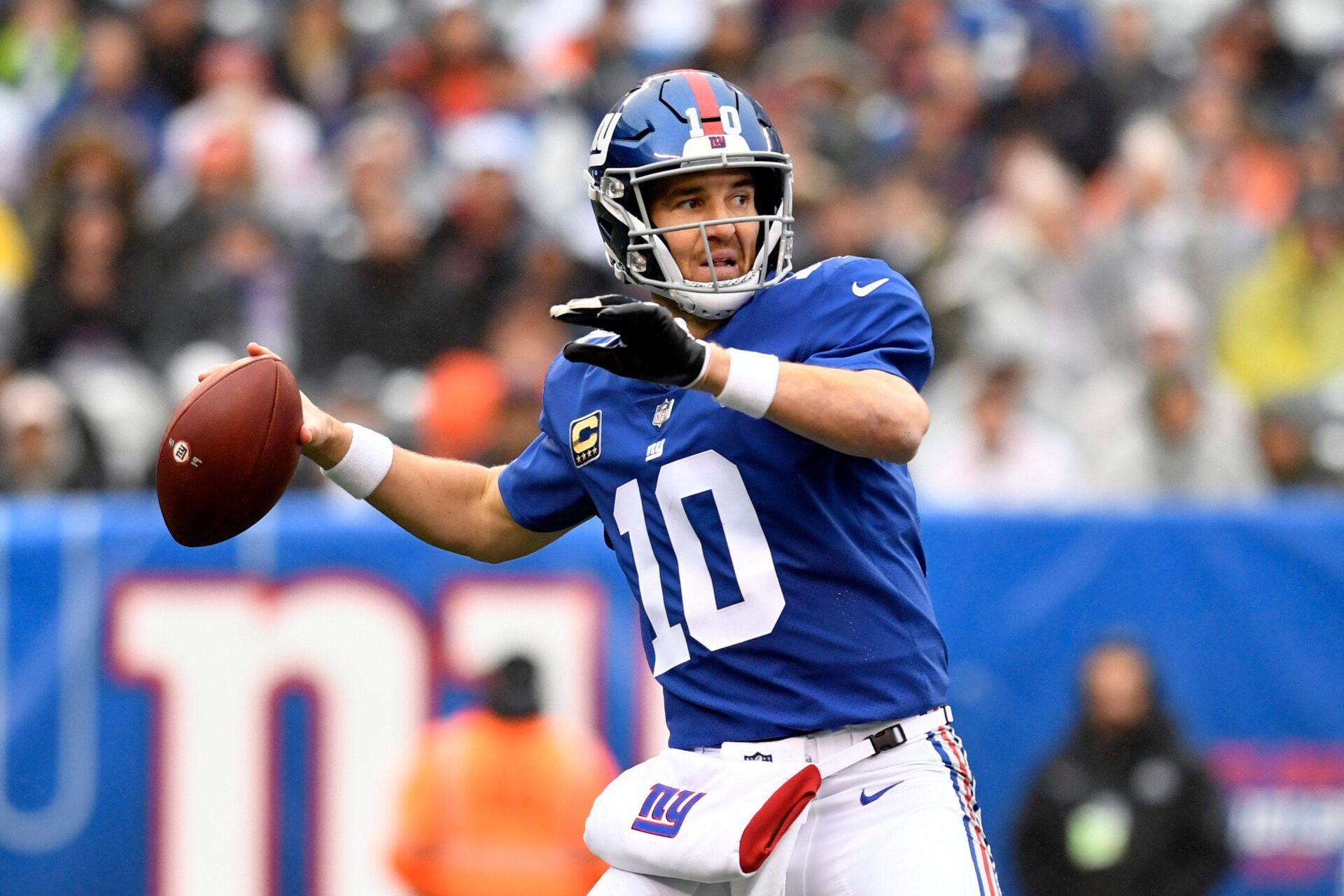
Eli Manning’s Hall of Fame case isn’t getting stronger with time. It’s getting weaker.
The two-time Super Bowl MVP missed the cut for the Pro Football Hall of Fame Class of 2026, the second consecutive year he’s been passed over despite reaching the finalist round. The news arrived alongside another stunning snub: Bill Belichick, the legendary New England Patriots coach whom Manning beat twice in the Super Bowl, also wasn’t inducted in his first year of eligibility.
Manning’s defining career moments came at Belichick’s expense, and now both men find themselves on the outside of Canton looking in, although for very different reasons. Let’s take a look back at Manning’s stats, accolades, and Hall-of-Fame case.
Eli Manning’s Career Numbers Tell a Complicated Story
Manning retired after the 2019 season with 57,023 passing yards, 366 touchdowns, and 244 interceptions across 16 seasons with the Giants. He ranks 11th all-time in both passing yards and touchdown passes. Those numbers reflect durability and longevity more than dominance.
Manning has the volume stats, plus two rings and the Super Bowl MVPs to go with them. The problem is what happens when you look beneath the numbers.
Manning finished his career with a 117-117 regular-season record. He never earned an All-Pro selection. He never won an NFL MVP award (or even received a single vote). He made four Pro Bowls in 16 years. His 84.1 career passer rating and 60.3% completion percentage were pedestrian numbers for a franchise quarterback of his era.
This is the core of the argument against Manning’s candidacy. He was never considered a top-five quarterback in any season he played. He threw 27 interceptions in 2013, and he posted seven winning seasons in 16 years.
According to PFSN’s QB Impact metric, his best season was in 2009 when he posted an 84.3 grade (B) and finished as the No. 9 QB in the league. In 2011, he also ranked ninth-best in the NFL with an 80.2 grade (B-). Even at his peak, he never had a top-five finish. In fact, these were the only years in which he posted a B grade and ranked higher than 15th.
From 2005-2018 (the only years he qualified for QBi), Manning’s average season-long ranking was 19th-best in the league. While some fans may think his later years are dragging down his ranking, this doesn’t include his final season in 2019, when he started only four games. And his worst year was actually 2013, when he posted a 64.0 grade (D), ranking 35th among qualified QBs despite being in his prime.
READ MORE: Top 100 2026 NFL Free Agent Rankings
Manning played at the same time as elite quarterbacks like Tom Brady, Peyton Manning, and Drew Brees for over a decade. Voters watched the comparison in real time, and they know exactly where Eli ranked among those legends.
But the postseason? That’s a different story entirely.
Manning went 8-4 in playoff games. He threw for 2,815 yards and 18 touchdowns in 12 postseason starts. His 1,219 passing yards in the 2011 postseason remain a single-season NFL playoff record. He engineered two of the most memorable drives in Super Bowl history, completing back-to-back fourth-quarter comebacks against a Patriots team that was undefeated the first time they met on football’s biggest stage.
Manning authored 37 game-winning drives and 27 fourth-quarter comebacks during the regular season, including an NFL-record 15 fourth-quarter touchdown passes in 2011. He consistently delivered in high-leverage moments, answering the call whenever the Giants needed him most.
Only five other players in NFL history have won multiple Super Bowl MVP awards: Tom Brady (five), Joe Montana (three), Terry Bradshaw (two), Bart Starr (two), and Patrick Mahomes (three). Every player on that list is either already in Canton or considered a lock to get there, with Manning standing alone as the outlier.
Pro Football Reference has a Hall of Fame monitor that evaluates each player’s candidacy based on their “AV, Pro Bowls, All-Pros, championships, and various stat milestones,” with a score of 108 being the average of QB inductees. Even with two Super Bowl MVP awards, Manning’s score is 87.01, which ranks 14th among the finalists in the Class of 2026.
It’s worth noting that QBs have gotten in with an even lower score than Manning’s, but only eight: Ken Stabler (82.2), Sonny Jurgensen (78.5), Bob Griese (73.0), Warren Moon (71.3), Joe Namath (70.0), Len Dawson (69.7), Troy Aikman (64.28), and Jim Kelly (59.1).
It appears voters have largely settled on where Manning stands, and his path to induction only becomes more difficult with each passing year. The league’s passing boom works against him, as Manning’s 57,023 career passing yards carried more weight in 2020 than they do today. As the NFL grows increasingly pass-heavy, raw volume statistics naturally lose some of their shine.
Manning’s Hall of Fame résumé is straightforward. Two Super Bowl MVPs. Two legendary postseason comebacks against the most dominant dynasty of the modern era. Yet voters have made it clear that those peak moments and his long career have not outweighed the rest of his profile, particularly the absence of an All-Pro selection or even a single MVP vote.
Among the 27 quarterbacks enshrined in Canton, nearly all paired elite regular-season production with playoff success. Manning’s case relies on voters placing greater value on what he accomplished in February rather than what he produced from September through December — and so far, that shift hasn’t happened.