
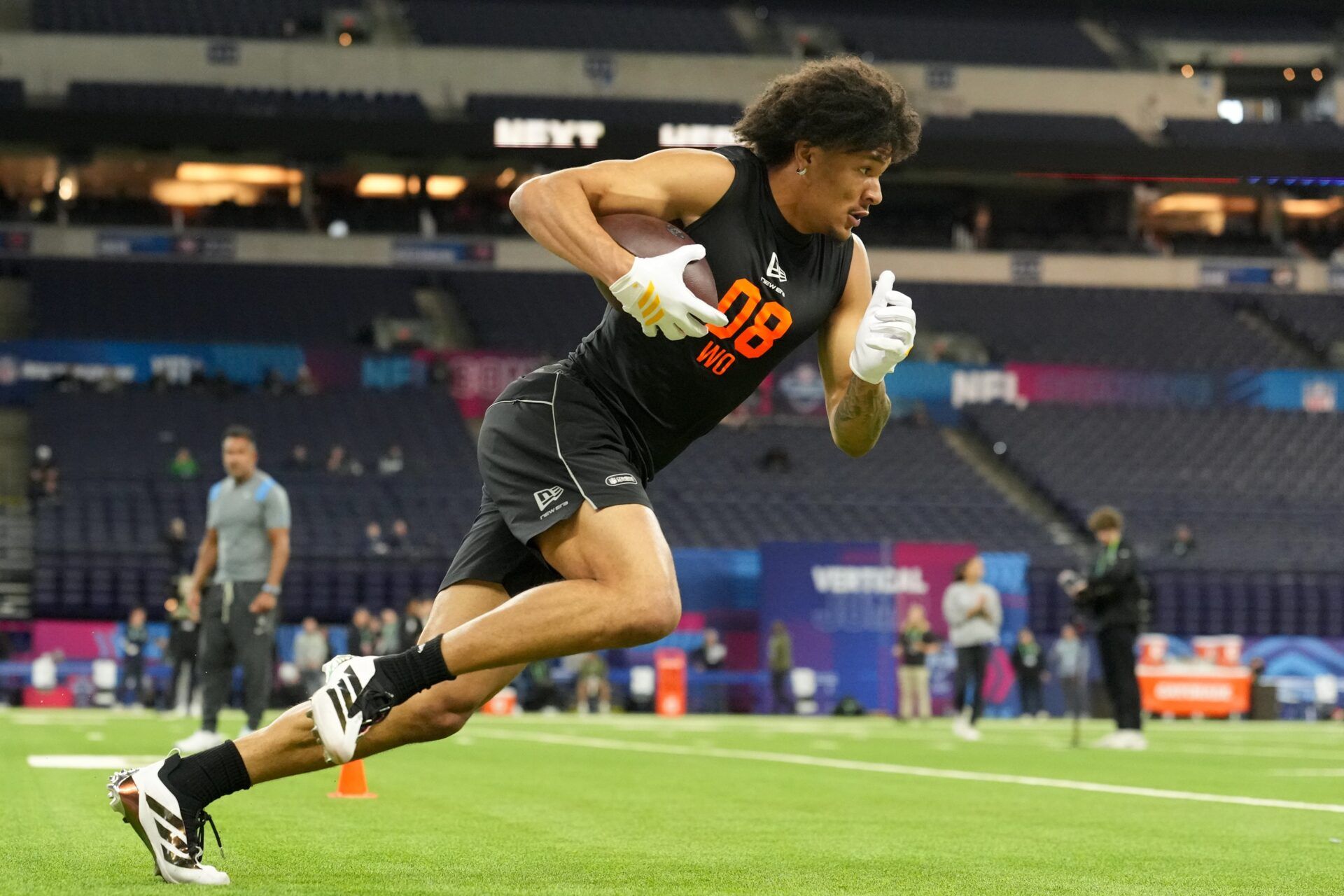
The Miami Dolphins may have created one of the more fascinating late first-round decisions in the 2026 NFL Draft. After trading Jaylen Waddle to the Denver Broncos, Miami not only picked up extra draft capital but also opened a major hole in its passing game.
That vacancy has naturally sparked speculation about who could become Malik Willis’ next top target in a reshaped offense. One name now being linked to that spot is Washington Huskies wide receiver Denzel Boston, a physically gifted but somewhat divisive prospect.
Why the Dolphins Could Draft Denzel Boston to Replace Jaylen Waddle
If Miami uses the No. 30 pick on Boston, it would signal that the Dolphins are looking for a very different type of receiver to help define their new era.
In his latest mock draft, PFSN analyst Ian Cummings projected Boston to Miami with the Dolphins’ second first-round selection. The logic behind that projection is tied directly to the franchise’s offensive reset after the Waddle trade and the organization’s apparent commitment to building around Willis.
“After insulating their secondary with high-level talent with their first Round 1 selection, the Dolphins shift to the offensive side of the ball at 30th overall, adding Denzel Boston as a potential WR1 for new quarterback Malik Willis,” Cummings wrote.
That fit is especially interesting because Boston would not stylistically replace Waddle, and it would not be appropriate to call Boston an immediate replacement given his limited college resume. But he could still fill a major role in a different way.
Instead of a smaller, speed-based separator, Boston offers size, body control, and catch-point dominance that could give Miami a more physical presence on the perimeter and a long-term answer in the receiving corps.
“At 6-foot-4, 212 pounds, Boston is a somewhat polarizing player. He’s not quite as proficient as smaller receivers against man coverage, but he still has the requisite agility and fluidity to offset and separate, as evidenced by his 6.8 three-cone. At the catch point, he’s one of the best in the class,” Cummings added.
That description aligns with what Boston showed at Washington, where he emerged as one of the more productive and reliable targets in college football. His combination of red-zone value, contested-catch ability, and dependable hands has helped push him into Round 1 conversations.
On the PFSN Consensus Big Board, Boston carries a grade of 84.70, ranks No. 38 overall, and is viewed as a potential first-round selection. He recorded 21 touchdowns throughout his college career, including 11 in the 2025 season alone, showing his poise and boosting his draft stock.
Why Miami’s Offensive Reset Makes Another Wide Receiver Investment Likely
The broader context also makes the projection easier to understand. According to PFSN’s Offense Impact Metric, the Dolphins finished 7-10 and posted a 73.1 OFFi, which ranked 19th in the league. Their offense received an overall C grade, reflecting a unit that remained competitive in stretches but clearly lacked enough consistency to be viewed as a long-term answer.
Altogether, the numbers suggest Miami still has meaningful work to do if it wants to build a more stable attack around its new quarterback. That is where Boston certainly becomes relevant.
BE AN NFL GM: PFSN’s Ultimate GM Simulator
Willis was reportedly informed of the Waddle trade in advance and remains fully bought into Miami’s rebuild, suggesting the organization sees 2026 as a major evaluation year for its new offensive core.
With picks No. 11 and No. 30 in the first round, the Dolphins have enough flexibility to address multiple needs while still adding a potential starting wideout. If Boston lands in South Florida, he would arrive with a real opportunity to become part of the foundation Miami is trying to build around Willis.
