
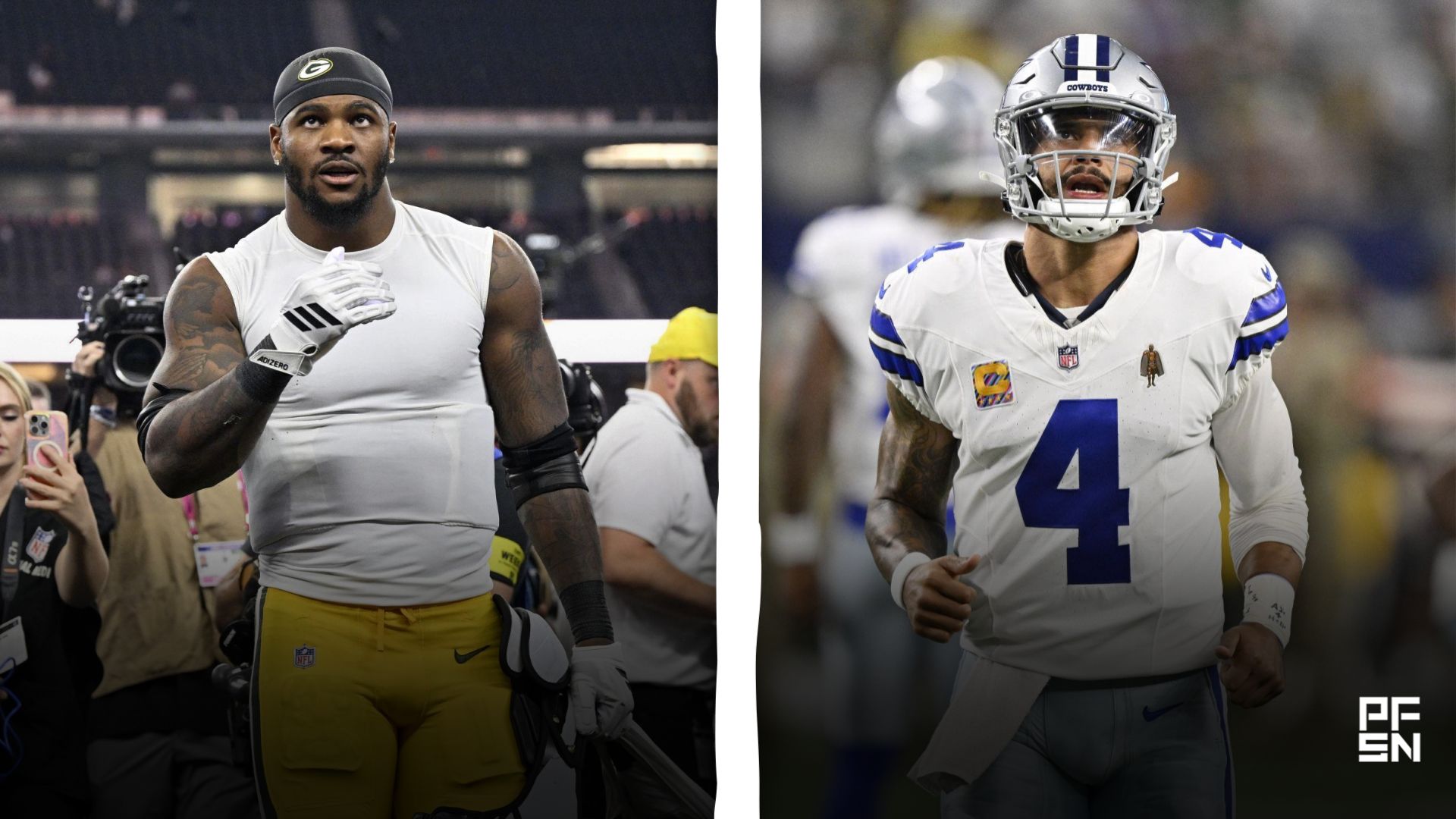
Dak Prescott put the league on notice in Week 4, delivering a performance that stands out for its statistical significance. According to PFSN’s proprietary metrics, Prescott’s 84.1 QB impact score was the third-highest of the week and ranks in the top echelon of his 132-game career. What really separates his night, though, was how he responded under duress — setting benchmarks in efficiency and poise.
How Did Dak Prescott’s Pressure Play Change the Game?
Prescott’s ability to thrive under pressure stood out in Sunday night’s wild 40-40 tie between the Cowboys and Packers, one of the most gripping contests of the season so far. Prescott led all quarterbacks in Week 4 with an elite 0.89 EPA per dropback when facing pressure, a number that speaks to both his decision-making and execution.
Prescott excelled against the rush, completing 12 of 14 passes for 162 yards and a touchdown. That passing yardage total under pressure ranks as the third-best game for him in such situations throughout his career. Despite the threat of a Micah Parsons sack, Prescott remained diligent when under pressure.
Context matters, especially in a matchup that demanded resilience and adaptability. The Cowboys were forced to play from behind, respond to momentum shifts, and execute in the game’s most stressful moments. Prescott’s individual brilliance kept Dallas in the game, and it was his pressure play that repeatedly turned drives from stagnation into scoring threats.
Transitioning out of the raw data, PFSN’s QBi and EPA/DB metrics illustrate a broader narrative: Prescott isn’t just padding stats, he’s driving tangible outcomes. Every high-leverage play had ripple effects on the scoreboard, and when the Cowboys needed smart leadership and production, he delivered with clinical efficiency.
Prescott’s teammates echoed this sentiment after the final whistle. After the game, tight end Jake Ferguson praised the quarterback: “He’s the guy that steadies the huddle. When things get crazy, he’s not flinching. That’s contagious.”
Prescott himself deflected praise, saying, “Our standard is high, and nobody’s backing down. It’s about pushing the drive ahead one play at a time.”
The Cowboys’ offensive line faced immense pressure all night, but Prescott’s ability to read and react turned what could have been a disaster into an opportunity; an element highlighted directly in PFSN’s game log analysis. His EPA per dropback when pressured not only led the league this week, it dwarfed outputs from other high-profile QBs.
This was Prescott’s 132nd career qualifying game, and the fact that this single week’s QBi ranks 17th overall, top 13%, isn’t a coincidence. PFSN’s comprehensive grading system weighs every throw, every situation, and every snap. A rating of 84.1 puts him among the NFL’s elite during the week, but also stacks his performance against the high-water marks of his own career.
Given the stakes of a primetime shootout and Parsons’ revenge game, Prescott showed the ability to claw from deficits, and his numbers underscore his position as both catalyst and anchor for Dallas.
Looking ahead, teams across the league will be dissecting this data, hoping to find a way to slow Prescott when pressure mounts. Yet, the raw numbers from PFSN, especially EPA/DB and QBi, make it abundantly clear: when the game speeds up and the pocket collapses, Prescott’s decision matrix is almost unmatched.