
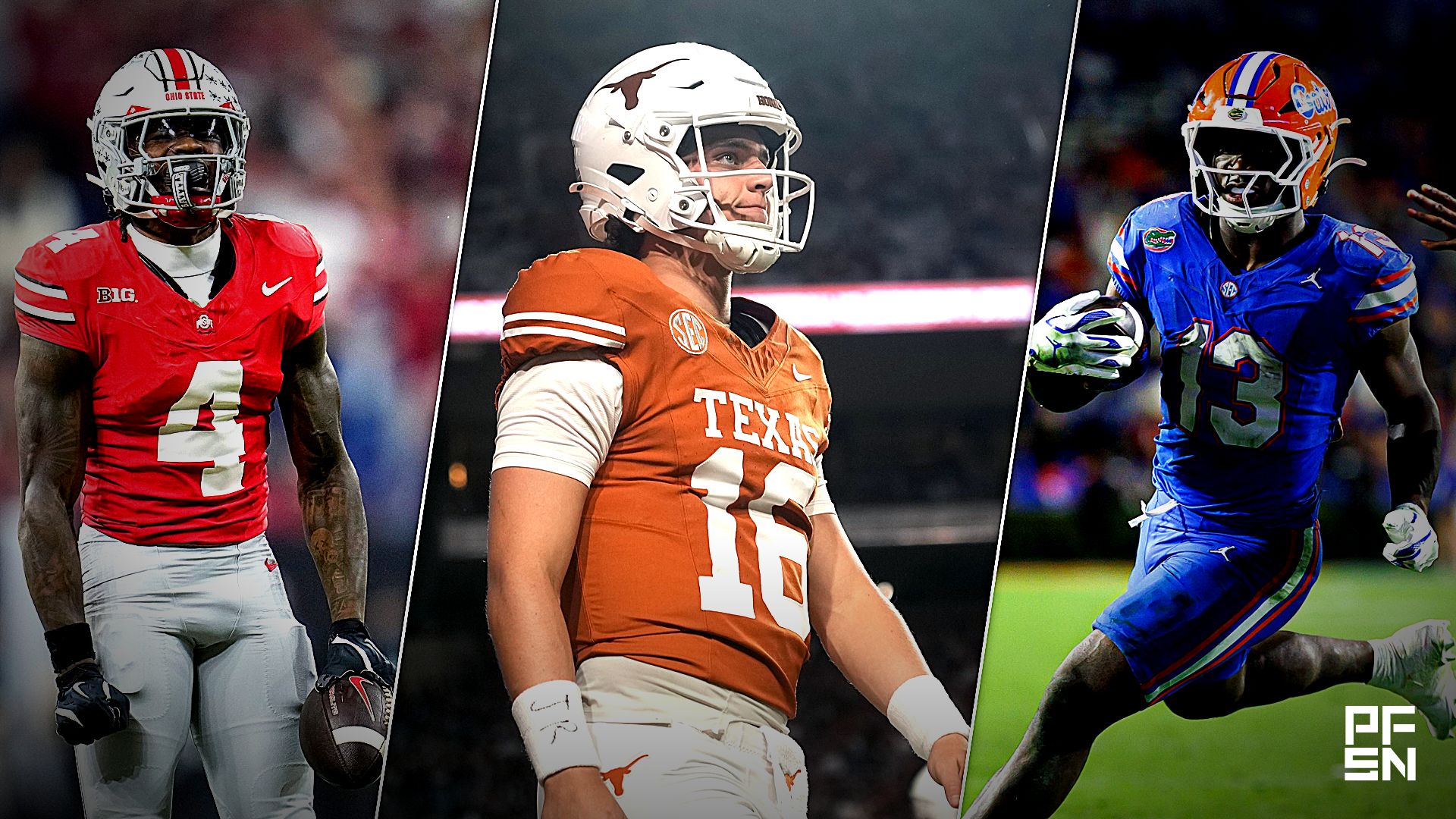
It’s still very early in the 2027 NFL Draft cycle, but enough time has passed in the summer months that we can conduct another mock draft, with additional scouting observations gained over the past few weeks.
Several positions, such as quarterback with Arch Manning and Dante Moore, still have the same relative pecking order, while other positions have risers like WR Charlie Becker, OT Melvin Siani, and DT Justin Scott climbing the ranks.
Using PFN’s NFL Mock Draft Simulator, let’s project the first three rounds of the 2027 NFL Draft.
Note: The 2027 NFL Draft order in this mock draft is derived from the current Super Bowl odds, and does not yet reflect the writer’s opinion about potential 2026 outcomes.

1) Arizona Cardinals
Arch Manning, Texas | QB
The Arizona Cardinals drafted Carson Beck at the top of Round 3 in the 2026 NFL Draft, and they should see what they have in Beck this coming season.
My personal opinion, however, is that the Beck selection was a massive reach for a QB whose arm is clearly stunted from past surgeries, and whose physical and operational qualities don’t come close to compensating. QB will likely be a need for Arizona again in 2027, and Arch Manning will be a prime contender to fill that role.
At around 6’4″, 226 pounds, Manning is an elite creative threat with high-level arm talent and platform freedom, and he flashes exciting operational comfort, with glimpses of impressive pocket maneuverability, poise, navigation, pre-snap discernment, and coverage diagnosis.
Manning’s 2026 season was a massive step in the right direction, and the future Round 1 buzz that was premature last summer is now truly warranted. Manning still needs to stack development if he wants to claim the QB1 mantle outright (his situational precision and inter-progression reads can improve), but the arrow is very much pointing in the right direction.
Manning’s legacy and pedigree already expand his imprint as a prospect, but looking at the film, he’s an exceedingly talented passer and creator with steely toughness, clear processing proficiency, and the ability to juggle pocket navigation and middle-field reads.
For Arizona, he has franchise QB ability, and can help elevate Marvin Harrison Jr., Michael Wilson, Trey McBride, and Jeremiyah Love.
2) Miami Dolphins
Dylan Stewart, South Carolina | EDGE
If the Miami Dolphins end up picking in the top-two as the current odds project, there’s bound to be some scrutiny regarding Malik Willis.
At the same time, looking at the state of the Dolphins’ roster, it’s entirely possible that the team struggles overall, while Willis still shows enough promise to warrant one more year. Let’s entertain that second outcome in this 2027 NFL Mock Draft and seek out blue-chip talent elsewhere.
Miami’s EDGE room, in particular, is extremely uninspiring. Chop Robinson hasn’t developed much since entering the league, and most of the remaining rotation is comprised of journeymen, strictly depth players, and unproven late-round rookies. Dylan Stewart can change that.
In 2025, Stewart registered a near-elite PFN EDGE Impact Score of 86.8 and an impressive true dropback pressure rate of 12.4%.Stewart’s pressure metrics fell a touch from 2024 in an injury-affected 2025 season, but he still earned a solid EDGE Impact Score of 80.3, while also putting up a 3.7% TFL rate in run defense and pursuit, while allowing just 0.76 yards per run stop, per TruMedia.
As an athlete and mover, the suspicions are true: Stewart moves different. At a listed 6’5″, 245 pounds, with near-34″ arms, Stewart’s explosiveness off the line is more akin to teleportation. He’s exceedingly twitched-up and light on his feet, with elite hip fluidity, ankle flexion, and torso reduction at his size, and his combination of explosion, length, and consistent lower-body load can yield overwhelming power exertions.
Stewart’s sheer physical potential is the core of his evaluation; he has a near-unmatched blend of explosiveness, lateral agility, quickness, bend, length, and relentless motor, and there are glimpses of proper pass-rush execution with angle manipulation, stunt efficiency, upper-lower synergy, and power production.
Overall, Stewart has room to keep expanding his counter arsenal and improve his hand precision, and he has room to add a bit more mass and supplement his play strength as well. But at his maximum, he’s a blue-chip presence, and that’s a type of ability Miami doesn’t yet have at one of the most important positions.
3) New York Jets
Dante Moore, Oregon | QB
Geno Smith and the New York Jets reunited during the 2026 offseason, but Smith’s 2025 play doesn’t invite heavy confidence that he’ll be a long-term solution for New York.
With three first-round picks in the 2027 NFL Draft, the Jets will be in prime position to go all-in on a quarterback, and in this mock draft, Dante Moore is still available as a QB prospect worth top-three capital.
At 6’3″, 206 pounds, Moore is a bit light, but he’s a prototypical passer with easy velocity and drive, both downfield and outside the numbers. He’s a smooth operator off-platform and out-of-structure with nimble mobility and impressive arm elasticity, and as an operator, he showcased notable growth in 2025.
He’s a competent pre-snap processor who can discern coverage styles and depths, and post-snap, he’s shown he can bait safeties out of position with his eyes, as well as sift through two-on-one spacing and throw receivers open with proper placement. All this being said, there’s an echelon of post-snap operator and anticipator that Moore still has yet to reach, and his relative turnover propensity is a product of late triggers, at-times forced decisions under pressure, and undiagnosed underneath defenders in zone.
Moore is still growing, but with another year of development, he can be a viable franchise QB candidate in the mold of C.J. Stroud. For New York, he enters an offense already loaded with Breece Hall, Garrett Wilson, Omar Cooper Jr., and Kenyon Sadiq.
4) Cleveland Browns
Justin Scott, Miami (FL) | DT
The Cleveland Browns just drafted Mason Graham two cycles ago and have a pressing need at the most important position, so I understand that this pick doesn’t match expectation.
But on my board, Manning and Moore are the only QB prospects worth top-10 capital right now. The Browns have three picks in the top-36 selections and may be able to make up for it later. Here, the pick is the best blend of need and BPA, and on my board, that’s Justin Scott.
With Maliek Collins on an expiring deal and Mike Hall Jr. falling below expectations, DT will be a need again sooner rather than later for Cleveland, and Scott is a perfect complement for Graham on the interior.
Scott’s elite run-defense ability can be quantified by an excellent 5.2% TFL percentage, and a paltry 0.76 yards allowed per run stop. Despite having the build of a disruptive 3-tech at around 6’4″, 303 pounds, with serviceable length, Scott makes his money as an alignment-diverse gap controller between 0-tech and 4i.
His athletic foundation lifts his floor; he’s exceedingly explosive, twitched-up in spite of slight hip stiffness, fluid in his lower half, and he can channel his size into awesome bouts of power drive and resetting stacking strength at the point of attack.
Scott’s ceiling, however, can be defined better by his sharp operational prowess. In run defense, he has elite hand usage, extension placement, balance on-engagement, and gap discipline, and he’s capable of two-gapping, resisting combo blocks and double-teams, and recovering positioning quickly to force runners into secondary lanes.
And while the sack and pressure production hasn’t come along consistently yet, there are bright flashes of Scott both driving power as a pocket pusher and using smooth euro-chop-rip combos, or weaponizing his burst and ankle flexion to curve into the pocket on stunts. Ultimately, Scott’s unrelenting motor ties it all together. Projecting as a scheme-diverse DT with vast alignment versatility, elite run-defense utility, stunting and slanting value, and independent pass-rush upside, Scott can join Graham to create one of the league’s best interior duos.
5) Las Vegas Raiders
Jeremiah Smith, Ohio State | WR
At 6’3″, 223 pounds, Jeremiah Smith has the size, length, and frame density to echo the brawling X-receivers of a WR era long past. He’s strong, explosive, physical, and an absolute hoss at the catch point, with an inherently proactive catch-point style that yields a near-20% catch rate over expectation.
Past the domineering surface-level skill set, however, Smith is quietly a complete WR. He has a high level of deceptive intelligence and footwork efficiency as a route runner, which he weaponizes through a solid release package and route tree. He’s impressively fluid and sudden for his size, with a natural nuance and feel for spatial manipulation that exceeds his years.
Smith isn’t as consistent as a RAC threat and there’s still room to reach a higher echelon as an intermediate stem artist on comebacks and curls, but he looks born to be a true WR1, offensive alpha, and blue-chip weapon, and that’s exactly what Fernando Mendoza and Klint Kubiak need.
6) Atlanta Falcons
Trevor Goosby, Texas | OT
Offensive tackle hasn’t been a need for the Atlanta Falcons since 2019, when the team brought in Kaleb McGary. McGary and Jake Matthews manned both sides of the line with relative consistency, but McGary’s retirement forced Atlanta to find a band-aid solution in Jawaan Taylor.
Taylor should suffice as a solid stop-gap, but the Falcons need a younger long-term starter sooner rather than later. That’s where Texas’ Trevor Goosby comes in. Goosby’s near-elite PFN OL Impact Score of 89.1 was top-25 in the entire nation in 2025, and his true dropback pressure percentage was just 4.6%, with only three sacks allowed.
Standing at 6’7″, 325 pounds, Goosby has an impressively long and lean frame, with excellent compact mass. While he’s a bit high-hipped and has trouble with waist-bending at times, he does a good job acquiring leverage and playing with controlled lean for his size, and his explosive, nimble athleticism serves as an asset in both phases.
In pass protection, he can get depth on his kick and use his explosive range to manipulate depth or to close ground and latch against apex rushers. And in the run game, Goosby is a rangy puller and second-level climber, and a flexible reach blocker who can use his length and rotational torque to fold and bury defenders in the turf.
Goosby has a strong sense of patience, timing, and upper-lower sync as a pass protector, but can improve at adapting, replacing his hands, and incorporating more counter strategies when rushers change the picture mid-rep. To that end, his tendency to grab against apex rushers who attain superior leverage renders him penalty-prone at times. Nevertheless, Goosby has an impact-starter projection at a premium position, with two-phase security and left-right flex.
7) Tennessee Titans
Colin Simmons, Texas | EDGE
The Tennessee Titans have their quarterback in Cam Ward, and they spent first-round capital in 2026 to get Ward a premier weapon with Carnell Tate. Only a select few premium positions need additional blue-chip talent.
One of those positions is EDGE, and Robert Saleh would be salivating at the chance to add Colin Simmons. In 2025, Simmons earned a strong PFN EDGE Impact grade of 86.9, while accumulating 12 sacks, 15.5 TFLs, and 3 forced fumbles, while also earning first-team All-SEC and second-team All-American honors.
At a listed 6’3″, 245 pounds, Simmons is slightly undersized, but has excellent proportional length to compensate. He’s a banshee on the rush with an insatiable playmaking motor, and those central qualities are magnified by his hyper-elite first-step explosiveness, long-track acceleration, tight cornering ability, effervescent twitch, and lateral explosive range.
Even at his size, tackles still need to respect his speed-to-power, and that opens up opportunities for Simmons to manipulate and exploit timing and angle advantages. Simmons has the rush intelligence to bait tackles out of positioning with initial rush angles, stutter-steps, and feigns, and his propulsive explosion, bend, and power pose devastating threats once out of position.
In run defense, Simmons’ flaws show up more; he doesn’t have the play strength to consistently set the edge and compress gaps. Additionally, he’ll void his gap to get upfield through over-aggression at times, and he can be inconsistent processing options. Still, as a pass-rush catalyst in odd and hybrid-front schemes, with a respectable run-defense floor, Simmons has the upside to be a game-changing presence. In Tennessee, he’d need to acclimate to more even-front looks, but he has the frame to add more mass, and his explosive element is lethal no matter where he plays.
8) Carolina Panthers
Leonard Moore, Notre Dame | CB
Jaycee Horn is under contract through 2029, but Mike Jackson is set to be a free agent in 2027 opposite him. If Ejiro Evero and Dave Canales ever desired to have the best CB tandem in the entire league, they could make it happen by selecting Leonard Moore in the 2027 NFL Draft.
Moore is a blue-chip prospect who should be the favorite to earn the CB1 mantle. He was an unheralded three-star recruit, but broke out as a Freshman All-American in 2024, amassing 2 interceptions, 11 pass breakups, and a PFN CB Impact Score of 82.4.
In 2025, he joined the ranks of the elite, putting up 5 INTs, 7 PBUs, and a CB Impact Score of 93.8 that was third in the entire CFB, behind only first-round picks Mansoor Delane and Chris Johnson. Moore looks destined to follow in his counterparts’ footsteps, and the film affirms his status.
At 6’2″, 197 pounds, Moore is long and lean, with a compelling mix of long-strider explosiveness, reactive quickness and twitch, and swivel fluidity. He has a natural mirror-motor and instant reaction in press, and perfectly blends the line between patient, disciplined, and physical.
Meanwhile, in zone coverage, he has excellent two-on-one route awareness, spatial reasoning, and is explosive on the click-and-close overtop breaks. At the catch point, Moore resembles a wide receiver with truly elite ball skills and catch-point control; he has 7 career INTs to date, along with a career forced incompletion percentage of almost 20%.
There are still areas for Moore to improve, nonetheless. While he’s an intelligent and physical support player, a 15.4% missed tackle rate in 2025 hints at a need for more conversion consistency, and he might not have elite speed or fluidity. In spite of this, Moore projects as a scheme and alignment-diverse CB1 with All-Pro upside.
9) New Orleans Saints
Carter Smith, Indiana | OL
Carter Smith’s 92.8 PFN OL Impact Score was seventh-highest in the nation in 2025 and third in the Big Ten. He didn’t allow a single sack in pass protection, and he put up an opposing pressure rate of just 2%.
Smith’s numbers place him among the ranks of NFL starters, and the film corroborates his proficiency. At around 6’5″, 313 pounds, without great length, Smith’s modest physical caps have stirred discussions surrounding a potential move inside. That’s where he would play for the New Orleans Saints in this projection.
He’s assuredly explosive and rangy, with good functional power and play strength, but Smith most often wins with his ultra-consistent footwork and leveraging, patient and precise hand usage, high-level intelligence and football IQ, relentless finishing physicality, and contact authority. He’s a true master at playing with a consistent anchor and controlled lean, using leverage acquisition and overarching flexibility to calibrate balance.
That foundation helps maximize his power and strength in the run game, and in pass protection, he’s a nuanced and synergetic operator who can execute pillar fits, circle punches, and anchor. On film, Smith bears striking similarity to 2023 first-round pick Peter Skoronski. A similar transition to guard likely awaits him, but at that spot, Smith can be an impact starter with scheme versatility.
10) New York Giants
David Stone, Oklahoma | DT
The New York Giants’ roster is slowly coming together under new head coach John Harbaugh, but after trading away Dexter Lawrence, New York desperately needs blue-chip talent on the interior defensive line. The best confluence of need and talent, David Stone is the easy pick in this 2027 NFL mock draft.
Stone earned a PFN DT Impact Score of 85.9 that ranked fourth among all qualifying DTs in 2025. He achieved a fearsome 5% TFL percentage in run defense while allowing just 1.9 yards gained per run stop, and he put up a pressure percentage of almost 10%.
At 6’3″, 315 pounds, with near-elite proportional length, Stone has a lab-built combination of natural leverage, compact mass, and power capacity, all of which is magnified by his otherworldly first-step explosiveness off the line. With his explosiveness, size, power profile, and unhinged motor, he’s a double-team magnet, and he can draw attention from 0-tech to 3-tech and 4i.
He’s a consistent pocket pusher on the attack with a devastating bull-rush, and his line-resetting power serves as an asset in run defense, where he can both puncture gaps and reverse displacement in its tracks. Stone is relatively reliant on his dominating traits at this stage; he can further develop his pass-rush plan, counter arsenal, and precision in the run game, and his leverage game is very inconsistent as well. Nevertheless, with more growth, Stone can be an orbital force, around which Abdul Carter, Arvell Reese, Brian Burns, and others can feast.
11) Washington Commanders
Cam Coleman, Texas | WR
The Washington Commanders scored one of the best value deals in the 2026 NFL Draft on paper with the addition of Antonio Williams as a WR2 in Round 3. Even with Williams, however, there’s still a sense they need more, especially with Terry McLaurin aging. In 2027, Cam Coleman could be a compelling choice.
At around 6’3″, 200 pounds, with near-33″ arms, Coleman has the build of an X-receiver, and the athletic profile of one, too. He’s a venerable long-strider on the vertical plane, but he is also an impressive short-area athlete with excellent short-area quickness, twitch, deceleration capacity, and hip fluidity for his size.
That athletic profile imbues him with a high degree of route running upside. He’s admirable for his intentionality in attempting to manipulate route leverage with stem work and throttle control, and he has a natural instinct for getting defenders to freeze before quickly regaining his stride.
He’s still learning how to be his most efficient self as a separator, with later hip tells and less upfield drift at route breaks. And as a near-7% drop rate in 2025 indicates, Coleman does have room to be a bit more consistent preventing passes from entering his body over the middle of the field.
Regardless, Coleman is a high-level athletic talent with a compelling size profile, a swarming catch radius on high-difficulty throws, flashes of vice-grip hand strength through contact, and a natural feel for space creation in the separation phase. At his maximum, Coleman can be a blue-chip WR1 for Jayden Daniels.
12) New York Jets
Tae Johnson, Notre Dame | S
The New York Jets have a suitable short-term look at safety with veterans Minkah Fitzpatrick and Andre Cisco, but Cisco is a free agent in 2027, and backup Malachi Moore hasn’t proven himself to be a viable full-time successor.
With one of their three first-round picks in 2027 NFL Draft, the Jets should consider a top-flight safety prospect. In this 2027 NFL mock draft, Tae Johnson is available as both a stellar value addition and a perfect positional fit. Johnson’s PFN Safety Impact Score of 95.8 was first overall among all qualifying safeties in 2025, even over 2026 first-round picks Caleb Downs and Dillon Thieneman.
Among other metrics, Johnson allowed just 0.4 yards per coverage snap, a measly opposing QB rating of 51.7, missed just 6.5% of his tackles, and forced an incompletion on 17.6% of targets. The numbers are elite, and the film follows suit. At 6’2″, 200 pounds, Johnson is long, well-built, and athletic, with a tantalizing blend of short-area quickness, foot speed on recalibration, swivel fluidity, and explosive long-strider range.
He has all-encompassing versatility across single-high, two-high, and box rover looks, but particularly in coverage, he excels. His center-fielder range makes him a deadly foe for any QB hunting for big plays, but he’s just as dangerous against two-on-one route combos. He’s fluid, malleable, and technically sound managing space, and is incredibly sharp, patient, and disciplined processing and sifting through route concepts, and he uses the QB’s eyes to guide him to conversion points with elite reaction-to-stimulus.
Despite a strong functional floor in run support, that’s where he most stands to improve; Johnson’s angles coming downhill can be too narrow, and he can engage second-level climbers with more consistent force. Even so, Johnson’s upside is that of a potential All-Pro with a dynamic playmaking imprint.
13) Minnesota Vikings
CJ Carr, Notre Dame | QB
CJ Carr’s 85.9 PFN QB Impact Score was top-25 overall in the nation last season, and other metrics also reflected well on his early performance, among them a 0.53 EPA per clean dropback figure and a 0.46 EPA per play in two-minute situations, per TruMedia.
At 6-foot-2, 215 pounds, Carr falls within the prototypical framework and has great natural arm talent. He can generate velocity with relative ease and has the high-level arm elasticity to layer the ball and adjust arm angles without strain.
He packages this new-age arm talent with an otherwise cerebral skill set. He’s not the most dynamic athlete or creator, but he has smooth off-platform feel and structural malleability. He’s a good processor for his experience level with age-defying pre-snap command, who shows promising glimpses of progression work, anticipation, and DB manipulation.
Carr’s combined mental acuity, mechanical prowess, and arm talent grant him quality NFL-starter potential, and with more experience, he can trend closer to that ceiling. For the Minnesota Vikings, his processing, accuracy, and angle freedom would be right at home in Kevin O’Connell’s scheme.
14) Pittsburgh Steelers
Drake Lindsey, Minnesota | QB
Drake Lindsey is a wild-card passer who could ascend as an early-round candidate in the 2027 NFL Draft cycle. At his best, and this is contingent on development in 2026, he could invite stylistic parallels to Big Ben from Steelers nation.
In 2025, while leading his team to a 8-5 record and a bowl victory as a redshirt freshman, he turned in a respectable PFN QB Impact Score of 77.8, and his 0.5 EPA per dropback in close-game scenarios was 15th among passers with at least 10 starts, according to TruMedia.
At 6-foot-5, 230 pounds, Lindsey perfectly fits the profile of the old-school, big-armed pocket passer. He’s big and high-mass, with quantifiably elite arm strength, velocity generation, and angle freedom, and those domineering traits aren’t just for show.
On top of having elite size and arm strength, Lindsey also shows off impressive pre-snap command, post-snap vision, opportunity identification skills, and layering ability for such a young QB. With another year of growth and accuracy improvement, Round 1 is possible.
15) New York Jets
Ahmad Moten Sr., Miami (FL) | DT
While the Jets managed to add T’Vondre Sweat via trade, Harrison Phillips, David Onyemata, Jowon Briggs, and Mazi Smith are all scheduled to be free agents in the 2027 offseason. New York has to hedge for this turnover, and Ahmad Moten Sr. helps with this.
At 6’3″, with a beefy, well-built frame weighing over 300 pounds, Moten has an ideal blend of natural leverage, compact mass, and proportional length, all of which is maximized by his hyper-elite first-step explosiveness.
He’s a flash off the line and can channel overwhelming amounts of raw power from those physical gifts, and he also has line re-setting force capacity and take-on strength. Moten’s motor runs red-hot, and as a pass-rusher, he flashes true independent disruption ability with relentless bull-rushes, swims and arm-overs, and rapid-firing rip combos.
As a dependable two-phase asset, Moten is still developing. His gap responsibility and double-team response can be inconsistent in run defense, and he has measured hip stiffness, which can impact his lateral explosive range, recalibration, and pad level maintenance. In spite of this, Moten projects as an alignment-versatile gap intruder and explosion-based obstructor, well-suited for hybrid-front schemes. Interestingly enough, my comp for Moten is Onyemata, but Moten is still early in his developmental arc.
16) Chicago Bears
Jadan Baugh, Florida | RB
With D’Andre Swift set to be a free agent in 2027, the last component left for Ben Johnson’s offense is a young and dynamic runner on a cost-controlled deal who can help Chicago pummel opponents into submission while playing ball control.
In this 2027 NFL mock draft, that runner is Florida’s Jadan Baugh. Baugh’s PFN RB Impact Score of 93.5 was the third-highest in the entire FBS in 2025, behind only Emmett Johnson and LJ Martin.
At 6’1″, 228 pounds, Baugh flashes freakish athleticism, both in terms of long speed and explosiveness, and short-area mobility. In spite of his rocked-up frame, Baugh is a springy short-area and lateral athlete with excellent hip fluidity, and he weaponizes that fluidity with rapid reactive instincts, keen vision, sharp pressing IQ, and angle anticipation.
He’s ultimately more reactive than manipulative as a mover, and he can improve at cutting down instances of premature lane commits. That said, very few backs in the 2027 NFL Draft have Baugh’s combination of size and athleticism, and fewer yet complement that physical talent with Baugh’s level of vision, creative IQ, and pass-down value.
Already, Baugh appears to be one of the best volume backs in the 2027 class, with the athleticism, instincts, and physicality to underscore an impact starter profile, as well as the receiving utility and high-end pass blocking to ensure usage on all three downs. A scheme-diverse runner with an all-encompassing skill set, Baugh has impact-starter ability, and running behind Johnson’s well-built front, with his schemes to aid, Baugh’s production potential would be through the roof.
17) Cincinnati Bengals
KJ Bolden, Georgia | DB
The Cincinnati Bengals added Bryan Cook as a quality strong safety in free agency, but Jordan Battle may not be long for the Bengals at the other safety slot, and the nickel defender spot brings similar questions.
If given the opportunity in the 2027 NFL Draft cycle, the Bengals could target a player who feasibly has the ability to play both roles (free safety and nickel) at a high level. In this 2027 NFL mock draft, few embody that more than Georgia’s KJ Bolden. In 2025, Bolden achieved an elite 91.6 PFN Safety Impact Score. Beyond that, he allowed just 0.5 yards per coverage snap and a measly opposing QB rating of 46.2, and he missed just 6.8% of his tackle attempts in support.
Bolden is close to average size at 6’0″, 195 pounds, but he compensates with high-level coverage athleticism and processing ability. An intense, disciplined, and versatile competitor, Bolden has the flexibility to play single-high, two-high, robber roles, or even from nickel alignments on a situational basis.
As a mover, he operates with controlled pacing that sometimes hides his top-end athleticism, but in quick-reaction and chase scenarios, his short-area twitch, swivel fluidity, hip sink, springy explosion, and long-strider speed shine.
In support, he’s patient yet decisive, angle-disciplined, and a sure solo tackler in spite of his leaner frame. In coverage, he’s intelligent, incredibly natural managing spacing and hip alignment in zone, smooth and effortless on his pedal, and quick to close gaps off his plant-and-drive once passers commit.
Bolden still has room to add more mass to his frame, and his aggressive trigger can leave him vulnerable to double-moves. To that end, he can also cut down on instances of extraneous physicality when attempting to recover route leverage. Nevertheless, Bolden projects as a defensive leader and “glue guy”, whose role and phase versatility, physicality, football IQ, and range would all be invaluable in a growing secondary that boasts ascending playmaker DJ Turner II and rookie Tacario Davis.
18) Jacksonville Jaguars
A’Mauri Washington, Oregon | DT
Jacksonville is in danger of losing both Arik Armstead and DaVon Hamilton in the 2027 offseason, and while young pieces Ruke Orhorhoro and third-round rookie Albert Regis show promise, the Jaguars need an orbit DT who can draw double-teams and reset the point with reliability.
Enter Oregon’s A’Mauri Washington.
Washington’s raw physical talent is a major selling point, and it’s verified by the numbers. Per Bruce Feldman’s Freaks List, Washington boasts a 36″ vertical at 6’3″, 339 pounds, as well as a max speed of almost 21 MPH and a max squat of 755 pounds. The explosiveness and lower-body power, in particular, is visible all across Washington’s tape. His burst off the line is exceedingly rare at his size, and he routinely uses it to both reset the contact point and blink through gaps as a penetrator.
While his frame and natural leverage profile project well at nose tackle, Washington has actionable alignment versatility across the front with his athleticism, and he can reliably puncture blocking schemes with his elite explosive element, as well as compress the pocket and bowl through solo pass blockers with relentless bull-rushes.
Technically, Washington’s game still needs further refinement. He’s raw as a pass-rusher outside of his mere power element, and in the run game, while he’s a capable power nullifier and one-gapper, his aggression getting upfield on the attack can play into him getting sealed off at times, and his two-gapping game at the fulcrum is inconsistent.
Having said all this, as an alignment-versatile 1-tech in one-gapping schemes, Washington can be an impact starter, and in Anthony Campanile’s attacking scheme, he’d be right at home.
19) Tampa Bay Buccaneers
Drew Mestemaker, Oklahoma State | QB
From Week 1 to Week 10 in 2025, Baker Mayfield totaled 16 touchdowns to just 2 interceptions. In the final eight games of the year, he threw just 10 scores to 9 picks. Mayfield’s dramatic regression between the first and second halves of the 2025 season was troubling to say the least, and it’s likely one reason why Tampa Bay is reluctant to extend him. If they end up looking elsewhere in 2027, Drew Mestemaker could be an option.
At a prototypical 6-foot-3, 211 pounds, Mestemaker has high-level arm talent with easy velocity, arm angle freedom, and torquing ability both in-structure and off-platform. He’s an excellent athlete with a creative affinity and the nimble mobility to navigate and create in and out of structure. He has strong reactive processing, understands how to ordain actions from second- and third-level defenders with his eyes, and he’s tough as nails.
More experience will help Mestemaker in certain areas. His processing still remains spotty on layered middle-field concepts, and mechanical inconsistencies can arise from his undisciplined dropback footwork, concentric throwing motion, and lower arm slot. If Mestemaker plays well enough to be drafted in Round 1 of the 2027 NFL Draft, he’ll still benefit from having a bridge QB to ease the early transition. But not far down the line, Mestemaker has quality starter potential for a Buccaneers team that might need to reset.
20) Denver Broncos
Jamari Johnson, Oregon | TE
The Denver Broncos have past-his-prime Evan Engram for another year and drafted Justin Joly in Round 5, but realistically, neither option should preclude Denver from taking the TE1 of the 2027 NFL Draft if they have the opportunity to do so. Right now, that TE1 is Jamari Johnson.
At 6’4″, 247 pounds, Johnson has the size and length that Kenyon Sadiq lacked in the 2026 cycle, and he boasts comparable vertical athleticism, with gliding speed and burst. He’s a twitched-up mover with great corrective quickness and stride recalibration, but he also boasts springy, effortless acceleration, and long-strider range.
Johnson is capable of taking reps from any alignment, has real two-phase value in-line as a blocker, interior gap puller, and defensive end dislodger, and in the passing game, he can be schemed RAC opportunities on swings and quick outs, threaten up the seam with his long speed and bend, or separate against man coverage with nuanced stem work.
While Johnson’s route tree is still developing, he flashes exceptional stem IQ, targeted physicality combined with release work, and the deceptive intelligence to bait defenders out of position with upfield presses and head fakes. Taking on TE1 volume will be Johnson’s next challenge, but he has first-round and impact-starter upside
21) Houston Texans
Jordan Seaton, LSU | OL
The Houston Texans are an incredibly difficult team to draft for, with relatively few needs across their roster. Keylan Rutledge is expected to shore up the team’s interior offensive line, and Braden Smith provides security at right tackle, but still, the OL may need a bit more in 2027.
Aireontae Ersery had an up-and-down rookie campaign and will be closely watched for a step up or a step down in 2026, and the starting-guard tandem of Ed Ingram and Wyatt Teller also has negative regression potential. Should the Texans’ unit regress again, Jordan Seaton can provide a quick fix.
He’s a touch light at 307 pounds, but sports a lean 6’5″ frame with good dimensions and proportional length. He’s an explosive, twitched-up, and rangy athlete at his size, and doubles as a heavy-handed combatant with excellent elbow load and force efficiency on punches.
In pass protection, Seaton has stellar synergetic feel and patient, nuanced hands; he can latch and anchor rushers with well-timed circle punches after matching, or flash hands to bait extensions before gathering. And in the run game, Seaton is angle-sound and adaptable.
Seaton does play with inconsistent knee bend and a relatively high center of gravity, and he needs to improve his hand and core strength. Additionally, in pass protection, he can be baited into over-setting or prematurely turning his hips and opening counter lanes. That second flaw could incentivize a move to guard, though it’s not necessitated.
Whether he plays at tackle or guard for the Texans, he’ll ultimately be able to go where he’s most needed. Seaton is an elite physical talent with certain soft skills that bode well for his development into a franchise cornerstone, and he could be the final piece for Houston’s offensive line.
22) Philadelphia Eagles
Austin Siereveld, Ohio State | OG
Philadelphia stuck with Tyler Steen and Landon Dickerson as their starting-guard duo in 2026, but Dickerson has struggled with injuries in recent years, and Steen is on the final year of his deal. The Eagles may need new interior talent in 2027, and Austin Siereveld is a top option.
At 6’5″, 325 pounds, Siereveld has impressive mass, and while his proportional length is closer to average, he compensates with high-level compact power, rotational torque at contact, and overwhelming leg drive post-contact. He’s a born displacer in the run game with elite contact authority and a tough, gritty play style. In pass protection, he’s relatively synergetic, acquires leverage well, naturally plays with controlled lean, and has shown he can erode opposing extensions with snatches and heavy-handed chops.
While Siereveld has the torso flexibility and bend to acquire leverage and maximize base load, his measured hip stiffness can impact recovery and serves as an underlying factor for his guard projection, along with his middling length. Nevertheless, Siereveld is strong, powerful, intelligent, uber-physical, and athletic enough to reach landmarks and enjoy scheme diversity. Ultimately, he’s a future impact starter at guard, with impressive discipline for his tone-setting style.
23) Detroit Lions
Ellis Robinson IV, Georgia | CB
The Detroit Lions’ need at CB may be more pressing than it appears. D.J. Reed is a good player, but is getting older. Terrion Arnold is entering a make-or-break season after an offseason that was eventful for the wrong reasons. Roger McCreary is a replacement-level starter, and while Keith Abney II has promise, the Lions need more re-investment.
Ellis Robinson IV could be an ideal target for the Lions in the 2027 NFL Draft after racking up 4 interceptions and 7 pass breakups in 2025. At 6’0″, 180 pounds, Robinson is light and lean, but possesses decent proportional length to go along with exceptional explosiveness, long speed, and elite coverage mobility. Robinson has the snappy short-area fluidity and recalibration to realign his base on-demand, as well as the hip sink, malleability on breaks, and reactive coil to recover leverage instantly in read-and-react situations.
In press-man, Robinson has a natural mirror-motor and can seamlessly match, redirect, and transition upfield with micro-movements. Meanwhile, working with more cushion in off-man and zone, Robinson can transition from pedal to trail and side-saddle, and can execute speed turns instantly out of hip recalibrations to clamp down overtop routes.
Overall, he’s extremely natural and adaptable as a technician, an adept processor and spatial manager, a near-elite catch-point playmaker, and a competitive contact dealer who, in spite of his lacking mass, plays with the chippy edge desired from boundary starters. Robinson ultimately needs to add more mass to his frame and can improve his block take-on and tackling in support, but he has all the hallmarks of a technically-diverse CB1 with turnover-generating flair, all qualities that will be valued in Kelvin Sheppard’s scheme.
24) Los Angeles Chargers
Charlie Becker, Indiana | WR
Charlie Becker was one of the unexpected heroes of Indiana’s National Championship campaign in 2025, but his exhilarating potential has always been quietly clear. In high school, he won Tennessee state championships in the 110-meter and 300-meter hurdles, but took home only a three-star recruit billing. Becker began the 2025 campaign behind Omar Cooper Jr., Elijah Sarratt, and E.J. Williams Jr. on the depth chart, but became indispensable to the Hoosiers’ offense once injuries forced him into the lineup.
In the final seven games, he amassed 27 catches for 522 yards and 3 touchdowns. His efforts culminated in a PFN WR Impact Score of 83.9 that ranked ninth in the entire FBS. His 26.11% catch rate over expectation rivaled Carnell Tate’s. His 1.27 EPA per target was best in the nation, and his 3.77 yards per route run was third.
We still need to see Becker operate with consistent WR1 volume, but the advanced metrics are glowing, and so too is the film. At 6’4″, 207 pounds, Becker is long and explosive, with gliding vertical athleticism and dangerous deep speed. But he’s also uniquely quick and fluid at his size, with excellent short-area twitch, foot speed, and the curvilinear acceleration to sustain pacing through route transitions.
Even this early in his career, he’s shown great promise as a route runner, with an expanding route tree, acute angle freedom and deceptive tendencies, throttle control, and a full release package. As an added bonus, Becker is also an elite utility player and blocker with universal alignment versatility. Mike McDaniel has expressed excitement for Quentin Johnston in 2026, but with Johnston’s long-term future still up-in-the-air, Becker could be a quality replacement and eventual upgrade, with true WR1 upside at his maximum.
25) New England Patriots
Sammy Brown, Clemson | LB
Sammy Brown was a five-star recruit who distinguished himself as a two-way star in football, while also running a 10.7 100-meter dash and claiming back-to-back Georgia state wrestling titles.
In 2025, he earned first-team All-ACC recognition while putting up 106 tackles, 13.5 TFLs, 5 sacks, an interception, and 5 pass breakups. His PFN LB Impact Score of 83.2 was 13th-highest in the nation, featuring a blitz pressure percentage of 15.9% and a missed tackle rate of just 6%.
Built with a rocked-up 6’2″, 235-pound frame, Brown has great tackling ability and contact authority. He plays with bristling energy post-snap and is very willing to engage blocks coming downhill, and he has the hyper-elite explosive element and sideline-to-sideline range to track plays to the boundary and cut off upfield angles.
Brown’s processing and coverage ability are still developing, but he is a freakish athlete with the right temperament and phase versatility, and he’s a worthwhile early-round investment alongside Robert Spillane as an attacking WILL LB with blitzing utility.
26) San Francisco 49ers
Kade Pieper, Iowa | C
In 2025, Kade Pieper earned third-team All-Big Ten recognition and was a key cog on an Iowa offensive line that won the Joe Moore Award. Along the way, Pieper secured an excellent PFSN OL Impact Score of 87.9, didn’t draw a single penalty, and allowed pressure on less than 5% of his true dropbacks.
Pieper’s 2025 production is an encouraging precursor for a move to center that will test him in new and different ways. Even with acclimation necessary, Pieper’s raw tools are easy to bank on. At 6’4″, 290 pounds, Pieper is a compact, streamlined blocker with extraordinary athleticism. Per Feldman’s Freaks List, he’s rumored to have a legendary 10-yard split of 1.52, a vertical jump of 37.4″, and a short-shuttle of 4.13, all of which would rank in the 100th percentile among centers all-time.
That athleticism is clearly visible on film, as Pieper has the raw explosiveness to teleport across gaps and work across-face as well as pull across the formation and climb to the second level without restraint.
He also has the hip and torso flexibility to swivel around at landmarks, seal off defenders, and aid in leverage acquisition and base load on driving blocks. Sourced from his rare explosive athleticism, Pieper’s lower-body power is overwhelming. He’s an asset in the run game, but also brings active hands, alert eyes, and an improving anchor in pass protection.
He needs to continue adding mass and improving his grip and core strength, but for zone-heavy schemes such as Kyle Shanahan’s in San Francisco, Pieper has high-level starter upside, and can be a game changer at the fulcrum when Jake Brendel inevitably moves on.
27) Dallas Cowboys
Omarion Miller, Arizona State | WR
If George Pickens’ absence from the Cowboys’ OTAs is any indication, Dallas still has a long-term question mark at WR as long as Pickens goes unsigned long-term. If he ends up moving on, Omarion Miller is a potential successor in the 2027 NFL Draft.
At a listed 6’2″, 210 pounds, Miller has great height and mass to go along with decent proportional length, but even more potent is his athleticism. Miller boasts elite explosiveness, short-area agility, and foot speed to go along with rare hip fluidity, impressive angle freedom on sharper route breaks, and smooth ankle mobility on curved transitions.
His burst, bend, and play strength make him a venerable RAC threat as evidenced by his 6.4 YAC per reception figure in 2025, which featured over 2 whole yards of RAC beyond expectation. But he’s also a budding separator with an inspiring foundation, route tree, and release arsenal.
Miller does need to improve at the catch point. While he flashes quality reaction speed and extension ability, his 7.8% drop rate was too high in 2025, and he isn’t the most consistent at playing catch-point positioning, using timing and angles to create late-snap spacing for himself. Still, if Miller can reach his ceiling, Round 1 capital is on the table, as a dynamic movement-Z with three-level threat appeal.
28) Kansas City Chiefs
Melvin Siani, Texas | OT
At around 6’6″, 313 pounds, with stellar proportional length, Melvin Siani is an elite athlete with high-level explosiveness and range, as well as menacing power capacity that’s magnified by his leg drive and rotational torque. In the run game, Siani thrives out on the move, where his leg action and explosiveness can feed into power sustain, and in pass protection, he acquits himself well for a younger blocker.
While his outside hand can get stronger, and his inconsistent hand replacement can lead to grabs and holds, he’s shown he can get depth on his kick, match and redirect, and feign strikes to bait rushers into more predictable paths before anchoring.
Siani needs to keep improving his upper-lower synergy, and especially in the running game, upright pad level drift and streaky balance can be an issue. But with more growth, Siani has impact-starter potential, and for Kansas City, he settles the right tackle spot across from Josh Simmons.
29) Baltimore Ravens
Mateen Ibirogba, Texas Tech | DT
Nnamdi Madubuike’s long-term outlook is still trepidatious, but in the 2027 NFL Draft, the Baltimore Ravens will have a chance to reinvest in high-upside DT talent. Former Georgetown edge rusher and Wake Forest standout Mateen Ibirogba is one of the top names on the list when it comes to upside.
Ibirogba has beefed up to 300 pounds since his Georgetown days, but he hasn’t lost any of the truly special explosiveness that first drew eyes to his film. Ibirogba’s first step is volcanic, and that hyper-elite explosive element can aid him in beating combo blocks, knifing through gaps, and eroding blocking schemes before they develop.
Siphoning from that explosiveness in tandem with his compact mass and proportional length, he also flashes overwhelming power output on bull-rushes and long-arms. More over-arching consistency remains a point of emphasis for Ibirogba, who can go quiet at times. His best reps are dominant, but upright pad level drift can make him easier to gather, his pass-rush arsenal still requires further expansion, and he can occasionally forfeit gap discipline in a desire to get upfield.
Still, Ibirogba’s explosive element is truly uncommon, as is his power profile at 3-tech, and in one-gapping, penetrating schemes with slant versatility, he has impact-starter upside. Alongside Travis Jones, he’d be a menace.
30) Seattle Seahawks
Kenyatta Jackson Jr., Ohio State | EDGE
At 6’6″, 265 pounds, with elite proportional length, Kenyatta Jackson Jr. possesses a rare physical makeup, blending high-level explosiveness, foot speed, play strength, and power capacity together.
His explosiveness alone enables him to sear through gaps and disrupt blocking schemes early in reps, but he’s also shown he can leverage his burst, mass, and length into awe-inspiring power output, which he can then channel with bull-rushes or sequence moves thereafter with push-pulls and forklift-swims.
In Matt Patricia’s defense, Jackson’s explosive power and contact authority make him an alignment-versatile staple. He can serve as a gap puncturer or combo absorber from 3-tech and 4i, or take on tackles one-on-one as an inside-outside slanter or from wider alignments. Mike Macdonald would likely utilize Jackson in a similar way, but in time, Jackson has the potential to develop beyond his pure power-producer mold and become a dangerous independent pressure threat with high-level run defense ability.
31) Buffalo Bills
Cayden Green, Missouri | OG
Cayden Green’s 2025 PFN OL Impact Score of 89.2 was near-elite, and alongside that figure, he allowed just a 2.4% true dropback pressure rate. At 6’5″, 324 pounds, Green has ideal height and mass to go along with elite proportional length. His domineering stature alone makes him a challenge to beat at the contact point as well as a venerable test for rushers aiming to work around him.
Green is explosive on the linear plane, with fearsome raw power capacity, knockback force at contact, and overwhelming grip and core strength. In pass protection, he’s patient, alert, and heavy-handed, with strong punches, latches, and snatch moves in his arsenal. In the run game, he’s a natural displacer and displacement reducer on the line.
Green’s OT experience insulates his depth and flex value, but his ceiling is highest at guard, where he can become an impact starter and a quality replacement for David Edwards in the Bills’ power, gap, and inside zone-heavy scheme.
32) Cleveland Browns
Quincy Rhodes Jr., Arkansas | EDGE
EDGE is far from a need for the Browns after acquiring Jared Verse, and with Alex Wright having recently been extended. However, Isaiah McGuire is a free agent in 2027, and the Browns could use more depth and high-end rotational utility.
Alignment versatility is an added bonus, and that’s something Quincy Rhodes Jr., one of the top sack-getters from the 2025 season, can provide. At around 6’6″, 277 pounds, with excellent proportional length, Rhodes has a freakish combination of size, lean mass, explosiveness, short-area quickness, and bend, and he fits the Browns’ desired size profile in their EDGE rotation.
While Rhodes’ operational skill set is relatively unrefined beyond that physical foundation, the foundation alone produces countless eye-catching reps on his film. Rhodes proves most consistent in the pass-rush phase, where he fires off the line, proves capable of acquiring leverage and generating power from a vast allotment of gaps and rush angles, and flashes keen angle IQ with a wicked spin move that leaves tackles lurching.
His power capacity and closing speed can overwhelm in tandem, but Rhodes can still be more consistent overall, with his pass-rush plan, counters, power sequencing and sustain, and sturdiness in run defense. Nevertheless, he warrants Round-1 consideration due to his scheme and alignment-versatile profile as well as his astronomical pass-rush upside. He provides a different player type from Wright and Verse, and adds to the “waves” of Cleveland’s pass-rush.
Round 2 | 33) Arizona Cardinals
Matayo Uiagalelei, Oregon | EDGE
At 6’5″, 272 pounds, Matayo Uiagalelei gives Arizona the complete package of burst, power, bend, and nuanced execution they’ve been seeking for a long time off the edge.
34) Miami Dolphins
William Echoles, Ole Miss | DT
Needing more interior defenders to fit Jeff Hafley’s schematic preferences, William Echoles serves as a perfect value addition here with his leverage game and pass-rushing reliability at 6’3″, 315 pounds.
35) New York Jets
Cole Sullivan, Oklahoma | LB
At 6’4″, 230 pounds, Cole Sullivan is a riser candidate with swarming full-field range, fluidity, and inspiring coverage feel, and he can develop nicely alongside veteran Demario Davis.
36) Cleveland Browns
Trinidad Chambliss, Ole Miss | QB
It wasn’t as early as expected, but we did finally address the QB position for the Browns, with an intriguing value add in Ole Miss’ Trinidad Chambliss.
At around 6-foot-1, 200 pounds, Chambliss is average-sized, with middling arm strength, but he nonetheless proves more than competent as a prospect. Chambliss is a smart, adaptable, and athletic game manager who’s proven capable of commanding an offense, keeping the chains moving, dishing to his targets with consistent accuracy, and keeping resolve in high-pressure and high-leverage situations.
Chambliss always has an answer, and that quality should make him a popular prospect for teams in search of a potential starting QB contender. A strong 2026 campaign can put him in the same range as Tyler Shough.
37) Las Vegas Raiders
Jacarrius Peak, South Carolina | OT
Jacarrius Peak must return to full health in 2026 after suffering an offseason injury, but the 6’4″, 310-pound blocker has the natural leverage, power component, and tone-setting physicality to make an impact.
38) Atlanta Falcons
Brendan Sorsby, Texas Tech | QB
At 6-foot-3, 235 pounds, Brendan Sorsby has excellent size-adjusted athleticism, velocity generation and angle freedom, and he’s a keen creative mind who flashes stellar layering ability and situational precision on drive throws.
Right now, he’s a developmental QB prospect; he still has a higher echelon to reach as a processor and anticipator, and his release mechanics and dropback discipline can be lax at times, but he has nonetheless has NFL-starter upside.
Now that he’s been granted eligibility for the 2026 season after a gambling controversy, he’ll have one last chance to improve his game and contend for early draft capital.
39) Tennessee Titans
Iapani Laloulu, Oregon | OL
The Titans could feasibly try out Iapani Laloulu at guard or center, but the 6’2″, 329-pound blocker projects best at the fulcrum with his anchor strength, grating power, and wealth of experience.
40) Carolina Panthers
Kewan Lacy, Ole Miss | RB
Chuba Hubbard needs a bounce-back year in 2026; if he doesn’t have one, Carolina could target a runner like Kewan Lacy, whose quickness, fluidity, and spatial feel are all reminiscent of James Cook.
41) New Orleans Saints
Yhonzae Pierre, Alabama | EDGE
At 6’3″, 253 pounds, Yhonzae Pierre fits Brandon Staley’s scheme as a wide-alignment stand-up rusher with explosiveness, physicality, angle IQ, and range in run pursuit.
42) New York Giants
Mario Craver, Texas A&M | WR
Given the uncertainty surrounding Malik Nabers’ recovery, investing in more WR depth and dynamism makes sense; Mario Craver helps John Harbaugh hedge for the loss of Wan’Dale Robinson.
43) Washington Commanders
Jelani McDonald, Texas | S
At 6’2″, 200 pounds, with brisk explosiveness, a sudden reactive coil, keen route vision, and ball-hawking ability, Jelani McDonald can be a quality starter alongside Nick Cross, with single-high and two-high ability.
44) Indianapolis Colts
PJ Williams, SMU | OT
Immediately, PJ Williams can serve as a swing OT for Indianapolis, but the 6’5″, 313-pound blocker has the athleticism, power capacity, and stunt vision to compete with Jalen Travis for the right tackle job.
45) Minnesota Vikings
Xavier Scott, Illinois | DB
Xavier Scott will be an older rookie (as he’s currently 23 years old), and he needs to return to 100% coming off an injury-impacted 2025 season. However, at his best, he’s a versatile, physical, and dynamic meshing presence on the back end, with nickel and safety versatility.
46) Pittsburgh Steelers
Samson Okunlola, Miami (FL) | OG
Gennings Dunker theoretically mans one guard spot long-term, but with Mason McCormick nearing a contract juncture, Samson Okunlola gives Pittsburgh size, athleticism, and physicality to develop.
47) Dallas Cowboys
Zabien Brown, Alabama | CB
While Zabien Brown’s non-elite athleticism may push him down the board, he’s an agile, instinctive, and physical CB with clean technique, excellent run support ability, and playmaking chops.
48) Chicago Bears
Teitum Tuioti, Oregon | EDGE
A twitched-up motor monster with excellent explosiveness and proportional length at 6’3″, 263 pounds, Teitum Tuioti gives the Bears a much-needed pass-rush boost on the edge.
49) Cincinnati Bengals
Chris Corbo, Georgia Tech | TE
At 6’5″, 250 pounds, Chris Corbo has the size and physicality to project well in-line, and as a receiver, he’s one of the most fluid and malleable athletes in the class, with a diverse route tree and quick reaction skills.
50) Jacksonville Jaguars
LJ Martin, BYU | RB
What LJ Martin lacks in explosiveness, he makes up for it with his fluidity and angle IQ at 6’2″, 225 pounds, and he can be the volume back that the Jaguars still lack.
51) Tampa Bay Buccaneers
Brice Pollock, Texas Tech | CB
Brice Pollock was as elite as elite gets in 2025, with a 90.5 PFN CB Impact Score and an allowed QB rating of just 34.6. His fluid coverage mobility, ball-hawking prowess, and run support instincts would be right at home in Tampa Bay.
52) Denver Broncos
Brandon Baker, Texas | OG
Previously a tackle, Brandon Baker will play guard in 2026, where he projects best long-term with his low center of gravity, compact power profile, anchor strength, and physicality.
53) Houston Texans
Wyatt Young, Oklahoma State | WR
The Texans have an ascending WR duo with Nico Collins and Jayden Higgins, but Wyatt Young completes the puzzle as a hybrid slot weapon in the mold of Cooper Kupp (sorry).
54) Philadelphia Eagles
Nick Marsh, Indiana | WR
The Eagles don’t have a major need at WR with DeVonta Smith, Makai Lemon, and Dontayvion Wicks, but this is too good a value to pass up for a venerable size-speed presence and a well-rounded potential X-receiver in Nick Marsh.
55) Detroit Lions
Princewill Umanmielen, Ole Miss | EDGE
Princewill Umanmielen needs to enhance his power element, but he has the elite explosiveness, finesse, and angle IQ to expand the Lions’ arsenal as well as the length to mold.
56) Los Angeles Chargers
Ashton Hampton, Clemson | CB
While Ashton Hampton isn’t the most explosive on the vertical plane and can improve his ball skills, he’s extremely long, competitive, smart, technically diverse, and has elite size-adjusted fluidity.
57) New England Patriots
Peter Clarke, Temple | TE
The irony of selecting a British-born TE for the New England Patriots isn’t lost on me, but Peter Clarke’s size, blocking utility, rumbling RAC, and strong hands in congestion combine for too much value to pass up.
58) San Francisco 49ers
Anthony Smith, Minnesota | EDGE
At 6’6″, 285 pounds, Anthony Smith has a unique blend of size, length, lean mass, and flexibility, and while he’s not the most dynamic pass-rusher, he’s a ready-made power producer with respectable run defense utility.
59) Green Bay Packers
Bear Alexander, Oregon | DT
Bear Alexander has resurrected his career at Oregon, and at 6’3″, 302 pounds, he fits the Green Bay Packers’ desired interior DL mold with his natural leverage, compact power and strength, explosiveness, and point-resetting ability.
60) Kansas City Chiefs
Trey’Dez Green, LSU | TE
Just two mock drafts into the 2027 NFL Draft cycle, this feels like the floor for Trey’Dez Green. His uncertain blocking projection could cause him to slip, but he’s too good of a fit as a proposed successor to Travis Kelce with his size, separation ability, and RAC.
61) Baltimore Ravens
Blake Frazier, Michigan | OL
At 6’6″, 295 pounds, Blake Frazier has a unique profile, with high-end explosiveness, lean power, and flexibility that could project better on the interior, in an outcome similar to that of Grey Zabel.
62) Seattle Seahawks
Koi Perich, Oregon | S
A first-team All-Big Ten performer and a second-team All-American as a true freshman in 2024, Koi Perich gives the Seahawks compelling role versatility and playmaking gravity.
63) Buffalo Bills
Rasheem Biles, Texas | LB
While Rasheem Biles is undersized at 6’1″, 220 pounds, he’s a rangy athlete who allowed a mere 61.2 QB rating in coverage last year, and missed just 8% of his tackle attempts.
64) Los Angeles Rams
Lance Heard, Kentucky | OT
With long-term uncertainty facing both Alaric Jackson and Warren McClendon, Lance Heard gives the Rams explosive athleticism and overwhelming power capacity to mold at 6’6″, 325 pounds.
Round 3 | 65) Arizona Cardinals
Niki Prongos, Stanford | OT
While Niki Prongos has to get stronger and improve his hand consistency, he has all the desired tools with elite athleticism and flexibility at 6’7″, 315 pounds.
66) Miami Dolphins
Bray Hubbard, Alabama | S
At 6’2″, 217 pounds, with 7 career interceptions, Bray Hubbard brings an exciting blend of playmaking skills and run support utility to the fold for a building Miami defense.
67) New York Jets
Anthonie Knapp, Notre Dame | OG
At around 6’4″, 300 pounds, Anthonie Knapp has the baseline athleticism, compact power and rotational torque, awareness, and tone-setting physicality to be a quality starter.
68) Cleveland Browns
Christian Alliegro, Ohio State | LB
At 6’4″, 247 pounds, Christian Alliegro has the size, range, and flexibility to project as a quality WILL presence and blitzing threat alongside Carson Schwesinger.
69) Las Vegas Raiders
A.J. Holmes Jr., Texas Tech | DT
With 6.5 sacks and 17.5 tackles for loss over the past two seasons, A.J. Holmes Jr.’s production is verified, and at 6’3″, 300 pounds, he’s a proven sawed-off disruptor.
70) Atlanta Falcons
Mario Landino, Indiana | DL
At around 6’4″, 275 pounds, Mario Landino fits the Falcons’ trench philosophy under Jeff Ulbrich with his alignment-versatile power profile and natural pass-rushing affinity.
71) Tennessee Titans
Ahmad Hardy, Missouri | RB
Ahmad Hardy, should he return to full health, is a venerable volume back with near-generational contact balance. He’s one-dimensional outside of that, but has a very clear floor projection.
72) Carolina Panthers
Andrew Rappleyea, Penn State | TE
Andrew Rappleyea has only caught 20 passes in his career to this point, but the 6’4″, 251-pound TE has the explosion, quickness, fluidity, and blocking utility to be a complete two-phase, three-down presence.
73) New Orleans Saints
Bryant Wesco Jr., Clemson | WR
Bryant Wesco Jr.’s hands need major work, but if he can improve that part of his game, he has the speed, fluidity, separation ability, and RAC to be a dynamic WR3 alongside Chris Olave and Jordyn Tyson.
74) New York Giants
Isaac Brown, Louisville | RB
With uncertainty looming at RB, Isaac Brown gives the Giants an assured ultra-dynamic presence with his speed, burst, cutting flexibility, vision, pressing IQ, and creative chops.
75) Washington Commanders
Braelin Moore, LSU | C
If Washington’s long-term center proves to not be on the roster, Braelin Moore can fill the void with his well-leveraged, physical, and high-IQ style of play.
76) Indianapolis Colts
Anto Saka, Texas A&M | EDGE
Anto Saka is still very much a project, but if he can develop at Texas A&M, he has the volcanic burst and power capacity at 6’4″, 255 pounds to be an eventual impact player.
77) Minnesota Vikings
DJ Vonnahme, Iowa | TE
The Vikings dip into the Iowa TE well again with DJ Vonnahme in this 2027 NFL mock draft. While Vonnahme is partly a projection, he has verified burst, quickness, RAC, and body control.
78) Pittsburgh Steelers
Kyngstonn Viliamu-Asa, Notre Dame | LB
With a need looming at LB, the Steelers could stand to invest in a high-upside player like Kyngstonn Viliamu-Asa, who’s a demon on the blitz and as a downhill attacker at 6’3″, 230 pounds.
79) Dallas Cowboys
Ben Roberts, Texas Tech | LB
At around 6’3″, 245 pounds, Ben Roberts has size, physicality, and fluidity, and is a high-level playmaking threat in coverage as evidenced by his 4 interceptions in 2025.
80) Chicago Bears
Kelley Jones, Mississippi State | CB
At nearly 6’4″ and 196 pounds, Kelley Jones fits the Dennis Allen mold of CB to a tee, and his 28.9% forced incompletion rate from 2025 reaffirms his catch-point authority.
81) Cincinnati Bengals
Antwan Raymond, Rutgers | RB
If Chase Brown leaves in free agency, Antwan Raymond can be a suitable replacement volume back with his running leverage, processing, creative mobility, and pass-down utility.
82) Jacksonville Jaguars
Ray Coney, Texas A&M | LB
At 6’2″, 240 pounds, Ray Coney is big, rangy, and extremely productive in pursuit. This season will be key, but he has the size, athleticism, and instincts Jacksonville needs inside.
83) Tampa Bay Buccaneers
James Smith, Ohio State | DT
James Smith can keep improving his operational consistency and leverage maintenance, but he’s built to be an odd-front DE at 6’3″, 297 pounds, with elite on-attack explosion.
84) Denver Broncos
Tao Johnson, UCLA | S
Having posted an elite 90.3 PFN Safety Impact Score in 2025, Tao Johnson has length, speed, big-nickel flexibility, and the ball skills you’d expect from a former wide receiver.
85) Houston Texans
Raleek Brown, Texas | RB
Raleek Brown is undersized at around 5’9″, 191 pounds, and he’ll be a 24-year old rookie, but he’s a ready-made creative asset with elite explosiveness and evasion authority.
86) Minnesota Vikings
Kayin Lee, Tennessee | CB
The Vikings have shown a willingness to bank on lighter CB prospects, and in spite of his 183-pound frame, Kayin Lee is fast, feisty, physical in press, and a ball-hawk at the catch.
87) Detroit Lions
Brody Foley, Louisville | TE
With Sam LaPorta’s long-term future uncertain, Brody Foley gives the Lions a fluid seam-buster and box-out threat at 6’6″, 260 pounds, with projected early-down upside.
88) Los Angeles Chargers
Taylor Wein, Oklahoma | EDGE
The Chargers brought back Khalil Mack on a short-term deal, but once he’s gone, they’ll need a rotational spark-plug with size and burst like Taylor Wein on the edge.
89) New England Patriots
Bryce Thornton, Florida | S
Carrying an elite PFN Safety Impact Score of 92.4 from 2025, Bryce Thornton has range, fluidity, playmaking instincts, and run support utility at 5’10”, 211 pounds.
90) San Francisco 49ers
Ryan Wingo, Texas | WR
At 6’2″, 211 pounds, with hyper-elite speed and explosion, Ryan Wingo has the athletic profile the 49ers look for along with dynamic RAC and building blocks as a separator.
91) Green Bay Packers
Jayden Bellamy, UCF | CB
A sleeper in 2027, Jayden Bellamy earned an 85.1 PFN CB Impact Score in 2025 and allowed just a 64.3 QB rating. He’s twitched-up, fluid, and versatile at 6’1″, 190 pounds.
92) Kansas City Chiefs
Ryan Coleman-Williams, Alabama | WR
Ryan Coleman-Williams needs to clean up his drops and get his confidence back in 2026, but he has the speed and fluidity Kansas City craves along with route-running nuance.
93) Baltimore Ravens
Zach Lutmer, Iowa | DB
Should Marlon Humphrey be let go in 2027, Zach Lutmer suffices as an explosive, tenacious, and instinctive nickel defender who can rotate in with the Ravens’ group.
94) Seattle Seahawks
Greg Johnson, Minnesota | OL
At 6’6″, 325 pounds, Greg Johnson has started games at every position but right guard and provides much-needed center-guard flexibility for a Seahawks team facing turnover.
95) Buffalo Bills
T.J. Moore, Clemson | WR
This could pass as an attempt to improve on the Keon Coleman experiment. T.J. Moore has a similar size-speed profile, but is more fluid and nuanced as a route operator.
96) Kansas City Chiefs
Tre Richardson, Louisville | WR
Doubling up at WR, the Chiefs add Tre Richardson, a Vanderbilt transfer who’s undersized at 5’10”, 175 pounds, but has electric athleticism, press-beating chops, and big-play ability.
97) Cincinnati Bengals
Suntarine Perkins, Ole Miss | LB
Suntarine Perkins isn’t your typical off-ball LB; he has very real blitzing and edge-rush chops, but his closing burst, quick reaction, and block engagement skills should earn him interest as a SAM.
98) Philadelphia Eagles
Darian Mensah, Miami (FL) | QB
There’s been speculation that, if Jalen Hurts continues to put forth mixed results in 2026, it could be his last year with the Eagles. It would be tough to break free of Hurts’ dead cap, but the Eagles could approach his situation similar to how they approached Carson Wentz.
In the Day 2 range, Darian Mensah makes sense as an investment for the future. Though his arm is non-elite and his pocket habits need work, he’s a nimble, heady operator with clear strengths as a processor and anticipator, where Hurts too often fails.
99) Los Angeles Chargers
Trevor Lauck, Iowa | OL
Trevor Lauck has a unique build with decent mass but average proportional length. That build may force him inside to guard, but his explosiveness, angle IQ, leg drive, and physicality can translate well.