
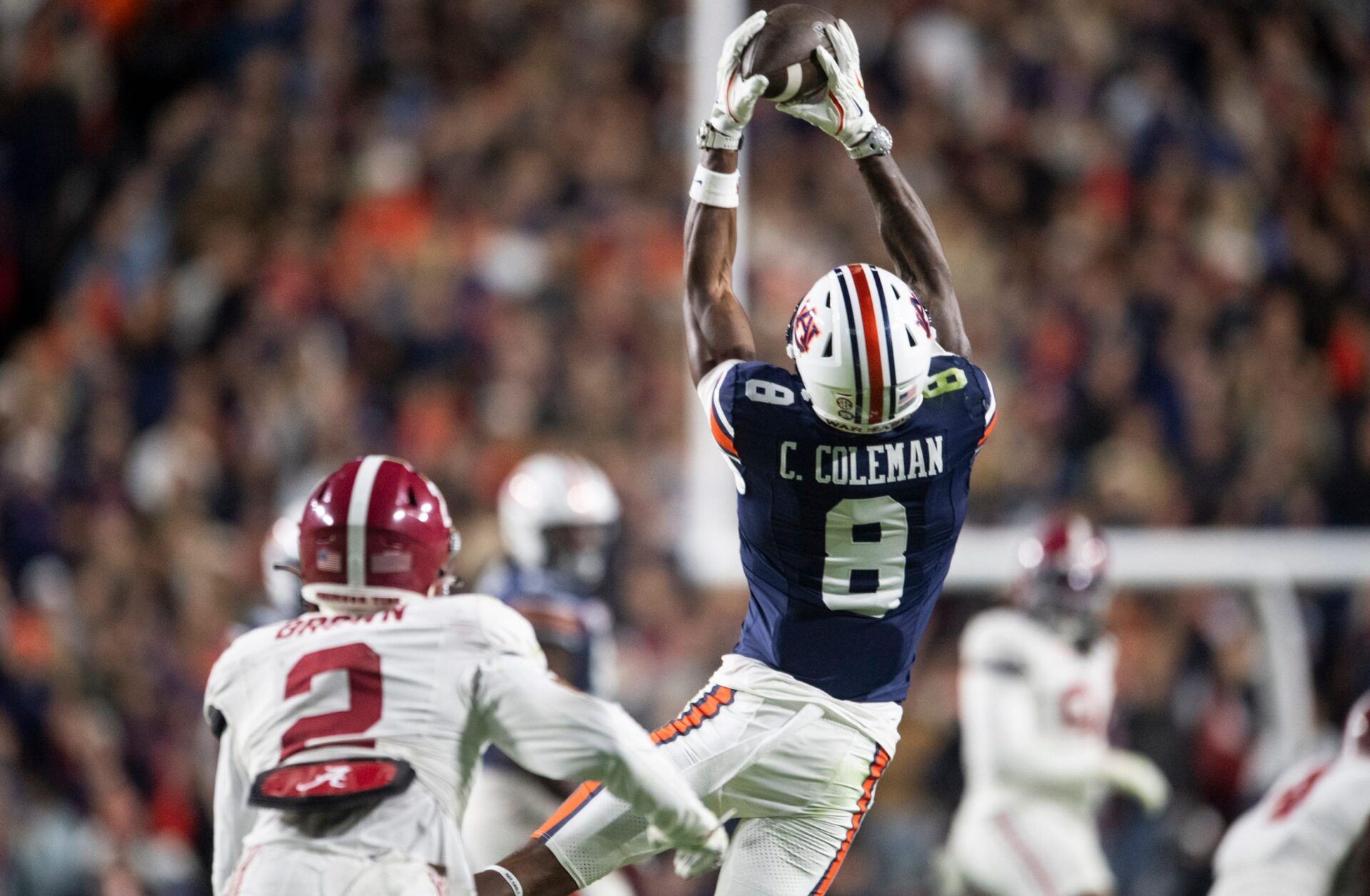
According to On3, one of the top-ranked wide receivers in the transfer portal has committed to Texas. Landing Cam Coleman is a significant addition for the Longhorns, not only for the program overall but also for quarterback Arch Manning as Texas builds toward a potential breakout season in 2026.
Momentum is already building in Austin. Manning closed the year strong, Texas continues to reload through the portal, and now the offense adds a high-upside weapon capable of elevating the passing game.

Cam Coleman Brings a New Spark to the Texas Longhorns’ Offense
After Texas lost one of Manning’s go-to targets, Parker Livingstone, to the transfer portal, it felt inevitable that Steve Sarkisian and company had something up their sleeve. They didn’t just replace production; they upgraded potential.
BREAKING: Auburn transfer WR Cam Coleman has committed to Texas, he announced🤘https://t.co/HDFEybJEdF pic.twitter.com/QKynNc88Wl
— On3 (@On3sports) January 11, 2026
Coleman arrives as a former elite recruit who, to this point, has been more potential than production. At Auburn, Coleman never quite popped statistically, but context matters. The Tigers’ offensive scheme and inconsistent quarterback play over the last two seasons severely limited his opportunities.
According to the PFSN WR Impact Metric, Coleman graded at 75.5 and 75.2 in his two seasons at Auburn, solid numbers that suggest there’s much more left in the tank. Texas gives him the platform to unlock that next level.
A Perfect Fit For Texas and Manning
Coleman won’t be asked to do everything himself. Pairing him with Ryan Wingo on the outside creates one of the most dangerous young receiver duos in the country. Defenses won’t be able to roll coverage toward one player without paying the price elsewhere, and that balance is exactly what Texas has been missing.
At Auburn, expectations were high heading into the season, but the offense failed to develop as hoped under Jackson Arnold at quarterback. The result was an offense that fell flat despite talent on the perimeter. Coleman now leaves that situation for one of the most quarterback-friendly systems in college football.
Coleman’s arrival aligns perfectly with Manning’s upward trajectory. While Manning started the season slowly, his growth down the stretch was undeniable. His PFSN CFB QB Impact Grade sat at 83.1 (37th nationally), but from Weeks 10–14, he trended sharply upward, posting 80-plus grades in three of the last four weeks and reaching a 94.7 impact grade in Week 13, the highest QB grade in the country that week.
Then came the bowl game. Against a strong Michigan defense, Manning delivered his most complete performance yet, totaling 221 passing yards with 2 passing touchdowns, 155 rushing yards with 2 rushing scores, and 4 total touchdowns. That performance wasn’t a fluke; it offered a clear glimpse of what’s to come.
One thing that often goes unnoticed is just how much Manning carried the offense. For much of the season, he was the run game. Texas averaged only 137.8 rushing yards per game, ranking 90th nationally, with some of that production coming from Manning himself.
That won’t be the case in 2026.
Texas added two true bell-cow backs in the portal: Raleek Brown and Hollywood Smothers. With a real ground game, elite perimeter weapons, and another year of development, Manning won’t have to be Superman every snap, though he’s already shown he can be.
