
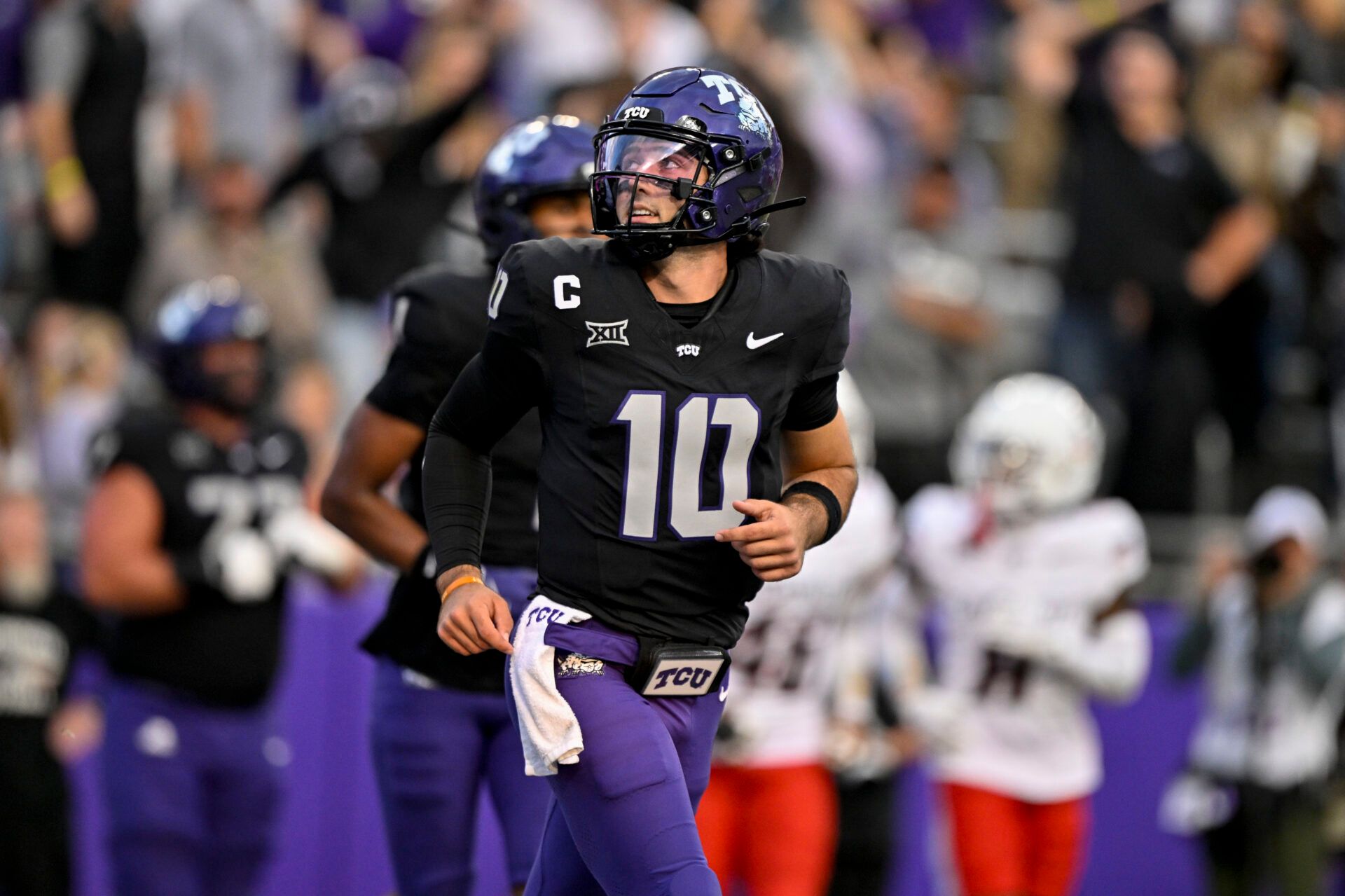
Josh Hoover closed the chapter on a productive four-year run with the TCU Horned Frogs and is now headed to Indiana after entering the transfer portal.
The move, reportedly valued at $2.3 million in NIL opportunities, signals a major opportunity for Hoover, one he hopes mirrors the kind of leap players like Fernando Mendoza made this past season.
But not everyone is sending him off quietly.
Sonny Dykes Calls Out Josh Hoover’s Turnover Record
But not everyone is sending him off quietly.
TCU head coach Sonny Dykes raised eyebrows with a blunt assessment of his former quarterback:
“Josh started 31 games here as a quarterback, and turned the ball over 42 times,” Dykes said (per Bussin’ With The Boys).
TCU HC Sonny Dykes didn’t hold back talking about Josh Hoover heading to Indiana
“Josh started 31 games here as a quarterback, and turned the ball over 42 times.”
pic.twitter.com/hIXly5IOUW— Bussin’ With The Boys (@BussinWTB) March 25, 2026
It reads as more than just a statistical observation. Coming from a head coach, it feels like a pointed critique, perhaps even a parting shot. The implication is clear: Hoover had ample experience and opportunity, yet ball security remained an issue throughout his tenure.
Dykes’ remark can be interpreted in multiple ways. On one hand, it highlights a legitimate concern. Hoover’s aggressive, gunslinger style has always been a double-edged sword.
This past season alone, he threw 29 touchdowns (tied for 9th nationally) but also 13 interceptions (tied for 3rd most nationally), reinforcing the narrative that risk-taking is baked into his game.
On the other hand, the timing and tone suggest something more. Hoover’s decision to transfer, especially for a high-profile NIL deal, may not have sat well with his former coach. There’s a sense that Dykes is pushing back against any notion that Hoover’s development was limited at TCU, instead implying that inconsistencies were on the player himself.
Hoover’s Move To Indiana Offers a Fresh Start
Despite the turnover concerns, Hoover’s overall performance tells a more complete story. Across his three years as a starter, he never posted a PFSN CFB QB Impact Grade lower than 23rd nationally, a mark of consistent, high-level play.
More importantly, he was far from the primary issue for TCU. The Horned Frogs’ offense thrived under his leadership, posting a strong PFSN CFB Offensive Impact score of 82.9.
Meanwhile, the defense struggled significantly, allowing 25.3 points per game, ranking 72nd in the country. In many ways, Hoover was tasked with carrying more of the load than most quarterbacks in similar situations.
Now with Indiana, Hoover gets a clean slate and perhaps a system better suited to refining his decision-making. With NFL aspirations looming, his final collegiate season will be critical. Cutting down turnovers while maintaining his playmaking ability could be the difference between being seen as a high-upside prospect and a risky one.
Dykes may have a point about the turnovers. But his comments also underscore the complicated nature of player development in today’s transfer portal era. Sometimes a change of scenery isn’t just about opportunity; it’s about perception, fit, and proving doubters wrong.
For Hoover, that opportunity starts now in Bloomington.
