
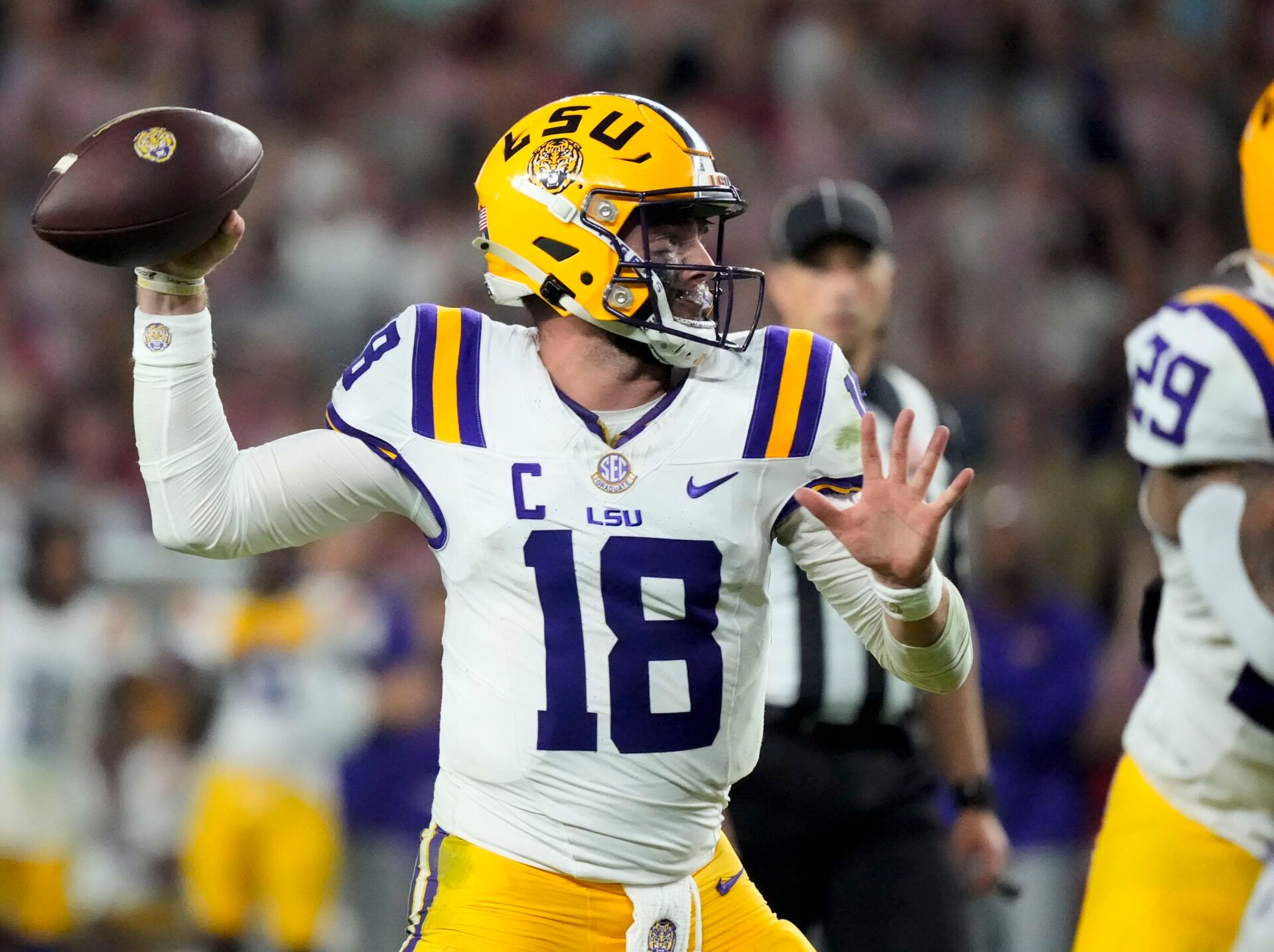
LSU quarterback Garrett Nussmeier is quietly rewriting the narrative around his 2025 season and his NFL Draft outlook after revealing just how severe his injury struggles truly were. He opened up about the oblique injury he battled throughout the year, admitting the extent of it may have been significantly underlooked by both fans and evaluators.
Has Garrett Nussmeier’s Injury Hurt His Draft Stock?
In a recent appearance on 104.5 ESPN, Nussmeier shared that the injury wasn’t simply a nagging pain; it fundamentally altered his mechanics as a passer. He revealed that at times he could barely rotate his torso while throwing, a devastating limitation for any quarterback, let alone one trying to operate at a high level in the SEC.
“I couldn’t use my core, so I was throwing the ball without my core. I’ve been having to go back from the ground up.” Nussmeier explained.
Ex-LSU QB Garrett Nussmeier talks 2025 struggles | Senior Bowl video pic.twitter.com/f7KVt7ARUP
— DailyComet (@DailyComet) January 28, 2026
That lack of rotation stripped away his ability to properly drive throws, forcing him to rely almost entirely on arm strength. For a quarterback who was never considered to have a true “plus” arm, that adjustment took an even heavier toll on his effectiveness. The result was a quarterback throwing without the foundational mechanics that make timing, velocity, and accuracy sustainable.
Simply put, Nussmeier was throwing all arm, and it showed on film.
Regression During 2025 Season Explained by Injury
The statistical drop in Nussmeier’s play aligns almost perfectly with the injury timeline. According to PFSN’s CFB QB Impact Grades, Nussmeier posted a 75.9 grade in 2025, a notable dip from his 81.6 grade in 2024, when he ranked 12th among all quarterbacks nationally.
That regression sparked criticism during the season, but in hindsight, it now reads more like a physical limitation than a talent decline. The oblique injury explains the mechanical inconsistencies, reduced velocity, and overall hesitation that crept into his game.
Nussmeier himself acknowledged that the recovery process hasn’t just been about healing, it’s been about rebuilding.
He described having to “learn from the ground up again,” returning to the fundamentals of quarterback play and re-training his body to move naturally within the throwing motion. Reestablishing proper lower-body engagement has been a central focus of his rehab, with the goal of returning to the version of himself fans were accustomed to seeing during his junior year.
Nussmeier’s injury didn’t just affect his own performance; it had a clear ripple effect on LSU’s offense as a whole.
PFSN’s CFB Offensive Impact Grade for LSU fell to 76.1 in 2025, down sharply from 83.2 the previous season. The decline raises inevitable “what-if” questions about how the Tigers’ season might have unfolded with a fully healthy quarterback.
LSU finished the year 7–5 during the regular season, a record that felt underwhelming relative to preseason expectations. With a healthy Nussmeier operating at peak efficiency, it’s fair to wonder whether that mark, and the offense’s overall identity, could have looked drastically different.
Draft Outlook: Opportunity Still Knocks
Despite the injury-affected season, Nussmeier remains firmly in the NFL Draft conversation. In what is widely viewed as a weaker quarterback class, he has a clear opportunity to capitalize.
Currently, PFSN’s consensus big board places Nussmeier as the QB3 in the class, with Fernando Mendoza and Ty Simpson projected as QB1 and QB2. That positioning reflects league belief that his regression wasn’t permanent, and that a healthier version of Nussmeier still offers starting-caliber traits. If he shows that same 2024 version of himself at the Senior Bowl, then his stock could be on the rise fast.
Also, if medical evaluations confirm that the oblique injury is fully behind him, Nussmeier’s stock could stabilize or even rise as teams re-contextualize his 2025 tape.
Now, with his rehab focused on restoring fundamentals and full-body sequencing, Nussmeier has a chance to reintroduce himself to NFL evaluators, not as a regressing prospect, but as one who survived a hidden injury and still projects as one of the top quarterbacks in his class.
