
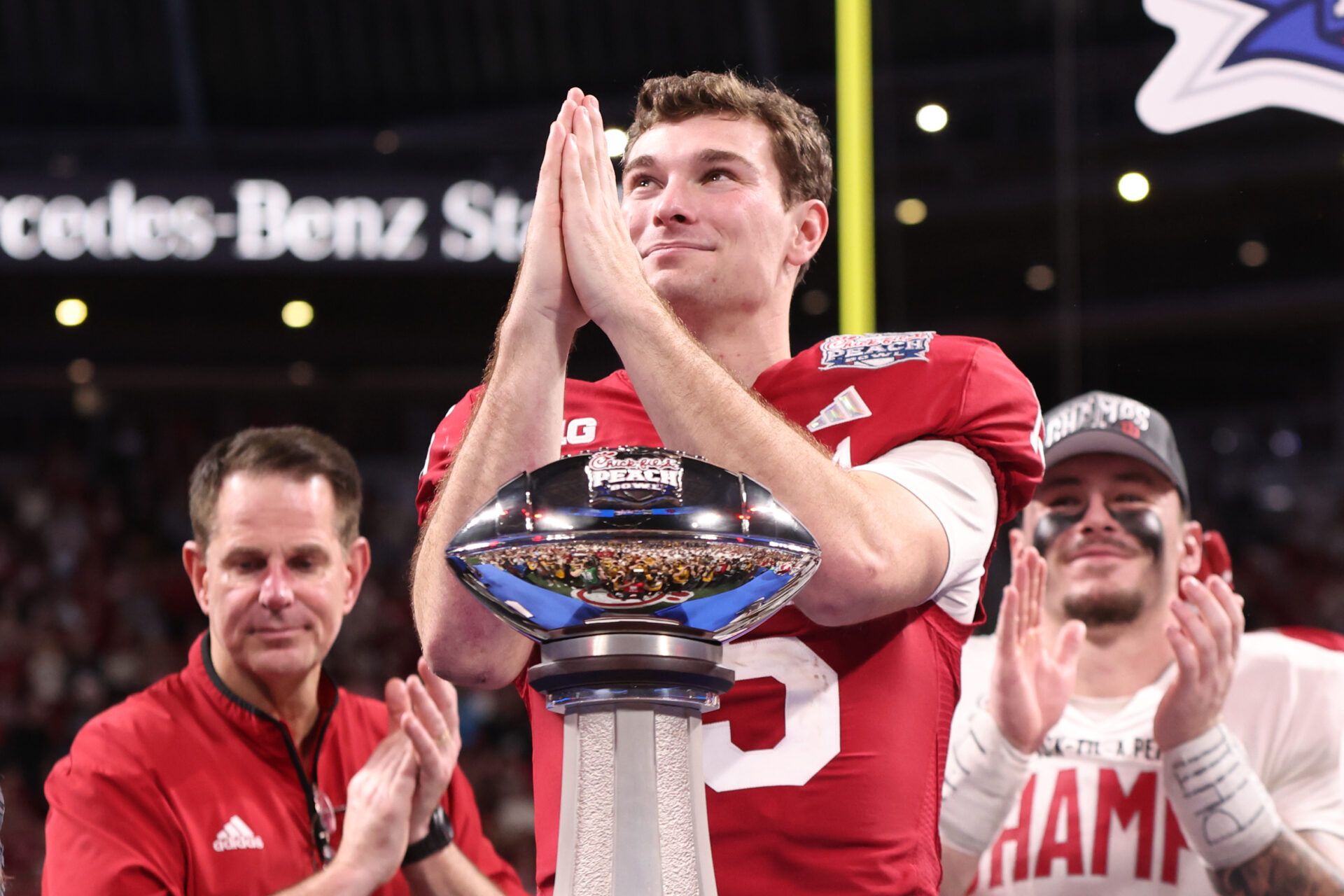
Hours before Monday night’s College Football Playoff National Championship between Indiana and Miami, the two quarterbacks who will command Hard Rock Stadium share far more than South Florida roots.
Both Fernando Mendoza and Hurricanes signal-caller Carson Beck have made their Christian faith central not only to their public persona but to how they’ve navigated the brutal realities of college football’s highest stage. And they are far from alone.
From the Pew to the Playoff: The Rise of Faith in College Football
When Mendoza stepped to the microphone after Indiana’s 56-22 demolition of Oregon in the Peach Bowl, the Heisman Trophy winner knew exactly how he wanted to begin.
“First, I want to give all the glory to God,” he told a national television audience, the same way he starts almost every post-game interview. “The man up above has done so much for us today, and has helped myself and our entire team play at such a high level.”
The phenomenon has become impossible to ignore. Across the 2025 college football season and into the playoff, player after player has used the post-game platform, that precious window of national attention, to acknowledge something beyond themselves.
These aren’t isolated moments. They’re part of a broader cultural shift within the sport, one that has gained particular visibility during this College Football Playoff cycle.
That said, nowhere has the intersection of faith and football been more pronounced than in Bloomington, where Mendoza’s devout Catholicism has helped spark something extraordinary beyond the gridiron.
Since transferring from Cal ahead of the 2025 season, Mendoza has attended Mass regularly at St. Paul Catholic Center, the Newman Center adjacent to Indiana’s campus. His presence hasn’t been passive.
According to Father Patrick Hyde, the Dominican priest who has become Mendoza’s spiritual mentor, Bible study attendance has grown from 50 students to 500 since the quarterback arrived. Sunday Mass attendance now exceeds 1,200 students, and the number of people expressing interest in becoming Catholic has quadrupled, from 30 last year to 120 this year.
As the National College Football Championships approach, Indiana University is set to face Miami University. Father Patrick Hyde, pastor at the Catholic center serving Indiana University, explains his role as a priest in guiding players off the field. pic.twitter.com/W7RP0BGyHH
— EWTN News Nightly (@EWTNNewsNightly) January 17, 2026
“When you’re 6’5″ at Mass, you’re going to be seen,” Father Hyde told the National Catholic Register. The priest doesn’t just minister from afar; he travels with the team, leading prayers before games alongside Mendoza and a group of teammates. He will be on the sideline Monday night in Miami.
Father Hyde has described Mendoza as “Tim Tebow 2.0,” and the comparison extends beyond their playing styles. Like Tebow, the Florida quarterback who won a Heisman in 2007 and made “Tebowing” a cultural phenomenon, Mendoza backs up his public declarations with private devotion.
He prays the Rosary every Friday with teammates, listens to online Mass before games, and has deliberately avoided social media to maintain focus. “I don’t have Instagram on my phone and Twitter or TikTok just because I want to stay focused on the season,” Mendoza explained after winning the Heisman. “That was my whole promise to myself before football camp.”
The connection to Tebow is more than spiritual. After winning the Heisman, Mendoza revealed that the Florida legend had personally texted him advice. “Tim Tebow, who also gave me great advice, and I just really idolize him and the way he spreads his faith,” Mendoza said.
The counsel?
“Live and make decisions you will not regret. Meaning, hey, I am going to stay up and play some video games, instead of watching more film. Whether it is Ohio State, that week, win, lose, or draw, I was gonna lay my pillow on my head and say I did everything possible I could have done to put my best foot forward.”
“That was great advice by Mr. Tebow, and I will carry that with me the rest of my life.”
A Championship Run Built on the Foundation of Faith
The visual symbols have become part of Indiana’s improbable run. Before each of the Hoosiers’ playoff games, the Big Ten Championship against Ohio State, the Rose Bowl against Alabama, the Peach Bowl against Oregon, a photographer named Garrett Ewald has sprinkled holy water on the Indiana end zone.
The water comes from a well at a Catholic retreat center in Bloomington, and Ewald plans to continue the tradition Monday night in Miami.
Yet for all the outward expressions, Mendoza insists his faith keeps him grounded rather than elevated. Asked about his apparent perfection during Championship Media Day, the quarterback offered a characteristically humble deflection.
MORE: Coming Home: Mario Cristobal’s Journey Back to Miami With His Family
“I would say that no one’s perfect. The only person I believe is perfect is my Lord and Savior, Jesus Christ. I have a lot of flaws in myself. For example, my roommates, we won’t mess with the boxes. Boxes will come in when we order the package, it’s kind of there in the living room. I would say I’m a little messy in that way.”
The self-deprecation belies an intensity that has transformed Indiana from college football’s losingest programme into the nation’s top-ranked team. Mendoza completed 71.5 percent of his passes for 33 touchdowns and just six interceptions during the regular season, leading the Hoosiers to their first Big Ten title since 1967.
“First of all, and I know we both agree with this — We want to give all the glory to God.”
Indiana QB Fernando Mendoza and WR Omar Cooper Jr. pointing to the Lord after their big win over Penn State. pic.twitter.com/ENmMBQVZpW
— Sports Spectrum (@Sports_Spectrum) November 8, 2025
Mendoza isn’t the only Indiana player who credits faith for his success.
Wide receiver Omar Cooper Jr., whose toe-tapping catch against Penn State with 36 seconds remaining preserved Indiana’s perfect season, wears eye black in the shape of a cross and recites Colossians 3:23-24 before every game: “Whatever you do, work at it with all your heart, as working for the Lord, not for human masters.”
“I tell myself that every time I go on the field,” Cooper told IUHoosiers.com. “It helps me push to the next level.”
After a 207-yard, four-touchdown performance against Indiana State earlier this season, Cooper offered a familiar refrain: “First, I just want to give all the glory and praise to God. I wouldn’t have been able to have that without Him.”
Linebacker Aiden Fisher, an All-American who followed coach Curt Cignetti from James Madison to Bloomington, has spoken openly about how his faith deepened during the transition. “I think where I really took a big step in my faith was leaving JMU and coming here to Indiana,” Fisher said on the Sports Spectrum Podcast.
“I went from an hour and a half away from home to 10 and a half hours. I’m uncomfortable. I don’t know anybody. That’s when I really took the step to get to know God more, to get to know the Scripture. I always felt that peace about it. It was always like He was right there with me the entire time.”
Carson Beck’s Faith-Based Redemption Arc Carried Miami to the National Championship Game
Carson Beck’s journey to Monday night’s championship game has been decidedly rockier than Mendoza’s, and his faith, he says, is what carried him through.
A year ago, Beck was the presumptive No. 1 overall pick in the NFL Draft, a two-year starter at Georgia who had won two national championships as a backup. Then came the elbow injury in the SEC Championship game, surgery, and a draft stock in freefall.
“I was in a very dark place,” Beck told ESPN.
His response was to lean into his faith. “I was just trying to accept what had happened,” Beck said on the “Built 4 More” podcast with pastor Joby Martin.
“I feel like God has a plan in everything He does, and everything ultimately comes into fruition for A, B, or C reason. You end up figuring that out in time. Even after the injury, it wasn’t even in my thought to go back to college.”
Yet back to college he went, transferring to Miami with a surgically repaired elbow and something to prove. The result has been a renaissance and a platform to share his beliefs.
Miami Hurricanes QB Carson Beck trusts in God and His plan, especially during the hard times.#Carsonbeck #miamihurricanes #gocanes #theU #CFBplayoffs #CFP #nationalchampionship pic.twitter.com/aSu5XGYOed
— @cbnsports_ (@cbnsports_) January 18, 2026
“Obviously, my faith has had a huge impact on me throughout this entire season and obviously throughout this entire year,” Beck said at Championship Media Day.
“Without it, I don’t know if I would have gotten through this season. It’s been a huge factor for me. I wouldn’t be here without God and all the moments that he’s put me through to get to this ultimate opportunity. I’m super grateful for that and super grateful for this opportunity He’s given me to play in this game and glorify Him.”
Beck plays with a cross symbol on his right thigh pad and draws crosses with eye black on his face, small declarations of a faith that has, by his own account, defined his improbable comeback.
“I think the biggest thing throughout my story is just to always trust in God and trust in His plan and that He has a story written for you,” Beck explained.
“At times, it’s really hard to see that. Sometimes it can be really dark. Sometimes you don’t see that light at the end of the tunnel. I feel like that’s where faith is at its strongest, and that’s where you have to be strongest in your faith and having that faith that God is going to pull you out of that, that He is the only thing that can pull you out of that.”
Faith in Football Isn’t a 2025 Season Development
While the expressions of religious gratitude in this championship cycle will be a significant part of the storyline of the national championship game, one of the biggest narratives of the 2024 College Football Playoff was written on a foundation of faith.
Boise State coach Spencer Danielson, after his team’s playoff loss to Penn State, offered perhaps the most striking testimony of the postseason: “No matter what, win, lose, or draw, I’m going to always give Jesus the glory. I’m so blessed to be the head coach here. And we do serve a champion. And I do know God never says ‘oops.'”
His player, Ahmed Hassanein, a defensive end from Cairo, Egypt, was even more direct.
“First, I want to start off and say all glory to Jesus Christ. He is the true champion. Coach D., you changed my life. I did not know God until I got to Boise State. And I serve a true champion. Jesus Christ is the only true God. He died and rose from the dead three days later. That’s the champion that I serve.”
MORE: Inside the Cignetti Football Dynasty: Father, Son, and a Legacy of Winning
Even in defeat, Boise State’s Ashton Jeanty, who fell just 27 yards short of the all-time single-season rushing record, began his post-loss remarks with perspective: “First of all, all glory to God for bringing us this far, for helping us restore the order this year. We couldn’t have done it without him.”
Meanwhile, Texas quarterback Quinn Ewers, after leading the Longhorns past Arizona State in a Peach Bowl thriller, connected his faith to his composure.
“I just try to be that calm within the storm for all the guys. And I think that my relationship with Jesus has helped me in that specific way of knowing that no matter what happens, that he’s going to be there for me. He’s still going to love me.”
Ohio State’s Will Howard, after the Buckeyes’ stunning destruction of Oregon in last year’s Rose Bowl quarterfinal, offered his gratitude first: “First and foremost, I’ve got to thank my lord and savior Jesus Christ for giving me this opportunity to be on this stage, here in the Rose Bowl.”
Notre Dame’s Riley Leonard, following the Irish’s playoff victory over Georgia, echoed the sentiment: “First and foremost, I want to thank my lord and savior Jesus Christ. Without Him, I wouldn’t be here.”
Why Do College Football Players Give All Glory to God?
What explains this surge of public faith among college football’s brightest stars? The pressures of the modern game — the NIL scrutiny, the transfer portal anxiety, the relentless expectation — may be part of it. For athletes navigating unprecedented wealth and attention at younger ages, faith offers an anchor, a reminder that identity extends beyond performance.
Father Hyde sees it in Mendoza.
“He’s a joyful person,” the priest told the Daily Wire. “I always, at least as a Catholic priest, go back to the scriptures where Jesus says, ‘I have said these things to you so that you might have my joy and your joy might be complete.’ It’s a reminder to us that joy is something to be shared.”
That joy has been evident throughout Indiana’s magical season; in Mendoza’s emotional Heisman speech thanking his mother, who has battled multiple sclerosis for years; in Cooper’s grateful smile after big catches; in Fisher’s quiet leadership during an injury absence that could have derailed the defense.
“My hope is that Fernando’s witness is an inspiration to people to put your faith first, to give God a try,” Father Hyde said.
“To get up and to go back to church if you’ve been away and to just trust that the Lord will help move you forward, but the Lord will also give you the strength day to day to do the right things that will make your life even better if you entrust your lives and your hearts to His providential care.”
When Mendoza and Beck take the field at Hard Rock Stadium, they will carry the weight of programs, regions, and expectations.
Mendoza will be playing in his hometown, the Miami-raised son of Cuban immigrants returning as a Heisman winner seeking to complete perhaps the greatest season in college football history.
Beck will be seeking redemption, a chance to prove that his NFL future remains bright despite the injury that nearly ended it.
Both will almost certainly begin their post-game interviews the same way — win or lose, joy or disappointment. Both have made clear that their worth isn’t measured in touchdowns or trophies, even as they compete for both.
“I would say everyone is going to remember this game,” Mendoza said Saturday. “It’s my duty to Hoosier football and my teammates to put my focus and preparation into this game because, although it’s great, winning the Heisman, winning the Rose and Peach Bowl, everyone is going to remember how I finished.”
For Mendoza, for Beck, for the growing number of college football players who have made their faith central to their public identity, that finish will be offered to something greater than themselves.
All glory to God.