
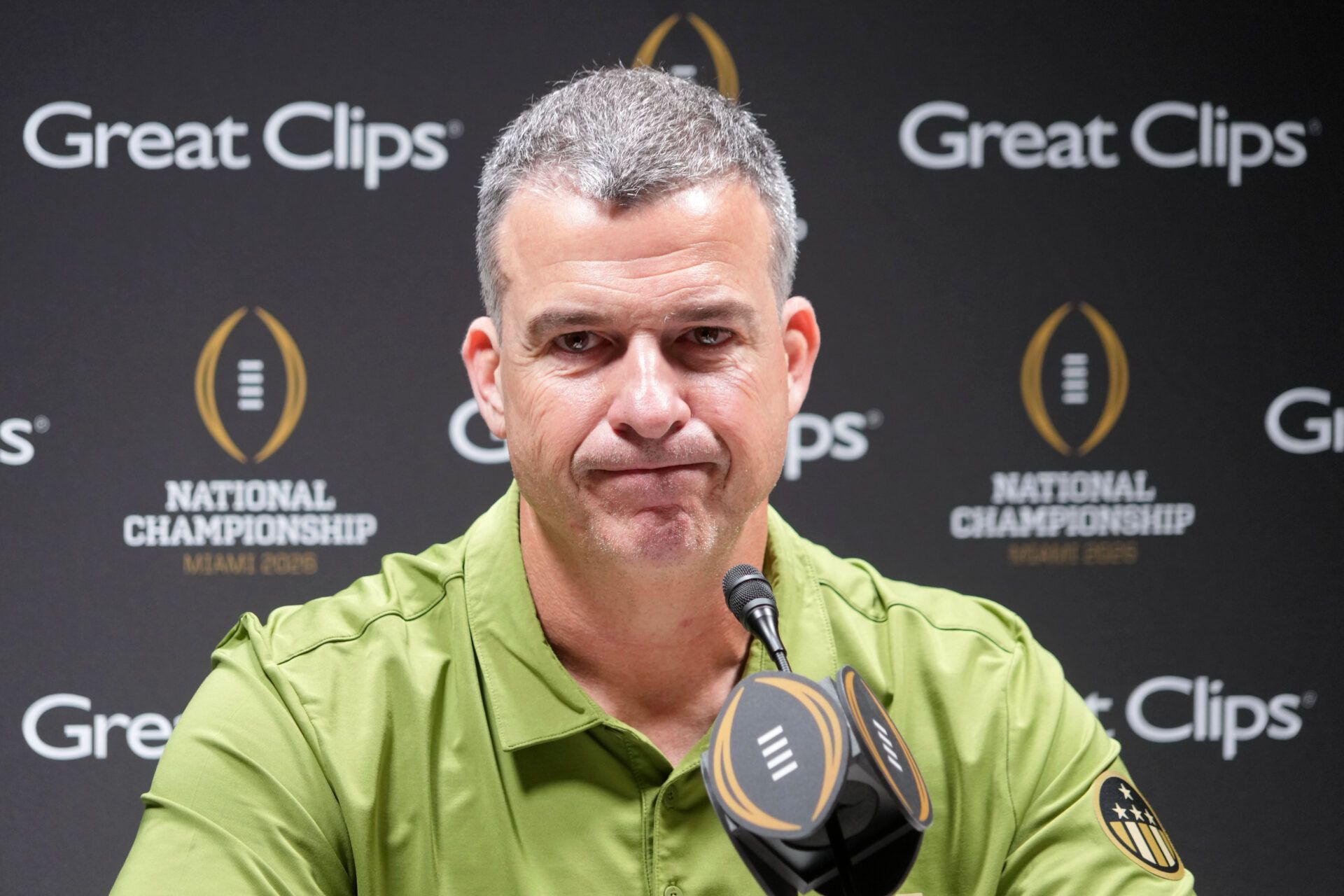
Monday night, when Mario Cristobal leads the Miami Hurricanes out of the tunnel at Hard Rock Stadium for the College Football Playoff National Championship against Indiana, the distance between player and coach will collapse into something far more profound.
The kid who wore the orange and green in the late 1980s, who hoisted national championship trophies in 1989 and 1991, will stand on the same sideline where his journey began, only this time, the weight of an entire programme rests on his shoulders.
Mario Cristobal’s Family History Fuels Miami’s National Resurgence
It’s a homecoming story unlike any other in college football. Yet to understand what Monday truly means, you have to trace the path back much further than Coral Gables.
The Cristobal story is, at its core, a Cuban American story. Mario’s grandfather, Mario Campos, grew up poor in the Cuban countryside before finding work with the national police. When Fidel Castro seized power, those who had served under the Batista regime were thrown into prison.
Campos escaped with his life and fled to Florida in 1961, arriving in a country that didn’t necessarily want him. Businesses openly displayed “Cubans Don’t Apply” signs in their windows.
Mario’s father, Luis Cristobal Sr., endured far worse. One of the youngest government workers in the Batista administration, he spent two years in Cuban prisons, was tortured regularly, and twice stared down the barrels of a firing squad.
He came to the United States with nothing and no family nearby.
What both men shared was an unshakeable belief that hard work could overcome anything. That philosophy became the bedrock upon which Mario was raised.
“Our grandfather, he had this philosophy,” Mario’s older brother Lou told CNN Sports. “If anybody can do it, I can do it, too. That’s kind of what we all believed.”
Luis Sr. opened a car battery business. Clara, Mario’s mother, processed titles at Kendall Toyota. They worked until they couldn’t anymore, Luis until his death in 1996, Clara until she retired at 79. Every dollar they earned went toward giving their sons opportunities they never had.
MORE: Mario Cristobal Reflects on Fernando Mendoza Sr. As High School Memories Resurface
Reflecting on his parents ahead of Monday’s title game, Cristobal offered a window into the household that shaped him.
“Well, mom and dad, they worked two jobs, went to night school, learned the language,” Cristobal said at a press conference last week.
“They were hard-nosed. They were tough. They made sure we understood the meaning of true work and to make absolutely zero excuses. They were absolutely relentless in their pursuit of just doing everything they could to provide for us.”
“My dad was a hard-nosed, tough-ass son of a gun,” Cristobal added, per CNN. “That’s what I know. And I’m forever grateful for him being hard on us and never gifted us anything, made us work for everything. I thank God for that.”
Those values would carry Cristobal through a winding coaching career that took him from graduate assistant to head coach at Florida International, then to Nick Saban’s staff at Alabama, and eventually to Oregon, where he won two Pac-12 titles and reached the Rose Bowl.
Through it all, Miami remained the dream he didn’t dare speak aloud.
The Prodigal Son Returns, But Without Immediate Success
When the Miami job opened in December 2021, Cristobal found himself at a crossroads. He had built something real in Eugene. Yet the pull of home proved impossible to resist.
In the middle of the toughest professional decision of his life, Cristobal called Dennis Lavelle, his former coach at Christopher Columbus High School.
“You’re 51 years old now,” Lavelle told him, according to ESPN. “And you got a chance to go home. … You got to go.”
“When you go away, you tuck [the connection to home] away, because it’s still about the vocation of being a football coach,” Cristobal explained to ESPN. “And I just did not ever think it would really be a reality. So when it became a reality, it hit like a ton of bricks.”
There was another factor, one that transcended football entirely. Clara Cristobal was in declining health. Taking the Miami job meant Mario could visit his mother at Kindred Hospital after long days of practice and meetings, something impossible from 3,000 miles away in Oregon.
Clara was intubated and unable to speak when her son accepted his dream job. Yet she squeezed her boys’ hands to let them know she understood. She died that spring.
The early returns at Miami weren’t pretty. The Hurricanes went 5-7 in Cristobal’s first season, 7-6 in his second. Critics questioned whether the former offensive lineman could coach at the highest level. Even this year, as Miami fought its way into the expanded College Football Playoff, doubters persisted.
Cristobal did what his parents taught him to do. He worked.
“Don’t get twisted with him,” Lou Cristobal warned in his CNN interview. “Just because he’s very articulate, nice and charming, and a good human. The guy is an animal. I mean that in the best sense of the word. There is no quit in that guy. You have to kill him to beat him.”
The Hurricanes’ playoff run has silenced the skeptics. Wins over Texas A&M (10-3), Ohio State (24-14), and Ole Miss (31-27) — the last secured on Carson Beck’s touchdown with 18 seconds remaining — have delivered Miami to the verge of a first national championship since 2021.
Lou likens his brother’s success to a drop of water beating on a rock. Methodical. Constant. Eventually effective.
When Miami takes the field against undefeated Indiana, Cristobal will stand just miles from the house where he grew up on SW 25th Street, a home his grandfather built with his own hands.
Mario Campos died of cancer in 1992. Luis Cristobal Sr. passed in 1996. Clara followed in 2022. None will be there to witness what their sacrifices made possible. Yet Lou sees them clearly.
“They would have expected it,” Lou told CNN. “My father, he was the guy who said you had to work hard. My grandfather, he taught us if you put your mind to it, you could do it. My mom would be more emotional.”
“But man, they would have had a blast. I know my dad and grandfather are up there smoking big old stogies, and my mom is batting her eyes against the tears. I can see them up there. They’re dancing.”
For Mario Cristobal, the championship game represents something beyond wins and losses. It is the culmination of a family’s American journey, one that began in Cuban prisons and ends, at least for now, under the lights at Hard Rock Stadium.
Home, at last.