
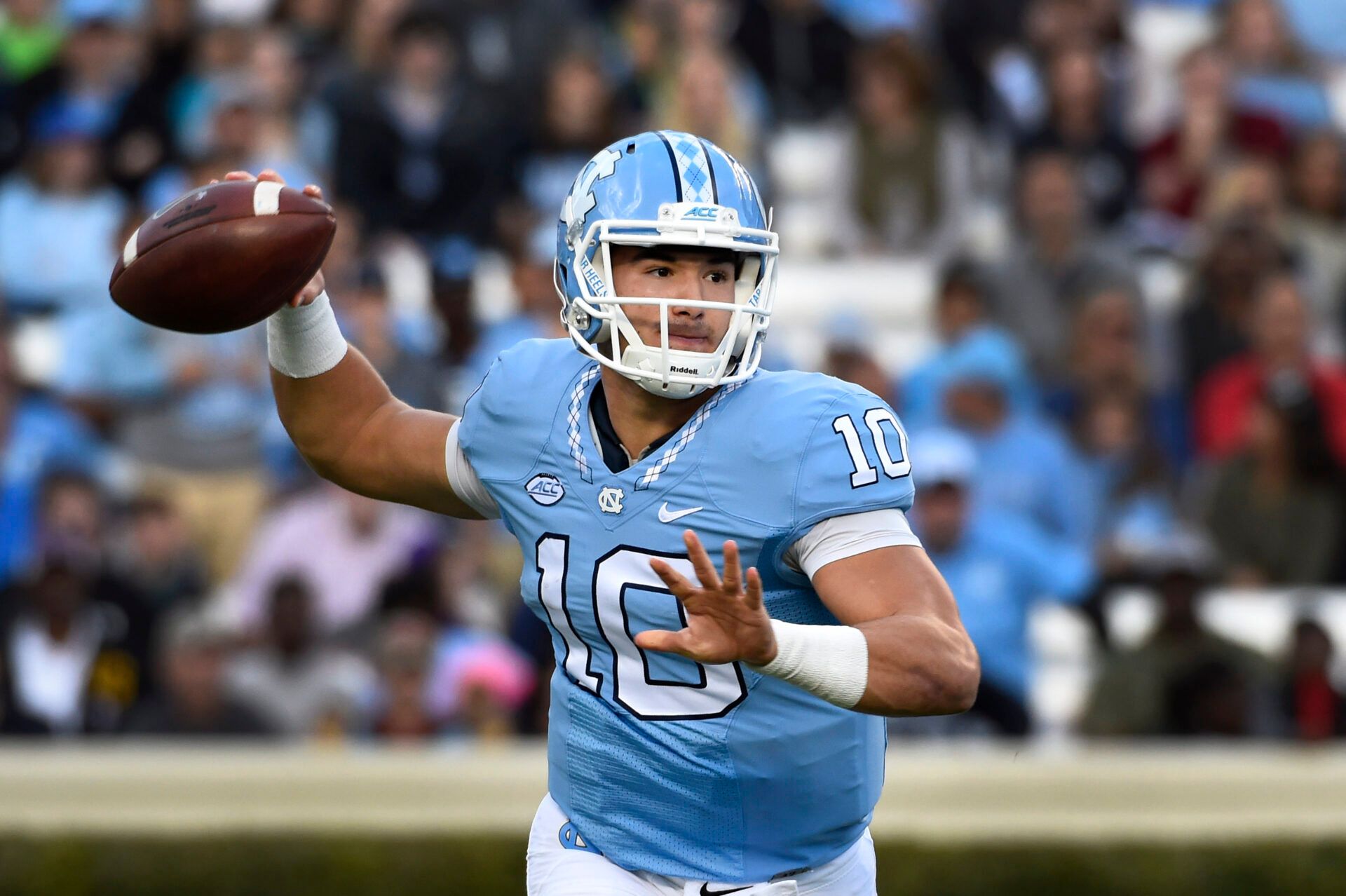
Mitchell Trubisky got the start at quarterback for the Buffalo Bills in Sunday’s Week 18 finale against the New York Jets, stepping in while Josh Allen nurses a foot injury ahead of the playoffs.
The 31-year-old backup has carved out a respectable NFL career since the Chicago Bears made him the second overall pick in 2017, but his path to the league ran through Chapel Hill, where his single season as a starter at North Carolina produced one of the more polarizing pre-draft evaluations in recent memory.
Mitchell Trubisky’s North Carolina College Career: One Year, One Chance
Trubisky’s college football career required patience. He redshirted in 2013 under North Carolina coach Larry Fedora, then spent two seasons backing up Marquise Williams. The reps were limited but instructive.
In 2015, Trubisky completed 40 of 47 passes for 555 yards and six touchdowns in mop-up duty, including a 17-of-20, four-touchdown explosion against Delaware that hinted at what was coming.
When Williams exhausted his eligibility, Trubisky finally got the keys. He started all 13 games in 2016 and set North Carolina single-season records with 3,748 passing yards and 30 touchdowns. His efficiency was striking with just six interceptions against those 30 scores, while his 68.0 completion percentage ranked among the ACC’s best.
MORE: Indiana Dominates the Transfer Portal as Curt Cignetti Snags TCU QB Josh Hoover
The film showed a quarterback with legitimate arm talent and the athleticism to extend plays. Trubisky threw for 453 yards and five touchdowns in a 37-36 win over Pittsburgh, the kind of performance that made scouts wonder what he could become with NFL coaching.
He also rushed for 308 yards and five touchdowns that season, adding a dimension that Williams’ system had utilized effectively.
But there were concerns.
Trubisky made only 13 college starts. The sample size was minuscule compared to contemporaries like Deshaun Watson and Patrick Mahomes. North Carolina went 8-5 that year, losing to Georgia, Virginia Tech, Duke, NC State, and Stanford in the Sun Bowl.
The Tar Heels ranked outside the top 50 nationally in defensive efficiency, which inflated some of Trubisky’s passing numbers against opponents selling out to stop the run.
Fedora’s offense leaned heavily on Trubisky’s arm; Carolina threw on 52.9 percent of plays, a significant departure from Fedora’s typical run-pass balance. Whether that reflected coaching adjustments or Trubisky’s limitations as a runner compared to Williams became a legitimate pre-draft debate.
From Tar Heel to Top-Two Pick: The 2017 NFL Draft
Trubisky declared for the 2017 NFL draft after his junior season, forgoing his final year of eligibility. The Bears traded up one spot to select him second overall, ahead of Watson (12th) and Mahomes (10th). The decision drew immediate skepticism, given his limited starting experience.
His NFL career has been a mixed bag. The 2018 season brought a Pro Bowl selection and Chicago’s first division title since 2010. The Bears went 12-4, and Trubisky threw for 3,223 yards with 24 touchdowns. But inconsistency followed, and Chicago declined to re-sign him after the 2020 season.
MORE: Dabo Swinney Faces Mass Exodus As Defensive Lineman Enters Transfer Portal
Trubisky spent 2021 as Allen’s backup in Buffalo, then started 11 games for the Pittsburgh Steelers across 2022 and 2023 before returning to Orchard Park. He’s now in his third season with the Bills, a trusted veteran insurance policy who understands his role.
Sunday’s start at Highmark Stadium figures to be brief. Allen is expected to take the first snap to extend his consecutive starts streak before handing the reins to Trubisky for most of the afternoon. Buffalo has already clinched a playoff berth, and keeping Allen healthy matters more than seeding.
For Trubisky, it’s another chance to remind everyone what North Carolina saw in 2016: a capable quarterback who makes the most of his opportunities, even if they’ve always come sporadically.