
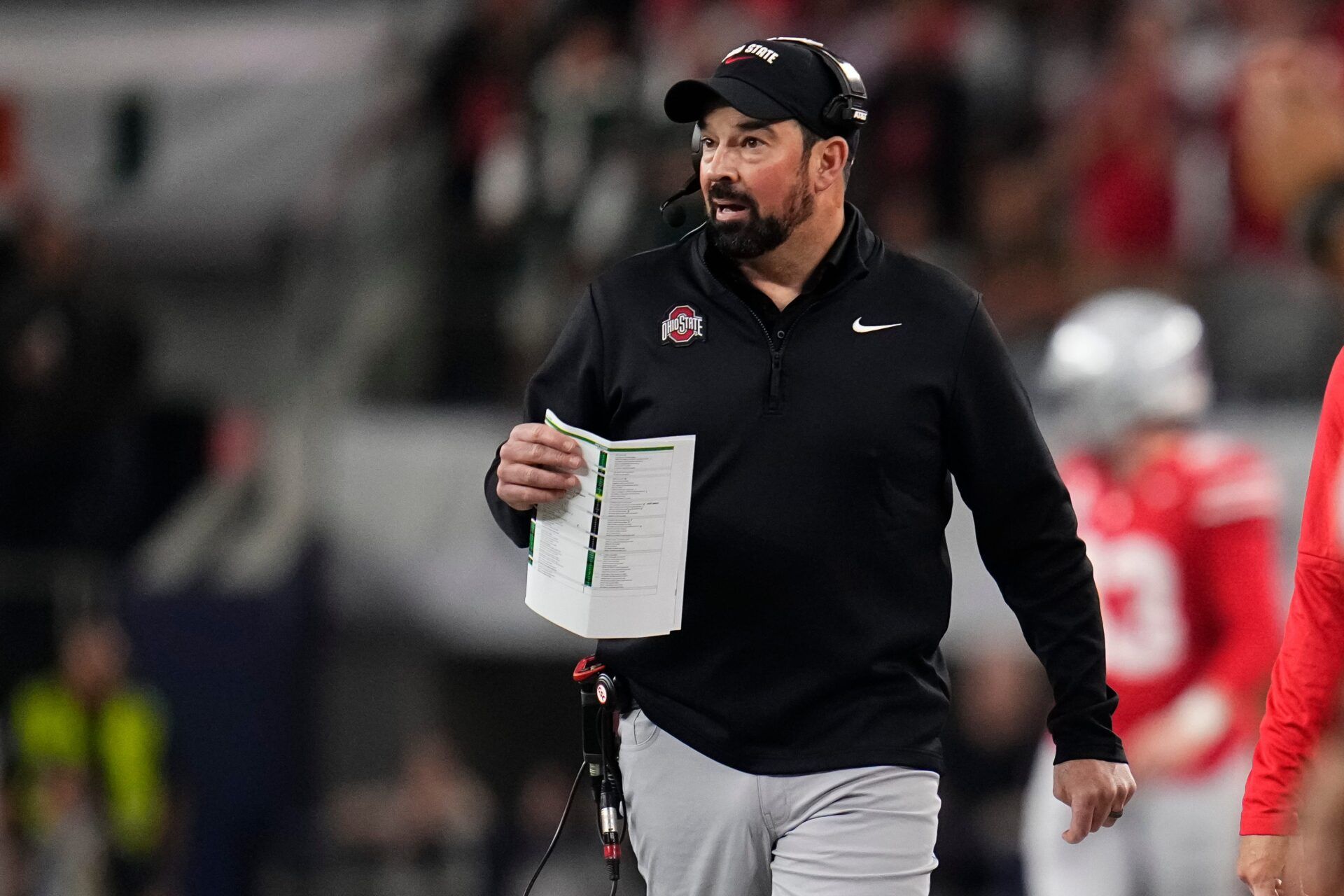
Ohio State is coming off what many would consider a successful season, but beneath the surface, the Buckeyes are staring at one of the most consequential roster transitions of the Ryan Day era.
With player attrition, rising NIL demands, and a rapidly evolving transfer market, Day and his staff are being forced to rethink what it truly costs to build a championship contender.
Ohio State’s Strong 2025 Masking Deeper Issues
Day has long been a firm believer in acquiring talent through high school recruiting, retention, and development. However, when Ohio State won the national championship last season, several key contributors came from the transfer portal, including quarterback Will Howard, running back Quinshon Judkins, and safety Caleb Downs.
That success appears to have reinforced Day’s belief that utilizing the transfer portal is essential for championship-level success in today’s college football landscape.He went on to say:
“There was going to have to be some attrition somewhere along the line,” Day said recently, acknowledging the unavoidable churn that now defines modern college football.
That churn comes with a price tag. A college football insider said last week that the cost of fielding a true national title–caliber roster is expected to exceed $40 million by the 2026 season. When asked about that figure, Day didn’t push back.
“It’s a fluid number that we’re chasing,” he said. “I don’t know that we’ll know until we’re finally done with the entire roster.”
That comment speaks volumes about where Ohio State stands. While the Buckeyes had a strong year by most standards, they also showed more vulnerabilities than originally anticipated.
Several of those issues might have been addressed more aggressively in last offseason’s transfer portal cycle, but they either weren’t identified early enough or weren’t prioritized at the time.
Now that Ohio State turns its attention to the 2026 season, the program is staring down a near-total reset in key areas. It will be a new roster, a new financial reality, and potentially a new blueprint for how the Buckeyes build championship teams.
Offensive Line Concerns Loom Large
One of the most glaring issues showed up up front. In high-leverage games, particularly the Big Ten Championship against Indiana and later in the College Football Playoff against Miami, the offensive line struggled to protect quarterback Julian Sayin consistently.
According to the PFSN College Offensive Impact metrics, Ohio State’s offensive line posted an 81.6 score, ranking 27th nationally. That’s far from disastrous, but it’s also not the standard Ohio State needs to meet if it wants to return to championship form.
If the Buckeyes are serious about addressing that weakness, they could still explore adding a marquee name, such as Colorado offensive tackle Jordan Seaton, should the opportunity present itself. A move like that would signal a more aggressive, NIL-driven approach, one that aligns with the financial reality Day is openly acknowledging.
Defensive Departures and Missed Opportunities
Defensively, Ohio State has been elite, earning a 95.1 score on the PFSN College Defense Impact metrics, fourth-best in the country. However, that dominance is under threat. The Buckeyes are set to lose several key contributors to the NFL Draft, and replenishing that level of talent has proven challenging.
Ohio State missed on a few high-impact targets who could have helped soften the blow, including safety Koi Perich and edge rusher Chaz Coleman. Those misses loom larger given the volume of defensive departures and the increasing importance of portal-ready contributors who can step in immediately.
Maintaining defensive excellence without elite reinforcements will be difficult, especially as rival programs continue to spend aggressively.
Spend Big, Win Big: The New College Football Reality
This is the new era of college football, for better or worse. Spending big is no longer optional if a program wants to win big.
Recent examples make that clear. Texas Tech rebuilt its defense almost overnight through the transfer portal, fielding a dramatically improved unit that graded as the second-best defense in the country (95.8 PFSN grade) and helped power a Big 12 title and CFP appearance.
Indiana took it even further. The Hoosiers currently sit No. 1 in both offensive and defensive PFSN grades, fueled in large part by portal additions, most notably Heisman-winning quarterback Fernando Mendoza.
Those programs didn’t wait. They identified needs, spent aggressively, and reshaped their rosters with urgency. Standing pat could lead to a familiar outcome: another season in which Ohio State is very good but not quite good enough, while others continue to pass them by.
Day understands the stakes. The question now is whether Ohio State will fully embrace the new college football economy or risk falling behind in a sport where hesitation is increasingly costly.
