
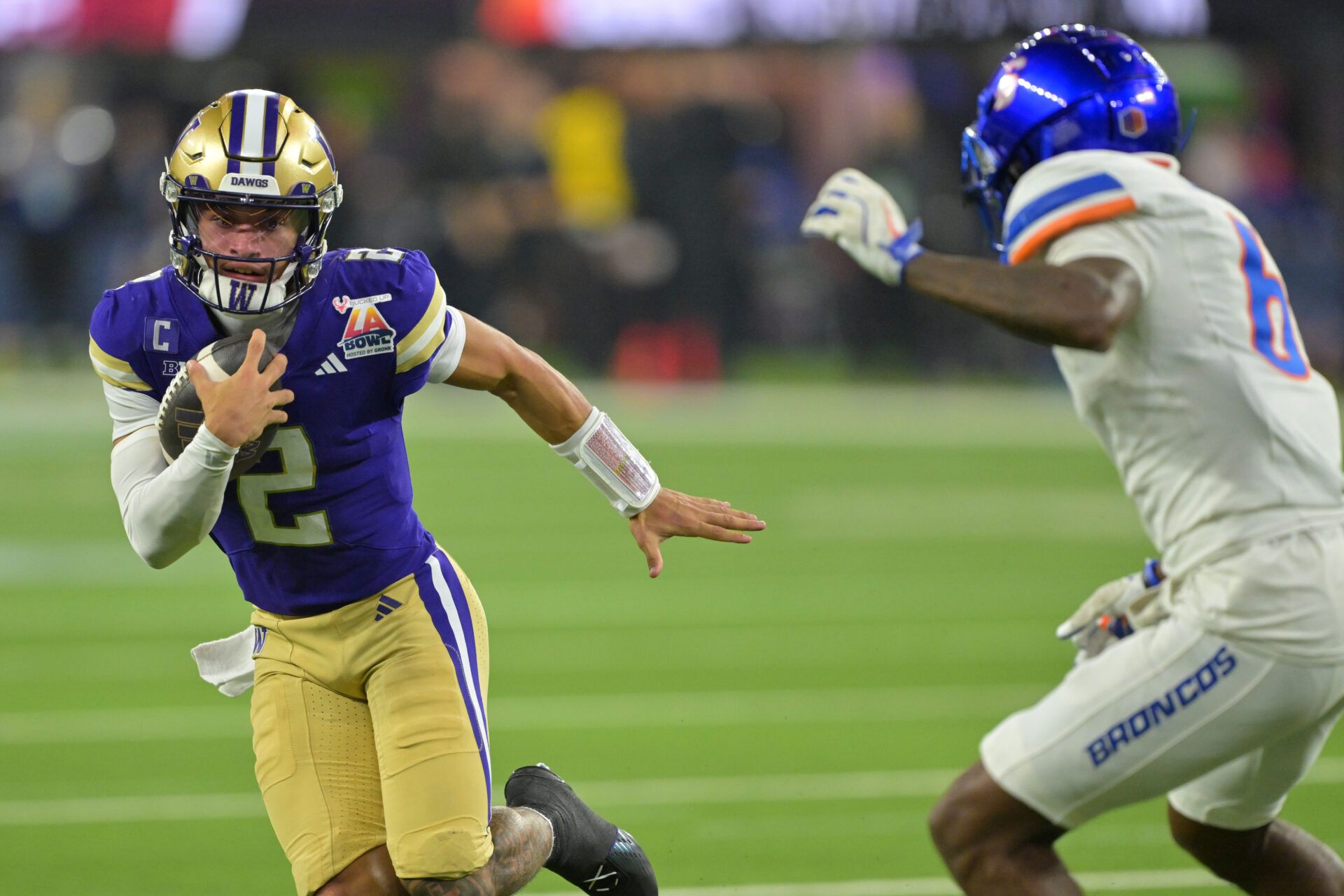
College football’s transfer portal has once again ignited debate across the sport, and this time, former NFL quarterback-turned-analyst Chase Daniel didn’t hold back.
Taking to X (Twitter), Daniel voiced his frustration with what he believes is a “broken” system, pointing to Washington quarterback Demond Williams as the latest and most glaring example of how far the sport has drifted from its original intent.
Demond Williams’ Shock Move Back to Transfer Portal Exposes College Football Chaos
Williams’ situation is at the center of the storm. Just days ago, the star quarterback recommitted to Washington, reportedly agreeing to a deal worth roughly $4 million for the upcoming season. That commitment appeared to signal stability for a Huskies program coming off a strong year. Daniels goes into saying:
“This is what’s wrong with college football right now,” Daniel wrote, criticizing the portal’s transformation from a second-chance safety net into what now resembles year-to-year free agency.
So one of the better QB’s in the portal Demond Williams committed back to Washington a few days ago & signed papers for $4M/Year…then tonight announces he’s entering the portal.
LSU is considered the landing spot for $6M/Yr…and this is all going on while stud QB Sam Leavitt is… https://t.co/toNyqEh0lJ
— Chase Daniel (@ChaseDaniel) January 7, 2026
Instead, Williams abruptly re-entered the transfer portal, despite having already signed an agreement to remain with Washington, effectively breaching the spirit, if not the letter, of his deal. Almost immediately, reports surfaced that LSU is now the favorite, with NIL figures rumored to be as high as $6 million per year.
The optics couldn’t be worse for a system already under scrutiny. As many others have pointed out, and as Daniels is insinuating, the portal was intended for players who were buried on depth charts, undergoing coaching changes, or seeking genuine second chances. Instead, it has evolved into a marketplace driven almost exclusively by the biggest offer on the table.
There’s no denying Williams’ talent. At just 19 years old, he’s already one of the most impactful quarterbacks in the country. According to PFSN, Williams owns a QB Impact Grade of 87.8, ranking 13th nationally. He’s an elite dual-threat, placing inside the top 40 among all quarterbacks in both passing yards and rushing yards.
His impact goes beyond individual stats. Washington’s offense finished No. 6 nationally with an 89.8 offensive grade, while the Huskies’ defense graded at 84, placing them inside the top 25. The result? A 9–4 season and clear evidence that Washington can compete with elite programs, both nationally and in the Big Ten.
So the question becomes unavoidable: why leave?
Williams is already being paid life-changing money, playing for a contender, and positioned as the centerpiece of a roster built to make another run. Sometimes, as the saying goes, the grass isn’t greener on the other side.
Much of the speculation centers on LSU, where optimism appears to hinge on the belief that one quarterback, along with the aura of Lane Kiffin, can instantly restore championship-level football in Baton Rouge.
LSU’s Struggles Highlight the Sport’s Structural Failures
But the numbers tell a different story. LSU finished just 7–6 overall and 3–5 in SEC play last season. The Tigers’ offense graded out at a modest 76.1 in PFSN’s Offensive Impact Grade, showing clear holes across the roster. This isn’t the Joe Burrow-led juggernaut of 2019, and expecting an immediate turnaround ignores the structural issues still facing the program.
If Williams does end up in Baton Rouge, he’ll be asked to shoulder a heavier load, both on the field and in expectations, with far less roster stability than he currently enjoys at Washington.
Daniel’s frustration reflects a growing sentiment across the sport: college football is trying to act like a professional league without the professional governance that accompanies it.
There’s no commissioner. No unified leadership. No enforceable standards. The result is chaos, NIL deals that appear contractual but lack full regulation, players switching programs annually, and commitments that carry little weight beyond the next offer.
Situations like the Demond Williams saga shouldn’t be happening. Not because players shouldn’t be paid; they should be. However, a system without structure invites exploitation on all sides.
Until college football undergoes a comprehensive overhaul with genuine leadership and accountability, this cycle will persist. And as Chase Daniel made clear, “broken” might not even begin to describe it.
