
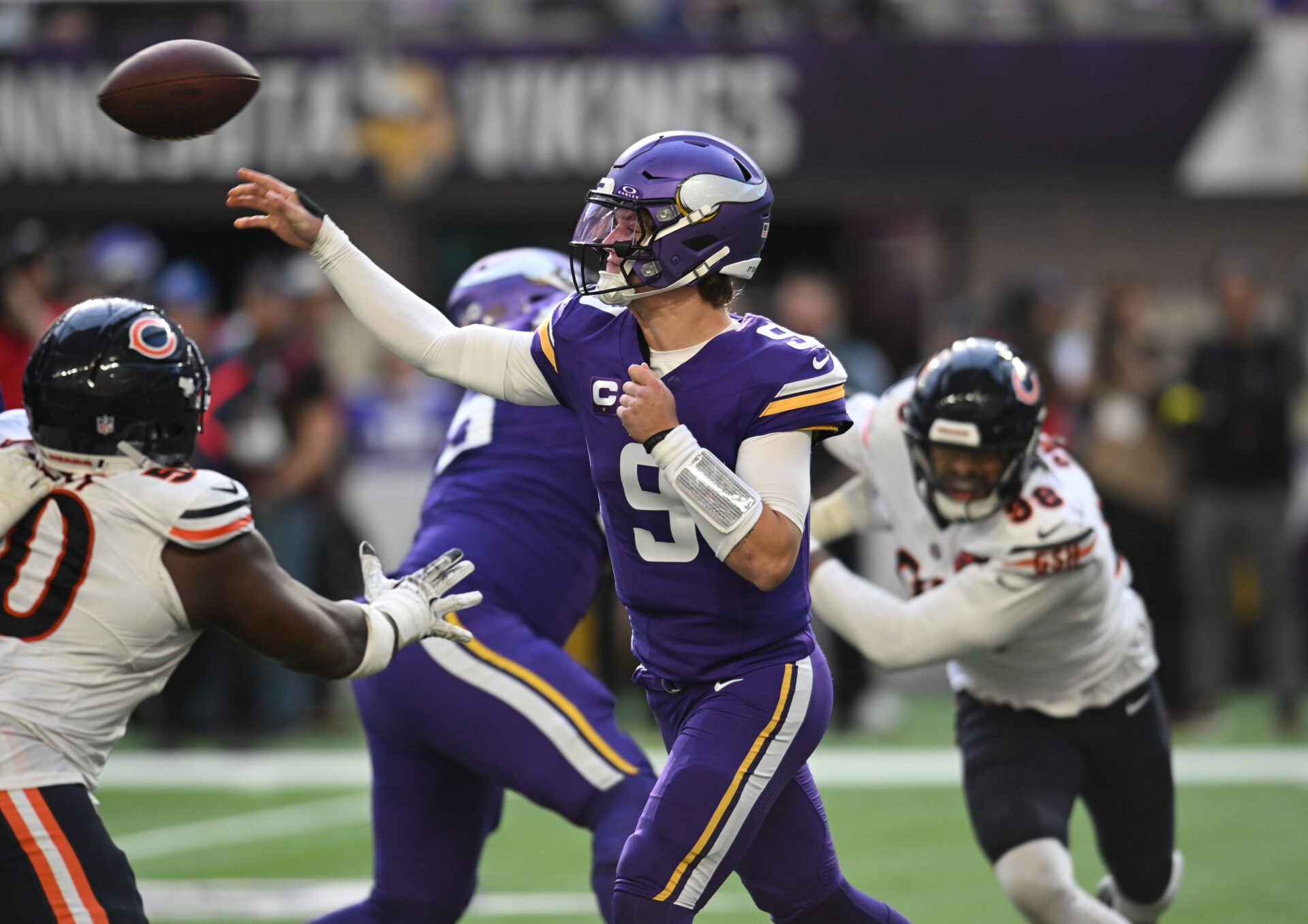
The Vikings are 4-6 and still searching for an offensive identity. They have the talent and an aggressive playcaller in head coach Kevin O’Connell. What they lack is consistency. Minnesota’s passing game is stuck between wide-open opportunities and a quarterback still processing the league. These three midseason truths explain why the offense has stalled and what must change moving forward.
What Has Gone Right: Minnesota’s Star Receivers Justin Jefferson, Jordan Addison Are Running Wide Open
For all the frustrations surrounding the offense, O’Connell is still generating open targets at a high rate. Receivers Justin Jefferson and Jordan Addison are consistently winning, often with multiple steps of separation. The Vikings have faced a steady diet of rotating coverages and defenses that sell out to take away Jefferson. Even with those challenges, Minnesota continues to scheme free access on crossers and deep-intermediate concepts.
Addison overcame two drops against the Bears to make a crucial 15-yard go-ahead touchdown catch with 50 seconds remaining. Meanwhile, Jefferson has not hit 100 receiving yards this season despite averaging over nine targets per game through 11 weeks.
Jefferson and Addison each rank inside the top 20 of PFSN’s WRi. But entering Sunday, McCarthy ranked 35th in QBi, and that number will likely drop after the second-year quarterback completed just 16 of 32 passes for 150 yards.
Protection has held up as well. Christian Darrisaw and Brian O’Neill have given Minnesota one of the better tackle tandems in the NFC. The design is there. The opportunities are real. Receivers are open with space to create. The issue is converting those chances into efficient production.
What Has Gone Wrong: The Development of J.J. McCarthy
The most consistent storyline of the season has been McCarthy’s uneven play. He exhibits high-end traits, but his growth has stalled in key areas, which limits the offense. His lower-body mechanics still fluctuate, resulting in inaccurate throws on routine balls. McCarthy remains hesitant on early-down throws and struggles throwing to his left. He also tends to drift into pressure, even when he has a clean pocket.
The result is an offense that moves the ball in spurts but rarely sustains drives. Minnesota’s designed pass rate remains high because so many called runs have built-in options that McCarthy checks out of. NFL quarterbacks need multiple options against any defense, but O’Connell is struggling to balance overall offensive flexibility with what benefits McCarthy most. This conflicting pressure would be eased by more structure, not the current volatility.
O’Connell is trying to give McCarthy as much of the playbook as he can handle, but the execution has not matched the design. Until the quarterback becomes more consistent with timing and ball placement, the offense will feel capped.
Key to the Second Half: The Vikings Must Run the Ball More
The most direct path to stabilizing the offense is recommitting to the run game. Not in empty statistical form, but in identity. Minnesota built its roster to run with power, featuring two elite tackles, an expensive interior, and a backfield led by Aaron Jones Sr. and Jordan Mason. Yet the ground game remains an accessory rather than a foundation. On Sunday, Jones and Mason combined for 24 carries for 115 yards and a touchdown.
READ MORE: 3 Key Reasons Why the Vikings Lost a Winnable NFC North Game Against the Bears
A more controlled run rate would do three things: take pressure off McCarthy’s processing, keep Minnesota in manageable downs, and create more predictable defensive structures for O’Connell to attack. When the Vikings have run with intent, they have protected leads and stayed on schedule. When they have drifted away from it, the offense becomes disjointed.
The second half of the season is less about explosive reinvention and more about becoming the team they built themselves to be. Minnesota’s receivers are winning, the scheme is generating openings, and McCarthy has talent worth developing. But until the Vikings find balance on the ground, the offense will continue to fight itself.
