The WNBA All-Star Game usually celebrates talent and growth. But this year felt different. With CBA negotiations stuck and players demanding a bigger piece of the league’s success, the weekend became a platform for labor action.
What happened at Gainbridge Fieldhouse during the WNBA All-Star Game was more than athletic excellence. It was a calculated, unified message from players who refuse to be sidelined in shaping the league’s future.
How Did WNBA Players Use the All-Star Stage to Amplify Their Message?
The 2025 WNBA All-Star Game became more than a midseason showcase. It turned into a microphone for the players’ voices. Right before tipoff, players from both Team Collier and Team Clark stepped onto the court for warmups wearing bold black shirts. Each one carried the same message: “Pay Us What You Owe Us.” The moment didn’t need explanation. The message rang louder with every step.
Both teams wearing shirts that read “Pay Us What You Owe Us” #WNBA pic.twitter.com/LB4LBAbPNr
— Aliyah Funschelle (@AliyahFun) July 20, 2025
Even Caitlin Clark, sidelined due to injury but still part of the night’s story, wore the same shirt. The visual impact was undeniable and intentional.
This All-Star display came just days after players met with WNBA commissioner Cathy Engelbert and league owners in Indianapolis. While the sit-down was billed as a pivotal moment in ongoing CBA talks, the players walked away unimpressed.
That Thursday gathering made history. Over 40 players showed up, marking the largest in-person union turnout in WNBPA history for CBA negotiations. But despite the milestone, no progress was made.
The session, which lasted a couple of hours, ended without resolution. Meanwhile, the clock keeps ticking. With the current agreement from 2020 now opted out of by the players, a new deal must be reached by October 2025 to avoid serious disruption, including a potential lockout.
The WNBPA didn’t mince words afterward.
“The WNBA’s response to our proposals fails to address the priorities we’ve voiced from the day we opted out: a transformational CBA that delivers our rightful share of the business we built, improves working conditions, and ensures the success we create lifts both today’s players and the generations that follow,” read the union’s statement.
That call for transformation echoed through the players’ comments all weekend.
Dallas Wings star Paige Bueckers didn’t hold back when reflecting on the league’s first counterproposal. Her words were blunt: “Disrespectful.”
Her comment captures the broader sentiment among players: frustration over stalled negotiations and a feeling that their contributions to the league’s growth remain undervalued.
What’s Behind the WNBA Players’ Growing Demands?
The WNBA is more popular than ever. This season has delivered record ratings, fueled largely by a wave of college superstars entering the league, including Clark, Angel Reese, Bueckers, and many others.
Clark’s recent on-court showdown with Bueckers drew a peak of 2.5 million viewers, making it one of the most-watched games in league history.
For the players, that popularity explains why the moment feels urgent. They believe the league’s growth connects directly to their talent and visibility, and they want the new CBA structure to reflect that impact. For them, the rising spotlight provides leverage to act.
Las Vegas Aces star A’ja Wilson, who played for Team Clark, explained it clearly:
“When it comes to things that we deserve and we’re demanding, and right now in this transformative time that we are in, we need to start capitalizing on that. We need to get what we have, we’re well overdue for. I think it just shows how powerful our league is and how powerful our voices are. We’re locking in for each other.”
A’ja on why they wore the warmup shirts:
“We need to get what we have we’re well overdue for. I think it just shows how powerful our league is and how powerful our voices (are). We’re locking in for each other” https://t.co/2fXgaAuqMR pic.twitter.com/lsJ2anu7zd
— Oh No He Didn’t (@ohnohedidnt24) July 20, 2025
The crowd response showed the fans were locked in too. During the award ceremony, chants of “Pay them!” echoed through Gainbridge Fieldhouse.
The whole stadium screaming “PAY THEM!” While Cathy is speaking, I know that’s right!! pic.twitter.com/ZsLC9zchT2
— Sapphics Source (@sapphic_source) July 20, 2025
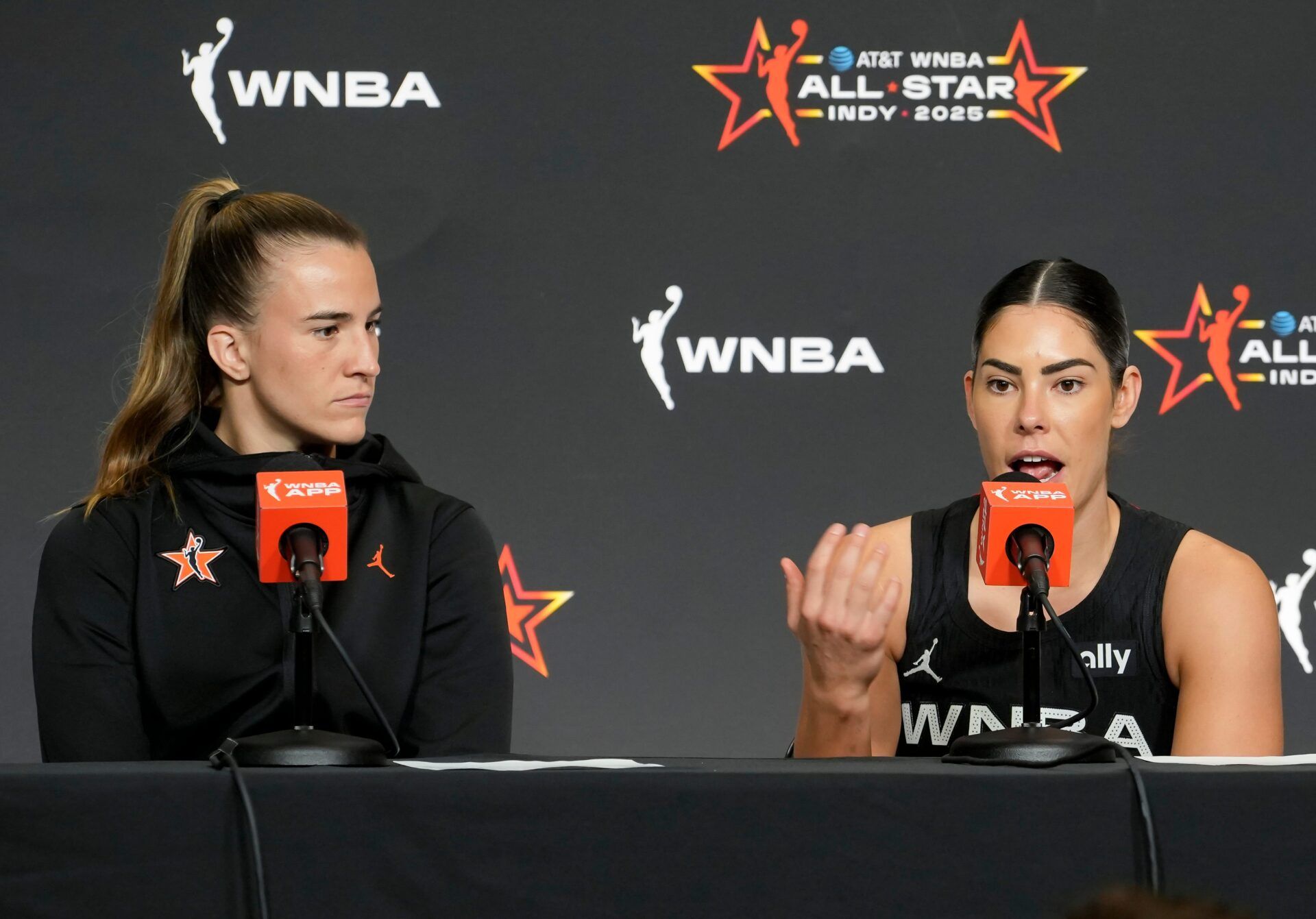
Indiana’s own Kelsey Mitchell, who led Team Clark in scoring, spoke clearly about the message behind the shirts:
“I think the statement spoke for itself. There’s no disrespect to me ever. And just wanna make sure, that this thing is made clear about we as players have grown and deserve. It was less about trying to make a statement, more about you gotta make sure this statement is clear and good.”
I asked Kelsey Mitchell why the players wore “Pay us what you owe us” shirts tonight.
Mitchell says it wasn’t to make a statement, but to make sure the message was clear. pic.twitter.com/fny6I5SfIQ
— Meghan L. Hall (@ItsMeghanLHall) July 20, 2025
Taking the message to center stage, Napheesa Collier, fresh off a game-high 36-point performance, spoke without filters about who drives the WNBA’s success. In her view, the league’s growth ties directly to the athletes, and their demands aren’t just reasonable but overdue.
“The players is what is making this brand and league. There is no league without the players… we feel like we are owed a piece of that pie that we helped create.”
She then acknowledged the strength around her, signaling a unified front determined to hold their ground.
“I see a bunch of strong women who aren’t going to back down from what they want.”
“The players is what is making this brand and league. There is no league without the players…we feel like we are owed a piece of that pie that we helped create.”
– Napheesa Collier on the pregame shirts
— christan (no i), ß (@ChristanWNBA) July 20, 2025
Veteran guard Kelsey Plum also weighed in on the moment’s power and how the union is approaching negotiations:
“The mission was accomplished because we built an incredible amount of awareness this weekend. Continuing to have our foot on the gas… we’re in a negotiation. We’re being unified in what we want.”
“The mission was accomplished because we built an incredible amount of awareness this weekend. Continuing to have our foot on the gas…we’re in a negotiation. We’re being unified in what we want.”
– K. Plum on keeping CBA talks/players fighting for what they deserve in the open
— christan (no i), ß (@ChristanWNBA) July 20, 2025
She later revealed that the T-shirt protest, though unified in execution, was largely a last-minute decision. Not all players were initially in the loop.
“It was a very powerful moment. As players, we didn’t know that that was going to happen. It was a genuine surprise. The T-shirt was determined this morning,” as Sabrina Ionescu nodded beside her. “Not to tattletale: zero members of Team Clark were very present for that,” she added.
KP: “It was a very powerful moment. As players, we didn’t know that that was going to happen. It was a genuine surprise. The t shirt was determined this morning. Not to tattletale: 0 members of Team Clark were very present for that” https://t.co/2fXgaAuqMR pic.twitter.com/awIfnqLjxv
— Oh No He Didn’t (@ohnohedidnt24) July 20, 2025
The CBA isn’t the only item on the WNBA’s expanding agenda. Just weeks ago, the league announced three new expansion teams: Cleveland, Detroit, and Philadelphia. Each team enters at a record $250 million price tag. Plus, a massive new $2.2 billion media deal set to begin in 2025-26 only raises the stakes.
Yet despite this influx of money, WNBA players are still fighting for a larger cut of the revenue they generate. That’s where the tension lies between the players and the league as they push for a fairer slice of the growing pie.
Right now, the numbers tell their own story. A WNBA supermax player earns just under $250,000 per season. The minimum salary for veterans hovers around $78,000. For comparison, each All-Star in Saturday’s game took home $2,575, with the MVP earning a modest $5,150.
So while the game delivered fireworks on the court, the most lasting image may be what happened before tipoff. Players from both sides stood united, not just for show, but for something more lasting.
The parallels to 1964 are striking. That year, NBA players threatened to boycott the All-Star Game unless their union was recognized. With players refusing to take the court, the NBA gave in minutes before tipoff, agreeing to recognize the union and grant key benefits.
It was a game-changing move that reshaped the league. Now, WNBA players are hoping their united front delivers the same kind of breakthrough.
