
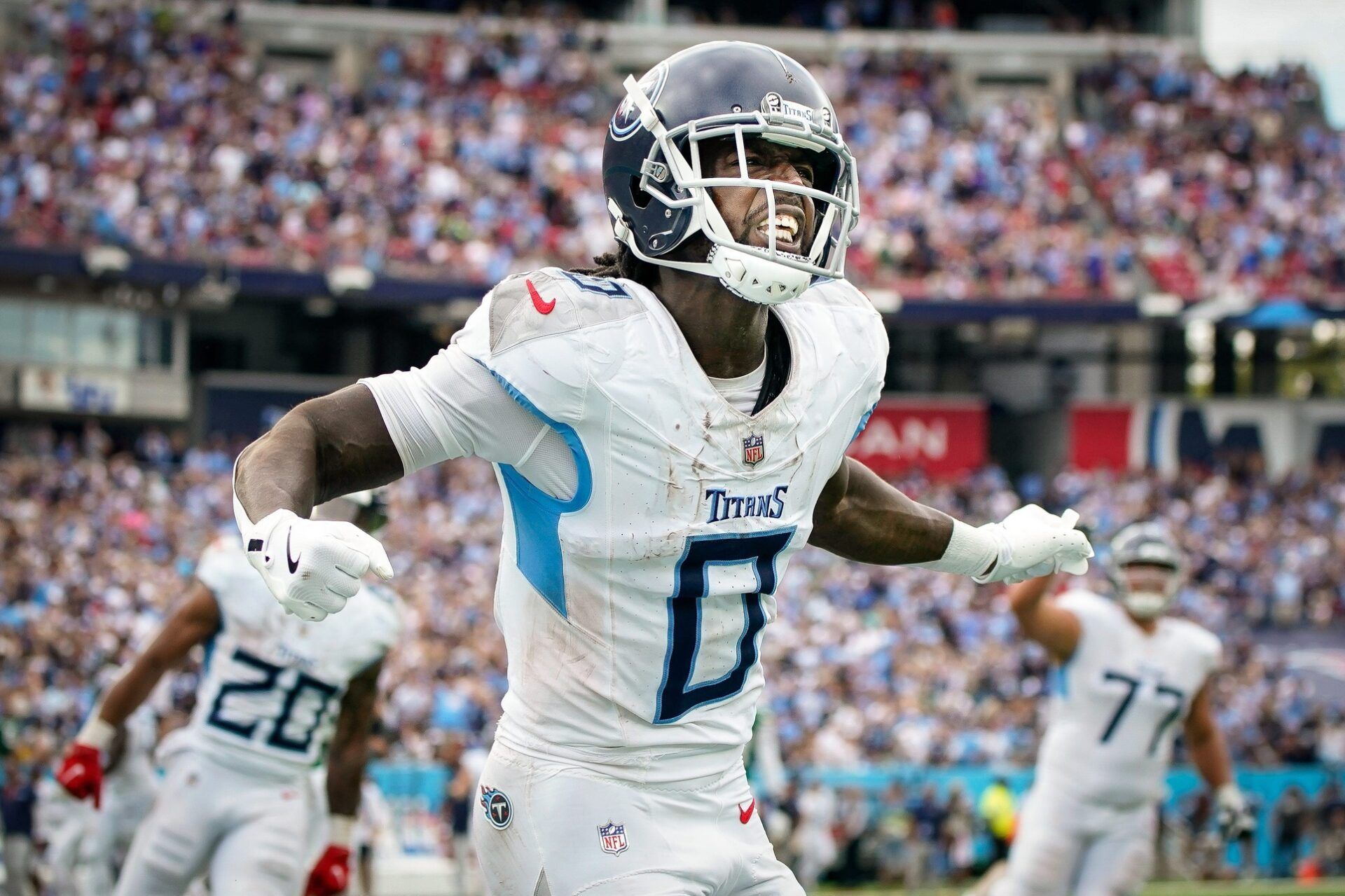
Tennessee Titans wideout Calvin Ridley enters the 2025 fantasy football season in a curious spot. Despite posting consecutive 1,000-yard campaigns and offering clear mid-round value, growing skepticism among fantasy managers has sparked a noticeable uptick in trade discussions.
Let’s examine why savvy fantasy managers might be looking to move on from the 30-year-old wideout.
The Trade Away Trend: A Warning Sign
The most telling indicator of fantasy sentiment comes directly from PFSN trade analyzer data. Ridley has been shipped off in 58.3% of deals involving him among PFSN users, representing the sixth highest rate among receivers this summer. The high trade-away rate signals clear buyer’s remorse, indicating that many fantasy managers who once saw Ridley as a solid investment are now seriously rethinking his long-term value.
When a player ranks sixth among all wide receivers in trade-away rate, it signals that the fantasy community has identified legitimate concerns that extend beyond typical draft-day fluctuations. This level of selling activity also indicates that managers are actively seeking to move Ridley before potential issues manifest during the season.
The Rookie Quarterback Conundrum
One of the biggest red flags for Ridley’s 2025 fantasy outlook is his reliance on rookie quarterback Cam Ward. While recent outliers like C.J. Stroud and Jayden Daniels have proven that first-year quarterbacks can make an immediate impact, history suggests that rookie quarterbacks often struggle to elevate top-tier fantasy receivers consistently.
Even when rookie quarterbacks perform well overall, they often experience growing pains and inconsistencies that can impact their receivers’ fantasy production throughout the season. This concern is particularly relevant given Ridley’s current draft position.
According to our free Fantasy Football Mock Draft Simulator, Ridley is being drafted as a starter in most leagues, typically going in Round 5. A slow start from Ward could make Ridley a scary weekly lineup decision for fantasy managers who invested significant draft capital in him.
Calvin Ridley pic.twitter.com/Y3YAEf2mIs
— Ian Hartitz (@Ihartitz) March 18, 2025
The transition to Ward represents both opportunity and risk. While the rookie showed promise at Miami with 39 touchdown passes and a 67% completion rate, the NFL presents a significantly different challenge.
As Titans coach Brian Callahan noted, Ward is still learning that “defenders in the NFL will diagnose and react much faster at this level.” That expected learning curve has clearly spooked some Ridley owners heading into the 2025 season.
The Red Zone Reality Check
Ridley’s two biggest fantasy seasons were directly tied to touchdown equity, as he led the league in end zone targets in both 2020 and 2023. The 2023 season was especially awe-inspiring, with Ridley receiving 25 end zone targets while playing for Jacksonville — the most among all wide receivers that season.
However, the 2024 season told a different story. After moving to Tennessee, Ridley’s end zone targets plummeted to just four for the entire season, ranking him 69th among wide receivers. This dramatic drop from first to 69th in end zone targets directly correlated with his touchdown production falling from 8 in 2023 to just 4 in 2024, resulting in him averaging a disappointing 11.7 fantasy points per game.
The concerning trend becomes even more pronounced when examining Ward’s collegiate performance in the red zone. The rookie quarterback completed just 39% of his red zone passes at the collegiate level in 2024 — a troubling statistic for a receiver whose fantasy value has historically been tied to scoring opportunities.
Suppose Ridley struggles with both quality and volume in scoring opportunities. In that case, his chances of falling outside the top 40 wide receivers become far more realistic than meeting the top-24 expectations typically tied to a Round 5 fantasy pick.
The Bigger Picture
While Ridley remains the undisputed No. 1 receiver for Tennessee and should see increased target volume with Ward’s aggressive downfield approach, the underlying concerns are legitimate. At 30 years old, Ridley is entering the twilight of his career, and his fantasy value has become increasingly dependent on touchdown production rather than consistent yardage accumulation.
The combination of a rookie quarterback with concerns about red zone accuracy, Ridley’s age-related decline in athleticism, and his historical dependence on touchdown equity creates a perfect storm of risk factors that may lead fantasy managers to consider trading away the veteran receiver.
For those considering moving Ridley, the time to act may be now, before potential early-season struggles with Ward diminish his trade value further. While he could certainly outperform expectations if Ward develops quickly, the risk-reward profile suggests that fantasy managers might be wise to seek more stable options for their starting lineups.
