
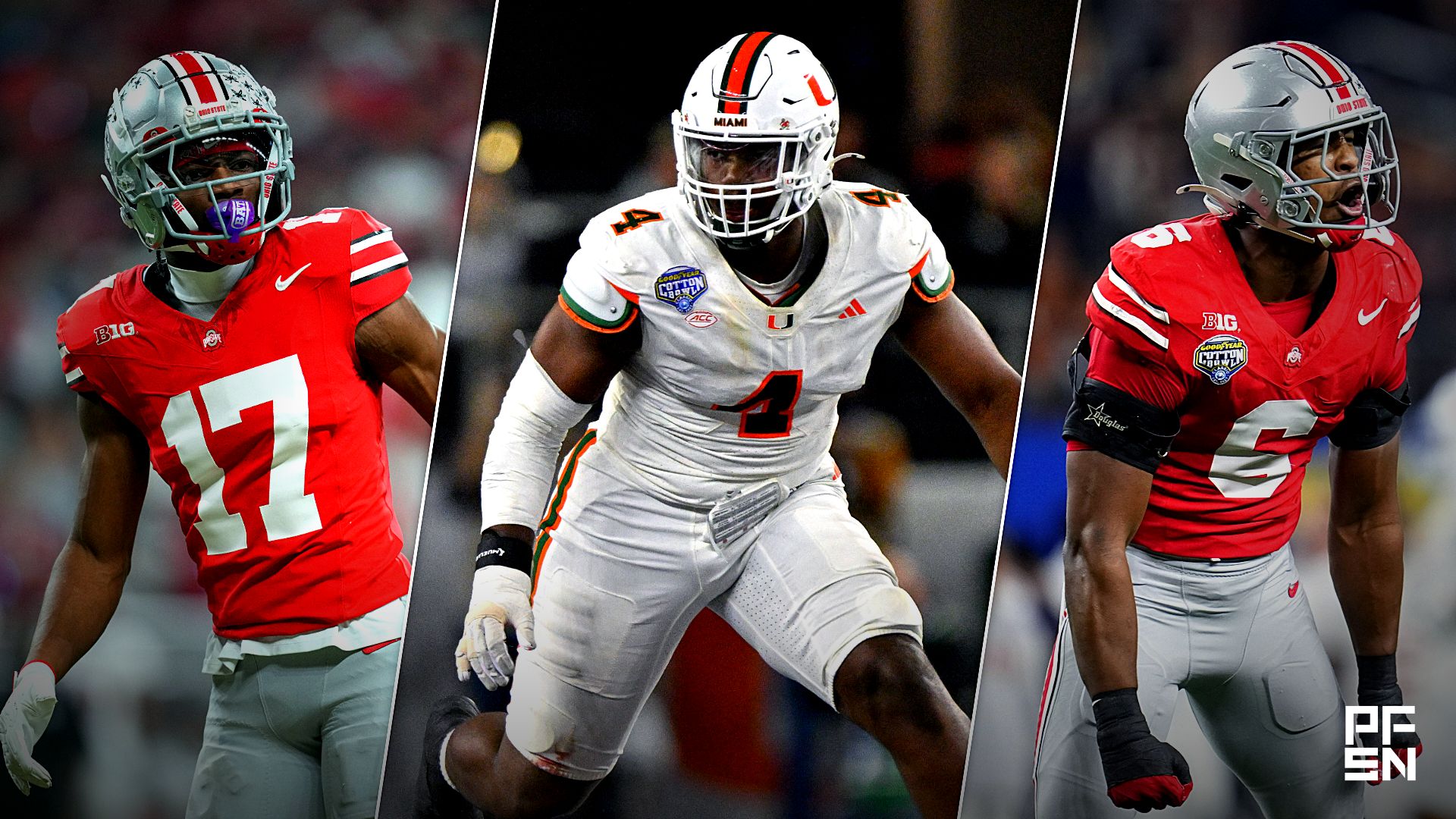
The 2026 NFL Draft is just days away, which means pro days are over and teams are putting the finishing touches on their evaluations and finalizing their big board.
This is the time of year when names start gaining real traction. You’ll start to hear a lot more noise (some real, some not) as smokescreen season ramps up during draft week.
Using PFSN’s Mock Draft Simulator, this mock looks at how all 32 teams could attack Rounds 1-3, factoring in team needs, player values, and recent momentum from the pre-draft process.
1) Las Vegas Raiders
Fernando Mendoza, Indiana | QB
Fernando Mendoza hasn’t moved off this slot in quite some time, and that won’t change now. After doing little in the pre-draft process due to an extended season and a national championship (and, quite frankly, not having to), his pro day only reaffirmed everything that was known about him. He showed great accuracy, arm strength, and moxie while being back around his teammates.
The Las Vegas Raiders are still trying to stabilize their post-Oakland identity, and this is the type of culture-setting pick that can reset everything. Mendoza may not have a rocket arm, but his game is rooted in precision, anticipation, and poise. He wins with timing and ball placement at all three levels with a game reminiscent of Matt Ryan. At 6-foot-5 with prototypical size and mature command of the huddle, he gives Las Vegas a steadying presence.
Pair him with new head coach Klint Kubiak, and this could be a match made in heaven for Mendoza’s development curve with Kubiak’s run-centric play-calling style. Clean up the tendency to hold the ball too long, and the Raiders may finally have their long-term answer under center.
2) New York Jets
Arvell Reese, Ohio State | LB/EDGE
The New York Jets might need a quarterback down the line, but 2027 feels more realistic when they have three first-round picks. There’s no clear franchise passer at No. 2, so instead of reaching, New York goes with the best player available: a defensive weapon who can do it all in Arvell Reese.
Reese only started for one season at Ohio State, but he made it count. With 10 tackles for loss, 6.5 sacks, and consensus All-American honors, he left his mark immediately.
A 6-foot-4, 241-pound linebacker running a 4.46 40-yard dash? That’s explosive. Reese pairs speed with power; he can shed blocks in the run game, turn the edge into a wrecking ball, and convert momentum into force on the blitz.
With the Jets’ defense slipping last season, he’s an instant cornerstone. His pass-rush moves need polish, but scouts see flashes reminiscent of Micah Parsons. Versatile, violent at the point of attack, and capable of reshaping the defense, Reese is exactly the kind of foundation piece New York can’t pass up.
3) Arizona Cardinals
David Bailey, Texas Tech | EDGE
Since there’s no projected trades in this mock draft, the Arizona Cardinals go with the BPA approach and get this defensive disruptor in David Bailey, one of the most explosive edge rushers in the country. In 2025, Bailey racked up 19.5 tackles for loss, including 14.5 sacks, earning the top PFSN CFB EDGE Impact Score in the nation (92.9).
At 6-foot-3, 250 pounds, he’s twitchy off the edge, with a first step that can shake any blocker, and the power to finish. A little hip tightness showed in drills, but his motor and bend make him a nightmare for OCs. He is arguably the best pure pass rusher in the entire class while also displaying enough untapped potential to really amplify how great he can be.
4) Tennessee Titans
Jeremiyah Love, Notre Dame | RB
The Tennessee Titans add Jeremiyah Love after not having either of the top edge rushers on the board fall to them. Love is a physical and versatile back who can run between the tackles, bounce outside, and contribute as a true receiver out of the backfield or even split out wide. A Heisman finalist, he brings the kind of burst and all-around athleticism that can shift momentum on any given play.
With second-year QB Cam Ward under center and struggling in year 1, Love becomes more than just a weapon; he’s a safety blanket. Whether it’s check-downs, screens, or quick outlet passes, Love gives Ward a reliable option when plays break down. His presence helps simplify reads and keeps the offense on schedule. Love also plays a key role in unlocking Ward’s full potential.
A strong run game will force defenses to respect play action, while opening up easier throwing lanes for the passing attack and taking pressure off the young quarterback as he still gets his feet under him. Defenses will have to account for Love on every snap, which creates more favorable looks for Ward in the passing game.
5) New York Giants
Sonny Styles, Ohio State | LB
The New York Giants add a dynamic defensive playmaker in Sonny Styles, whose stock skyrocketed after a phenomenal NFL Scouting Combine showing.
At the Combine, he turned heads with a 43 1/2-inch vertical, 4.46 40-yard dash, and an 11-foot-2 broad jump, elite numbers for any linebacker. He also displayed fluidity and range in position drills, confirming the athletic ceiling scouts had projected.
Styles brings speed, versatility, and sideline-to-sideline range to the Giants’ defense. He can cover tight ends, make plays in space, and impact the game in multiple ways, a perfect fit for a team looking to rebuild a dynamic defense.
Coach John Harbaugh knows how important a great defense is, and he won’t chase draft picks; he’ll take the best player available to keep stacking the roster.
6) Cleveland Browns
Francis Mauigoa, Miami (FL) | OT
The Cleveland Browns stay in the trenches and lock down the right side of their offensive line with Francis Mauigoa, one of the most physical blockers in the entire draft.
At 6-foot-6, 335 pounds, he’s a true mauler. This is a tone-setting type of lineman who wants to move people, not just wall them off. For a Browns team that’s looking to lean even more on a physical run game, adding a player like this just fits.
At Miami, Mauigoa showed he can handle power and dish it right back. He anchors well in pass protection, shuts down bull rushes, and in the run game, he’s constantly looking to finish blocks and put defenders on the ground. That edge shows up snap after snap.
Cleveland’s priority here is simple: protect the quarterback and get back to controlling games up front. Mauigoa helps solidify that right side immediately and gives them a long-term piece who can set the tone for how they want to play.
7) Washington Commanders
Caleb Downs, Ohio State | S
Head coach Dan Quinn gets a cornerstone piece for his defense in Caleb Downs and possibly the smartest player on the entire team from day 1.
Downs may have slid slightly on draft boards based on where some teams have him ranked among overall players, but Washington won’t hesitate to scoop up a true field general. At 6-foot-0, 205 pounds, he’s fluid, instinctive, and thrives both near the box and in coverage. His ability to process routes quickly and close passing windows gives this secondary a much-needed stabilizer.
For a defense that had issues in coverage and consistency, Downs brings a physical presence and high football IQ, a true “glue guy” who can help tie everything together on the back end. Under Quinn, who values versatility and discipline, Downs fits exactly the mold of a tone-setting defender.
8) New Orleans Saints
Carnell Tate, Ohio State | WR
With most of the top defensive talent already gone, the New Orleans Saints pivot and go offense, adding Carnell Tate to pair with Chris Olave and give Tyler Shough more to work with as they evaluate him as a long-term answer.
Tate brings the profile of a true outside receiver: 6-foot-3, strong at the catch point, and comfortable winning through contact. Even in a loaded receiver room at Ohio State, he found ways to stand out, consistently handling one-on-one matchups and showing he can produce against top competition.
For New Orleans, this is about building a clearer picture of what they have at quarterback. Tate’s ability to high-point the ball, shield defenders, and come down with contested catches gives Shough a bigger margin for error, especially on throws outside the numbers. Alongside Olave’s route-running and explosiveness, Tate adds a different dimension to the passing game. If the Saints are serious about figuring out whether Shough is their guy, this is the kind of move that helps them find out quickly.
9) Kansas City Chiefs
Mansoor Delane, LSU | CB
After moving Trent McDuffie to the Rams, the Chiefs address a glaring need in the secondary by grabbing one of the top pure corners in the class. Mansoor Delane finished 2025 with a PFSN CFB CB Impact score of 97, the best in the nation, and consistently locked down opposing WR1s in the SEC.
Kansas City faces elite receivers in the AFC West, and Delane gives them a true lockdown option. He reads routes quickly, anticipates breaks, and plays downhill against the run. His mix of instincts, athleticism, and polished technique allows him to shadow top receivers without constant safety help.
For a secondary suddenly in transition, Delane provides both immediate impact and long-term stability, exactly what the Chiefs need to keep building around Patrick Mahomes and get back to competing for championships.
10) Cincinnati Bengals
Rueben Bain Jr., Miami | EDGE
The Cincinnati Bengals go defense here, adding Rueben Bain Jr., and it’s a move that feels overdue. For the past few seasons, Cincinnati has rolled out one of the league’s most dangerous offenses, led by Joe Burrow, but it hasn’t translated into the playoff success they’re chasing. At some point, you have to get stops. You can’t keep wasting Burrow’s prime trying to win shootouts every week.
Bain brings exactly what this defense has been missing: a natural pass rusher with some real juice and power off the edge. At 6-foot-3 with 20.5 career sacks, he wins with burst, bend, and a nonstop motor. He’s the kind of player who can disrupt timing, force quarterbacks off their spot, and change the tone of a drive.
There are some questions about his arm length that could cause some concern, but his first step and explosiveness pop immediately on tape. He gets into tackles quickly, plays through contact, and doesn’t take snaps off. For a Bengals defense that’s lacked consistency and a true edge presence, Bain gives them a piece they can start building around right away.
11) Miami Dolphins
Makai Lemon, USC | WR
After parting ways with Tyreek Hill in free agency and trading Jaylen Waddle to the Denver Broncos, Miami’s need for a top-tier receiver couldn’t be clearer, making Makai Lemon the perfect fit. At 5-foot-11, 195 pounds, he’s precise with his routes, has excellent body control, and can turn speed into explosive plays after the catch.
In 2025, Lemon caught 79 passes for 1,156 yards and 11 touchdowns, earning the Biletnikoff Award. He’s reliable in contested catches, rarely drops the ball, and consistently makes plays in tight windows.
For a Dolphins offense suddenly short on weapons, Lemon gives them an immediate slot weapon who can stretch the field, create separation, and help the passing game regain its edge. Coach Jeff Hafley needs to surround new QB Malik Willis with some talent to get a real evaluation, and this starts that process.
12) Dallas Cowboys
Dillon Thieneman, Oregon | S
The Dallas Cowboys land one of the biggest risers in the draft with the selection of Dillon Thieneman, a safety who checked every box and more during an impressive showing at the NFL Scouting Combine.
Thieneman tested exactly how scouts hoped he would: fast, athletic, and fluid, confirming the range and movement skills that show up on film. His performance in Indianapolis had evaluators heading back to the tape, where they saw a complete football player who consistently plays with instincts, toughness, and high-level technique.
Before transferring to Oregon to play under head coach Dan Lanning, Thieneman was already a standout at Purdue, just hidden behind the losses. At Oregon, he took another step forward, refining his game in a pro-style defensive system. He’s known for taking sharp pursuit angles, finishing tackles with authority, and consistently being around the football.
For Dallas, Thieneman brings instincts, physicality, and reliability to the back end of the defense. After his Combine breakout, he’s the type of prospect many teams will be hoping somehow falls to them, but the Cowboys make sure he doesn’t.
13) Los Angeles Rams (via Falcons)
Spencer Fano, Utah | OT
Spencer Fano fits the mold of a trench cornerstone, and that is much needed for this Rams team with Matthew Stafford running it back for at least one more year. Rated as the No. 1 offensive tackle on several consensus boards, Fano offers rare explosiveness and power at 6-foot-5 and 304 pounds.
Especially after the trade for corner Trent McDuffie, offensive tackle could be the Rams’ biggest need. Some may want receiver here with the Puka Nacua news, but there are plenty of receivers later on to highlight for LA.
His acceleration off the snap and ability to displace defenders in the run game jump off the tape. He plays with a combative, finishing mentality and thrives climbing to the second level. While his pass-protection anchor and foot placement continue to improve, the trajectory is promising. Los Angeles fortifies its offensive line with a tone-setting presence who can protect the quarterback and reestablish physicality in the run game.
14) Baltimore Ravens
Olaivavega Ioane, Penn State | OG
With Tyler Linderbaum now in Las Vegas, Baltimore’s interior offensive line suddenly became a pressing concern. The Ravens respond by selecting Olaivavega Ioane, a 6-foot-4, 330-pound mauler from Penn State.
Ioane isn’t flashy, but he’s powerful, technically sound, and built to anchor the middle of the line. At his pro day, he impressed Ravens scouts, underscoring the team’s serious interest in him as they look to continue dominating the ground game.
For a team that prides itself on physicality up front, Ioane brings immediate toughness and reliability, helping protect the quarterback and create lanes for Baltimore’s rushing attack.
15) Tampa Bay Buccaneers
Kenyon Sadiq, Oregon | TE
Tampa Bay has poured resources into its offensive weapons over the last few years, but the depth chart isn’t as secure as it once looked. With Mike Evans now gone and Chris Godwin Jr. dealing with ongoing injury concerns, not to mention a looming decision on his future after the season since he has no guaranteed money beyond this year, the room suddenly feels thinner than expected. If the Buccaneers want to keep Baker Mayfield supported, adding another dynamic pass-catcher makes a lot of sense.
Kenyon Sadiq brings that kind of upside. At 6-foot-3 and nearly 250 pounds, he’s a rare athlete at the position, combining strength with legitimate vertical speed. He broke out as Oregon’s top tight end, hauling in 51 catches and eight touchdowns, leading all tight ends in college football in scoring. He’s not just a possession target either, he can stretch the seam, create mismatches against linebackers and safeties, and turn short catches into chunk plays.
Tampa Bay can use him in a lot of ways right away, but the bigger picture is what makes this pick interesting. Pairing Sadiq with Emeka Egbuka gives the Buccaneers a fresh, explosive duo to grow with Mayfield. It’s a shift toward a new era offensively, one built on speed, versatility, and matchup problems. With questions surrounding the current receiver room, Sadiq isn’t just a luxury pick; he’s a forward-looking move that helps stabilize the offense now while setting up a new foundation for the future.
16) New York Jets (via Colts)
Jordyn Tyson, Arizona State | WR
Jordyn Tyson entered the draft cycle as many evaluators’ WR1, and the New York Jets will gladly scoop him up after sliding a little bit due to injury concerns. At 6-foot-1 and 195 pounds, Tyson blends size and route fluidity with effortless acceleration.
He separates with sharp footwork and elastic movement, but he also plays through contact and wins after the catch. He didn’t work out at the Combine or his pro day, but that shouldn’t affect his draft stock all that much, especially considering he’s a true difference-maker when healthy.
With a roster full of needs and a need to pair another weapon with Garrett Wilson, Tyson gives New York another dynamic complement who can operate at all three levels to take pressure off whoever ends up being under center. He’s explosive, refined, and quarterback-friendly, a necessary addition for an offense looking to find consistency.
17) Detroit Lions
Monroe Freeling, Georgia | OT
Detroit looks to reassert its dominance in the trenches and get back to a ground-heavy identity by selecting Monroe Freeling, an offensive tackle who impressed across the board at the NFL Scouting Combine. His strong showing in Indianapolis only reinforced his status as a foundation-level prospect.
At nearly 6-foot-7 with an 84-inch wingspan, Freeling pairs elite length with impressive athleticism. He offers quickness off the snap, fluid pass sets, and solid run-blocking ability, making him a versatile piece up front.
Initially, the Lions can slot him where the line needs him most, with the potential to develop into the long-term replacement for stud right tackle Taylor Decker. Freeling brings the size, movement skills, and upside Detroit needs to protect the quarterback, anchor the run game, and help establish a physical identity in the trenches for years to come.
18) Minnesota Vikings
Keldric Faulk, Auburn | EDGE
Minnesota focuses on building its defense, adding a potential big upside pick in Keldric Faulk. A physical defender who sets the edge against the run and collapses pockets with power, Faulk forces offenses to account for him with chip-and-slide protections, creating favorable matchups across the front.
Coach Kevin O’Connell knows to let the draft fall to him at this point in his career. Minnesota doesn’t have many needs on offense outside of QB, but they signed Kyler Murray to compete with J.J. McCarthy and can address other areas on that side of the ball throughout the draft as roster depth picks.
19) Carolina Panthers
Emmanuel McNeil-Warren, Toledo | S
The Carolina Panthers continue to bolster their defense by addressing the secondary, bringing in Emmanuel McNeil-Warren to fill a clear need at safety after already boosting the edge with the Jaelan Phillips signing in free agency.
McNeil-Warren has the kind of size you look for on the back end: over 6-foot-3, 209 pounds with long arms, and he moves a lot better than you’d expect for someone built like that. He’s quick, explosive laterally, and plays with a physical edge that shows up both against the run and in coverage. He’s especially effective coming downhill, where his closing burst really stands out, but he’s not just a box safety. He’s shown he can handle short and intermediate zones comfortably, staying smooth and under control in space.
For Carolina, this is about continuing to build a balanced defense. They’ve added help up front, and now they’re making sure the back end can hold up too. McNeil-Warren gives them a versatile piece who can contribute early and help stabilize the secondary.
20) Dallas Cowboys (via Packers)
Jermod McCoy, Tennessee | CB
Despite missing all of 2025 with a torn ACL, Jermod McCoy still feels like a Round-1 talent. At 5-foot-11, 188 pounds, he’s not the biggest corner, but he competes, finds the ball, and has the kind of recovery speed teams look for on the outside.
For the Cowboys, this is about getting younger and more reliable in the secondary. They’ve made it pretty clear the focus is shifting back to the defense, and adding a corner like McCoy fits that direction. There’s risk coming off the injury, no question, and he’ll need to keep adding strength to deal with bigger receivers. More questions have come up following his pro day; he did run very well, but concerns popped up when it came to agility drills, as he didn’t look fully comfortable still with change of direction.
But if he’s healthy, this is the kind of upside swing that makes sense. The tools, instincts, and competitiveness are all there, and Dallas could use more of that on the back end.
21) Pittsburgh Steelers
Kadyn Proctor, Alabama | OT
The Pittsburgh Steelers go back to what they’ve always been about here: getting tougher up front. Kadyn Proctor out of Alabama fits that identity to a tee. At 6-foot-7, 360 pounds, he’s a massive presence who plays with real power and isn’t afraid to lean on defenders.
For new head coach Mike McCarthy and this team, it’s about setting a tone again.
The offensive line has been up and down, and adding someone like Proctor gives them a chance to be more consistent and more physical week to week. He’s not a finesse player, he’s the kind of lineman who wants to move people and wear defenses down. And for a team that still wants to run the ball and control games, that’s exactly the kind of piece that makes sense.
22) Los Angeles Chargers
Malachi Lawrence, UCF | EDGE
The Los Angeles Chargers look to the future of their pass rush by selecting Malachi Lawrence, a player who could eventually step in as a Khalil Mack replacement when the veteran decides to hang up his cleats.
Lawrence had a breakout 2025 season, recording 7 sacks and a career-high 11 tackles for loss, while posting a strong 78.3 PFSN EDGE Impact grade. His 13.2% dropback pressure rate ranked near the top 10 nationally, highlighting his ability to consistently disrupt opposing quarterbacks.
At 6-foot-4, 270 pounds with 33 1/2-inch arms, he combines solid size with outstanding functional athleticism. Explosive off the snap, Lawrence pairs lateral agility with the power to shed blockers, giving the Chargers a versatile edge rusher who can contribute immediately and develop into a cornerstone of their defense.
23) Philadelphia Eagles
Max Iheanachor, Arizona State | OT
The Philadelphia Eagles have built their identity around the trenches, but even the best offensive lines don’t stay dominant forever. With questions starting to creep in, especially with Lane Johnson getting closer to the back end of his career, there’s a real need to start thinking about depth and the future at tackle. That urgency showed up last season, too, when the line wasn’t quite as sharp and the run game took a noticeable hit.
Max Iheanachor fits the kind of move that makes sense here. Originally from Nigeria and still relatively new to football, he’s developed quickly and forced his way into first-round conversations. At 6-foot-6, 330 pounds, with long arms and natural power, he looks the part right away. The physical upside is hard to miss, and it’s exactly the kind of foundation the Eagles like to work with.
He’s not a polished, plug-and-play prospect yet; there’s some rawness in his technique and consistency, but Philadelphia doesn’t need him to be perfect immediately. What they need is depth now and a plan for later. Iheanachor can come in, compete, and develop behind veterans while giving them insurance at a critical spot.
24) Cleveland Browns (via Jaguars)
Omar Cooper Jr., Indiana | WR
Scouts have been tracking Omar Cooper Jr. since midseason, and he’s done nothing but build momentum after getting more run as the go-to target after Elijah Sarratt went down. He finished the year strong and is now widely regarded as the top receiver coming out of Indiana.
For the Cleveland Browns, this is about adding another reliable weapon to the offense that desperately needs it. No matter how things shake out at quarterback, they need more consistency and physicality at receiver. Cooper brings that. He’s a strong, controlled route runner who handles contact well and stays on time. His athleticism surprised some, running a 4.42 40-yard dash that all but confirmed his Round-1 status.
Dropping him into a group alongside Jerry Jeudy would give Cleveland a solid one-two combination. They win in different ways, but they complement each other and give the offense a better chance to stay balanced and efficient.
25) Chicago Bears
Zion Young, Missouri | EDGE
The Chicago Bears look to keep building out their defense here, adding more pass-rushing presence after a 2025 season in which the defensive unit as a whole showed flashes of being opportunistic and turning the ball over, but not enough consistent disruption down to down. The reality is that style of defense can only carry so far if offenses are able to move the ball at will.
Zion Young gives them a swing at exactly the kind of edge talent they’re missing. He’s been part of a strong Missouri pipeline of edge rushers but might’ve been forgotten about. In 2025, he put up 6.5 sacks, 16.5 tackles for loss, and forced two fumbles, showing steady growth in production against SEC competition.
At around 6’5″, 255 pounds with 33-plus inch arms, Young has the kind of frame that stands out and translates to the edge of the line to keep those big tackles off him. There’s legit burst in his game, and when he’s on the attack in true pass-rushing situations, you see the length and power show up at contact. He can convert speed to power and uses his hands well enough to create disruption when he times things right.
For Chicago, this is about raising the ceiling of the defense. They’ve seen what happens when the pass rush is inconsistent, and adding another edge who can win one-on-one reps helps change that. Young isn’t a finished product, but in this range, the Bears take the bet on traits, upside, and a pass rusher who could grow into a real difference-maker off the edge.
26) Buffalo Bills
KC Concepcion, Texas A&M | WR
The Buffalo Bills continue to load up Josh Allen’s offense with playmakers. Even after trading for DJ Moore this offseason, they add another receiver to maximize his weapons. Speed and explosiveness are the name of the game.
KC Concepcion is electric in space at 5-foot-11, 187 pounds, turning short catches into long gains and creating mismatches anywhere on the field. He’s quick, slippery, and dynamic, perfect for screens, jet motions, or taking the top off a defense.
For Buffalo, Concepcion is a weapon who stretches defenses and complements Allen’s existing targets. Adding him gives the Bills even more vertical juice and big-play potential, keeping the offense fast, explosive, and hard to cover.
27) San Francisco 49ers
Caleb Lomu, Utah | OT
The San Francisco 49ers stay true to their formula here, investing in the offensive line by selecting Caleb Lomu to keep things steady up front. At 6-foot-5, 302 pounds, Lomu brings a really intriguing mix of athleticism and length. During his time at Utah, he showed quick feet, easy movement in space, and the ability to stay in front of edge rushers. These are traits that fit well in San Francisco’s scheme, where linemen are asked to move and block at the second level more frequently.
He’s a bit lighter than some tackles, but he makes up for it with balance, flexibility, and solid technique in pass protection. He can recover when he gets beat early and does a good job staying under control against both speed and power.
For the 49ers, this is about keeping the offense running smoothly and preparing for the now while also thinking about life after Trent Williams retires. Whether it’s protecting the quarterback or opening lanes in the run game, adding a player like Lomu gives them another dependable piece in a system that relies heavily on its offensive line doing a little bit of everything.
28) Houston Texans
Peter Woods, Clemson | DT
The Houston Texans look to keep their defense playing at a high level by adding more talent up front, even after the extra strides they made last season by becoming one of the most feared units in all of football. For DeMeco Ryans, it’s all about maintaining that edge and continuing to build a unit that can compete with the best in the league.
Peter Woods fits right into that vision. At 6-foot-3, 315 pounds, he brings strength, leverage, and the kind of versatility Ryans values along the defensive line. His 2025 season had some inconsistencies, but the flashes are hard to ignore, especially his ability to move and disrupt from different alignments during his time at Clemson.
Ryans sees the upside here and trusts his staff to develop it. He’s gotten a lot out of his defensive front already, and Woods gives him another piece with real potential to mold. With the right coaching, there’s a path for him to become a consistent difference-maker. Woods adds depth and physicality inside, someone who can help collapse the pocket and keep quarterbacks uncomfortable.
29) Kansas City Chiefs (via Rams)
Akheem Mesidor, Miami (FL) | EDGE
Kansas City doesn’t draft with a long runway in mind, they draft to stay on top. When you’re competing for division titles every year and making deep playoff runs, the focus shifts toward players who can contribute right away. That’s what makes this fit with Akheem Mesidor make sense.
Mesidor brings a more polished game than most prospects in this range. At 25 years old, he’s older than your typical rookie, but that also shows up in how refined his play is. He understands leverage, plays with consistent effort, and has the versatility to line up both on the edge and kick inside in certain packages. That kind of flexibility is valuable in a defense that likes to mix looks and keep offenses guessing.
For the Chiefs, this is about adding to a rotation that can’t afford to wait on development. They need players who can step in early and hold their own, especially up front where pressure can make life easier on the backend. Mesidor fits that timeline and can make an immediate impact.
30) Miami Dolphins (via Denver Broncos)
T.J. Parker, Clemson | EDGE
Miami is one of the few teams in a position to take a real swing. With a stockpile of draft capital and a roster that already has established pieces, they don’t have to play it safe with every pick. That flexibility opens the door to betting on upside, and that’s exactly what this move with T.J. Parker represents.
Not long ago, Parker was viewed as a potential top-10 selection. The tools are obvious: burst off the edge, the ability to bend and flatten to the quarterback, and the kind of explosiveness that can change a pass rush. His stock dipped after an inconsistent season, but the flashes never disappeared, and his Senior Bowl showing reminded teams why he was so highly regarded in the first place.
For the Dolphins, this is about trusting their ability to develop talent while taking advantage of their draft capital. They can afford to be patient and let Parker grow into his role, rather than needing him to carry the load immediately.
31) New England Patriots
Blake Miller, Clemson | OT
After Will Campbell struggled at times this past season, the New England Patriots aren’t looking to replace him, but they do want to add value and versatility along the line. Blake Miller can play multiple spots if the Patriots need to shuffle positions.
A four-year starter for Clemson football with nearly 4,000 snaps, Miller brings polish and maturity at 6-foot-6, 315 pounds. He’s the type of player who can help stabilize a line, giving a quarterback like Drake Maye the clean pockets he thrived in last year.
For New England, this pick is about depth, flexibility, and long-term upside, keeping the offensive line strong and adaptable while protecting the QB and maintaining continuity up front.
32) Seattle Seahawks
Avieon Terrell, Clemson | CB
The Seattle Seahawks had a big hole to fill after losing Tariq Woolen in free agency, and they made sure not to let the draft pass them by. They scoop up Avieon Terrell to help keep their defense elite.
At 5-foot-11, 180 pounds, Terrell might be a bit undersized, but his production speaks for itself: 21 pass breakups and 8 forced fumbles over the past two seasons at Clemson. He plays with urgency, instincts, and natural ball-hawking ability, consistently getting his hands on the football and attacking plays downhill.
For Seattle, Terrell is a perfect fit; an aggressive, playmaking corner who can step in and help maintain a championship-level defense. He adds depth, versatility, and turnover potential, giving the Seahawks another weapon in the secondary alongside their existing stars as they aim to compete at the highest level.
Round 2 | 33) New York Jets
Keionte Scott, Miami | CB/S
The Jets add a dynamic and versatile defensive piece with the selection of Keionte Scott, one of the standout performers from Miami’s playoff run and a rapidly rising prospect in the 2026 class.
In 2025, Scott filled up the stat sheet with 13 tackles for loss, 5 sacks, and 2 pick-sixes, earning a CBi of 85 and showcasing his ability to impact the game in multiple phases. What makes this pick especially valuable for the Jets is his positional versatility; Scott has lined up all over the defense, from nickel to safety to outside corner.
That flexibility gives the Jets’ coaching staff the freedom to deploy him creatively, whether it’s blitzing off the edge, matching up in coverage, or playing downhill against the run. In a league that increasingly values hybrid defenders, Scott’s all-around skill set makes him a perfect fit.
34) Arizona Cardinals
Ty Simpson, Alabama | QB
Ty Simpson’s limited sample size hasn’t dimmed his intrigue. After waiting his turn at Alabama, he flashed clear first-round traits in 2025. His stock is going up even though he’s not doing anything right now.
With Trinidad Chambliss getting an extra year of eligibility, the gap between QB2 and QB3 is wider than it’s ever been in an already scarce QB crop. In fact, there’s been some buzz about Simpson and Mendoza being closer in comparisons.
Though slightly undersized at 6-foot-2, 210 pounds, Simpson’s developmental arc suggests untapped upside despite the late-season struggles. Arizona takes a calculated swing on a quarterback at the right time in Round 2 with natural tools and upward momentum.
35) Tennessee Titans
Denzel Boston, Washington | WR
The Titans add size and reliability to their receiving corps with the selection of Denzel Boston, a big-bodied target who can become a dangerous weapon in the passing game in an area that is suddenly a big need after question marks at the position.
At 6-foot-4, 209 pounds, Boston brings an imposing frame and a massive catch radius. During his breakout season with Washington, he recorded 63 receptions for 834 yards and 9 touchdowns, highlighting his dependable hands.
While he may not be a pure burner, Boston thrives in contested-catch situations, using his size, body control, and strong hands to win at the catch point. His ability to box out defenders and secure the football makes him a consistent target, especially near the goal line.
36) Las Vegas Raiders
CJ Allen, Georgia | LB
The Raiders land a steal in Round 2 by selecting CJ Allen, a rangy, athletic linebacker whose value at this point in the draft is simply too good to pass up. Developed under Kirby Smart, Allen enters the league fundamentally sound, instinctive, and ready to contribute early.
For a team focused on building around Mendoza on offense, this pick also reinforces the importance of balance across the roster. Pairing Allen in the middle of the defense with an already-improving unit and the possibility of keeping Maxx Crosby as a cornerstone gives the Raiders a strong foundation on both sides of the ball.
Allen’s versatility and football IQ allow him to impact the game in multiple ways, whether it’s stopping the run, dropping into coverage, or serving as the quarterback of the defense. In Round 2, this is the kind of high-value selection that helps accelerate a team’s rebuild while maintaining long-term stability.
37) New York Giants
Skyler Bell, UConn | WR
The Giants add an ascending playmaker to their offense with Skyler Bell, a receiver whose stock rose significantly after the NFL Scouting Combine. Bell impressed evaluators with sharp, fluid field drills and exceeded expectations in the 40-yard dash, clocking an impressive 4.40, confirming the vertical speed that shows up on film.
Bell profiles as a complete three-level threat, capable of running a full route tree while tracking the football naturally downfield. He broke out as the go-to target for quarterback Joe Fagnano, consistently creating separation and serving as one of the safest options in the passing game all season, with the quarterback throwing just 1 interception when targeting him.
38) Houston Texans
Jadarian Price, Notre Dame | RB
With uncertainty in the backfield, Jadarian Price adds juice and versatility with plenty of tread left on his tires since he split time with Jeremiyah Love in college. For a while, it looked like the Texans might be able land Price with their later second-round pick, but that might not be the case anymore with his stock rising.
PFSN’s Consensus Big Board has him as the RB2, and the Texans’ biggest need might be at running back, so they don’t take any chances and scoop him up. A breakout 2025 performer, he profiles as a dynamic complementary piece in the backfield with starting potential and special teams upside to his game.
39) Cleveland Browns
Brandon Cisse, South Carolina | CB
The Cleveland Browns go defense here, which lines up with how this roster is built. They’ve put a lot into that side of the ball, and continuing to add young talent, especially in the secondary, just makes sense.
Brandon Cisse fits what they look for at corner. He’s 6-foot-0, around 190 pounds, and has the kind of movement skills you want: quick feet, fluid hips, and the ability to stay in phase with receivers. The technique still needs some work, but the raw traits are easy to see.
This is the kind of swing that makes sense in the second round. The Browns see the value in betting on upside here, even if it comes with a little less proven production. That’s what Day 2 is about: taking players with tools you can develop into something more.
40) Kansas City Chiefs
Caleb Banks, Florida | DL
The Chiefs continue strengthening their roster by selecting Caleb Banks, a powerful presence in the trenches whose value at this spot was simply too good to ignore.
At 6-foot-6, 325 pounds with 35-inch arms, Banks brings rare size and explosiveness, giving Kansas City a disruptive force on the interior. His ability to generate push up the middle and collapse the pocket adds another dimension to the Chiefs’ defensive line, creating more opportunities for their edge rushers and helping shore up the run defense.
With the right development, Banks has the upside to become a difference-making interior defender, capable of plugging running lanes, pressuring quarterbacks, and elevating the overall effectiveness of Kansas City’s front seven. This selection reflects the Chiefs’ commitment to reinforcing the trenches and maintaining a well-balanced, championship-caliber roster.
41) Cincinnati Bengals
Colton Hood, Clemson | CB
The Bengals take advantage of the value here by selecting Colton Hood, continuing to invest in a defense that needs to take a step forward if this team wants to get back into the playoff picture. Hood stepped into a CB1 role at Tennessee in 2025 and didn’t look out of place. He handled the jump well and put together a strong season, showing he can hold his own against top receivers.
At 6-foot-0, 195 pounds, he brings the kind of explosiveness and physicality you want at the position. He’s comfortable pressing at the line, competes through routes, and has the twitch to stay with receivers downfield. There’s still room to grow, but the tools are there.
For Cincinnati, this is about building a more complete team around Joe Burrow. The offense can score, but the defense has to be more consistent to make a real run. Adding a player like Hood gives them more depth now and a potential starter down the line, exactly the kind of move that helps push this team back toward the postseason and keeps their franchise quarterback confident in where things are headed.
42) New Orleans Saints
A.J. Haulcy, LSU | S
After landing what many see as the top receiver in the class with Carnell Tate in Round 1, the Saints turn their attention to the other side of the ball and look to reinforce the secondary.
A.J. Haulcy makes a lot of sense here. At 6-foot-0, 220 pounds, he’s built like a box safety but moves better than you’d expect for his size. He’s comfortable in coverage, shows good range, and has a feel for reading plays as they develop.
He’s at his best when he can trust what he sees and go. He diagnoses routes quickly, comes downhill with purpose, and isn’t shy about getting involved against the run. There’s a physical tone to how he plays, but it doesn’t come at the expense of awareness.
What stands out is the flexibility he brings. He’s the kind of defender you can move around, drop him deep, bring him into the box, or match him up in different situations. That gives the Saints more options in how they want to shape the back end of their defense. After going offense early, this is about balance. New Orleans adds a playmaker who can help tighten things up in the secondary and give them a more active, versatile presence on defense.
43) Miami Dolphins
Treydan Stukes, Arizona | S
The Dolphins take a chance on value here with Treydan Stukes, adding a defensive back who’s produced at a high level when he’s been on the field.
He’ll come in as an older rookie after six college seasons, and the medical history is something teams will have to be comfortable with. But if that checks out, this could end up looking like a steal. He went from a walk-on to a multi-year captain and turned himself into one of the better defensive backs in college football last season.
The need is clear after the Minkah Fitzpatrick trade, opening up more opportunities to play right away. The production really stands out: a 90.4 CB impact grade, a 35.9 QB rating allowed, and he forced incompletions on 15% of his targets. He’s not the biggest guy, but he’s quick, fluid, and stays in phase well, which lets him make plays on the ball consistently. For Miami, this feels like a smart add to the secondary; low risk, high upside if he stays healthy.
44) New York Jets (via Dallas Cowboys)
Keylan Rutledge, Georgia Tech | OG
The Jets go to the offensive line here in Round 2, even after it was one of the team’s strengths last season. This is about not getting comfortable; keep building the wall and make it a true strength moving forward.
Keylan Rutledge fits that mindset perfectly. At around 6’4″, 330 pounds, he’s a compact, powerful presence inside who plays with nonstop energy. He brings a physical edge on every snap, and you can see it in the way he fires off the ball and keeps working through contact.
What really stands out is how he pairs that power with quick feet and a high play pace. He’s not just a space-eater; he moves well, stays active with a solid anchor, and generates serious force with his hands. There’s a lot of torque in his game, and when he gets into defenders, he can control reps in a hurry.
The versatility is a big part of the appeal, too. He’s got the ability to play both guard and center, which gives the Jets flexibility to mix and match depending on how the lineup shakes out. Whether he’s competing for a starting role early or providing depth across the interior, he gives them options.
45) Baltimore Ravens
Cashius Howell, Texas A&M | EDGE
The Ravens continue to invest in their pass rush by selecting Cashius Howell, doubling down up front even after signing Trey Hendrickson this offseason. There were talks that the Ravens wanted to pair Hendrickson with Maxx Crosby, but with that blockbuster trade ultimately falling through, Baltimore still makes a move to bolster the edge.
Howell is coming off a breakout 2025 season with 11.5 sacks and 14 tackles for loss, showcasing the kind of production that’s hard to ignore. While he doesn’t have prototypical size for the position, he makes up for it with elite burst and bend, traits that every defensive coordinator covets in an edge rusher.
This is a classic Ravens swing on the upside. Howell’s explosiveness allows him to stress offensive tackles and create pressure quickly, and in a system known for developing defensive talent, he has a real chance to outperform his draft slot.
46) Tampa Bay Buccaneers
Keith Abney II, Arizona St. | CB
The Buccaneers look to fix one of the league’s worst pass defenses from a season ago by selecting Keith Abney II, adding much-needed talent and playmaking ability to the secondary.
Abney exploded onto the scene during Arizona State’s playoff run and backed it up with an elite 93.1 CBi score, emerging as one of the more exciting defensive backs in this class. At 5-foot-11, 190 pounds, he wins with quick, energetic footwork and strong ball skills, allowing him to stay competitive in coverage and make plays on the football.
For a Buccaneers team in need of reinforcements on the back end after ranking 19th in the NFL in PFSN’s Defense Impact metric (with a grade of 72.8), this pick is all about upgrading a struggling unit. Abney brings the kind of competitiveness and instincts that can help stabilize the secondary and begin turning a major weakness into a strength.
47) Indianapolis Colts
Chris Johnson, San Diego St. | CB
Even after making a splash move to bring in Sauce Gardner, Indianapolis shouldn’t stop adding to the secondary. If anything, that move raises the standard for the entire unit.
With playoff expectations ramping up, and without their 2027 first-round pick, the Colts are clearly in a win-now window. That makes reinforcing the defensive backfield a priority, and Chris Johnson out of San Diego State fits that direction well.
He was one of the top cornerbacks in college football in 2025 and stands out immediately for his movement skills. At 6’0″, 185 pounds, he’s not the most physically imposing corner, but he compensates with elite quickness and fluidity. His foot speed is constant, and he has that rare ability to reset and mirror receivers without losing balance, traits that show up consistently in off-man and zone coverage.
That stylistic preference actually complements what Indianapolis is building. With a true CB1 already in place, Johnson doesn’t need to be thrown into the fire as a pure matchup corner right away. He can play with cushion, keep everything in front of him, and use his instincts and closing burst to limit big plays.
48) Atlanta Falcons
Kayden McDonald, Ohio State | DT
The Atlanta Falcons look to strengthen the heart of their defensive front with the selection of Kayden McDonald, choosing to add a powerful space-eater rather than chase a skill-position player.
At 6-foot-3, 330 pounds, McDonald can command double teams and open lanes for linebackers to make plays. His impact at Ohio State often flew under the radar, but his ability to consistently control the line of scrimmage made him a key component of the Buckeyes’ interior defense. Ohio State coaches and players have credited him for their success in a big way to allow his teammates free running lanes.
For Atlanta, McDonald provides a run-stopping, pocket-collapsing force that fits perfectly with the team’s emphasis on building a physical, disruptive front. His combination of size, strength, and football intelligence gives the Falcons an interior anchor they need to fortify the defensive line to elevate the unit as a whole.
49) Minnesota Vikings
Chase Bisontis, Texas A&M | OG
The Vikings add a physical anchor to the interior line with Chase Bisontis. At 6-foot-5, 320 pounds, he brings mass, power, and proven development from unranked recruit to first-team All-American, giving the Vikings a trench-ready guard to protect the pocket and run the ball effectively for years. This will provide additional support for Murray or McCarthy, whoever O’Connell decides to run his offense this upcoming 2026 season.
50) Detroit Lions
LT Overton, Alabama | EDGE
The Lions look to bolster their pass rush by selecting LT Overton, giving Aidan Hutchinson a much-needed running mate off the edge. With offenses able to key in on Hutchinson, adding another disruptive presence becomes a priority, and Overton fits exactly what Dan Campbell looks for in the trenches.
A former five-star recruit, Overton brings a rare blend of edge and interior traits. While his production hasn’t always matched the flashes, the physical tools are undeniable. His size, power, and versatility allow him to line up in multiple spots along the defensive front, creating opportunities for creative pass-rush packages.
This is a bet on upside and development, but in Detroit’s culture, that’s exactly the kind of player who can thrive. Overton’s toughness and raw ability align with Campbell’s identity, and if he puts it all together, he has the potential to become a key piece alongside Hutchinson in elevating the Lions’ defensive front.
51) Carolina Panthers
Oscar Delp, Georgia | TE
The Panthers keep working to put Bryce Young in the best possible position to succeed, adding more help around him with the selection of Oscar Delp. If they’re going to figure out whether Young is the long-term answer, it starts with giving him real options to work with.
Delp isn’t Brock Bowers, but Georgia has a track record of developing tight ends, and he brings a well-rounded skill set. He can block, he can run routes, and that balance should get him on the field pretty early.
As a receiver, he’s shown he can do damage after the catch, sink his hips on short routes, and find space against zone looks. But what really helps him stand out is how complete he is. He’s not just a pass-catcher; he’s a legit two-phase tight end who can hold up as a blocker and stay involved in all situations.
52) Green Bay Packers
R Mason Thomas, Oklahoma | EDGE
The Packers address a growing need on the edge with the selection of R Mason Thomas, adding a dynamic pass rusher to complement their front seven.
After losing Rashan Gary to a trade and Micah Parsons coming back from knee surgery, this leaves the Packers looking for more consistent pressure, and Thomas provides just that. In 2025, he recorded 6.5 sacks and 9.5 tackles for loss, pairing speed with an ability to penetrate and disrupt the backfield.
His 80.6 EDGE Impact score reflects a player who can consistently make plays around the line of scrimmage. While some may see this as a slightly early pick, Thomas’s twitch, burst, and upside give Green Bay a rusher who could grow into a foundational piece of their defense.
53) Pittsburgh Steelers
Cole Payton, NDSU | QB
The Steelers look to add competition and depth to the quarterback room under new head coach Mike McCarthy by targeting Cole Payton, a Bison product generating buzz after a visit to the team. A potential Round 2 selection, Payton gives the Steelers a physically gifted prospect to develop behind the current roster.
Payton finished 2025 with the second-highest PFSN CFB QB Impact score in the FCS at 89.7, showcasing the kind of athletic tools that immediately stand out. At 6-foot-3, 233 pounds, he combines a well-built frame with elite explosiveness, long speed, and a rocket arm capable of generating velocity from multiple launch points.
While he has just one year of starting experience and is still refining his processing and in-game reads, Payton’s physical upside makes him a compelling developmental option. For McCarthy and Pittsburgh, he brings competition, intrigue, and the potential to develop into a dynamic playmaker.
54) Philadelphia Eagles
Anthony Hill Jr., Texas | LB
Every year, it feels like a talented player unexpectedly slides, and every year, Philadelphia is right there to scoop up the value. The Eagles have built a reputation for trusting their board, taking the best player available, and figuring out the fit afterward. This feels like one of those situations where the slide ends in Philly.
Anthony Hill Jr. brings a unique skill set that fits exactly how the Eagles like to think defensively. At his core, he’s a run-and-chase linebacker, someone who can erase angles and track ball carriers sideline to sideline with elite range. But that’s only part of the appeal.
At Texas, he showed versatility by lining up as a traditional off-ball backer, standing up on the edge, and even rushing the passer in certain packages. That kind of background gives Philadelphia options. With his rare athleticism, there’s a real chance they get creative, whether that’s as a pressure piece on passing downs or even experimenting with him as a hybrid safety/linebacker role to maximize his speed in space. He can be a bit reliant on his natural tools at times, but in the Eagles’ system, that’s not a dealbreaker. They’ve consistently bet on high-end traits and let their coaching staff bring everything together.
55) Los Angeles Chargers
Emmanuel Pregnon, Oregon | OG
Los Angeles is rebuilding its offensive line rebuild after injuries up front derailed their 2025 season and made it difficult to consistently keep Justin Herbert upright. For Jim Harbaugh, it’s all about getting back to stability in the trenches and making sure the foundation in front of Herbert is solid moving forward after he found himself on the injury report more often then anyone in the organization would’ve liked to see.
Emmanuel Pregnon fits that approach perfectly as a long-term answer on the interior, as they already have their bookend left and right tackles. At 6-foot-5, 320 pounds, Pregnon brings real size, mass, and length, along with the kind of upper-body strength that shows up immediately at the point of attack. He does a good job getting his hands inside early, using power to control defenders and either anchor or wash them out of the play.
What stands out is that he’s not just a mauler, he can move a bit too. There’s enough lateral agility in his game to work across the line when needed and climb to the second level in the run game, which fits what the Chargers want to do offensively in the new scheme under OC Mike McDaniel.
56) Jacksonville Jaguars
D’Angelo Ponds, Indiana | CB
Jacksonville already made a big investment in the secondary with the addition of Travis Hunter a year ago, but the job isn’t finished. After finishing 20th in the league in passing yards allowed, it’s clear this unit still needs reinforcements. On top of that, there’s still no definitive plan for how Hunter will be deployed long term, whether he’s a full-time defender or continues to see snaps on both sides of the ball. That uncertainty makes adding another corner not just smart, but necessary.
D’Angelo Ponds fits the kind of player who can quietly elevate a secondary. At 5-foot-9, 180 pounds, he’s undersized compared to prototypical outside corners, but he makes up for it with instincts, awareness, and technique. He’s a sharp, competitive defender who understands leverage, reads routes well, and consistently puts himself in position to make plays. He’s the type who doesn’t always look the part on paper but shows up on film.
57) Chicago Bears
Chris Brazzell II, Tennessee | WR
At 6-foot-5, 200 pounds, Chris Brazzell II is a vertical and red-zone weapon. Ben Johnson gets a high-upside project with rare catch-point skills after trading away disgruntled receiver DJ Moore to the Bills.
Brazzell is a good player with a ton of upside, and if anyone can help him realize his full potential, it’s Johnson after pairing him with Rome Odunze and Luther Burden III.
58) San Francisco 49ers
Gabe Jacas, Illinois | EDGE
After addressing the offensive line in Round 1, the 49ers come back to a familiar priority here, adding depth along the defensive line after a season in which injuries really tested that group and led to their exit in the second round of the playoffs.
Gabe Jacas gives them exactly the kind of reinforcement they need. He headlined Illinois’ defense in 2025, putting up 11 sacks and 13.5 tackles for loss while earning All-Big Ten recognition. At 6’3″, 260 pounds, he brings a strong, physical profile with an explosive first step and the kind of hand power that shows up when he’s finishing through contact.
For most of his career, he’s worked out of a two-point stance standing up, and you can see the mobility in his game but there’s a real case that he can grow into even more as a down lineman with his power he possesses through his hands. This is about building out the rotation. With Nick Bosa leading the group and Mykel Williams in the mix, adding Jacas gives them another body they can trust to step in and keep the pressure consistent
59) Houston Texans
Garrett Nussmeier, LSU | QB
The Texans look to add competition and depth at quarterback by selecting Garrett Nussmeier, giving C.J. Stroud a legitimate challenger and a potential safety net if struggles arise. Nussmeier offers the Texans a chance to either push Stroud to elevate his game or, if needed, step in himself and lead the team, especially if he can recapture the form he showed in 2024 before injuries derailed him.
At 6-foot-2 and 200 pounds, Nussmeier isn’t a prototypical NFL quarterback. He lacks elite athleticism, isn’t a dynamic playmaker outside the offense’s structure, and has average arm strength.
Still, his understanding of the game, accuracy when on target, and experience navigating a pro-style system make him a viable option for an offense that needs stability at the position. For Houston, he represents a strategic pick to protect their investment in Stroud while keeping the door open for a potential resurgence from a talented, if inconsistent, signal-caller.
60) Chicago Bears (via Buffalo Bills)
Jacob Rodriguez, Texas Tech | LB
The Bears go get a playmaker for the middle of their defense with Jacob Rodriguez, and honestly, it’s hard to ignore the production. This is a unit that needs help pretty much everywhere, and adding someone who consistently finds the football is a good place to start.
Rodriguez was everywhere last season, with 4 interceptions, 7 forced fumbles, and just constantly creating chaos. He backed that up with a 90.1 LB Impact grade and basically swept every major defensive award: Nagurski, Lombardi, Butkus, Bednarik, plus Big 12 Defensive Player of the Year. Then, he went to the Senior Bowl and kept it rolling.
He’s not the biggest linebacker at 6-foot-1, 230 pounds, and that does show up at times when he’s dealing with blocks or trying to hold his ground. But he makes up for it with how fast he plays. He processes quickly, covers a ton of ground, and is just really comfortable in coverage, which is a big deal in today’s game.
61) Los Angeles Rams
Chris Bell, Louisville | WR
The Rams come into this pick looking to add some real juice to the receiver room. Even after investing heavily on offense in recent years, they add another explosive option outside with long-term planning in mind. Chris Bell fits that mold. At 6-foot-2, 220 pounds, he brings size, physicality, and legitimate speed to threaten defenses vertically. Even while working his way back from injury, there’s real belief in the kind of downfield stress he can create once he’s fully healthy.
The Rams don’t have to rush him either. They can ease him back into action and let him develop at a natural pace while still tapping into his ability to stretch the field when needed. This also adds important insurance for the bigger-picture situation. With questions about the long-term stability of the receiver room, whether it’s Puka Nacua’s off-field issues or planning ahead for a future without Davante Adams eventually in the mix, Bell gives them another piece with real outside ability.
If he rounds back into form, he has the traits to become a dynamic weapon on the perimeter and a key part of keeping the Rams’ passing game dangerous for years to come.
62) Denver Broncos
Eli Stowers, Vanderbilt | TE
The Broncos continue building around Bo Nix by selecting Eli Stowers, a tight end who can step in as a potential successor to Evan Engram and give the offense a reliable target in the passing game. Stowers, who was Diego Pavia’s go-to target last season at Vanderbilt, proved to be an underrated contributor to the Commodores’ success.
At around 6-foot-4 and 240 pounds with nearly 33-inch arms, Stowers pairs a lean, long-limbed frame with impressive athleticism for his size. His combination of length, speed, and catching ability makes him a natural mismatch in coverage and a versatile weapon in both intermediate and downfield passing concepts.
For Denver, this pick strengthens the passing attack around Nix while providing a skilled, athletic tight end with a profile similar to Engram’s, with the height, weight, and speed to dominate.
63) New England Patriots
Elijah Sarratt, Indiana | WR
The Patriots address a growing need at wide receiver by selecting Elijah Sarratt, especially after the release of Stefon Diggs earlier this offseason made the position an even bigger priority than it initially appeared.
Sarratt has quietly been one of the most productive receivers in college football since 2022. After posting a 1,000-yard season with James Madison, he became the go-to target at Indiana during the program’s surprising College Football Playoff run. In 2025, he reached another level, setting a career high with 15 touchdowns, proving himself as a reliable red-zone weapon.
At 6-foot-2 and 210 pounds, Sarratt wins with strong hands, body control, and physicality at the catch point. While he may not be a pure burner, he understands leverage, runs disciplined routes, and consistently wins in contested situations.
64) Seattle Seahawks
Brian Parker, Duke | OC
The Seahawks continue to invest in the trenches by selecting Brian Parker, reinforcing an offensive line that plays a key role in keeping their run game a consistent strength.
At 6’5″, 300 pounds, Parker has a densely-built frame with impressive overall mass and good proportions that shows shades of a former Blue Devil teammate in Graham Barton as a potential interior offensive line convert at the tackle position. Both display the versatility to play every position along the offensive line also showing how valuable he can be to any NFL franchise that decides to draft him.
For Seattle, this pick is about maintaining identity. With a commitment to the run game, adding a reliable, technically sound interior lineman like Parker helps ensure stability up front and keeps the offense operating at a high level in zone-heavy schemes.
Round 3
65) Arizona Cardinals
Logan Jones, Iowa | OC
66) Tennessee Titans
Kamari Ramsey, USC | S
67) Las Vegas Raiders
Ted Hurst, Georgia State | WR
68) Philadelphia Eagles
Jalon Kilgore, South Carolina | S
69) Houston Texans
Lee Hunter, Texas Tech | DT
70) Cleveland Browns
Gennings Dunker, Iowa | OT
71) Washington Commanders
Jaishawn Barham, Michigan | LB
72) Cincinnati Bengals
Malik Muhammad, Texas | CB
73) New Orleans Saints
Max Klare, Ohio State | TE
74) Kansas City Chiefs
Travis Burke, Memphis | OT
75) Miami Dolphins
Drew Allar, Penn State | QB
76) Pittsburgh Steelers
Bud Clark, TCU | S
77) Tampa Bay Buccaneers
Romello Height, Texas Tech | EDGE
78) Indianapolis Colts
Kaleb Elarms-Orr, TCU | LB
79) Atlanta Falcons
Zachariah Branch, Georgia | WR
80) Baltimore Ravens
Eli Raridon, Notre Dame | TE
81) Jacksonville Jaguars
Jake Golday, Cincinnati | LB
82) Minnesota Vikings
Christen Miller, Georgia | DT
83) Carolina Panthers
Derrick Moore, Michigan | EDGE
84) Green Bay Packers
Dani Dennis-Sutton, Penn State | EDGE
85) Pittsburgh Steelers
Chandler Rivers, Duke | CB
86) Los Angeles Chargers
Sam Hecht, Kansas State | OG/OC
87) Miami Dolphins
Louis Moore, Indiana | S
88) Jacksonville Jaguars
Julian Neal, Arkansas | CB
89) Chicago Bears
Markel Bell, Miami | OT
90) Miami Dolphins
Brenen Thompson, Mississippi State | WR
91) Buffalo Bills
Gracen Halton, Oklahoma | DL
92) Dallas Cowboys (via San Francisco 49ers)
Aiden Fisher, Indiana | LB
93) Los Angeles Rams
Red Murdock, Buffalo | LB
94) Miami Dolphins (via Denver Broncos)
Mike Washington Jr., Arkansas | RB
95) New England Patriots
Jake Slaughter, Florida | OC
96) Seattle Seahawks
Zane Durant, Penn State | DT
97) Minnesota Vikings
Kyle Louis, Pittsburgh | LB
98) Philadelphia Eagles
Taylen Green, Arkansas | QB
99) Pittsburgh Steelers
Bryce Lance, North Dakota State | WR
100) Jacksonville Jaguars
Adam Randall, Clemson | RB
