
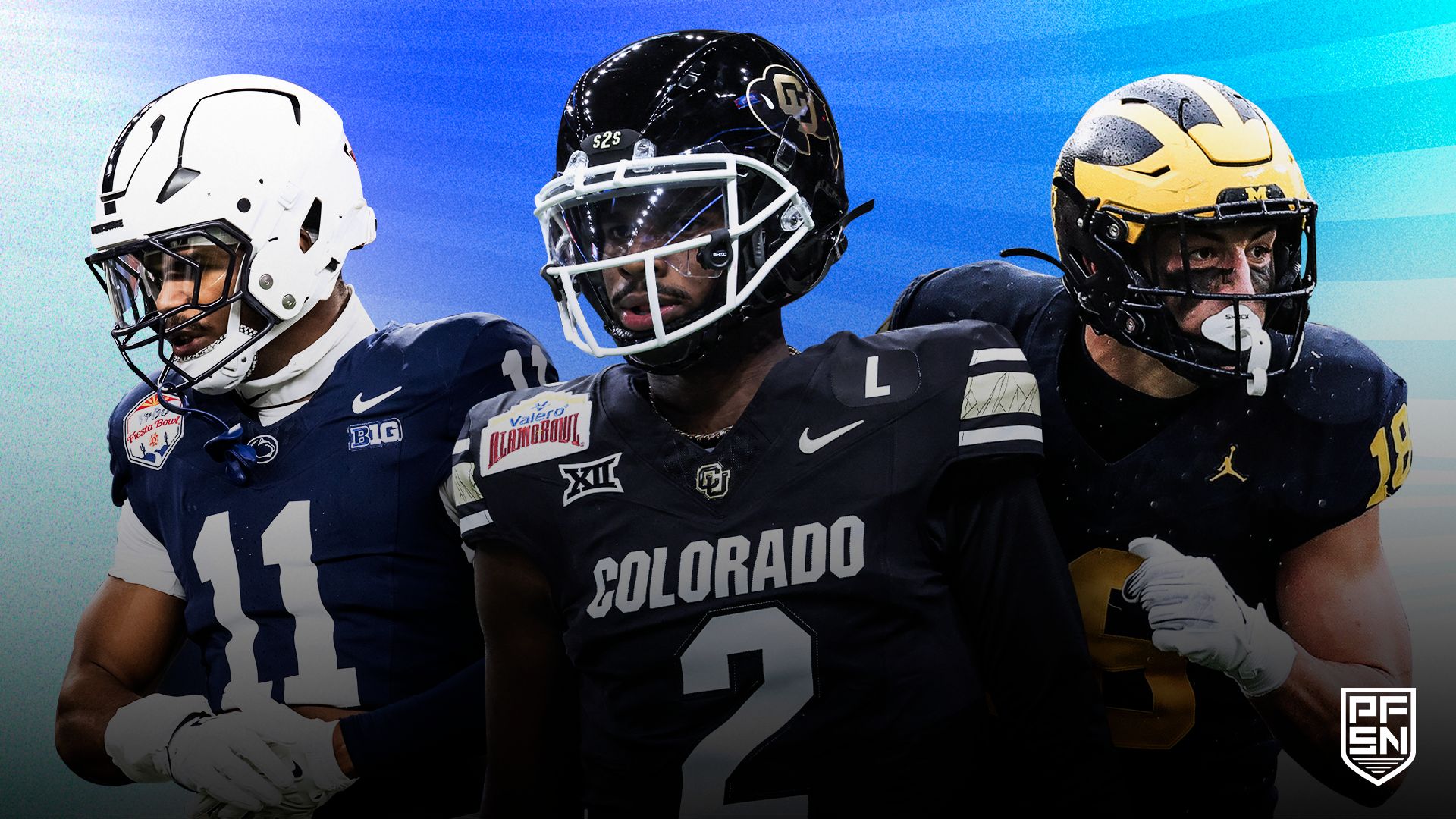
The 2025 NFL Draft is quickly approaching, but there remains a lot of mystery surrounding the top of the draft.
PFSN’s Stats and Insights team took a crack at predicting the first three rounds of the draft, with full analysis on potential prospect fits and team needs for every pick in the first two rounds.
1) Tennessee Titans
Cam Ward, QB, Miami (FL)
The Tennessee Titans enter the 2025 NFL Draft with a glaring need at quarterback. They finished the 2024 season ranked 27th (D grade) in our Offense+ metric, and the struggles under center were a major catalyst. Whether it was Will Levis or Mason Rudolph, the quarterback play amplified the urgency to upgrade at the position.
Tennessee finished with a 32% offensive pass success rate (24th in the NFL) and a -0.04 EPA per dropback (23rd). Levis, the team’s second-round pick in 2023, ranked 37th in EPA/DB from a clean pocket (0.03), 29th when pressured (-0.44), and 37th overall (-0.15). The offensive line didn’t do them any favors, allowing a 8.9% sack rate (27th) and 36.6% pressure rate (23rd).
The Titans need better play from their offensive line and their quarterback next season. Both things can be true. The front office made improvements up front in free agency, and now they are upgrading at quarterback. Cam Ward is a gunslinger with lethal accuracy and natural improvisational skills. He’s not a flawless prospect, but the Titans need a playmaker running the show, and Ward is exactly that, both inside and outside the pocket.
2) Cleveland Browns
Shedeur Sanders, QB, Colorado
There are multiple avenues the Cleveland Browns could take here, but their most pressing need is at the quarterback position. Cleveland finished the 2024 season last in our Offense+ metric, as one of only two teams to post an F grade (along with the New York Giants).
Cleveland gave Deshaun Watson a historic fully-guaranteed contract, and the returns haven’t come close to the investment. The three-time Pro Bowler hasn’t played a full season since joining the Browns, and he’s been bad when he’s been on the field.
In 2024, Watson ranked in the bottom five for nearly all of the metrics we look at, including third-down conversion rate (19.7%; 39th), net yards per attempt (4.4; 39th), passing from a clean pocket (-0.01 EPA per dropback; 38th), and passing when under pressure (-0.55 EPA/DB; 37th). Jameis Winston at least provided some entertaining moments, but he was never a long-term answer.
There’s some speculation that Cleveland could pass on quarterback here, and no one will scoff at them taking either Travis Hunter or Abdul Carter. However, this front office knows they cannot begin next season without an answer under center. Shedeur Sanders is one of the two best quarterbacks in the class. He has the ultimate confidence in his abilities, even if you don’t. Sanders won’t be confused for an elite athlete, but he has great poise, toughness, and the intangibles to change the culture of this franchise.
3) New York Giants
Travis Hunter, CB/WR, Colorado
Travis Hunter’s usage in the NFL likely depends on which team drafts him. Luckily for the Giants, the Heisman Trophy winner could fill more than one need on the roster. New York’s offense was awful last season, finishing 31st in Offense+ (F grade). They finished 29th in success rate in both the passing game and the rushing game. They were also inept in the red zone, ranking last in touchdown rate (43%) by a wide margin.
Hunter is a world-class athlete. He may not have the most polished route-running technique in the class, but he makes up for anything he lacks with his physical tools. Hunter has an insane catch radius, and he’s a leaper who can go up and make acrobatic catches look routine. Pairing Hunter with last year’s first-rounder, Malik Nabers, would give New York one of the most dynamic wide receiver duos.
The Giants could also use Hunter’s athleticism and ball skills on the defensive side of the ball. The unit was lackluster against the pass for much of the year, ranking 30th in passer rating allowed (103.1) and 29th in net yards per pass attempt (7.7).
New York has some solid young secondary pieces, including safety Tyler Nubin and cornerback Dru Phillips, who both shined as rookies. However, Deonte Banks struggled in 2024, and Hunter’s rare instincts and stickiness in coverage could help solidify the unit.
4) New England Patriots
Abdul Carter, EDGE, Penn State
The New England Patriots will be ecstatic if Abdul Carter falls into their lap at No. 4. Their defense consistently struggled to generate a pass rush last season, ranking last in sacks (28) and 31st in pressure rate (28%). The front office prioritized bolstering their roster with capable edge rushers in free agency, adding Harold Landry III and K’Lavon Chaisson, who combined for 14 sacks in 2024.
Even though New England addressed the need in free agency, they shouldn’t stop there. With all due respect to Landry and Chaisson, Carter is the kind of talent that could help transform this defense, which ranked among the worst in the NFL. Carter, the No. 1 prospect on PFSN’s 2025 NFL Draft Big Board, was the Big 10 Defensive Player of the Year and a unanimous All-American in 2024.
The Penn State product was a game-wrecker last year, racking up 12 sacks and 24 tackles for loss in his first season as a full-time edge defender. Carter lacks ideal length, but he possesses rare athleticism and explosiveness. Combine that with his relentless motor and high IQ, and you have a cornerstone talent on your hands.
5) Jacksonville Jaguars
Mason Graham, DT, Michigan
In 2023, the Jacksonville Jaguars’ defense ranked sixth in rush success rate, but it was the sixth-worst in that category a season ago. Adding a disruptive force like Mason Graham could help them as they continue to build a competitive defense.
Graham’s combination of power, quickness, and a diverse set of pass-rush moves makes him a potential Pro Bowl-caliber player. Beyond his physical tools, it’s Graham’s football IQ that sets him apart from other interior defenders.
With Joshua Hines-Allen and Travon Walker anchoring the edge, Graham would provide the missing piece in the middle. A top-tier interior tackle, he’s known for his ability to win with his hands, giving the Jaguars a powerful presence on the line.
6) Las Vegas Raiders
Ashton Jeanty, RB, Boise State
The Las Vegas Raiders’ ground game has been one of the league’s worst over the past two seasons. They finished dead last in rushing yards in 2024 and were third-worst the year before. Last season, Raiders running backs combined for just 1,120 rushing yards — the lowest total for a team since the 2020 Houston Texans.
Las Vegas added veteran Raheem Mostert in free agency, but he’s 33 years old and has a long history of injuries. Mostert profiles more as a complementary piece than a lead back at this stage of his career. Ashton Jeanty feels like the perfect fit at No. 6 overall. He’s an explosive, versatile back who can jumpstart a stagnant rushing attack and immediately raise the ceiling of this offense.
Jeanty is a physical runner who flashes a strong stiff arm, and it often takes multiple tacklers to bring him down. He’s a rare playmaker at the position who does all the little things well while also offering game-breaking home-run ability. His presence helps take pressure off new quarterback Geno Smith.
7) New York Jets
Will Campbell, OT, LSU
The New York Jets earned a 64.0 grade in PFSN’s OL+ metric (26th) last season, so they should be looking to upgrade their offensive line in the early rounds of the draft.
They posted a strong pressure rate in 2024 (28.0%, fifth-best in the league), but that was partly thanks to Aaron Rodgers getting the ball out quickly. When the offensive line was forced to hold blocks longer, their weaknesses were exposed, as evidenced by a pass block win rate that ranked just 23rd overall.
Their struggles extended to the run game as well. Jets running backs averaged only 0.78 yards before contact per rush (23rd in the league), and the offensive line’s run block win rate was even worse, ranking 29th.
Will Campbell has proven that he can perform against high-level talent, which should put him high on the Jets’ draft board. He has the size, strength, agility, and football IQ to step in right away as a starting offensive lineman. Campbell is a pro-ready starting offensive lineman with the potential to make Pro Bowls, and he could offer positional versatility.
8) Carolina Panthers
Jalon Walker, LB, Georgia
The Carolina Panthers finished with the worst defense in the NFL last season, according to our Defense+ metric. Many of their struggles started in the trenches, most notably their pedestrian pass rush.
Carolina ranked last in the league in pressure rate (25.1%) and 29th in sacks (32). Dan Morgan and the front office didn’t do much to improve in that area in free agency, so you have to believe they’ll attack the need early in the draft.
Jalon Walker received the Butkus Award as the nation’s top linebacker in his final season in college, and his versatility and athleticism could be just what the Panthers are missing on the edge. He has the size and athleticism of a traditional inside linebacker, but at Georgia, he thrived in a role that leaned heavily on his ability to blitz and generate pressure as a pass rusher.
9) New Orleans Saints
Will Johnson, CB, Michigan
After moving on from four-time Pro Bowl cornerback Marshon Lattimore last season, the New Orleans Saints have a massive hole in the secondary to fill heading into the draft. The unit’s numbers against the pass were actually respectable considering they traded Lattimore and Paulson Adebo suffered a season-ending injury midseason.
The Saints finished with a top-12 pass defense by success rate and EPA per play. However, with Lattimore and Adebo both playing elsewhere in 2025, this is a cornerback room that lacks overall talent and depth. There’s no proven No. 1 corner on the roster, and Will Johnson offers that kind of potential.
A fluid, physical defender with excellent size and length, Johnson pairs his natural tools with sharp instincts and a fearless mentality in coverage. His ability to recognize routes and play aggressively at the catch point allows him to consistently disrupt plays and separate himself from other corners. With a high football IQ and true CB1 potential, Johnson is a polished, pro-ready talent who could make an immediate impact in New Orleans.
10) Chicago Bears
Armand Membou, OT, Missouri
The first season of the Caleb Williams era for the Chicago Bears was a massive disappointment. The offensive line got plenty of criticism, but they weren’t the only reason for the struggles, and they finished as a middle-of-the-pack unit in OL+. They allowed a 10.7% sack rate (last in the NFL), but they were asked to block for the fourth-longest time of any unit last season (3.09 seconds).
Ryan Poles and the Bears’ front office have made it a point to upgrade their offensive line this offseason. They completely revamped the interior, adding Joe Thuney, Drew Dalman, and Jonah Jackson through free agency. There’s still room for improvement at left tackle, where questions remain about Braxton Jones’ future in Chicago.
Armand Membou was one of the most battle-tested offensive linemen in the country, consistently holding his own against top-tier competition. His technique still needs refinement, but his athleticism and effectiveness are undeniable. Membou has the physical tools to become one of the league’s more dominant right tackles.
11) San Francisco 49ers
Jahdae Barron, CB, Texas
The San Francisco 49ers moved on from Pro Bowl cornerback Charvarius Ward in the offseason, leaving Renardo Green and Tre Brown as the projected starting corners on the outside. Losing Ward is a tough blow given the lack of depth at the position.
The pass defense numbers were actually solid in 2024. San Francisco allowed just 10.3 yards per reception (fifth-best in the NFL) and 6.7 yards per pass attempt (fourth-best). They have one of the best slot corners in the league in Deommodore Lenoir, but they must add some juice on the outside to replace Ward. While interior defensive line is also a major need, this year’s defensive line crop is deep.
Jahdae Barron has quickly climbed up draft boards. He showcased his versatility and playmaking ability with five interceptions last season while locking down receivers on the outside. Barron is a reliable tackler, brings play strength in the run game, and also has the versatility to match up well against quick slot receivers. His combination of experience, football IQ, and physicality gives him a clear path to early playing time.
12) Dallas Cowboys
Tetairoa McMillan, WR, Arizona
The Dallas Cowboys have been waiting a long time for a legitimate wide receiver to play opposite CeeDee Lamb, who has consistently paced the team in targets (152 in 2024) and has developed into one of the NFL’s elite wideouts.
GET DRAFTING: Try PFSN’s Free NFL Mock Draft Simulator With Trades
The next highest-targeted pass catchers last season were tight end Jake Ferguson (86) and wide receiver Jalen Tolbert (79). While Tolbert had the best EPA per target on the team last season (+0.25), he lacks the desired dynamic ability of a No. 2 receiver.
Tetairoa McMillan’s elite combination of size, route-running prowess, and hands could give Dallas two legitimate alphas, fueling a return to glory behind a QB in Dak Prescott who has posted a top-five QB+ grade in three of his past five healthy seasons.
13) Miami Dolphins
Kelvin Banks Jr., OT, Texas
There are no secrets in Miami: keeping Tua Tagovailoa upright is a priority, and they will likely try to address this need early.
This is a timing-based offense that relies on getting the ball out quickly (2.49 seconds per dropback to throw, easily the lowest in the NFL and 12.6% less time than league average) and while that puts less emphasis on preventing pressure, it does require the offense to function on-time — something that isn’t possible if the offensive line struggles.
Despite the desire to catch and release the ball, Miami was still only league average in opponent sack rate (6.8%, NFL average: 6.9%), an area that should be much stronger given their style of play. Kelvin Banks Jr. comes loaded with upside and most scouts believe him to be a versatile weapon on the line, something that is very appealing to this specific offense that requires continuity as much as anything.
14) Indianapolis Colts
Tyler Warren, TE, Penn State
The Indianapolis Colts’ offense was very much hit-or-miss in 2024, finishing 21st in EPA per play (-0.04) and 19th in points per drive (1.91). Obviously, the constant struggles at the quarterback position were a large reason for the inconsistency and while that may not change in 2025, additional support allows this franchise to truly evaluate what they have in Anthony Richardson.
While Indianapolis has building blocks at wide receiver in Michael Pittman Jr., Josh Downs, and Alec Pierce, there’s not much juice at the tight end position. Tyler Warren possesses everything you could ask for in a tight end prospect and could truly impact how an offense is run at the professional level from Day 1.
While the idea of catching passes from Richardson and/or Daniel Jones doesn’t exactly sound appealing, the Colts have to do everything in their power to help their QB succeed.
This offensive line has taken a step backwards recently (16th last season in our rankings after years inside the top-10), and Warren’s versatility should help on that front as well. If the plan is truly to go best available player, there’s only one selection to be made with the way this specific draft has unfolded.
15) Atlanta Falcons
Shemar Stewart, EDGE, Texas A&M
An unofficial Raw Athletic Score (RAS) of 10.0 has Shemar Stewart moving up draft boards. Not only did the Atlanta Falcons rank 30th in pressure rate last season, they ranked 31st at creating heat on third down — a death sentence in this era of accuracy at the quarterback position.
Atlanta has spent the last few drafts building up its offense, and as those pieces develop, it’s time to add difference-makers on the other side of the ball — a box Stewart certainly has the potential to check this season.
The Dirty Birds haven’t had a winning season since 2017, but look for that to change sooner rather than later.
16) Arizona Cardinals
Josh Simmons, OT, Ohio State
The Arizona Cardinals’ offensive line finished the 2024 season as a top-10 unit in our OL+ metric, but that doesn’t mean they can’t add to a strength given the resources they’ve invested in the skill position players on that side of the ball.
They were excellent when facing four or fewer rushers, finishing fifth in pressure rate (25.3%) and second in sack rate (3.9%). In the run game, Arizona ranked ninth in run blocking yards before contact per rush (1.00) and 11th in run block win rate.
Josh Simmons is a good athlete who offers elite power and block-finishing ability. By pairing Simmons with Paris Johnson Jr., the Cardinals could form one of the most promising offensive tackle duos in the NFL. This team fielded a highly productive offense last season, and solidifying themselves in the trenches could elevate them even higher.
17) Cincinnati Bengals
Walter Nolen, DT, Ole Miss
The Cincinnati Bengals were a bottom-10 defense in pressure rate last season for the first time since 2020 and while Walter Nolen’s strength figures to more of a presence in the run game (6’4”, 296 pounds), he was third in this class in pressure rate and has the athletic traits to excel in a variety of ways at the professional level.
During the second half of last season, Cincinnati was 4-0 when creating pressure on at least 35% of non-blitzed dropbacks, proof positive that if they can heat up quarterbacks without compromising their secondary, this team can be a true threat in short order.
18) Seattle Seahawks
Grey Zabel, OL, North Dakota State
The Seattle Seahawks were close to making the playoffs last season despite fielding one of the worst offensive lines in the league: Seattle finished 31st in our OL metric with an F grade, better than only the Texans.
On the season, the Seahawks allowed a 39.4% pressure rate (30th) and an 8.3% sack rate (24th), weaknesses that won’t be acceptable if the expectation is for Sam Darnold to come anything close to repeating his 2024 production. Additionally, they ranked third from last in yards before carry per rush (0.66) and 28th in run-block win rate, giving opposing defenses nothing to truly fear.
Charles Cross and Abraham Lucas are promising as the bookends, but the Seahawks have lacked stability on the interior. Grey Zabel offers positional versatility, having played four of the five offensive line positions, and he should fold nicely into Klint Kubiak’s motion-oriented attack.
19) Tampa Bay Buccaneers
Malaki Starks, S, Georgia
Only the Washington Commanders have a lower interception rate over the past three seasons than the Tampa Bay Buccaneers, making the addition of this ballhawking Bulldog a natural pick.
Malaki Starks has the physical gifts to compete against the run when called upon (Tampa Bay ranked second in blitz rate a season ago), but his ability to track the ball and cover ground is why we are intrigued by this fit.
The Buccaneers were one of four offenses to score 500 points last regular season, and they’ll look to support that talented unit by adding upside on the defensive end.
20) Denver Broncos
Luther Burden III, WR, Missouri
Sean Payton was confident he found his quarterback of the future last draft and nothing during Bo Nix’s stellar rookie campaign has him thinking differently as we sit here today.
Now, he’s likely to dive all in when it comes to building around the most valuable commodity in professional football: a competent signal-caller on a rookie deal.
Courtland Sutton ranked seventh (minimum 75 targets) in average depth of target a season ago, so while Luther Burden III profiles as the type of playmaker who can have success at all three levels, the thought here is that Payton, like Missouri last year, leans into what Burden can do with the ball in his hands.
21) Pittsburgh Steelers
Kenneth Grant, DT, Michigan
The Pittsburgh Steelers finished 12th in PFSN’s Defense+ metric in 2024, a rare non-top-10 ranking for a franchise that usually makes its bones on that side of the ball. The run defense was below average, ranking 17th in success rate (61%) and 20th in yards before contact per rush (1.55). This is something they figure to address in this draft at some point, so why not right off the bat?
Kenneth Grant profiles as an excellent run-plugger who would fit nicely next to Cameron Heyward on the interior. With Keeanu Benton not quite developing into the three-down contributor the Steelers expected just yet, Grant would also add much-needed depth and competition to help Pittsburgh rebuild a once ferocious defensive line on the fly.
22) Los Angeles Chargers
Trey Amos, CB, Ole Miss
Trey Amos is a smooth athlete with receiver-like traits, and that should help plug a hole in this Los Angeles Chargers defense. While the Chargers were the fourth-best defense according to PFSN’s metric, they really struggled to defend the deep pass last season.
Charger Defensive Ranks, Passes Thrown 15+ Yards
- Yards per attempt: 22nd
- Passer rating: 24th
- Touchdown rate: 32nd
The combination of size (6’1”) and speed (4.43-second 40-yard dash) makes this as good a fit as you’ll find in the second half of the first round.
23) Green Bay Packers
Mykel Williams, EDGE, Georgia
The Green Bay Packers have invested heavily in the trenches in the early rounds, spending a first- or second-round pick on a lineman in five of the last six drafts.
With 2023 first-rounder Lukas Van Ness yet to emerge as a consistent contributor, it wouldn’t be surprising to see the Packers seek out a running mate for Rashan Gary.
Georgia’s Mykel Williams is an explosive athlete whose strength should give him three-down value. Williams needs a more developed pass rush plan, a byproduct of Georgia’s deep rotation limiting his snaps, but he could quickly develop into the star pass rusher the Packers have hoped Gary would become.
24) Minnesota Vikings
Nick Emmanwori, S, South Carolina
The Minnesota Vikings saw lots of turnover in the secondary in free agency. Safety Camryn Bynum left for the Colts, while both Harrison Smith and Josh Metellus could be gone after contract years in 2025. As such, it’s time for the Vikings to rebuild the position with the best athlete of any defensive back in this class.
Nick Emmanwori crushed the NFL Combine testing, but also had real production with 88 tackles en route to First Team All-American honors. He shows coverage potential matching up with tight ends, which was one of the Vikings’ few defensive weaknesses last year (ranking 17th with 7.4 yards per attempt allowed to opposing TEs).
Emmanwori would have time to develop as a third safety in 2025 before potentially becoming the leader of the position group in his second season.
25) Houston Texans
Colston Loveland, TE, Michigan
This spot would be a little later than many expect for Colston Loveland, who has an argument as the best receiving tight end in this class. And while Dalton Schultz is still penciled in as the Houston Texans’ starting tight end, adding a dynamic pass catcher like Loveland would be a huge coup for an offense that is lacking in options beyond Nico Collins.
Loveland would allow Houston to use even more 12 personnel after ranking 11th in usage last season (34.7%). Having multiple tight ends on the field could also help the Texans’ woeful rushing offense, which ranked last in success rate (31.5%). Of course, the primary benefit would be improving C.J. Stroud’s chances for a rebound season, particularly if paired with more offensive line help in the early rounds.
26) Los Angeles Rams
Shavon Revel Jr., CB, East Carolina
The Los Angeles Rams had a clear weakness in the secondary last season, and they have yet to make an addition to that position group. Shavon Revel Jr. has as much upside as any cornerback in this class short of Travis Hunter, though he might require some patience after a late-September torn ACL ended his college career.
Revel’s combination of length and top-end speed would allow the Rams to play more press coverage. Ahkello Witherspoon often handled those duties in 2024, but with very hit-and-miss results (8.5 yards per target). The Rams’ returning veterans would allow Revel to ease into the mix to begin the season before hopefully earning a starting job down the stretch.
27) Baltimore Ravens
Tyler Booker, G, Alabama
Drafting a guard this high would be unusual for the Baltimore Ravens, who have typically leaned towards higher-value positions in the first round. However, the Ravens have shown a willingness to break tendency for premium prospects, as they did in 2022 when they took Kyle Hamilton and Tyler Linderbaum with their two first-round picks.
Tyler Booker represents a similar idea since he could also fill the only real glaring hole on the Ravens’ offense. Even if Baltimore has faith in Andrew Vorhees to assume Patrick Mekari’s starting left guard role, Booker is a powerful run blocker who would fit beautifully into the offense’s gap run scheme. That could make him too good to pass up, particularly with the Ravens in win-now mode after years of close calls.
28) Detroit Lions
Matthew Golden, WR, Texas
The Detroit Lions have been unafraid to make unconventional picks, with the shining example being Jahmyr Gibbs going No. 12 overall two years ago. Matthew Golden would raise similar eyebrows, as his speed-based skill set would overlap heavily with Jameson Williams.
However, strong organizations address needs before they arise, and the Lions may not be able to retain Williams on a $20-25 million per year deal with all their other big contracts on offense. With Aidan Hutchinson also due his own mega-extension soon, replacing Williams’ skill set while also adding receiver depth in the short term might be the most prudent path to keep the offense rolling in the post-Ben Johnson era.
29) Washington Commanders
Jihaad Campbell, LB, Alabama
The Washington Commanders are in the strange position of being a contending team without too many long-term building blocks in place. As such, the Commanders can feasibly lean toward picking the best available player without worrying too much about roster needs.
Even with Bobby Wagner and Frankie Luvu set to return at linebacker in 2025, drafting the consensus top off-ball linebacker in Jihaad Campbell would be a great succession plan.
Campbell also brings some pass-rush ability, which would be useful for a Washington defense that blitzed at the sixth-highest rate (32%) in 2024. However, his calling card is his sideline-to-sideline range in a prototypical linebacker body — a rare quality in a league where linebackers get smaller every year. Campbell wouldn’t have pressure to play right away, but could quickly grow into the centerpiece of Dan Quinn’s defense.
30) Buffalo Bills
James Pearce Jr., EDGE, Tennessee
The Buffalo Bills have one white whale they’re chasing, as the Kansas City Chiefs are the only real roadblock preventing them from winning their first Super Bowl. There’s been one proven way to beat Patrick Mahomes, and that’s by overwhelming the Chiefs in the trenches.
While Joey Bosa, Michael Hoecht, and Larry Ogunjobi were nice low-cost free agent acquisitions, Buffalo could double down in the draft with one of the best pure pass rushers in this class.
The Bills had a mediocre pass rush in 2024, as they had the lowest pressure rate of any playoff team at 32.5%. James Pearce Jr. was a consistently disruptive playmaker for Tennessee, recording 17.5 sacks and 28 TFLs over his last two seasons. Both totals led all SEC players over that span. He may only be a designated pass rusher, but Pearce will easily pay off that investment if he’s getting the Chiefs offense off the field in January.
31) Kansas City Chiefs
Derrick Harmon, DT, Oregon
The Chiefs are a little thinner than usual at defensive tackle beyond Chris Jones. Tershawn Wharton and Derrick Nnadi both left in free agency, leaving Mike Pennel, Jerry Tillery, and Marlon Tuipulotu as the next options on the depth chart. With Jones turning 31 in July, it would be wise for Kansas City to find a running mate to alleviate some of the burden on their All-Pro cornerstone.
MORE: PFSN’s 2025 NFL Draft Big Board
Derrick Harmon is the type of versatile athlete who can play multiple techniques along the defensive line. Harmon had experience two-gapping at Oregon, but also showed flashes of disruptiveness with 10.5 TFLs and five sacks last season. He should be able to play on early downs right away, giving him a fairly high floor.
32) Philadelphia Eagles
Mike Green, EDGE, Marshall
It’s no secret that the Philadelphia Eagles will be looking to replenish their defensive line. While the Birds added some low-cost pass rushers in free agency, they’ll need to draft a more permanent long-term replacement for Josh Sweat.
Enter Mike Green, whose production wasn’t simply the byproduct of playing in a smaller conference. Green’s explosive power and relentless motor allowed him to dominate Sun Belt competition, and should translate well to the NFL, too.
After leading the FBS with 17 sacks in 2024, Green would immediately help replace some of the Eagles’ lost pass-rushing production to help the defense maintain its elite form.
Round 2 | 33) Cleveland Browns
Emeka Egbuka, WR, Ohio State
After drafting Shedeur Sanders in the first round, the Browns must put talent around him to set their young quarterback up for success. Cleveland’s wide receiver room lacks overall talent and depth beyond Jerry Jeudy and Cedric Tillman.
Emeka Egbuka is a well-built movement-Z receiver who projects as an impact NFL starter. He offers solid overall size for the position and has good strength and athleticism. He primarily aligned in the slot while at Ohio State, but he has the size, athleticism, and separation IQ to move across the formation.
Egbuka is an excellent route runner who can use head and body fakes to create separation while also using his hands to keep his body clear through stems. He’s a third-down machine who consistently gets open and moves the chains. He has extremely strong hands and outstanding body control over the middle, and after the catch, he’s tough and competitive with the ball in his hands.
Egbuka will likely never be a home-run threat at the next level, as he lacks the deep speed to stress NFL-caliber corners vertically. But he’s a valuable high-volume Swiss army knife with multi-level and blocking utility.
34) New York Giants
Donovan Jackson, G, Ohio State
The Giants temporarily addressed the revolving quarterback position in free agency, signing veterans Russell Wilson and Jameis Winston. While that seems like a band-aid, either is an upgrade over what the team trotted out last season. Now, they must bolster their offensive line, which continues to be a pain point for New York.
The Giants allowed a 38.4% pressure rate last season, which ranked 28th in the NFL. The pressure numbers were ugly, whether against the blitz or not, and their sack rate suggests that their quarterbacks might have been making things look better when escaping pressure and making plays.
Donovan Jackson has been on the NFL Draft radar since he joined the Ohio State Buckeyes in 2021 as a five-star recruit. He went on to start 31 games at left guard and the final nine games of his career at left tackle — in a championship run that opened evaluators’ eyes. Jackson’s ability to play tackle in a pinch is extremely valuable, and teams can’t ignore that. Still, Jackson likely projects better as a guard at the NFL level.
He’s not the most flexible in his midsection or on recovery, and that could be a limiting factor outside. On the interior, Jackson has a perfect build. He’s low-to-the-ground and hyper-dense at 6’4″, 315 pounds, with near-34″ arms. He has great lateral mobility, clean pass sets, forceful and active hands, power in both phases, and the core strength to absorb. With inbuilt security and versatility up front, as well as long-term upside, Jackson is a great prospect to invest in.
35) Tennessee Titans
Donovan Ezeiruaku, EDGE, Boston College
The Titans’ defense was a talented unit that finally cracked under the strain of supporting a non-functional offense last season. They finished with one of the worst pass defenses in the NFL during Weeks 10-18. Tennessee’s pass rush didn’t do the back end of the defense any favors, ranking 29th in sacks (32) and pressure rate (28.8%).
The Titans parted ways with Harold Landry III, their best pass rusher over the past several years. That leaves Arden Key and free-agent signing Dre’Mont Jones as the only established edge defenders on the roster. Adding Donovan Ezeiruaku could elevate this unit.
The sack production from 2024 speaks volumes, but Ezeiruaku’s tape is flooded with pro-ready technique. He uses his hands incredibly well, and he plays with relentless passion when he’s chasing down the ball. His sack total doesn’t just consist of proverbial empty calories; Ezeiruaku earns his sacks with active rush angle manipulation and intelligent hand application and counter work, emboldened by his natural leverage, burst, bend, and proportional length.
Because of his smaller frame, Ezeiruaku could struggle against the run early in his NFL career. Additionally, while he has good tools overall, he doesn’t quite have elite size-adjusted speed and burst. Still, as a stand-up outside linebacker in a base 3-4 system, Ezeiruaku has the skill set to be a solid starter fairly early in his career, particularly on pass-rushing downs.
36) Jacksonville Jaguars
Benjamin Morrison, CB, Notre Dame
The Jaguars’ pass defense came on strong towards the end of last season, but they ranked 31st in pass defense success rate for much of the year. They added Jourdan Lewis as the slot corner, but they need to draft someone who can elevate this unit and push Tyson Campbell and the rising Jarrian Jones.
Benjamin Morrison primarily aligned outside for the Fighting Irish and was often tasked with shadowing the opposing team’s No. 1 option — a challenge he never backed down from. He broke out as a true freshman and boasted elite ball production when healthy, but an injury-riddled 2024 campaign sullied his NFL Draft stock for teams.
How Morrison is recovering from his hip injury will be key for evaluators, as hip injuries can be tricky for redirection and coverage mobility. That said, Morrison is trending up, and when he’s fresh, he’s one of the best man-coverage defenders in the class.
With his effervescent quickness, competitive mentality, and short-area twitch, he can function as a gnat in press, and that same disruptive imprint shows up at the catch point. At his best in 2022 and 2023, Morrison looked like a first-round talent. With any luck, he can get back to that level.
37) Las Vegas Raiders
Azareye’h Thomas, CB, Florida State
The Raiders enjoyed a surge during the second half of the 2024 season. Overall, they had a middling pass defense, but they gave up 29 passing touchdowns on the year (26th in the NFL). Las Vegas’ need for cornerback help cannot be overstated heading into the draft after Nate Hobbs left in free agency and the team released Jack Jones.
Just a one-year starter at Florida State, Azareye’h Thomas’ lack of experience can be viewed as both a positive and a negative. He is not a refined player as it stands today, but he has a lot of room for improvement and will only get better with more playing time and NFL coaching.
From a physical standpoint, Thomas has a lot to like. He is tall and has excellent length overall to excel as an outside boundary corner in the NFL. His movement skills are good given his size and length, and he certainly has starting NFL potential. Thomas is a prototypical outside corner and excels when he can get physical at the line of scrimmage — something new head coach Pete Carroll will surely appreciate.
38) New England Patriots
Josh Conerly Jr., OT, Oregon
The Patriots’ offensive line was among the worst in the NFL last season, finishing with an F grade in our OL+ metric. They ranked last in run block win rate and second from last in pass block win rate. They were 31st in pressure rate (39.5%) and 29th in sack rate (9.0%) despite being just 12th in time to throw (2.91 seconds). The Patriots have to upgrade their offensive line, particularly at left tackle, where Vederian Lowe struggled a season ago.
Josh Conerly Jr. has tremendous athleticism and body control. His foot speed and redirection ability insulate his range as a blocker, making it easier for him to execute blocking assignments on the move. Though he projects best in a more zone-oriented running system, he has thrived in gap assignments as well.
Conerly’s natural leverage and coordination make it easier for him to climb to the second level and drive linebackers. He’s obviously bigger and stronger than the off-ball defenders he goes up against, but his precision and fluidity on the move allow him to take precise angles blocking in space.
Though his play strength isn’t elite yet, Conerly did get stronger as his time at Oregon progressed. He improved how well he absorbed power at the point of attack, and if he can continue to better withstand bull rushes and stabs, his ceiling is high. He’s athletic, long enough to stick outside, and a high-IQ two-phase player.
39) Chicago Bears
Nic Scourton, EDGE, Texas A&M
The Bears should continue to prioritize the trenches after getting Caleb Williams some protection in Round 1. The defense posted a 36.8% pressure rate in 2024 (eighth in the NFL), but depth is a real concern. Chicago added defensive end Dayo Odeyingbo in free agency, but they need to bolster this unit with some serious juice on the edge opposite Montez Sweat.
Nic Scourton might be the most aesthetically pleasing pass rusher in the class. He’s wise beyond his years regarding his arsenal of rush moves, and his well-developed frame is NFL-ready despite only being 20 years old. Unfortunately, gaining unnecessary weight for the 2024 season likely hurt his NFL Draft stock.
At a more “natural” weight of around 265 pounds, Scourton would still offer a steady base as an edge setter while improving his initial get-off and bend. That bend at his density is a thing to behold. His ankles allow him to run under the table, and his hips hinge smoothly to soften rush angles while his hands dissect blocks through the outside shoulder.
If he becomes more consistent as a run defender, Scourton could be one of the league’s best dual-threat EDGE defenders. His fluidity and manipulative nature as he closes the gap on blockers make him potent on both outside rushes and inside counters, and he’s a prime candidate to move about the formation on obvious passing downs to find matchups to exploit.
40) New Orleans Saints
Tyleik Williams, DT, Ohio State
The Saints’ defense struggled mightily to stop the run last year, ranking 31st in yards per rush (4.9), 30th in rush success (55.6%), and 30th in yards before contact per rush (1.95). Bryan Bresee has shown flashes, but we have yet to see a full-on breakout season. New Orleans brought in veteran Davon Godchaux this offseason to bolster the unit, but the front office must continue to attack the interior of the defensive line to fix its biggest weakness.
Tyleik Williams is an exciting defensive tackle prospect who possesses the kind of raw athleticism and physical tools that get NFL decision-makers excited. He is a highly disruptive run defender and is nearly impossible to block 1-on-1. In the passing game, Williams primarily wins with his bull rush and overall motor, but he can convert speed to power, collapse the pocket, or stunt across alignments and penetrate gaps.
Williams makes a ton of plays late in the down, as he never stops working even when his initial rush is stymied. However, he does lack length, which hurts his ability to finish and pry through extensions at times. Williams must develop consistent hand counters to keep his chest clear as a rusher, but he projects as a high-upside run defender with similar potential in the passing game, and he brings inbuilt alignment versatility from 1-tech all the way to 5-tech on early downs.
41) Chicago Bears
Omarion Hampton, RB, North Carolina
This feels like a bit of a luxury pick, considering the Bears have a capable starter in D’Andre Swift. However, the numbers suggest they weren’t efficient when running the football. Chicago ranked 27th in yards per rush (4.0) and 28th in third-down rush conversion rate (42.6%). Having a potent rushing attack would help ease the load on Caleb Williams’ shoulders, and one of the best RBs in the class is still available.
Jeanty is the most heavily marketed RB in the 2025 NFL Draft, but there’s another player who could very well hear his name called within the first 32 picks: Omarion Hampton. Having amassed 3,164 yards and 30 touchdowns over the past two seasons, Hampton has the tools to be an impact starter as a volume back in the NFL. At 6’0″, 221 pounds, his size and physicality stand out as separating traits, but he brings even more to the table.
Hampton’s speed and burst, when he’s able to find a hole, is borderline special for his size, and he has the vision and spatial awareness to tempo his runs and create second-level windows with his footwork. Additionally, while he’s not as productive as others in the receiving phase, he undoubtedly has enough in his tool box to take short passes for RAC.
42) New York Jets
Jaxson Dart, QB, Ole Miss
The New York Jets officially moved on from the Aaron Rodgers era, and the school of thought was that they’d be in the market for a QB at the top of the draft. The $40 million investment in Justin Fields ended that speculation, so they likely won’t be taking a QB at the No. 7 spot. However, it’s only a two-year deal for Fields, so QB is still a need for Gang Green. Ole Miss QB Jaxson Dart is a potential end-of-first-round QB, but if he makes it to round two, it’s a spot that could work for a new Jets offense.
The Lane Kiffin offense at Ole Miss is one that consistently insulates QB production, and Dart is the latest to ascend within it. His numbers improved year-over-year in college, culminating with 4,279 passing yards and 29 touchdowns in 2024. Now, Dart has some fringe first-round hype in the 2025 NFL Draft cycle.
Looking at the physical profile, it’s easy to see why. At 6’2″, 223 pounds, he has good size, great athleticism, and toughness, plus a loose, elastic arm that can layer throws. The big question is exactly how translatable his game is to the pros. There are flashes of window anticipation on film, but NFL progression work is scant, and he often drops his eyes under pressure. Starter potential is there, but he has work to do before he harnesses it.
43) San Francisco 49ers
T.J. Sanders, DT, South Carolina
In a pretty deep defensive tackle draft class, T.J. Sanders has managed to stand out as one of the more enticing players in the group. A powerful 3-technique defensive tackle who also brings some juice as a penetrating 1-technique, Sanders appears to have the strength and improving technique to hold his own in NFL trenches.
With solid overall quickness and an improving arsenal of moves to shed blocks, Sanders was a true impact player for South Carolina in 2024. He’s an effective run defender who brings enough pressure as a pass-rusher to entice NFL teams.
There’s still some room for Sanders to grow, as his pad level is a pretty consistent issue with his game. He’s shown development as a technician, but he still could use a little more work utilizing counter moves and taking on down blockers. Overall, he’s a high-floor run defender with good pass-rush upside as well.
44) Dallas Cowboys
Kaleb Johnson, RB, Iowa
Kaleb Johnson rumbled for 1,537 yards and 21 touchdowns on 240 carries in 2024. At 6’1″, 224 pounds, Johnson isn’t the most explosive or the fastest back, but he compensates with some of the best vision and creative instincts the class has to offer.
Those skills are exactly what Dallas is in search of; the Cowboys need some upside at the position (27th in RB yards per carry before contact last season), and Johnson gives them increased hope of that entering 2025.
A fast first- and second-level processor, and an efficient footwork technician, Johnson knows how to use his setup space to bait defenders and clear lanes. He also has the bend and constant leg churn to create chunk plays once he’s working vertically.
45) Indianapolis Colts
Xavier Watts, S, Notre Dame
In 2024, Indianapolis allowed 12.6 yards per deep pass attempt, the fifth-highest rate in the NFL (league average: 11.4). Xavier Watts would give them more confidence on the back-end and thus allow them more versatility throughout their defensive scheme.
He is a versatile defender who displays the ability to play single high, as a split safety, and in the box as a rover. A ball magnet with 13 INTs through 2023 and 2024, Watts creates turnovers at an abnormally high clip. He doesn’t have elite speed, but excels anyway with his elite processing ability, instincts, recalibration quickness, and fluidity.
Watts’ awareness and feel shine on the back end, and he has the short-area energy to plant and drive on the football. In run support, he’s tough and physical, displaying a quick trigger, comfort running alleys, and tenacity at contact. In man coverage, Watts is competitive with his frame density and movement skills, but can struggle at the breakpoint, and his speed limits his efficacy in vertical trail.
As such, Watts is best in roles where he can play spacing and roam with confidence. In those roles, he has the mental acuity, competitiveness, coverage mobility, and playmaking propensity to be a quality starter.
46) Atlanta Falcons
Maxwell Hairston, CB, Kentucky
The Falcons allowed a touchdown on the second-highest percentage of opponent passes in 2024 (5.9%, NFL average: 4.5%), trailing only the Panthers. In what should be a defensive-oriented draft, this is a logical move in the middle of the second round.
Armed with tremendous speed and a playmaking mentality, Maxwell Hairston is one of the most fun defensive backs to watch in this entire class. His interception numbers speak for themselves, but he’s an aggressive playmaker underneath in coverage. He thrives in hook-curl zones and flat zones that allow him to shoot downhill and make a play on the ball.
Hairston’s testing athleticism (including a Combine-best 4.28-second 40 time) reflects what you see from him on tape. He has the deep speed to defend vertical route concepts and can match some of the fastest receivers in the game stride for stride. His instincts in coverage have grown considerably since he began his collegiate career.
47) Arizona Cardinals
Denzel Burke, CB, Ohio State
The Cardinals were the best defense in the league in 2023 in terms of limiting yards after the catch, but they were nothing more than average a year ago (17th), fueling the need for a player like Denzel Burke, who was a four-year starter and has the ability to be used across a variety of defensive formations.
Should Arizona go this direction, they’d be wise to get creative, as Burke’s instincts are strong when it comes to pressing the line of scrimmage on run plays.
48) Miami Dolphins
Shemar Turner, DL, Texas A&M
Shemar Turner is a disruptive and versatile defensive lineman with the ability to excel at multiple positions across the front. He combines a quick first step with impressive strength, allowing him to penetrate gaps and create consistent backfield pressure.
Turner’s hand usage and lateral movement make him effective against both the run and pass, while his motor and physicality enable him to shed blocks and pursue plays with intensity. His agility and athleticism for his size are notable, giving him the flexibility to line up inside or on the edge.
Ultimately, Turner will project best as a 3-tech or 4i at 6’3″, 290 pounds, but he has the athleticism to rush from different alignments, and his 33″ arms serve as a great conduit for power. His aggression can contribute to a lack of discipline at times, but he’s a fiery disruptor with a great ceiling if coaches can temper his passion.
Miami allowed the second-most yards per carry after contact to opposing running backs, completely wasting the ability to control the line of scrimmage that their 2024 defensive line was able to establish. Fix that and it opens the door in a big way when it comes to the potential of this unit.
49) Cincinnati Bengals
Tate Ratledge, OG, Georgia
Joe Burrow was great last season when feeling pressure (104.0 passer rating), but the Bengals would be wise to strengthen the offensive line as a repeat performance is unlikely (career pressured passer rating prior: 79.7).
Tate Ratledge’s evaluation involves a lot of back-and-forth, but he undoubtedly has a path to becoming a solid if unspectacular NFL starter. A two-time national champion with 37 starts at right guard to his name, Ratledge’s experience is a strength, but the 24-year-old rookie also missed time to lower-body injuries multiple times in his career.
He’s an elite athlete with rare explosiveness, agility, and second-level mobility, but at almost 6’7″, with arms just over 32″, his build is a bit unorthodox. He plays taller than preferred, and can be coaxed into lurching with his average reach, and those two issues can impact his balance and leverage. Nevertheless, Ratledge makes up for these flaws with his athleticism, football IQ, flexibility, and grating physicality, and he should be able to carve out a respectable starting career.
50) Seattle Seahawks
Alfred Collins, DT, Texas
Seattle was able to generate some rush a season ago, but they ranked 17th in pressured sack rate. They were also the 10th-worst rush defense on a per carry basis, something that needs to improve if this team wants to compete at a high level.
Alfred Collins has enigmatic qualities as a 2025 NFL Draft prospect. He accumulated just seven career sacks in five seasons at Texas, and as expected, he struggles to attack independently on pass-rushing downs, despite his physical tools. However, he is extremely effective as a run defender — perhaps the most effective in the class. His style will not suit every team, but Collins’ high floor in the run game, combined with his athletic upside, makes him an extremely compelling Day 2 investment.
At 6’5″, 332 pounds, with long levers for arms, Collins is a pure space-eater who also has the explosiveness to reset the line and hit blockers with jarring power. He can slab blocks, stack-and-shed with violence, and snuff out carries, and his power profile and motor imply untapped potential on later downs.
51) Denver Broncos
TreVeyon Henderson, RB, Ohio State
TreVeyon Henderson and Quinshon Judkins are graded very similarly on our 2025 NFL Draft board, but Henderson comes away with a slight edge, even though he’s a year older (22).
Henderson is the type of back that every offensive coordinator would love to have in their RB room. He had no qualms about sharing the Ohio State backfield with Judkins, and even as Judkins eclipsed Henderson in carries, Henderson was the better option in goal-line situations and as a receiving threat.
At 5’10”, 202 pounds, Henderson is a compact, low-to-the-ground slasher with the burst and speed to reach the second level in a blink. He’s physical and hyperactive, yet he’s a controlled pass-catcher and an ultra-reliable pass-protector with third-down value. That all-around ability, combined with his home-run speed, could cause him to go higher than expected on draft day.
Denver didn’t give a single running back 140 carries a season ago and ranked 28th at the position in yards per carry gained after contact — Henderson provides another bite at the apple with Javonte Williams out of the mix after signing with the Cowboys.
52) Seattle Seahawks
Jonah Savaiinaea, OG, Arizona
Jonah Savaiinaea checks a lot of boxes as an early-round offensive line target. He has great size and natural leverage at 6’4″, 324 pounds, with 34″ arms. He’s an elite athlete with a documented 4.95 40-yard dash and 1.72 10-yard split — numbers that are reaffirmed by his energized athleticism and blocking range on tape. And on top of it all, he has extensive experience at both guard and tackle, and can play both in a pinch.
He’s expressed his desire to play guard at the NFL level, and that’s likely where he projects best with his wide frame, anchor strength, and driving physicality. That said, he has enough length to stick at tackle, and he’s flashed improvement with his hand placement and timing on extensions. At either spot, Savaiinaea can function as a rangy people-mover with a tone-setting mentality and sturdiness in pass protection.
The Seahawks allowed pressure at the third-highest rate a season ago, a weakness they certainly need to address in the first season of what they hope is a successful era under Sam Darnold.
53) Tampa Bay Buccaneers
J.T. Tuimoloau, EDGE, Ohio State
J.T. Tuimoloau profiles as one of the safer picks among the EDGEs in this class. A former five-star recruit, Tuimoloau finally realized his potential in 2024 with a prolific campaign that included 12.5 sacks, 22 tackles for loss, two forced fumbles, and three pass deflections.
At around 6’4″, 265 pounds, with near-34″ arms, Tuimoloau has always had an impeccable power profile, and in 2024, he more consistently generated production from that profile. With his build, Tuimoloau will never have much of a bend component, but he’s one of the most reliable speed-to-power rushers in the entire class. He can cave in the pocket, finish moves with strong hands, and he’s a sturdy player in run defense, with stand-up and even-front EDGE versatility.
Building a defense is about more than addressing direct needs. The Buccaneers were able to create pressure at a high rate last season thanks to an aggressive scheme, but the ability to get home from a standard formation will prove critical if the Bucs want to improve upon the fourth-lowest interception rate in the league (1.1%).
54) Green Bay Packers
Jayden Higgins, WR, Iowa State
Jayden Higgins possesses prototypical length and frame density for an “X” receiver at the NFL level. But his calling card is actually his fluidity and manipulative predisposition on intermediate routes, which has elevated his standing in the class. Despite being nearly 220 pounds, the Cyclones’ WR separated well at the college level through fluidity and deception.
Although fluid, Higgins lacks the explosiveness to consistently threaten on the vertical plane. This allows confident defensive backs with NFL-level reactive athleticism to crowd the long-limbed receiver. Without an adequate vertical threat, that horizontal fluidity can only take him so far against competent NFL cornerbacks.
What could legitimately get him on the field early in his NFL career is his blocking ability. Higgins adequately uses his length to win leverage battles against shorter-armed defensive backs. Additionally, his hands remain active and he understands how to use a defender’s momentum against them while also not keeping a hold of too much jersey to attract zebra attention.
The Packers take wide receivers in the second round on a seemingly annual basis. With Christian Watson set to miss time in 2025 after a January ACL tear, the Packers need a boundary threat who can threaten the defense vertically in a way that none of Green Bay’s non-Watson targets could. Higgins likely wouldn’t play a full load of snaps right away with the Packers’ deep receiver room, but he could contribute on passing downs and keep defenses honest.
55) Los Angeles Chargers
Landon Jackson, EDGE, Arkansas
With 13 sacks and 25 TFLs over the past two seasons, Landon Jackson has been one of the more productive pass-rushers in the 2025 NFL Draft on the surface. Still, his projection has some complications.
At 6’6″, 264 pounds, with near-34″ arms, Jackson played some 4i at his size, particularly on early downs. He lacks the mass to function inside full-time in the NFL, but profiles well as an even-front defensive end, who can play support at 5-tech and rush from 7-tech and wide-9.
At his size, Jackson has elite explosiveness numbers, and that trait shows up on tape, along with impressive size-adjusted flexibility. He needs to unlock more of his power element, and pass-rush consistency remains an emphasis, but in the right role, Jackson can be a high-floor, high-ceiling addition.
However, the Chargers can afford to be patient this year with Khalil Mack and Tuli Tuipulotu holding down the edge. Long term, Los Angeles has very few foundational pieces on the defensive line, a fact which surely vexes Jim Harbaugh. Jackson is the type of moldable athlete who could become the leading man on a defensive line by 2027, while contributing in a rotational role right away.
56) Buffalo Bills
Tre Harris, WR, Ole Miss
Tre Harris topped 1,000 receiving yards for the first time in 2024 with Ole Miss, finishing with 1,030 yards and seven touchdowns on 60 receptions. Those numbers were made even more impressive, considering he played in just eight games — having missed time in November and December due to a groin injury. His 128.8 receiving yards per game led all eligible players in the FBS, and he earned a First-Team All-SEC nod for his play.
He was originally a transfer from Louisiana Tech, but proved he belonged alongside top SEC competitors with an incredibly productive two-year stretch at Ole Miss. He neared 1,000 yards in 2023, and in 2024, he eclipsed that mark in just eight games, while scoring a TD on over 10% of his catches. At 6’2″, 205 pounds, with 32″ arms, Harris has the build of a potential X-receiver, and he also has the catch-point authority to hound defensive backs.
With his body control, hand strength, and attacking IQ, he controls conversion situations, but his game is also quietly complete beyond his catching ability. While he’s not an elite vertical threat, he’s an explosive stem artist with great size-adjusted fluidity and angle freedom on in-breakers, and he can use his bend and play strength as a RAC threat, too. Bearing some similarity to prime Allen Robinson, Harris should be in heavy demand just outside of Round 1.
The Bills are set in the slot with Khalil Shakir, but had to use Keon Coleman as a pure X receiver last year due to their lack of options on the perimeter (particularly after the Amari Cooper trade acquisition flopped). Adding a player like Harris would enable the Bills to use Coleman in a more versatile flanker role, while reintroducing the deep ball after Josh Allen ranked just 27th in completion rate on throws of 15+ air yards last season (40.2%).
57) Carolina Panthers
Jaylin Noel, WR, Iowa State
Jaylin Noel might be one of the most underrated WR prospects in the 2025 NFL Draft. He was productive right out of the gate at Iowa State but peaked with 81 catches for 1,194 yards and eight touchdowns in 2024.
Noel’s testing numbers at 5’10”, 194 pounds — a 4.39 40-yard dash, 41.5″ vertical, 11’2″ broad jump, 6.82 three-cone, and a bench press count of 23 — are elite across the board, and it’s reflective of a truly rare three-level skill set that Noel brings on tape.
Noel plays with supercharged energy in short areas, and he has the hyper-elite burst and speed to compound separation, threaten vertically, and extend short RAC passes for big gains. A cherry on top is his catching reliability; he had just a 3.4% drop rate in 2024. If your offense needs a weapon, Noel can be that player.
That YAC ability would be a huge boon to Bryce Young and the Panthers’ passing game. Carolina ranked last in average YAC per reception (4.2), suppressing what could have been an even more impressive second-half resurgence from Young. A slot receiver like Noel would pair well with the bigger ball winners the Panthers already have in Xavier Legette and Ja’Tavion Sanders.
58) Houston Texans
Aireontae Ersery, OT, Minnesota
Aireontae Ersery is a highly experienced player who started for three full seasons at left tackle for the Gophers. He played in a zone-running scheme and was a highly productive player throughout his time.
At 6’6″, 331 pounds, with a 1.75 10-yard split and a 9’3″ broad jump, Ersery’s combination of size and on-attack explosiveness is a sight to behold. He’s one of the most dynamic zone blockers in the class; he’ll reach his landmarks with efficiency and drive through defenders with overbearing physicality.
However, Ersery’s size can be a double-edged sword. He plays tall, without elite knee bend, and his non-elite length causes him to lurch and sacrifice balance on extensions. Ultimately, his best fit may come at guard in the NFL, but more refinement could strengthen his OT projection. That uncertainty is largely why Ersery isn’t likely to go in the first round despite his significant experience in a major conference.
However, the Texans can afford to welcome a higher floor at left tackle, where Cam Robinson is their current projected starter after allowing the second-most pressures in the NFL last season. Ersery would provide Houston more options to protect C.J. Stroud after finishing with PFSN’s 31st-ranked offensive line in 2024.
59) Baltimore Ravens
Darien Porter, CB, Iowa State
Darien Porter is as boom-or-bust of a CB prospect as you can get in 2025. By drafting him, you’re getting a moldable ball of clay with elite height, length, and speed. He has inspiring ball skills, with his background as a receiver showing up in his coordination and ball-tracking capabilities.
Porter’s elite physical attributes grant him a fairly high floor in coverage. His ability to process off the line of scrimmage in off-man and zone is very encouraging, and his long-strider range allows him to close space and limit separation post-breaks.
The concerns on tape are about what you would expect given Porter’s profile. He’s lanky, not as fluid, and lacks consistency in run support. But for zone-heavy schemes, he’s a great fit, and he has special-teams value as well.
After losing Brandon Stephens in free agency, the Ravens are in need of competition at the outside cornerback spot to join Marlon Humphrey and Nate Wiggins. Baltimore signed Chidobe Awuzie and could give Jalyn Armour-Davis a shot, but providing more options would be a wise path. Even if Porter doesn’t win the job as a rookie, there’s a realistic future where he and Wiggins develop into one of the most physically imposing outside starting cornerback duos in the league.
60) Detroit Lions
Bradyn Swinson, EDGE, LSU
Bradyn Swinson was a late bloomer after beginning his career at Oregon with minimal production, but his breakout at LSU in 2024 — to the tune of 8.5 sacks and 14 tackles for loss — makes it impossible to overlook his tape.
At 6’3″, 255 pounds, with over 33″ arms, Swinson has virtually every trait you could seek in an edge rusher. He’s explosive off the edge, he has great bend and sinking capacity around the apex, he can channel speed-to-power and attack blockers inside their frame, and he has the sturdiness in run defense to set the edge and wall off pullers.
There’s still room to reach a greater level of consistency in both phases, but Swinson is trending up fast after 2024, and his motor is an undeniable strength.
The Lions have typically leaned towards bigger defensive ends, but could simply use some juice off the edge to alleviate the pressure on Aidan Hutchinson. The Lions superstar edge played only five games in 2024, yet still led the team in sacks (7.5) while tying for the team lead in pressures (45). Even as a pure designated pass rusher, Swinson could contribute immediately to Detroit’s Super Bowl hopes.
61) Washington Commanders
Quinshon Judkins, RB, Ohio State
A big part of the Ohio State Buckeyes’ championship run in 2024 was their ground game, and running back Quinshon Judkins played a massive role in their success. The Ole Miss transfer finished with 1,060 rushing yards and 14 touchdowns on 194 carries during his only season with the Buckeyes, forming a dynamic backfield tandem with Tre’Veyon Henderson.
One of the trickiest quandaries for talent evaluators in the 2025 NFL Draft cycle is ranking the two-headed RB tandem at Ohio State. Judkins comes in as the second-best of the two on our board, but he’s compelling as an early-round option in his own right. Judkins rode his historic early production to an opportunity with the Buckeyes in 2024, and he was able to win a national championship while sharing touches with Henderson. His production dipped, but his projection remains tantalizing for scouts.
At 6’0″, 221 pounds, Judkins is a hyper-energetic, short-strider with elite burst and searing speed through gaps. He’s not an adept creator when things go off-script, but when things are on schedule, he’s a super-charged carving knife with his keen vision and quick pace.
Considering the Commanders don’t have a single running back under contract past 2025, drafting their potential future starter in the backfield figures to be a priority at some point. Judkins can maximize his potential with better technique, and splitting touches with Brian Robinson Jr. and Austin Ekeler for a year can help him develop those traits. Down the road, it wouldn’t be surprising if he formed an imposing thunder-and-lightning rushing duo with Jayden Daniels.
62) Buffalo Bills
Carson Schwesinger, LB, UCLA
Carson Schwesinger is a dynamic linebacker known for his high football IQ and relentless playing style. He combines impressive lateral agility with a quick first step, enabling him to navigate through traffic and make plays sideline to sideline effectively. His instincts shine in both run defense and pass coverage, as he excels at reading plays, maintaining proper positioning, and disrupting passing lanes.
There are some concerns over his experience as a starter, and he is sometimes overly ambitious when it comes to his tackling angles. Additionally, his play strength taking on blocks can also improve. That said, Schwesinger’s tackling is generally reliable, and he brings added value as a blitzer, demonstrating a knack for pressuring quarterbacks.
His IQ inside the box and playmaking response, combined with his high-level zone coverage feel, give him impact starter upside.
With Matt Milano re-structuring his contract and not appearing as dynamic after multiple major injuries, the Bills may need a new starter next to Terrel Bernard down the line. Schwesinger profiles as a very similar linebacker stylistically to Milano, who was one of the best coverage players at his position in his prime. While this would shape up as more of a succession plan pick, Buffalo would also have a better option to inject more athleticism into its defense immediately if Milano doesn’t bounce back in 2025.
63) Kansas City Chiefs
Mason Taylor, TE, LSU
The son of Hall of Famer Jason Taylor, Mason Taylor was a slightly surprising early declaration for the draft. However, Taylor demonstrated enough of a well-rounded game that his youth and projectable upside could play to his advantage.
Taylor carries a top-50 grade on PFSN’s 2025 NFL Draft Big Board, and he has the tools to be an impact NFL starter with time. Taylor can still improve his play strength and blocking, but his ability as a receiver is unquestionable. He’s fleet-footed, fluid, and explosive out of breaks, with sharp instincts and soft hands at the catch. And his added RAC element makes him a truly complete pass-catching presence.
A common comparison that’s been made for Taylor is former Arkansas standout and second-round pick Hunter Henry. With his skill set, Taylor can mimic Henry’s pass-game reliability, chain-moving chops, and schematic versatility to eventually become a high-end starter. His hands are outstanding, and he displays impressive spatial awareness around the sideline. Taylor currently doesn’t boast much regarding technical route running ability, but that could very well come in due time given his natural athleticism.
With Travis Kelce approaching retirement, it’s time for the Chiefs to consider succession plans. Noah Gray took a big step forward in 2024 and can certainly become a TE1, but Kansas City will need multiple tight ends anyway. The Chiefs used multiple TEs at the highest rate in 2024, with 49.1% of their offensive snaps coming with at least two tight ends on the field. Taylor would allow Kansas City to maintain its offensive infrastructure as Kelce nears the end of his Hall-of-Fame career.
64) Philadelphia Eagles
Wyatt Milum, OG, West Virginia
Relative to the average prospect heading into the 2025 NFL Draft, Wyatt Milum is a safe projection. With proper hand placement, a high football IQ, and above-average play strength, he has the intelligence and power needed to slide into a starting NFL offensive line role from Day 1. His zone-gap versatility as a run blocker should help him out a considerable amount, too.
He’s a high-floor prospect, even though he’ll likely need to kick inside to guard due to his shorter arms. Though his athletic upside isn’t quite elite, he’s far from a liability, with enough explosion and agility to work in small spaces. There are offensive linemen with higher ceilings in the 2025 NFL Draft than Milum, but his floor is one of the highest in the class.
Although the Eagles have Tyler Steen on their roster and took a swing in trading for former first-rounder Kenyon Green, the right guard spot is still a question mark after Mekhi Becton’s departure in free agency. Milum brings a far higher floor than the Eagles’ current options at that spot. With talent gushing through the rest of the offense, that’s really all Philadelphia needs to maintain its status as one of the truly elite offenses in the NFL.
Round 3
65) New York Giants:
Jalen Milroe, QB, Alabama
66) Kansas City Chiefs:
Marcus Mbow, OL, Purdue
67) Cleveland Browns:
Ozzy Trapilo, OT, Boston College
68) Las Vegas Raiders:
Jalen Royals, WR, Utah State
69) New England Patriots:
Jared Wilson, C, Georgia
70) Jacksonville Jaguars:
Isaiah Bond, WR, Texas
71) New Orleans Saints:
Princely Umanmielen, EDGE, Ole Miss
72) Chicago Bears:
Andrew Mukuba, S, Texas
73) New York Jets:
Harold Fannin Jr., TE, Bowling Green
74) Carolina Panthers:
Dorian Strong, CB, Virginia Tech
75) San Francisco 49ers:
Chris Paul Jr., LB, Ole Miss
76) Dallas Cowboys:
Demetrius Knight Jr., LB, South Carolina
77) New England Patriots:
Lathan Ranson, S. Ohio State
78) Arizona Cardinals:
Oluwafemi Oladejo, EDGE, UCLA
79) Houston Texans:
Josaiah Stewart, EDGE, Michigan
80) Indianapolis Colts:
Dylan Fairchild, OG, Georgia
81) Cincinnati Bengals:
Zy Alexander, CB, LSU
82) Seattle Seahawks:
Kyle Williams, WR, Washington State
83) Pittsburgh Steelers:
Will Howard, QB, Ohio State
84) Tampa Bay Buccaneers:
Smael Mondon Jr., LB, Georgia
85) Denver Broncos:
Kobe King, LB, Penn State
86) Los Angeles Chargers:
Terrance Ferguson, TE, Oregon
87) Green Bay Packers:
Darius Alexander, DT, Toledo
88) Jacksonville Jaguars:
Gunnar Helm, TE, Texas
89) Houston Texans:
Cam Skattebo, RB, Arizona State
90) Los Angeles Rams:
Quincy Riley, CB, Louisville
91) Baltimore Ravens:
Elijah Arroyo, TE, Miami (FL)
92) Seattle Seahawks:
Jordan Hancock, CB, Ohio State
93) New Orleans Saints:
Jack Bech, WR, TCU
94) Cleveland Browns:
Barrett Carter, LB, Clemson
95) Kansas City Chiefs:
Jordan Burch, EDGE, Oregon
96) Philadelphia Eagles:
Lathan Ransom, S, Ohio State
97) Minnesota Vikings:
Ashton Gillotte, EDGE, Louisville
98) Miami Dolphins:
Cobee Bryant, CB, Kansas
99) New York Giants:
Emery Jones, OT, LSU
100) San Francisco 49ers:
Cameron Williams, OT, Texas
101) Los Angeles Rams:
Anthony Belton, OT, N.C. State
102) Detroit Lions:
CJ West, DT, Indiana

Lousy draft..
How can you have Ranson picked twice in the same round?
What a crock!
Stupid is as stupid does…just ask President CALIGULA!
96) Philadelphia Eagles:
Lathan Ransom, S, Ohio State
96) Philadelphia Eagles:
Lathan Ransom, S, Ohio State
77) New England Patriots:
Lathan Ranson, S. Ohio State
95) Kansas City Chiefs:
Jordan Burch, EDGE, Oregon
Is this like a Spiderman multiple universe type draft?