
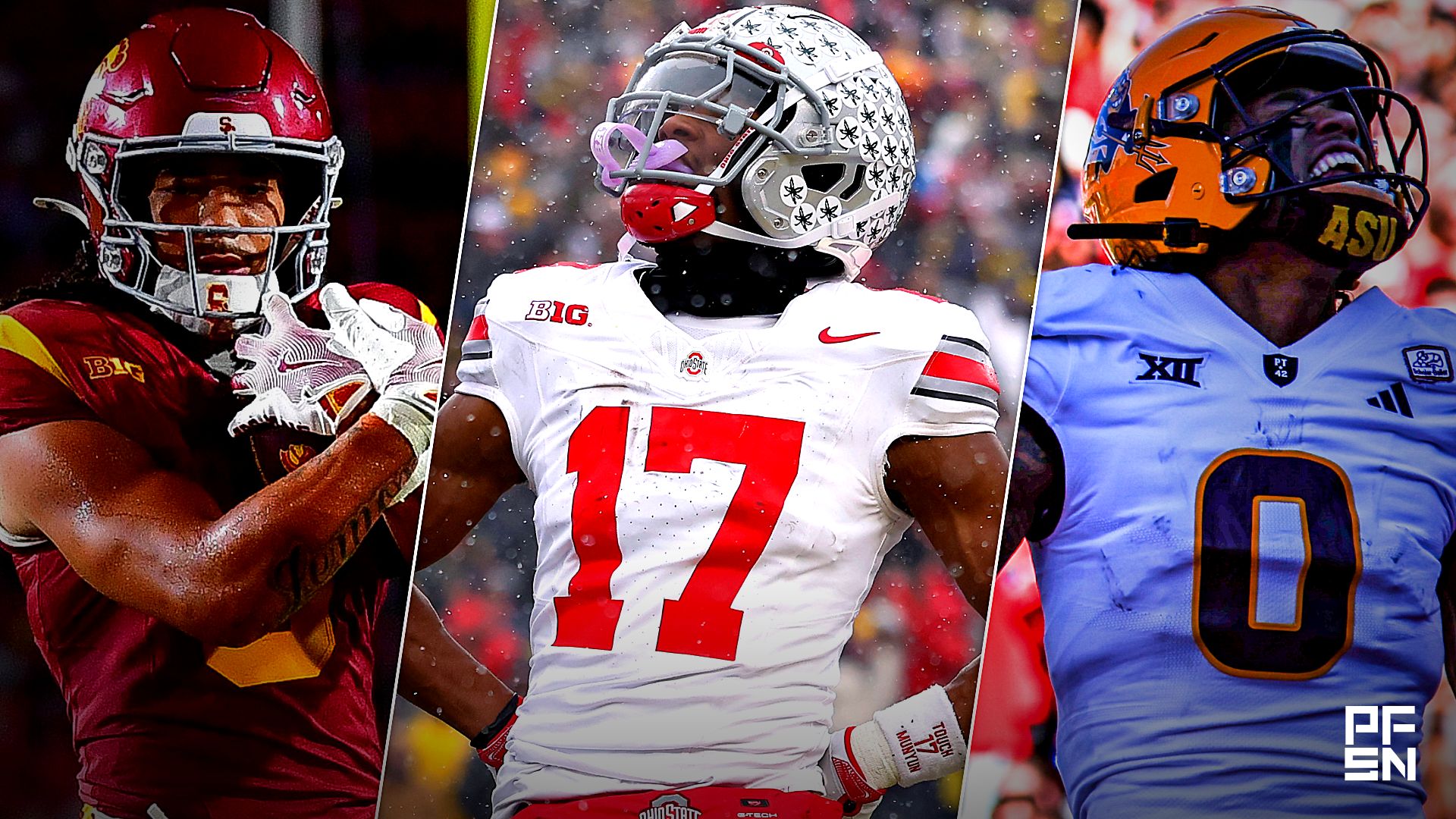
On the eve of the 2026 NFL Draft, this one-round mock looks at how things could realistically play out when teams are on the clock. These picks came together during episode 19 of “Football Debate Club,” where the board was worked through live using PFSN’s NFL Mock Draft Simulator, mixing team needs, player fits, and real debate along the way.

1) Las Vegas Raiders
Fernando Mendoza, Indiana | QB
The Las Vegas Raiders’ first overall pick might as well be written in Sharpie, and there was no debate as to who the selection would be. Fernando Mendoza checks every box as a well-built, poised, and intelligent quarterback who sees the field clearly and operates with natural timing.
The Heisman Trophy winner pairs excellent pocket presence with a strong arm that can deliver strikes at every level, making him one of the most polished passers in this class with both a high floor and clear big-play upside. His production backs it up, too, earning an elite 93.3 PFSN QB Impact Score in 2025 along with a 0.56 EPA per Clean Dropback, per TruMedia. In structure, Mendoza brings the prototypical size, arm talent, processing speed, accuracy, and poise needed to step in and thrive right away at the NFL level.
2) New York Jets
David Bailey, Texas Tech | EDGE
With multiple first-round picks in the 2026 NFL Draft, the New York Jets are in a strong position to accelerate their rebuild, and they start on the defensive side with no quarterback on the board worthy of the No. 2 selection. David Bailey fits the bill as a high-impact addition, coming off a dominant 2025 season in which he posted a 92.9 PFSN EDGE Impact Score, 14.5 sacks, and a pressure rate north of 22%, per TruMedia.
At 6-foot-4 and 251 pounds with near-34-inch arms, Bailey brings a powerful build, but it’s his burst and urgency that separate him. He’s pass-rush lightning in a bottle, pairing elite first-step explosiveness with the flexibility to turn the corner and a refined hand arsenal that allows him to consistently win against offensive tackles. His stock surged even further after a stellar Combine performance that included a 4.50 40-yard dash and a 1.62 10-yard split, reinforcing his elite athletic profile.
There’s also a level of certainty in Bailey’s projection. With over 1,300 career snaps off the edge, he offers a much larger sample size than some of the other high-upside prospects in this class. That experience shows up in his polish and consistency, giving him a higher floor as a more developed, technically sound pass rusher who can contribute right away while still offering impact upside.
3) Arizona Cardinals
Arvell Reese, Ohio State | EDGE
It’s a tight call between David Bailey and Arvell Reese, especially depending on how much weight you place on immediate impact versus long-term upside. Bailey offers the safer projection as a polished, high-floor edge rusher, but Reese brings a ceiling that’s hard to match in this class.
At 6-foot-4 and around 245 pounds with elite speed and explosiveness, Reese is a rare athlete whose 23.1% win rate on blitz and pass-rush reps in 2025 highlights just how disruptive he can be. He has the raw power to collapse pockets, but what really separates him is the flexibility and cornering ability he flashes, traits that point to legitimate EDGE upside despite his off-ball background. At just 20 years old, he’s still developing, which makes his trajectory even more enticing.
An argument could be made that Reese is the best overall player in this draft. He gives Arizona an immediate impact presence at outside linebacker, with the burst, power, and bend to eventually transition into a full-time edge role. His size, length, and physicality already stand out, and when paired with his attacking mentality and athletic profile, it’s easy to envision an All-Pro ceiling if everything clicks at the next level.
4) Tennessee Titans
Jeremyiah Love, Notre Dame | RB
This is where things get interesting for Tennessee. While it may feel early to take a running back for a roster with multiple holes, Jeremiyah Love brings a level of offensive impact that’s hard to pass up. Other options on the board come with positional value questions or off-field concerns, making Love a compelling choice as a true difference-maker.
Love has the explosive second-level athleticism, twitch, and finishing physicality reminiscent of a prime Ahman Green. Excluding positional value, there’s a strong case he’s a top-five player in the 2026 NFL Draft. He’s an explosive runner who combines smart decision-making between the tackles with elite speed, quick feet, and sharp change-of-direction ability. On top of that, his toughness consistently shows up both as a runner and as a receiver after the catch.
For a Tennessee offense in need of playmakers, Love offers immediate juice and long-term star potential, giving them a foundational piece they can build around moving forward.
5) New York Giants
Sonny Styles, Ohio State | LB
With two picks in the top 10, the Giants have flexibility, and while the interior defensive line is worth considering, Sonny Styles is too good to pass up here. New York already has a strong edge rotation with Brian Burns, Kayvon Thibodeaux, and Abdul Carter, but adding a versatile playmaker on the back end helps complete the defense.
Styles gives New York size, speed, versatility, and intelligence as they continue building toward contention. Their record didn’t fully reflect it, but the Giants were competitive against strong teams in 2025 and saw encouraging early returns from Jaxson Dart, even if they’re still a few pieces away from a playoff push.
Styles has grown from a raw athlete into one of the top prospects in the 2026 NFL Draft, with improved instincts that now match his explosive, well-built frame. With a wide tackling radius, aggressive play style, and the ability to impact the game in coverage, he brings an all-around defensive presence that can elevate this unit right away.
6) Cleveland Browns
Monroe Freeling, Georgia | OT
For Cleveland, the decision comes down to prioritizing value and positional scarcity. While wide receiver is tempting, the drop-off at tackle is steeper, making this the right spot to address the offensive line. Monroe Freeling stands out as the best pure left tackle available, and that matters when projecting long-term stability up front.
Freeling is an upside play, but one worth betting on. Despite being just a one-year starter, he showed he can hold his own against SEC competition, flashing rare movement skills for his size. At 6-foot-7 and 315 pounds with near-35-inch arms, he brings a prototype frame, and his fluidity and flexibility make him a natural fit on the left side. His hand usage still needs refinement, but the foundation is there.
Other tackles in this range project more cleanly to the right side, which further elevates Freeling’s value. His combination of size, length, and elite athletic traits has fueled a late rise up draft boards, and while he’s still developing, the ceiling is extremely high. For a Browns team looking to build a strong offensive infrastructure, Freeling offers a long-term answer at a premium position.
7) Washington Commanders
Carnell Tate, Ohio State | WR
This is a spot where Washington can lean into building around its offense, and Carnell Tate makes a lot of sense. Pairing him with Terry McLaurin gives the Commanders a much-needed complement, especially with uncertainty surrounding the rest of the receiver room. Tate brings that “go up and get it” presence, with the size, ball skills, and vertical ability to consistently stress defenses downfield.
He may have flown under the radar at times at Ohio State due to the depth of talent around him, but there’s a strong argument he’s the top wide receiver in the 2026 NFL Draft. His game is built on an enticing blend of size and vertical speed, and his body control at the catch point allows him to win in contested situations. He’s also better vertically than his 40 time suggests, showing an ability to create subtle separation downfield and track the ball naturally.
Tate’s length, separation ability, and high-end ball skills are exactly what Dan Quinn could look for in a true difference-maker on the outside. For Washington, this pick adds a dynamic element to the passing game and gives them a legitimate long-term weapon opposite McLaurin.
8) New Orleans Saints
Rueben Bain Jr., Miami (FL) | EDGE
Rueben Bain Jr. is the pick here, and a big part of it comes down to positional value within this class. EDGE isn’t nearly as deep as corner, and finding a player with Bain’s impact on Day 2 is far less likely. Even with recent off-field concerns, most teams appear comfortable with where things stand, and on the field, his value is undeniable.
Bain is a powerful, explosive edge rusher who consistently wins with force and technique. He plays with a naturally low center of gravity, converts speed to power with ease, and has a deep pass-rush arsenal that allows him to sequence moves and overwhelm blockers. His production backs it up, including a dominant stretch with eight sacks during the College Football Playoff.
At 6-foot-2 and 275 pounds with sub-31-inch arms, he’s not a prototype, but he compensates with strength, burst, flexibility, and refined rushing nuance. He’s also an elite run defender, capable of setting the edge and controlling gaps with physicality. For a Saints defense in need of a true difference-maker up front, Bain offers immediate impact and blue-chip upside as one of the most complete edge prospects in the 2026 NFL Draft.
9) Kansas City Chiefs
Francis Mauigoa, Miami (FL) | OT
With Rueben Bain Jr. off the board, the Chiefs pivot to protecting their most valuable asset. Francis Mauigoa makes a ton of sense here as a long-term answer on the right side, especially with Jaylon Moore currently more of a stopgap option. Pairing Mauigoa with Josh Simmons gives Kansas City a strong foundation moving forward, and most importantly, helps keep Patrick Mahomes upright.
Mauigoa brings a high-floor profile with real versatility. At 6-foot-6 and 330 pounds, he combines functional athleticism with refined leverage and a powerful anchor, allowing him to consistently hold up in both phases. While his arm length may not stand out, his technique does. He lands his hands with precise timing and placement, and once engaged, his grip strength allows him to control reps effectively.
He also shows strong awareness against complex rush looks, rarely overshooting in pass protection, and redirecting smoothly when needed. That combination of polish, power, and positional flexibility gives him immediate value with long-term upside, making him an ideal fit for a Chiefs team looking to stabilize the offensive line and maximize its offensive ceiling.
10) New York Giants
Caleb Downs, Ohio State | S
Caleb Downs is the kind of player who can step in and make an instant impact, and that’s exactly what makes him such an appealing pick here. While Dillon Thieneman is also in the conversation, Downs stands out because of his complete, do-it-all profile. With a coach like John Harbaugh valuing versatility in the secondary, Downs fits perfectly as a chess piece who can line up in the slot as a big nickel, play split-field safety, operate as a single-high defender, or drop into the box as a rover.
BE AN NFL GM: PFSN’s Ultimate GM Simulator
He’s exactly as advertised on film, bringing rare versatility with experience across multiple alignments. Downs is a physical, athletic, and highly intelligent defender with strong ball skills and the range to cover ground in both single-high and two-high looks. While safety value can sometimes make his draft range tricky to project, there’s no questioning the talent. He’s one of the most complete defensive prospects in the 2026 NFL Draft and a player who can elevate a defense from Day 1.
11) Miami Dolphins
Mansoor Delane, LSU | CB
Mansoor Delane stands as the clear CB1, and for a team like Miami, the best-player-available approach points directly to him. His 2025 production was elite across the board, highlighted by a 93.7 PFSN CB Impact Score (No. 1 in the FBS), a 31.4% forced incompletion rate, and an opposing passer rating of just 31.3 on targets, per TruMedia. Those numbers reflect true lockdown ability, backed by consistency over a large sample size.
Delane’s value goes beyond the metrics. He brings the versatility to play both boundary and slot, giving a defense flexibility in how it deploys coverages. His instincts, fluid movement, and competitiveness at the catch point consistently show up on tape, and he pairs that with the physicality needed to contribute in run support.
While offensive line is a consideration, Miami has another first-round pick to address that need. Taking Delane here gives them a premier defensive playmaker with shutdown potential and the ability to elevate the entire secondary from Day 1.
12) Dallas Cowboys
Dillon Thieneman, Oregon | S
With the board falling this way, Dallas has options, but the decision leans toward versatility and long-term stability in the secondary. Dillon Thieneman gets the nod over other considerations, including Jermod McCoy, largely due to scheme fit and fewer medical questions. In a defense rooted in zone principles under Christian Parker, having a hybrid safety who can wear multiple hats is incredibly valuable.
Thieneman fits that mold perfectly. He can operate as a true single-high safety, rotate into split-field looks, or drop into the slot as a big nickel defender. That kind of versatility is becoming essential in today’s NFL, and it aligns well with what Dallas needs at both linebacker and in the secondary. His range and instincts in coverage allow him to impact plays on the back end, while his willingness as a tackler gives him value closer to the line of scrimmage.
After transferring to Oregon in 2025, Thieneman continued to flash his playmaking ability, building on a standout freshman season at Purdue, where he recorded 6 interceptions. While his most recent season graded as a B in PFSN’s CFB SAF Metrics, the traits are still there. He’s a rangy defender with ball skills, downhill physicality, and the upside to develop into a true centerpiece in the secondary. For a Cowboys team with clear needs at corner and linebacker, Thieneman offers a versatile solution that can impact the game in multiple ways from Day 1.
13) Los Angeles Rams
Makai Lemon, USC | WR
The Rams have enough stability along the offensive line with Warren McClendon and Alaric Jackson to pass on forcing a need here and instead lean into a best-player-available approach. That opens the door for Makai Lemon, who adds another dynamic layer to an already dangerous offense.
Pairing Lemon with Puka Nacua and Davante Adams would give Los Angeles one of the most versatile receiving groups in the league. Lemon projects primarily as a high-end slot weapon, but his role in Sean McVay’s system could be much more expansive. Whether it’s schemed touches on in-breakers, slot fades, or back-shoulder looks, his ability to separate and create after the catch makes him a constant mismatch.
An All-American in 2025, Lemon posted 79 receptions for 1,156 yards and 11 touchdowns, showing both reliability and explosive playmaking. He’s a sharp route runner who consistently wins against man and zone coverage, and his quickness, paired with YAC ability, gives him immediate impact potential. In this offense, he wouldn’t just complement the existing weapons; he’d amplify them, making this a fun and highly effective fit.
14) Baltimore Ravens
Olaivavega Ioane, Penn State | OG
Olaivavega Ioane gives you exactly what you want when trying to raise the floor of an offensive line right away. He projects as a rock-solid Day 1 starter thanks to his strong center of gravity, square power, and high football IQ. At the point of attack, he consistently resets defenders with heavy hands, anchors well in pass protection, and brings a physical, mauling presence in the run game.
Ioane’s game is built on leverage and consistency. He uses his hands and pad level effectively to control reps, stays angle-sound, and processes quickly against different fronts and rush looks. That combination gives him one of the higher floors among interior linemen in this class. He was dominant in pass protection at Penn State, providing steady, reliable play even when the rest of the offense struggled.
With the tight end class offering depth into Day 2 and Day 3, prioritizing a plug-and-play interior lineman here makes sense. Ioane stabilizes the unit immediately and gives the offense a dependable presence up front moving forward.
15) Tampa Bay Buccaneers
Kenyon Sadiq, Oregon | TE
The Buccaneers are a tricky team to project here, but this is a spot where leaning into offensive versatility makes sense. Even after re-signing Cade Otton, taking Kenyon Sadiq at No. 15 is a worthwhile swing, especially given the lack of ideal value at edge and linebacker on the board.
Sadiq brings a different dimension to the offense. He’s an elite athlete who consistently separates against man coverage, with reliable hands and the ability to stretch the seam. He can line up in-line, in the slot, or even out wide, giving Tampa Bay flexibility to lean into more 12 personnel looks while still maintaining spacing and explosiveness. With uncertainty around the receiver room following the departure of Mike Evans and ongoing durability concerns for Chris Godwin, adding another dynamic pass-catching weapon becomes even more important.
Sadiq capitalized on his opportunity in 2025 with eight touchdown receptions, flashing his ability as a vertical threat and a dangerous run-after-catch option. For Baker Mayfield, having a versatile target like Sadiq can simplify reads and create easier throws, especially as the offense evolves. He may not be the traditional tight end build, but his receiving upside and ability to stress defenses make him a modern weapon with legitimate first-round value.
16) New York Jets
Jordyn Tyson, Arizona State | WR
With the Jets already addressing EDGE with David Bailey, this pick is easy. Jordyn Tyson, when healthy, has a strong case as a top-10 talent in this class and fills a clear need for more offensive firepower. New York leaned heavily on Garrett Wilson last season, and adding a true three-level threat like Tyson helps balance the attack while easing that burden.
Tyson wins with his agility and route-running nuance, consistently sinking his hips and creating separation underneath while adjusting his tempo and approach based on coverage. He shows advanced footwork and strong pattern recognition, which allows him to uncover at all levels of the field.
While he can be a bit more consistent at the catch point, his reaction quickness, body control, and catch radius all point to high-end upside. He’s also a dangerous RAC threat, pairing vision with burst to create extra yardage. Injury history may impact where he’s selected, but the ceiling remains extremely high for a receiver who can impact the game in multiple ways.
17) Detroit Lions
Spencer Fano, Utah | OT
With Caleb Lomu still on the board, the choice here is Spencer Fano, largely because of how well he fits the scheme. If the goal is to lean into a physical run game with backs like Jahmyr Gibbs and Isiah Pacheco, Fano brings the kind of compact power and leg drive needed to consistently move defenders. He’s more reliable in that phase, generating force while staying square and using his hands efficiently to control reps.
Fano isn’t a finished product. His anchor in pass protection can be inconsistent, and he doesn’t have elite length. But what stands out is the athleticism, flexibility, and mirroring ability he brings to the table. He extracts power from tight spaces, maintains balance through contact, and shows the footwork and lateral quickness to hold up against speed off the edge. Pairing him with Penei Sewell would give this offense one of the most athletic and physical tackle duos in the league.
A position-versatile lineman, Fano checks the boxes for a Round 1 investment. While he may not be the biggest or strongest tackle in the class, he’s one of the most polished, consistently landing his strikes with proper pad level and technique. With his movement skills and overall refinement, he projects as a Day 1 starter with the upside to develop into a high-end offensive lineman.
18) Minnesota Vikings
Jermod McCoy, Tennessee | CB
With no medical flags, Jermod McCoy is a borderline top-10 prospect, and while teams may value him differently coming off injury, the Vikings have a clear rationale to bet on his CB1 upside. McCoy didn’t play in 2025 due to a torn ACL, which could cause a slight slide, but his 2024 tape and pro day testing were both elite. He’s an athletic defensive back with excellent ball-tracking ability, smooth mirroring skills in coverage, and a scrappy, competitive edge in press situations.
There are real shades of Darius Slay in his game, particularly in his hip fluidity, closing speed, and playmaking instincts at the catch point. Like Slay in his prime, McCoy shows the ability to flip and transition over the top of routes with ease, making difficult, high-angle breaks on the ball while maintaining control. He also brings strong production at the catch point, consistently contesting and finishing plays. If he returns to full health, McCoy has all the tools to develop into a true No. 1 corner at the next level.
19) Carolina Panthers
KC Concepcion, NC State | WR
With Omar Cooper Jr. still on the board, the pick here is KC Concepcion, who offers a more refined profile as a separator right now while still bringing vertical juice and dangerous run-after-catch ability. He fits cleanly alongside Tetairoa McMillan as a true movement Z, capable of slicing up man coverage and consistently working open for Bryce Young. While he can clean up the occasional drop, his ability to create separation at all three levels makes him an immediate contributor.
Concepcion is a natural separator with ultra-dynamic RAC ability, combining quickness, burst, and sharp route-running to win consistently out of his breaks. Across his time at Texas A&M and NC State, he’s proven to be a reliable underneath weapon with the versatility to align inside or outside. Adding a player with his skill set would give this passing attack a much-needed boost, bringing both explosiveness and consistency to the receiver room.
20) Dallas Cowboys
Akheem Mesidor, Miami (FL) | EDGE
Akheem Mesidor may not check every traditional Round 1 box at 25 years old with sub-33-inch arms, but his tape makes a compelling case. He’s an explosive, twitchy pass rusher who plays with relentless energy, compact power, and a deep, well-developed arsenal. The tools have always been there, and he finally put everything together in 2025 with Miami, showing he can both set the edge and consistently disengage as a pass rusher.
There’s a strong argument for Dallas to address cornerback here, but the need along the defensive front stands out. Rashan Gary hasn’t ranked inside the top 30 in PFSN EDGE Impact grading over the past three seasons, and while there’s still upside in the room, adding a more consistent presence makes sense. Mesidor brings exactly that. He’s polished, powerful, and technically advanced, giving him one of the higher floors in the class. Despite being an older prospect, he projects as a Day 1 starter who can make an immediate impact with his physicality and refined pass-rush skill set.
21) Pittsburgh Steelers
Omar Cooper Jr., Indiana | WR
Omar Cooper Jr. is an impressive receiver with strong ball skills, coordination, and reliable hands, consistently adjusting to the ball in the air and creating after the catch with agility and toughness. While Pittsburgh already added Michael Pittman Jr., the need for another dynamic weapon still stands, and Cooper fits that mold. He brings a well-rounded skill set with speed, body control, and YAC ability, pairing vision and contact balance to maximize every touch.
There’s also real upside here. Outside of the consensus top tier, Cooper has a case as one of the highest-ceiling receivers in the class, with the potential to develop into a true WR1 if his route running continues to progress. Regardless of the quarterback situation, he projects as a long-term building block, and adding him would give Pittsburgh a much deeper and more dangerous receiving corps than what they fielded last season.
22) Los Angeles Chargers
Keldric Faulk, Auburn | EDGE
Keldric Faulk brings a rare, almost lab-built frame at 6-foot-6 and around 280 pounds with over 34-inch arms, pairing that size with explosiveness, power, and a relentless motor. His ability to generate leverage and hold the point of attack makes him a strong run defender early, while his alignment versatility gives him intriguing upside as a pass rusher. He can win off the edge with his length and burst, but there’s also real value in kicking him inside, where his size-adjusted quickness can create mismatches.
Faulk’s 2025 production dipped, finishing with just two sacks, but the traits remain clear on tape. He sets the edge well, anchors with strength, and flashes the kind of movement skills that hint at more pass-rush upside than the numbers suggest. For a team like the Chargers, who could use reinforcements both on the edge and along the interior of their base front, Faulk offers a true chess piece. He can line up in multiple spots, contribute immediately against the run, and develop into a disruptive presence on passing downs, making him a high-upside addition to the defensive front.
23) Philadelphia Eagles
Caleb Lomu, Utah | OT
Caleb Lomu stands out as the top offensive lineman on the board here, and the value is simply too good to pass up. A smooth, polished left tackle, Lomu didn’t allow a single sack across 382 pass-blocking reps in 2025, showcasing elite consistency with his hand timing, balance, and range in protection. His athleticism, flexibility, and natural sense of timing draw comparisons to Jake Matthews, especially in how he mirrors rushers and stays controlled through contact.
While he’s primarily played left tackle, this is an ideal situation for long-term development. With Lane Johnson still in place, Lomu can afford to sit for a year and refine the footwork and hand usage needed to transition to the right side. Compared to other options like Blake Miller, Lomu’s explosiveness, coordination, and ability to block on the move give him a higher ceiling. Even if he doesn’t start immediately, he projects as a long-term answer at tackle and a potential cornerstone piece once he’s ready to take over.
24) Cleveland Browns
Denzel Boston, Washington | WR
Denzel Boston’s ceiling may vary depending on the evaluator, but his floor as a fluid, explosive zone-glider with vice-grip hands and elite catch-point instincts is appealing on its own. At 6-foot-4 and 209 pounds, he brings the profile of a classic X receiver, combining size, physicality, and reliability in a way that mirrors Michael Pittman Jr. Boston consistently wins above the rim with strong ball skills and coordination, showing the ability to high-point passes and control his frame through contact.
For a Cleveland offense in need of weapons, this is a logical swing. Boston adds a true possession presence to complement a shifty separator like Jerry Jeudy and a speed-based upside play like Isaiah Bond. His route running continues to develop, but he already shows an understanding of leverage, using his hands and footwork to manipulate defenders and create throwing windows.
Whether it’s Shedeur Sanders or Deshaun Watson under center, Boston gives the offense a dependable target with the size, catch radius, and consistency to help stabilize the passing game while offering long-term upside as a potential lead receiver.
25) Chicago Bears
Colton Hood, Tennessee | CB
Colton Hood stands out as one of the better value picks in this 2026 NFL Mock Draft, bringing the reactive quickness, physicality, and playmaking flashes to develop into a long-term starter. With Jermod McCoy sidelined for much of the season at Tennessee, Hood stepped up as CB1 and showed he could handle the responsibility. He’s a lengthy, ball-hawking corner who plays with physicality through routes and has the traits to grow into an impact defender by Year 2 or 3.
For Chicago, this might feel a bit off the beaten path, but it addresses a quietly important need. Tyrique Stevenson has been inconsistent, and while Jaylon Johnson remains a cornerstone, the depth behind him is far from settled. Hood fits the mold of what this defense looks for on the outside, offering size, length, and explosiveness, along with strong ball skills. With multiple Day 2 picks available to address other needs like edge, taking Hood here gives Chicago a high-upside corner who can contribute early and potentially solidify the secondary long term.
26) Buffalo Bills
Zion Young, Michigan State | EDGE
Zion Young is the type of high-motor, high-upside gamble that can pay off early. At around 6-foot-6 and 262 pounds with over 33-inch arms, he brings an ideal power profile, combining explosive athleticism with the strength and length to set the edge and hold up in run defense from Day 1. He finished No. 20 in EDGEi among FBS players, and his steady improvement from Michigan State to Missouri shows a player still trending upward.
Young consistently wins with power, but there’s more nuance to his game than he often gets credit for. His short-area quickness, developing finesse, and expanding pass-rush arsenal allow him to attack blockers in multiple ways and collapse the pocket effectively. He’s a high-floor edge defender with the tools to grow into more, and compared to some of the flashier athletes in this class, he may be better suited for a win-now window. For a team like Buffalo, Young projects as a Day 1 starter who can immediately strengthen the front while continuing to develop as a pass rusher.
27) San Francisco 49ers
Max Iheanachor, Arizona State | OT
Max Iheanachor brings the kind of traits that teams are willing to bet on early: rare athleticism, length, clean pass sets, and natural power. At 6-foot-6 and 330 pounds, he’s an outstanding mover for his size, showing the foot quickness and coordination that hint at a very high ceiling. While he’s still a raw technician and can struggle with pad level, his physical tools stack up with the best tackles in the 2026 NFL Draft.
For San Francisco, the long-term need at tackle stands out, and this is a swing on upside. Iheanachor may not be the most polished option on the board, but he arguably offers the highest ceiling. With Trent Williams and Colton McKivitz in place, there’s no immediate pressure for him to start, giving him time to develop. His background in soccer and basketball shows up in his movement skills, and when paired with his strength and length, it’s easy to see the long-term vision. This is a developmental pick, but one that could pay off in a big way down the line.
28) Houston Texans
Kayden McDonald, Ohio State | DT
The Houston Texans already boast one of the league’s top edge-rushing duos in Will Anderson Jr. and Danielle Hunter, but the interior defensive line remains a clear area for improvement. Adding a true space-eater would help balance the front and create more opportunities for those edge threats to thrive.
Kayden McDonald fits that need perfectly. A thickly built interior presence, he’s arguably the top run-stuffing defensive tackle in the 2026 NFL Draft. McDonald brings a powerful anchor and the ability to two-gap effectively, showing strong spatial awareness and discipline against the run. While he may not rack up gaudy sack totals, he does flash surprising burst off the line for his size.
With Sheldon Rankins offering more quickness and penetration inside, McDonald provides the ideal complement as a physical force who can clog lanes, command double teams, and free up one-on-one opportunities for Houston’s edge rushers. It’s a fit that makes sense both schematically and structurally, giving the Texans a more complete and imposing defensive front.
29) Kansas City Chiefs
Brandon Cisse, South Carolina | CB
Brandon Cisse brings the kind of coverage, mobility, and processing that point to immense upside. After flashing at NC State, his transfer to South Carolina in 2025 helped unlock his full potential, showcasing a freak athlete with strong instincts and the ability to explode out of his breaks and act quickly on what he sees.
For Kansas City, this pick lines up with a clear need after moving on from Trent McDuffie. Cisse stands out as a natural mover, with fluid hips, smooth transitions, and high-end acceleration coming out of his pedal. He’s comfortable working across his body and staying in phase, which allows him to step in and contribute early. While his physicality in coverage is solid rather than elite, his effort in run support and his ability to limit yards after the catch consistently show up on tape.
With his athleticism, quickness, and instincts, Cisse fits what Kansas City needs on the outside and offers the tools to develop into a long-term starter in their secondary.
30) Miami Dolphins
Blake Miller, Clemson | OT
Blake Miller checks every box for a first-round offensive tackle. At 6-foot-7 and 317 pounds with 34-inch arms, he pairs ideal size with an elite athletic profile and brings rare experience, starting 54 career games at Clemson while consistently dominating ACC competition. He wins with accurate hand placement and timing, plays with a nasty demeanor at the point of attack, and shows the kind of power and intelligence that translate immediately to the next level.
Miller’s testing only reinforced what shows up on tape. He already wins with refinement, spatial awareness, and strength, but the athletic upside suggests there’s even more to unlock. That combination of polish and traits gives him both a high floor and long-term ceiling. For Miami, he’d have a strong chance to step in early and compete with Austin Jackson, with the potential to quickly take over and solidify the offensive line as a dependable, long-term starter.
31) New England Patriots
Malachi Lawrence, LSU | EDGE
Malachi Lawrence offers an intriguing blend of finesse and power, with the physical tools to develop into a high-end edge rusher. At 6-foot-4 and 251 pounds with near-34-inch arms, he has a moldable power profile, but it’s his explosiveness, flexibility, and pass-rush nuance that stand out most. With long arms, a wicked first step, and a diverse arsenal of moves, Lawrence brings clear first-round upside as a disruptor off the edge.
While wide receiver is a need, the value at this spot leans toward the defensive front. New England has already added pieces like Dre’Mont Jones and Harold Landry III, but there’s still room for more burst and depth in the pass rush. Lawrence fits that bill. He may need to add strength and improve his consistency as a run defender, but his athletic upside is undeniable. In the short term, he can contribute as a rotational pass rusher while developing into a more complete player alongside veterans like Jones and Kevin Byard III.
32) Seattle Seahawks
Gabe Jacas, Illinois | EDGE
Gabe Jacas has the profile of a Round 1 sleeper, bringing a blend of production, experience, and physicality that fits what Seattle needs off the edge. At 6-foot-3 and 260 pounds with 33-inch arms, he’s a four-year starter, team captain, and former two-time wrestling champion whose background shows up in his leverage and hand usage. His explosiveness is evident with a 95th-percentile 10-yard split, and he backed it up with a 14% pressure rate in 2025 while totaling 19 sacks over his final two collegiate seasons.
Jacas may not be the most flexible edge rusher in the class, but he compensates with strong short-area burst, power, and a deep pass-rush arsenal that allows him to consistently win at the point of attack.
BE AN NFL GM: PFSN’s Ultimate GM Simulator
For Seattle, the need along the defensive front outweighs the urge to address corner, especially with Devon Witherspoon and Josh Jobe already in place. With potential turnover looming in the edge room, Jacas fits the mold of a player who can step in early and strengthen the pass-rush rotation in Mike Macdonald’s defense while continuing to develop into a reliable starter.
