
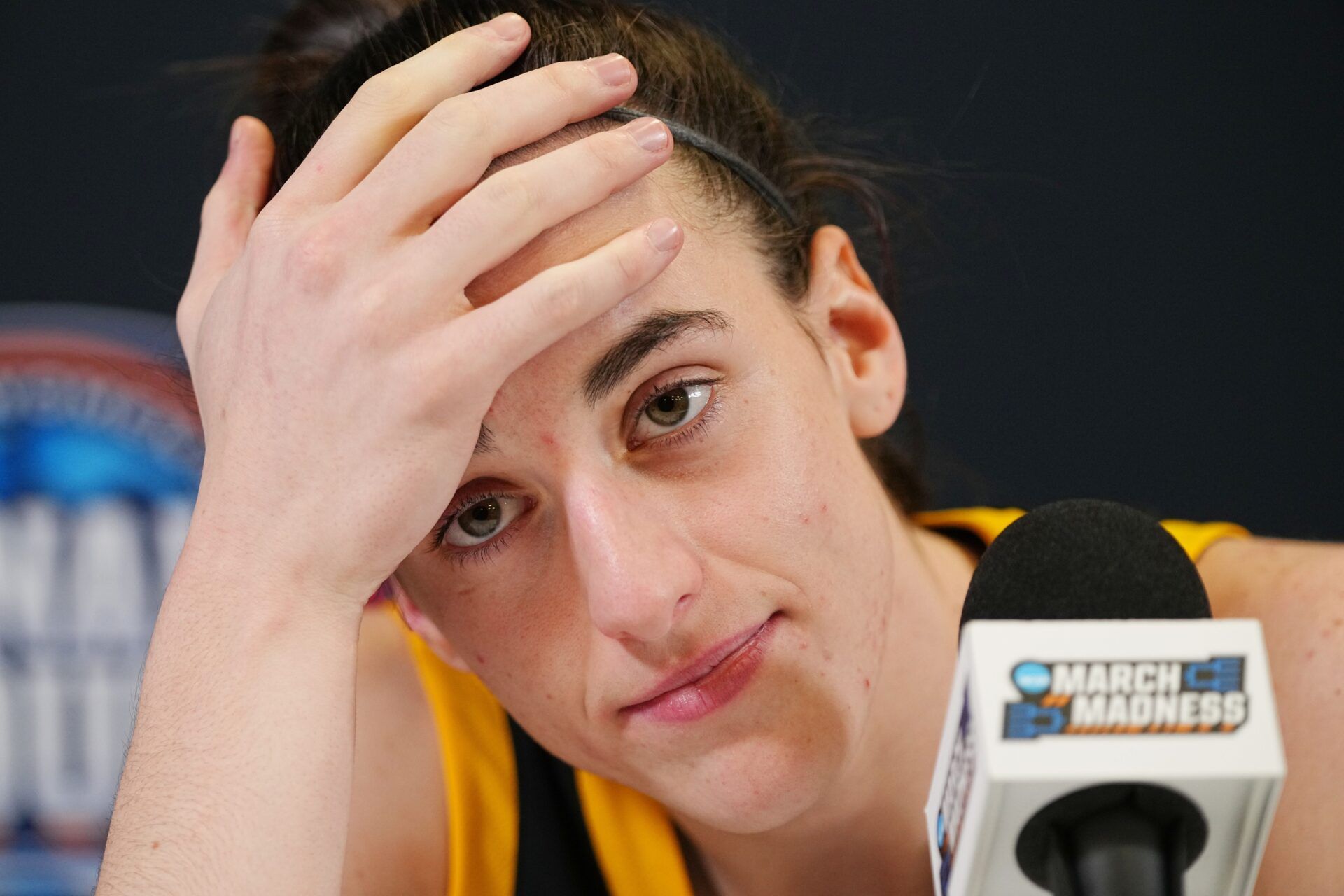
Caitlin Clark’s departure from Iowa did more than mark the end of a historic on-court era. It also exposed how much financial weight one transcendent player carried for an entire program. Newly released NCAA financial data for fiscal year 2025 shows a sharp pullback in revenue for Iowa women’s basketball following Clark’s move to the WNBA.

Ticket Revenue Falls After Caitlin Clark’s WNBA Move, but Iowa Remains Near the Top
In the first full academic year without Clark, Iowa women’s basketball ticket revenue declined by 27%, falling from $3,260,451 in fiscal year 2024 to $2,366,160 in fiscal year 2025. That drop represents a $894,291 decrease in a single year, a scale that underscores how closely demand was tied to Clark’s presence.
Game-day spending followed a similar pattern. Revenue from parking, concessions, programs, and novelty items slid 40%, dropping from $858,548 to $511,960. Team-specific royalties also fell, declining 21% from $470,749 to $370,408.
Taken together, those figures point to fewer casual purchases and less premium spending even as interest in the program remained strong. Despite the downturn, Iowa’s position nationally did not collapse. The $2.37 million ticket total still ranks among the highest in women’s college basketball.
The decline likely allowed Connecticut to reclaim the top spot among public programs at the gate. UConn reported $4.25 million in women’s basketball ticket sales for fiscal year 2025 after Iowa had briefly passed it during Clark’s final season.
Such post-star adjustments are common across college sports. When Deion Sanders left Jackson State to coach at Colorado, Jackson State football ticket revenue dropped from $3.2 million to $2 million. Iowa’s experience fits that broader pattern, though the program remains financially elite by women’s basketball standards.
The contrast becomes sharper when viewed against Iowa’s recent revenue history. In fiscal year 2022, during Clark’s sophomore season, ticket sales totaled $767,000.
During fiscal year 2024, Iowa became the only public Football Bowl Subdivision school whose women’s basketball team generated more ticket revenue than its men’s program.
That season represented the apex of Clark’s financial impact. Iowa led the nation not only in ticket sales but also in related game-day income. All home games sold out months in advance.
Clark was named the nation’s top women’s college basketball player for the second straight year, and Iowa reached the national championship game before losing to South Carolina.
After her exit, the program entered a period of transition. On the court, Iowa finished 23-10 and was eliminated in the second round of the NCAA Tournament as a No. 6 seed.
In her final season at Iowa, Clark delivered one of the most dominant statistical performances the sport has seen. Over 39 games, she averaged 31.6 points, 8.9 assists, and 7.4 rebounds, finishing first nationally in both scoring and assists.
She rewrote the record book, setting new NCAA single-season marks. Clark also eclipsed Diana Taurasi’s NCAA Tournament record for three-pointers and established new tournament career scoring standards.
The season ended with unanimous Big Ten Player of the Year recognition and the 2024 National Player of the Year award, sealing a career in which she posted the highest scoring average, 28.42 points per game, in Division I history.
