
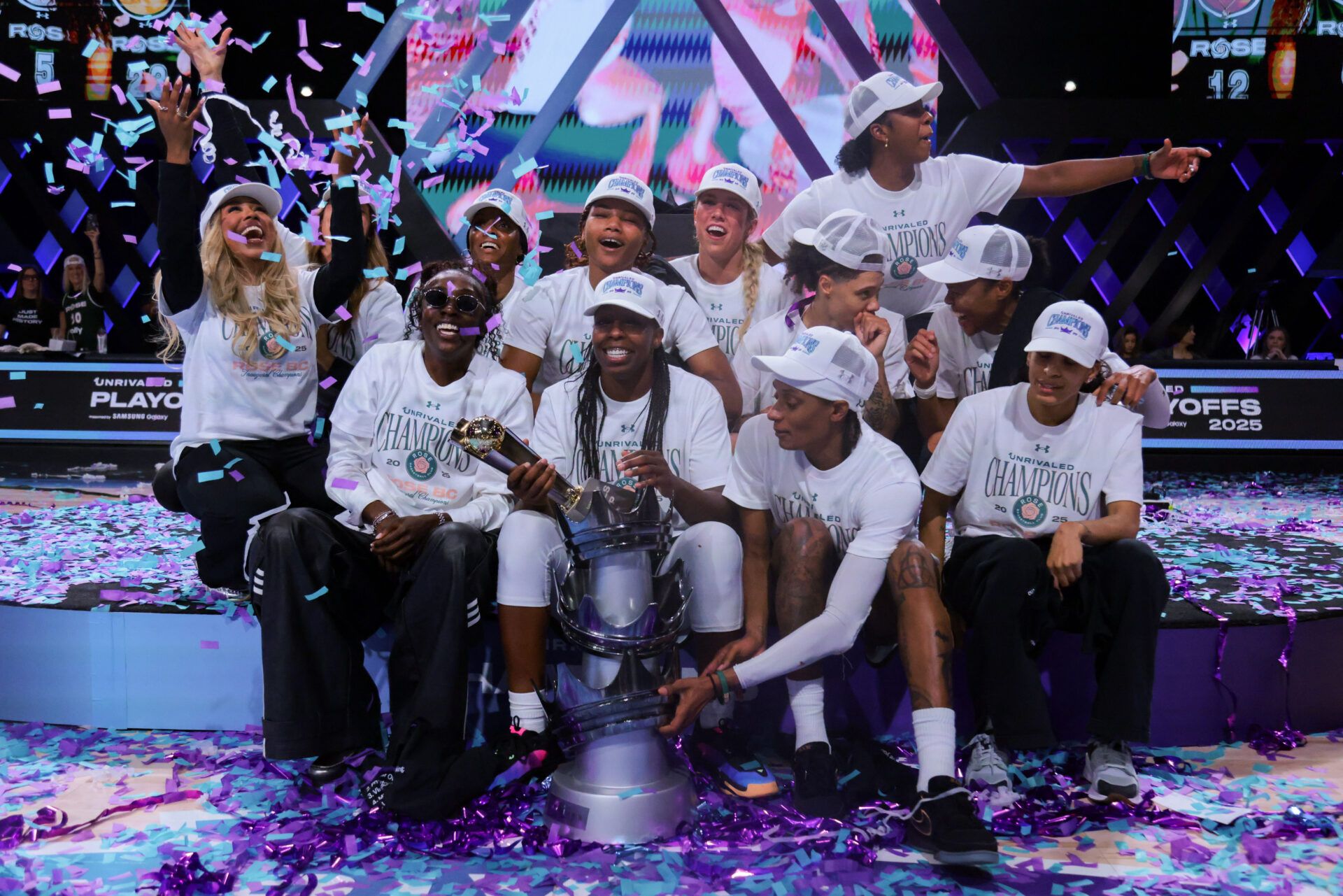
The inaugural season of Unrivaled, the 3-on-3 women’s basketball league founded by Breanna Stewart and Napheesa Collier, began quietly on January 17, 2025. At the time, it was billed as a creative offseason alternative — a chance for WNBA players to stay in shape, make some money, and build visibility during the league’s long winter break.
But within months, that “offseason project” became one of the most talked-about stories in women’s sports. Unrivaled exploded in popularity. By the time its eight-week debut season wrapped, the league had delivered record viewership and A-list investors. Nine months after its inception, its value had gone from a mere $35 million to a staggering $340 million.
The success was staggering enough to make even the WNBA take notice. But it turns out the WNBA once had a chance to be part of that rise and said no.
How Did the WNBA Miss Being a Part of the Unrivaled’s Success?
According to ESPN’s Ramona Shelburne and Kendra Andrews, Unrivaled co-founders Collier and Stewart offered the WNBA a small equity share early in development. The move was meant as a gesture of alignment, showing that the new league wasn’t trying to compete but complement. The offer, however, was rejected.
“Collier and Stewart initially offered the WNBA a small equity share in Unrivaled to show alignment, multiple sources say, but ultimately such a partnership could have violated league rules, and they were turned down,” as per Shelburne and Andrews. “The WNBA was focused on its own revenue growth, and it was still unclear whether Unrivaled would be viable.”
At the time, that logic made sense. The WNBA was finally riding a wave of growth — higher ratings, bigger sponsors, and real financial momentum. The league was projecting revenues to surpass $1 billion for the first time in 2025.
Still, hindsight tells a different story. Within just nine months, Unrivaled’s valuation had soared past $300 million. Backed by investors like Bessemer Venture Partners, Serena Ventures, and Warner Bros. Discovery, it became a business success story no one saw coming.
And the numbers spoke for themselves. The debut season averaged 221,000 viewers across TNT and truTV, with the championship game — Rose BC vs. Vinyl — drawing an audience of 364,000. Over eight weeks, the league reached 11.9 million total viewers, delivering the 10 most-watched women’s basketball games ever on TNT Sports networks.
That kind of impact isn’t typical for a start-up league. It’s a movement, and the WNBA’s decision to walk away now looks like a missed opportunity.
Napheesa Collier’s Unrivaled Seems To Have Found a Rival in the WNBA
Part of Unrivaled’s appeal was its player-first philosophy. Unlike the WNBA, where salaries remain capped and dismal pay has long drawn complaints, Unrivaled promised higher pay, shorter travel, and a real sense of control.
For years, stars like Diana Taurasi, Sue Bird, and Brittney Griner had played overseas in Russia or Turkey to earn what the WNBA couldn’t pay. Now, Unrivaled offered a homegrown solution — competitive pay without leaving the country.
By the time Collier read her emotional four-minute statement during the Minnesota Lynx’s exit interview in September — accusing Commissioner Cathy Engelbert of toxic leadership and saying players should be “grateful on their knees” for TV deals, the divide was already visible.
Behind the scenes, relations had deteriorated fast. Sources say Engelbert met privately with Collier and her husband, Unrivaled president Alex Bazzell, back in February to discuss the league’s rapid growth. What began as a conversation about cooperation reportedly turned into one about competition.
Now, many around the league see Unrivaled as a direct rival rather than an ally. The irony, of course, is that both leagues are thriving. Deloitte projects the WNBA’s value to cross $1 billion this year, while Unrivaled has built a self-sustaining model off player ownership and brand freedom.
Players like Angel Reese, Chelsea Gray, Arike Ogunbowale, Kelsey Plum, Jewell Loyd, and Rhyne Howard all suited up in Season 1, proving that the best talent is no longer confined to one league.
And while the WNBA remains the crown jewel of professional women’s basketball, the arrival of Unrivaled has shifted power dynamics in ways few could have predicted.
Collier, once just a star player, is now something more: an executive and, in many ways, the face of a changing era. Her league has become a mirror, reflecting everything players have wanted: better treatment, bigger checks, and more say in their careers.
The WNBA may have turned down that early equity offer, but in doing so, it may have also sparked the creation of its greatest challenger yet.
