
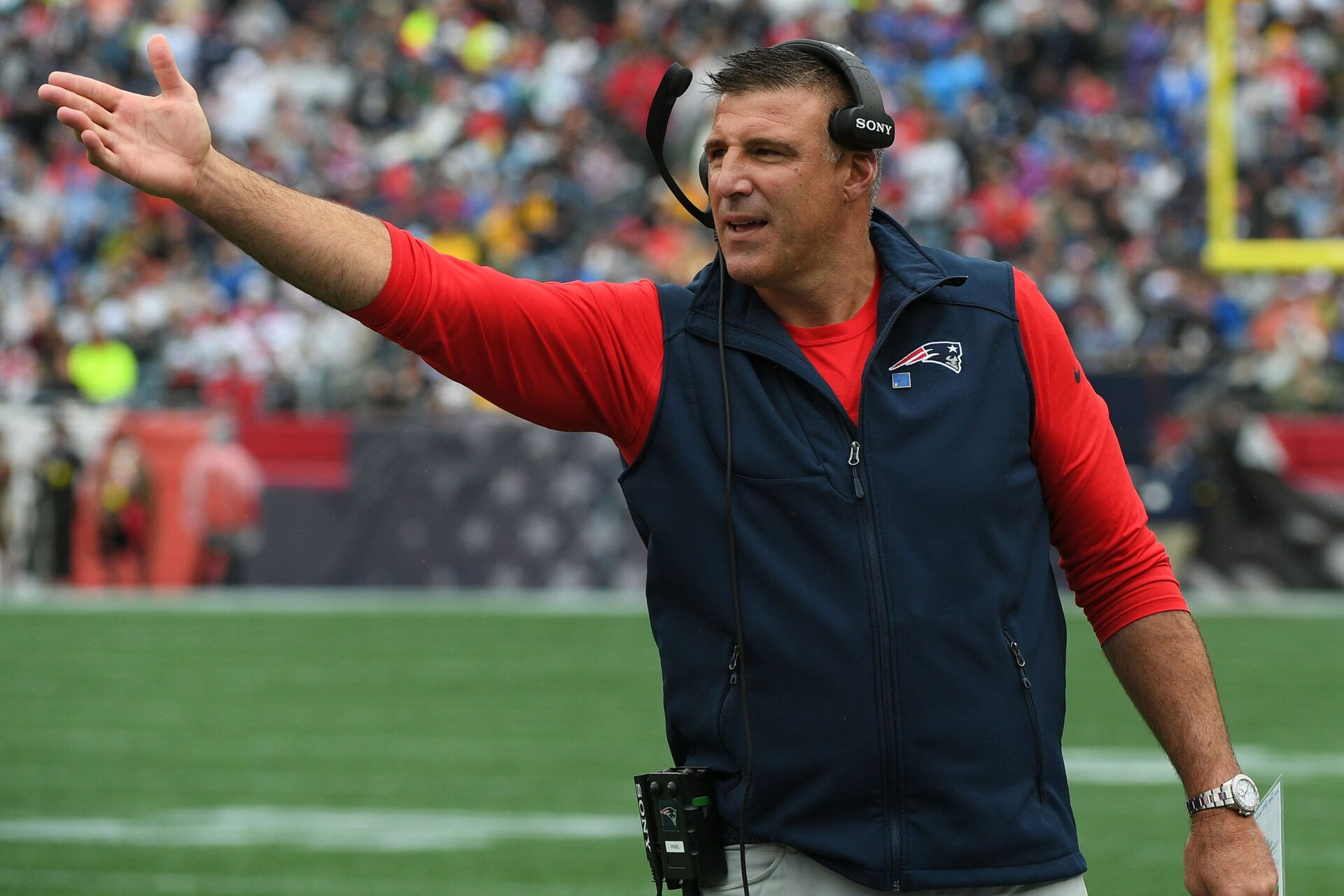
Only eight coaches in NFL history had taken a team to the Super Bowl in their first season leading a new team. That exclusive group reflects how rare it is for a new voice to reshape a franchise quickly enough to reach the sport’s biggest stage.
Mike Vrabel now joins that company after orchestrating one of the most dramatic turnarounds in recent NFL history with the New England Patriots.
From inherited contenders to overnight transformations, these coaches delivered immediate results that defined their legacies and, in some cases, changed NFL history.
Mike Vrabel, New England Patriots (2025-26)
When Vrabel took over as head coach of the New England Patriots in January 2025, few expected the championship turnaround that followed.
In his first season with the franchise, where he won three Super Bowls as a player, Vrabel guided the Patriots from back-to-back 4–13 campaigns to a 14–3 regular-season record, an AFC East title, and a Super Bowl berth, tying the largest single-season improvement in NFL history by a first-year head coach.
If Vrabel, who was named the 2025 AP NFL Coach of the Year, wins Super Bowl 60, he would become the first person to win a championship as both a player and head coach for the same team, and the fifth head coach to win it in his first season with a franchise.
Gary Kubiak, Denver Broncos (2015-16)
Kubiak took over the Denver Broncos in 2015 after John Fox’s departure, inheriting a team with veteran leadership and a historically dominant defense. In his first season, Kubiak led Denver to a 12–4 regular-season record, claiming the top seed in the AFC behind Peyton Manning’s experience at quarterback and a fierce Von Miller-led pass rush.
The Broncos defense overwhelmed opponents en route to Super Bowl 50, where Kubiak’s unit defeated the Carolina Panthers 24-10. Miller’s MVP performance highlighted the team’s identity, and Kubiak became one of the rare head coaches to win a Super Bowl in his first season with a team, earning Denver’s third Lombardi Trophy.
MORE: Try PFSN’s FREE Mock Draft Simulator
Kubiak came up 0-3 on the biggest stage during his playing career, but the former Broncos eighth-round pick is the first person to play in the Super Bowl and go on to win it as a head coach, both with the same team. Tom Flores, Mike Ditka, Tony Dungy, and Doug Pederson each won a Super Bowl as both a player and a head coach, though with different franchises.
Jim Caldwell, Indianapolis Colts (2009-10)
Stepping into Tony Dungy’s shoes was no small task, but Jim Caldwell wasted little time steadying the Colts. In 2009, he guided a Peyton Manning-led roster to a 14–2 record, including a 14–0 start, reinforcing that Indianapolis remained elite despite the coaching change.
Caldwell’s first postseason run carried the Colts to Super Bowl 44, where they got ambushed by a New Orleans Saints team firing on all cylinders. Indianapolis struggled to keep pace and ultimately lost 31–17, bringing Caldwell’s phenomenal rookie season to a close.
Jon Gruden, Tampa Bay Buccaneers (2002-03)
In February 2002, the Tampa Bay Buccaneers acquired Jon Gruden from the Oakland Raiders in a blockbuster coaching trade, sending two first-round draft picks, two second-round draft picks, and $8 million to Oakland for his rights. Gruden signed a multi-year contract and quickly justified the move, leading the Buccaneers to a 12–4 regular-season record and the NFC South title.
Tampa Bay then defeated the San Francisco 49ers and Philadelphia Eagles in the playoffs to reach Super Bowl 37, where, facing his former team, Gruden guided the Buccaneers to a decisive 48–21 victory over the Raiders. The win delivered Tampa Bay’s first Super Bowl title and made Gruden the youngest head coach to win a championship at 39 years old.
Bill Callahan, Oakland Raiders (2002-03)
Bill Callahan served as head coach of the Oakland Raiders in 2002 after Gruden was traded to Tampa Bay, posting an 11–5 regular-season record and an AFC West championship out of the gate. Oakland marched through the AFC playoffs, defeating the New York Jets and Tennessee Titans to reach Super Bowl 37, but fell short against Gruden’s Buccaneers when it mattered most.
READ: Top 100 2026 NFL Free Agent Rankings: Where Do George Pickens, Daniel Jones Rank?
Callahan was later publicly accused by former players Tim Brown, Jerry Rice, and others of sabotaging the Raiders’ Super Bowl game plan, possibly due to his relationship with Gruden and his frustrations with the organization, which he denied and expressed disappointment over.
George Seifert, San Francisco 49ers (1989-90)
George Seifert was promoted to head coach of the San Francisco 49ers in January 1989, succeeding Bill Walsh after a Super Bowl victory the previous season. Meeting the high expectations set, Seifert led his team to a 14–2 regular-season record, the NFC’s top seed, and a Super Bowl 24 matchup against the Denver Broncos on Jan. 28, 1990.
San Francisco dominated the game by the largest margin of victory in Super Bowl history, 55-10, winning the franchise’s fourth Lombardi Trophy in Seifert’s first season.
Red Miller, Denver Broncos (1977-78)
After the previous Denver head coach, John Ralston, resigned, Red Miller took the 1977 Broncos to a 12–2 regular season and the team’s first Super Bowl appearance. Denver was anchored by the legendary Orange Crush Defense, led by linebackers Randy Gradishar, Bob Swenson, and Tom Jackson, while veteran quarterback Craig Morton ran the offense.
However, the Broncos were unable to stop the Tom Landry-coached Dallas Cowboys in Super Bowl 12, which was played on Jan. 15, 1978. Led by quarterback Roger Staubach, running back Tony Dorsett, and their own legendary Doomsday Defense, the Cowboys overpowered Denver, 27–10.
Don McCafferty, Baltimore Colts (1970-71)
Don McCafferty was elevated to head coach of the Baltimore Colts for the 1970 season after Don Shula left for the Miami Dolphins. With veteran quarterback Johnny Unitas in charge of the offense, the Colts won the AFC East and finished 11–2–1. In Super Bowl 5, Baltimore edged out the Dallas Cowboys, 16–13, on a last-second field goal by Jim O’Brien, making McCafferty the first rookie head coach to win a Super Bowl.
