
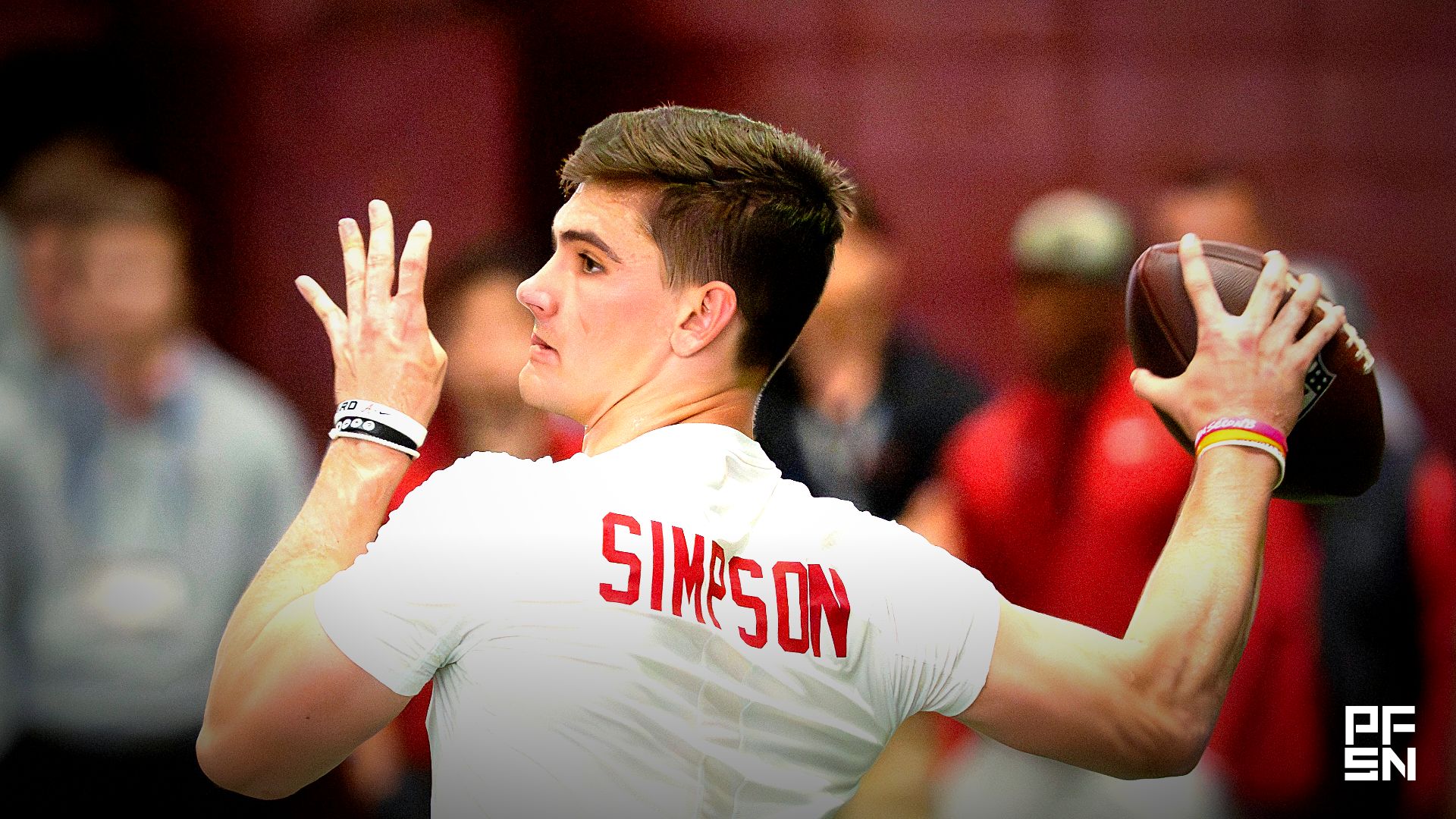
Ty Simpson, the Alabama quarterback, stood in front of dozens of NFL scouts on March 25 and answered the question directly.
“Absolutely,” Simpson said when asked if he believes he is a first-round pick. “I feel like I’ve done everything I can, but it’s not up to me. I just know that wherever I go, I’m going to give it my all and make sure I’ll put my best foot forward.”
He had just put together a clean throwing session at Alabama’s pro day, 40-plus minutes, scouts from all 32 teams watching, essentially one imperfect moment (a deep ball his receiver did not haul in). The confidence in the statement was earned in the moment. Whether the moment translates to Thursday night is the question that is splitting the draft community.
Ty Simpson’s Case to be a First Round Pick
The scouting report on Ty Simpson starts with his mechanics. Evaluators have praised his footwork and release timing in consistent terms: clean, polished, NFL-ready. The foundation that most quarterback prospects spend years correcting is already there.
PFSN’s NFL Draft Analyst Ian Cummings had this to say about Simpson. “One of Simpson’s best traits is his mechanical profile; he has some of the cleanest throwing form in the class, with consistent sync and hip torque across situations. And in his best moments, he’s shown he can quickly discern coverage voids pre-snap and anticipate over the middle.
That said, his post-snap processing and trigger run hot-and-cold, his situational precision falters too often in spite of his solid mechanics, and his non-elite arm strength shows up when attempting to drive passes downfield.”
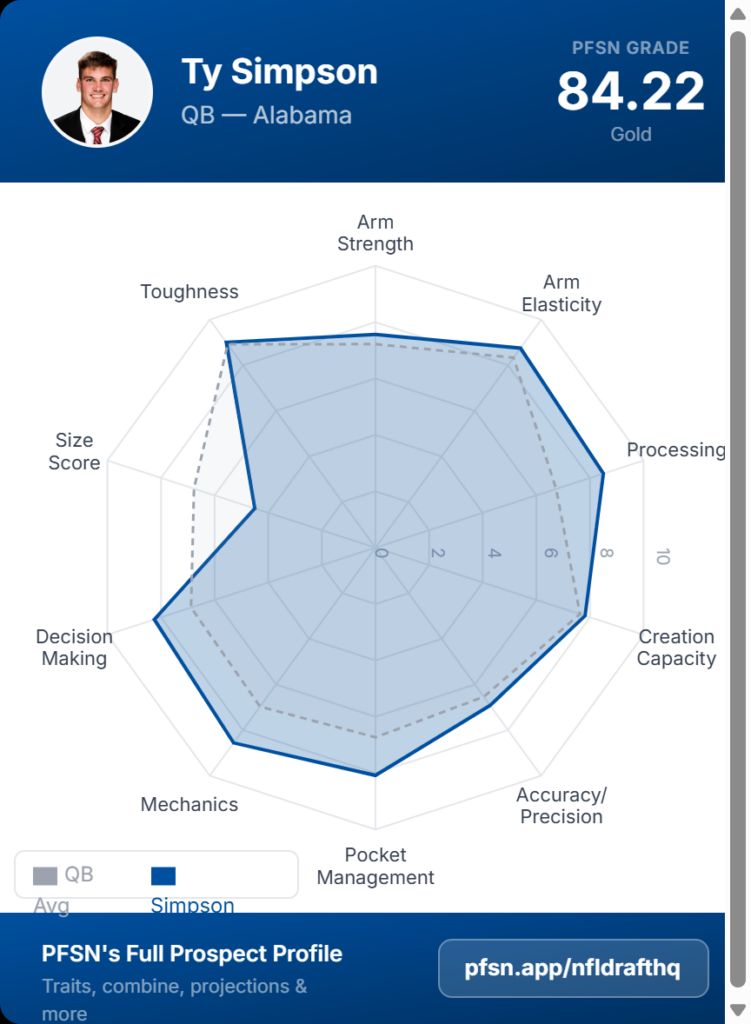
When asked if Simpson was a first-round pick, Cummings added: “I think Ty Simpson can be a solid NFL starter, but I don’t think he has a first-round profile. That’s for a multitude of reasons, but it primarily boils down to being uncertain whether or not he can elevate an NFL roster to Super Bowl contention. He’s 6’1”, 211 pounds, with good-not-great arm talent and good-not-great athleticism.
He’s a one-year collegiate starter who, despite his solid PFSN QB Impact score of 85.4, only had one game with a score above 80 over the course of the 2025 season, and none in SEC play. At his best, Simpson appeared to have the requisite processing ability, mechanical congruence, and baseline talent to be a first-round pick. But down the stretch, Simpson’s consistency wavered, and mechanical and mental freneticism, particularly against pressure, got the best of him too often in big-time games.
It’s important to note that Simpson was dealing with multiple injuries late in the year, including a severe case of gastritis. Fully healthy, his film was at its most consistent and most confident. Ideally, however, NFL teams would have had more top-end film to make a ruling off of. The fact of the matter is, the sample size is too small to guarantee a prospect like Simpson, who’s good but not an elite in talent categories, the benefit of the doubt. I would value him as an early-to-mid Round 2 prospect. First round may be too risky. If he works out, no one will remember the risk or the opportunity cost. If he doesn’t, it’s all they’ll remember.”
His 2025 season at Alabama backed the scouts up. After spending three years on the roster, one year behind Bryce Young in 2022 and two years behind Jalen Milroe in 2023 and 2024, Simpson won the starting job and ran with it: 3,567 yards, 28 touchdowns, 5 interceptions, a 64.5 percent completion rate across 15 starts.
He led the Tide to an 11-4 record, the SEC Championship Game, and the CFP quarterfinals. He earned second-team All-SEC honors from both the Associated Press and the conference coaches. The production was not a mirage. He finished the year with an 85.4 PFSN CFB QB Impact Score (B).
His pro day throwing session drew a Grade A assessment from most evaluators in the building. The short-area quickness scouts value in pocket quarterbacks showed up in the on-field work. He has a legitimate arm. His deep ball showed up on Alabama film and showed up again on the pro day field, even if the one uncompleted deep attempt came off a receiver’s hands.
ESPN’s Matt Miller and most public boards rank Simpson as the number two quarterback in this class, behind consensus QB1 Fernando Mendoza. The gap between them, on the dimensions that matter most for a pocket passer (decision speed, trigger quickness, accuracy against zone), is narrower than his physical profile or experience level would suggest.
The number that keeps appearing in every evaluation conversation is 15.
Fifteen career starts and one season as a starting quarterback. Three years on the roster at Alabama before he took a meaningful snap as the starter. The entire body of film evaluators is working with is from a single season at 23 years old. That is not a disqualifying fact. Plenty of successful NFL quarterbacks had limited starts in college. It is a real constraint on the certainty teams can feel about a first-round investment.
At 6-foot-1 and 211 pounds, Simpson is below the physical threshold most franchises set for a franchise quarterback. His arm length is 30 and 7/8 inches. His hand size is 9 and 3/8 inches. None of those numbers is unusual for a smaller-framed quarterback prospect, but none of them gives a team’s front office the instant comfort that a 6-foot-4, 225-pound passer does when they are spending a top-32 pick.
Ty Simpson’s Landing Spot Problem
Miller’s 25 percent first-round projection is not about Simpson’s ability. It is about the draft board.
The teams picking in the first 16 selections do not, by and large, need a quarterback. The teams that might, and the scenarios under which any of them would reach for Simpson, are specific and not guaranteed.
The Arizona Cardinals have emerged as the heavy favorite to draft Simpson. They hold the third overall pick and have spent pre-draft visits on him, though a reach at No. 3 is viewed as unlikely, and the more plausible scenarios involve trading back into the late first round or selecting him at No. 34. According to PFSN’s NFL Mock Draft Simulator data, Simpson is drafted by the Cardinals nearly 10% of the time.
The Jets, who hosted Simpson for a private pre-draft workout in Tuscaloosa on March 30, are also in the conversation, with picks at second and 16th overall.
A team trading back into the first round to take Simpson is theoretically possible. In practice, it requires a buyer and a seller to align on a quarterback who, by most consensus boards, falls right on the Round 1/Round 2 border. That alignment is harder to engineer than it sounds.
The Steelers Conditional
The most important variable in Simpson’s draft outcome is not his tape. It is Aaron Rodgers.
If Rodgers returns to Pittsburgh, a decision that has not been made with the draft tonight, the Steelers do not need a quarterback at pick 21. However, if Rodgers does not return, Pittsburgh is the most natural first-round landing spot for a quarterback in this class, and Simpson is the most natural fit for that pick.
BE AN NFL GM: PFSN’s Ultimate GM Simulator
That condition has been hanging over every Simpson evaluation since March. Multiple analysts have run the same projection with the same caveat.
As of Monday, NFL insiders Ian Rapoport and Tom Pelissero reported the Steelers do not expect an answer from Rodgers before the draft begins, and everything hinges on a decision yet to be made.