
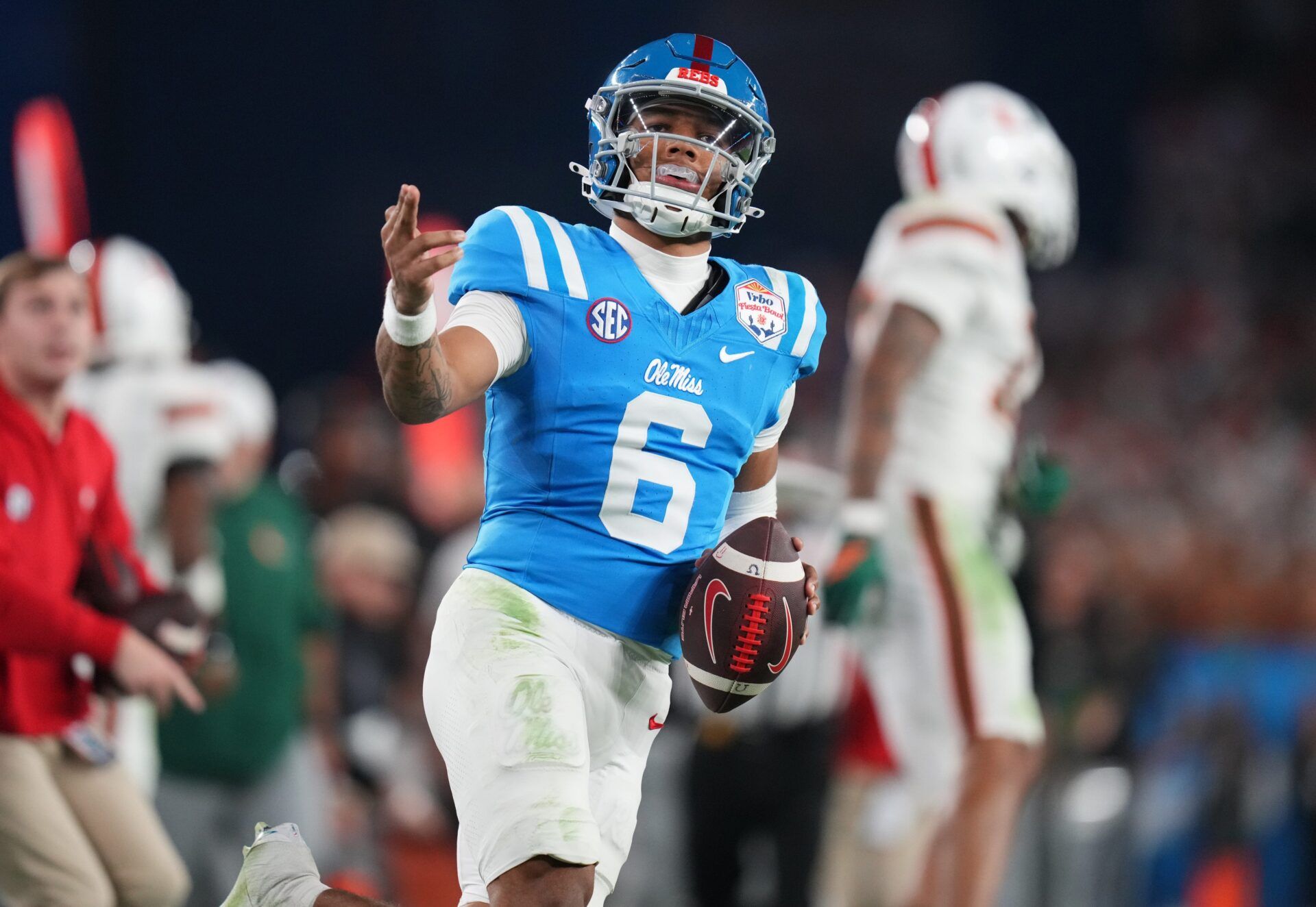
When the NCAA denied Ole Miss quarterback Trinidad Chambliss an additional year of eligibility, it closed the door on what many believed would be a crucial final chapter in his college development. But in the NFL world, doors rarely stay shut for long.
Instead, Chambliss now enters the 2026 NFL Draft with momentum, intrigue, and opportunity, perhaps more than any quarterback in a class widely viewed as lacking elite top-end QB talent. What initially felt like a setback could ultimately prove to be a blessing in disguise.
2026 NFL Draft Quarterback Class: Opportunity for Risers
Early evaluations of the 2026 draft paint a clear picture: there is no consensus superstar quarterback prospect separating himself from the field. That reality alone creates fertile ground for risers, and Chambliss may be best positioned to capitalize on it.
According to the PFSN Consensus Big Board, the top two quarterbacks are Fernando Mendoza (Indiana) and Ty Simpson (Alabama). Chambliss currently sits just behind Simpson at QB3.
At first glance, Chambliss’s ranking might feel discouraging. Ty Simpson sits comfortably at 30th overall with a draft grade of 84.92, while Chambliss checks in at 143rd with a 79.78. On paper, that gap looks significant, but context tells a different story. Factors like system fit, late-season momentum, and dual-threat ability suggest Chambliss could be considerably undervalued at this stage of the draft process.
One reason for the gap could be timing. Many analysts expected Chambliss to win his eligibility appeal and return to college football for another season. That assumption likely delayed deeper film study and comprehensive scouting reports, leading to him being somewhat glossed over in early evaluations.
When the tape is examined closely, the comparison between Chambliss and Simpson becomes far more nuanced.
Production vs. Perception
PFSN’s metrics paint a striking picture of Chambliss’s impact last season. He posted a 90.3 PFSN CFB Quarterback Impact Grade, the fifth-best in the nation, while Ty Simpson earned an 85.4, ranking 25th. The difference highlights just how consistently effective Chambliss was on the field.
READ MORE: Super Bowl 60 Predictions: Predicting the Winner, Final Score, MVP, and More
Simpson burst onto the scene early, generating Heisman buzz through the first half of the season. But as defenses gathered tape and adjusted, his production plateaued. Chambliss followed the opposite trajectory.
Chambliss entered the season as an afterthought, not even expected to start. An injury changed everything.
From that moment on, his growth was undeniable. Week after week, his confidence rose, his command of Lane Kiffin’s offense sharpened, and his ability to elevate those around him became clear.
That progression culminated in one of the most impressive runs of the season. Chambliss led Ole Miss to the College Football Playoff semifinals, including a statement win over Georgia, and pushed Miami to the brink, falling just one victory short of a national championship appearance.
Experience also leans in his favor. While many of Chambliss’ earlier starts came at the Division II level, he still logged 13 total starts this season, matching Simpson’s total at the Division I level. Notably, this was Simpson’s first year starting for Alabama, making their respective learning curves an important point of comparison.
Physical Tools, Traits, and Scheme Fit
Physically, the two quarterbacks are nearly identical on paper:
- Simpson: 6’2”, 208 lbs
- Chambliss: 6’1”, 200 lbs
Any lingering size concerns will be clarified at the NFL Combine, where height, weight, and hand measurements will offer definitive answers.
Stylistically, the contrast is clearer. Simpson is viewed as the more cerebral, mechanically refined quarterback. Chambliss, on the other hand, brings superior athleticism, off-script creativity, and playmaking ability. Arm strength appears comparable, but side-by-side throwing sessions during the pre-draft process will be critical in separating the two.
One frequent knock on Chambliss is the system he played in. Some view Lane Kiffin’s offense as a negative when compared to Simpson’s experience in a pass-heavy Ryan Grubb/Kalen DeBoer scheme.
That criticism doesn’t fully hold up.
Kiffin’s system has produced NFL quarterbacks, including Matt Corral and Jaxson Dart, and Kiffin himself has NFL coaching experience. Playing in his offense shouldn’t be viewed as a red flag, but rather as evidence of Chambliss’ ability to operate efficiently in a modern, pro-influenced attack.
This isn’t a knock on DeBoer’s system, but dismissing Chambliss because of Kiffin’s scheme oversimplifies the evaluation.
When viewed holistically, the gap between Simpson and Chambliss appears far narrower than current rankings suggest. As the pre-draft process unfolds, through interviews, private workouts, and deeper film evaluation, Chambliss has a real opportunity to climb.
If his football IQ, leadership, and understanding of X’s and O’s match the playmaking ability he’s shown on the field, a reshuffling near the top of the quarterback board is very much in play.
One door closed when the NCAA denied his appeal. Another opened straight into the 2026 NFL Draft spotlight. And by the time draft night arrives, Trinidad Chambliss may no longer be chasing the field; he may end up leading it.
