
No other week in the NFL calendar has more pressure for prospects than Combine week. Throughout the city of Indianapolis, NFL scouts, GMs, and coaches will be running around trying to watch and analyze this year’s NFL Draft class. While quarterbacks generally steal the headlines at the combine, this year will be an exception.
There’s really only one consensus number-one overall pick, and that’s Indiana’s Fernando Mendoza. Luckily for NFL Draft enthusiasts, all of the top receivers in this year’s class will be working out and looking to put on a show.

Carnell Tate, Ohio State
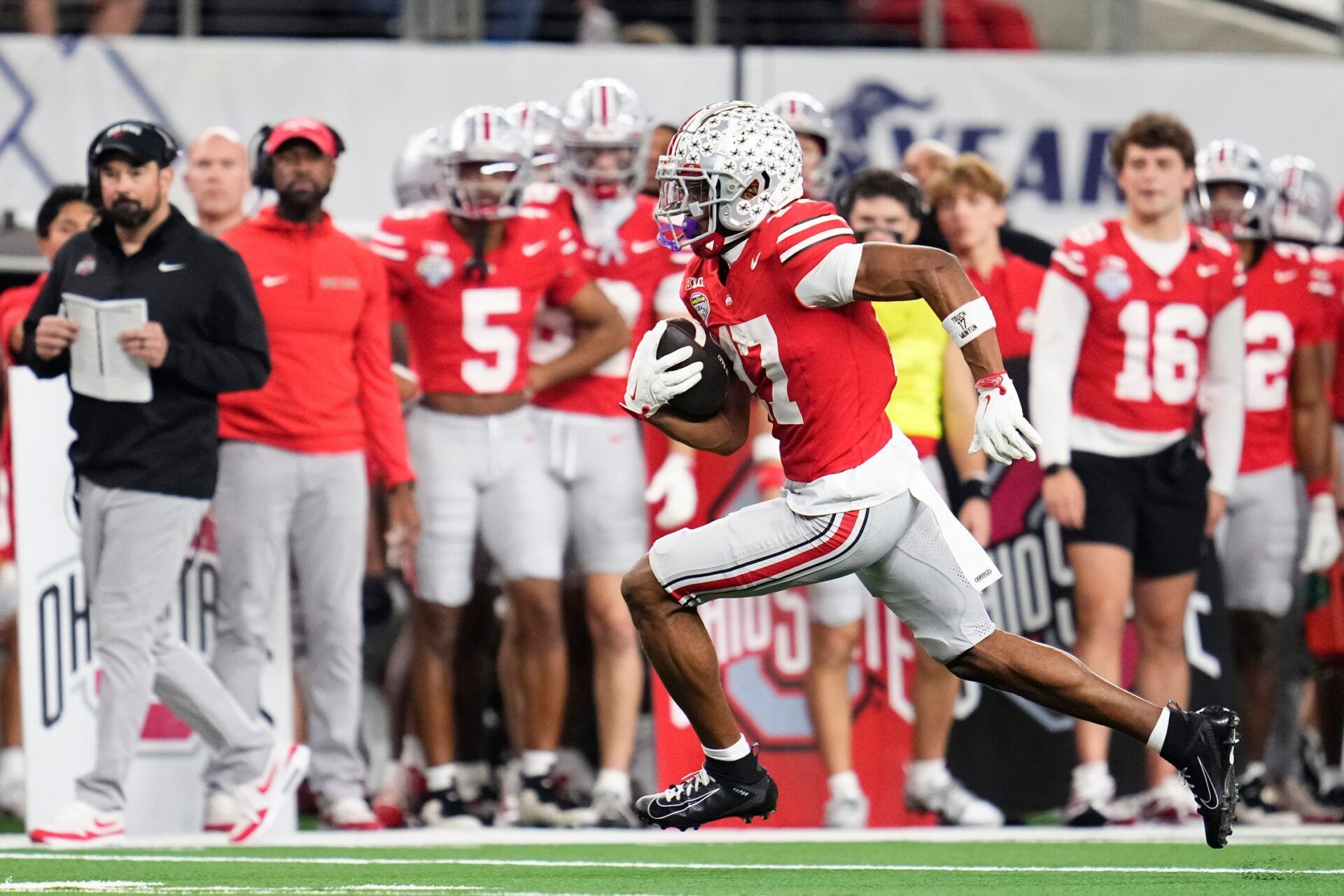
Ohio State wide receiver Carnell Tate has separated himself as the top receiver in this year’s class. The 6-foot-3 wideout entered the 2025 season under the radar, but exceeded expectations.
Over the course of the season, Tate demonstrated his potential as a WR1, recording 875 yards and 9 touchdowns. While he may not showcase the same yards after catch (YAC) ability as Makai Lemon or the extraordinary athleticism of Jordyn Tyson, Tate presents a strong profile as a true X receiver.
Jordyn Tyson, Arizona State
Jordyn Tyson opened the year as PFSN’s top-ranked wide receiver prospect in the 2026 NFL Draft class. But an injury-plagued second half of the season shifted the conversation, creating room for Makai Lemon and Carnell Tate to gain momentum as contenders for the top receiver spot.
Across two seasons with the Arizona State Sun Devils, Tyson found the end zone 18 times. That production included a remarkable stretch this year in which he recorded a touchdown in seven straight games.
At 6-foot-2, Tyson possesses the prototypical size and length teams look for in an X receiver. His combination of speed, agility, and polished route running also allows him to slide inside and operate from the slot when needed. Durability will be a key evaluation point for teams, but for any franchise searching for a potential game-changing playmaker, Tyson clearly checks the box.
Makai Lemon, USC
It comes as no surprise that the 2025 Biletnikoff Award winner secured one of the top spots in the wide receiver rankings following the dynamic season Makai Lemon put together at USC. He recorded more than 1,500 receiving yards and 11 touchdowns, and his 85.1 WRi, College Wide Receiver Impact, is the only mark among the top three prospects that ranks inside PFSN’s top five overall.
Lemon’s explosiveness, athletic ability, and immediate burst off the line of scrimmage make him one of the most appealing receivers in the upcoming NFL Draft.
With modern offenses constantly moving playmakers around the formation, Lemon has the skill set to develop into a true Swiss Army Knife option for whichever team selects him in the first round.
KC Concepcion, Texas A&M
A true spark plug at both NC State and Texas A&M, KC Concepcion piled up more than 2,600 all-purpose yards across just three collegiate seasons. Frequently featured in the run game during his time at NC State, his evolution into a multidimensional offensive weapon suggests his upward trajectory is far from finished.
At 190 pounds, labeling Concepcion as undersized feels misleading, especially after watching defensive backs struggle to bring him down in one-on-one situations.
He is an elite separator who combines sudden, twitchy athleticism with a refined understanding of route concepts. Concepcion consistently recognizes leverage, changes speeds effectively, and explodes in and out of his breaks with sharp precision.
Denzel Boston, Washington
Following a breakout 2024 season in which Washington’s Denzel Boston posted more than 800 receiving yards and nine touchdowns, he followed it up in 2025 with a similar level of production, hauling in 11 touchdowns.
Even without a major statistical leap, matching his previous output reinforces the idea that he is a steady, reliable X receiver at the next level.
At 6-foot-4, Boston has a strong case for the best hands in the class, paired with an outstanding catch radius that shows up consistently when the ball is in the air.
Like Carnell Tate, he is not necessarily known for elite yards-after-catch ability, but his skill at stretching the field and winning at the catch point against top-tier cornerbacks makes him an intriguing option for teams willing to invest in a high-ceiling receiver.
Chris Bell, Louisville
From a physical standpoint, Bell stands apart. At 6 feet 2 and around 227 pounds with impressive length, he has the frame of a power back but the movement skills of an outside playmaker.
His dense, compact build jumps off the tape, translating to overwhelming strength at the catch point and outstanding balance through contact.
Bell also offers true vertical ability. His long striding speed enables him to close space quickly and turn ordinary touches into explosive gains.
Defensive backs have a difficult time knocking the ball loose once it reaches him, and despite his size, he retains the burst and explosiveness that make him such a dangerous threat.
Omar Cooper Jr., Indiana
While teammate Omar Cooper Jr. may offer more pure vertical explosiveness, Elijah Sarratt has become Indiana’s trusted target in high-leverage moments. His greatest strength shows up at the catch point.
Sarratt wins with precision and nuance, consistently flashing late hands, strong positioning, and impressive body control to secure passes in traffic.
He may not consistently threaten defenses with top-end vertical speed, but he makes up for it with smooth hip sink, functional acceleration, and outstanding pace variation throughout his routes. Sarratt understands how to lean on defenders, manipulate leverage, and separate efficiently at the break point.
Ja’Kobi Lane, USC
Ja’Kobi Lane may not command the same spotlight as Makai Lemon in USC’s passing attack, but his NFL upside is legitimate. Across three seasons with the Trojans, Lane has steadily emerged as a dependable scoring option, reaching the end zone 18 times while serving in a complementary yet impactful role within a loaded receiver group.
He may lack true top-tier straight-line speed, but he generates enough burst off the line to challenge defenses vertically and keep safeties honest.
That ability to apply vertical stress is central to his game, creating space for himself at different levels of the field. Lane already brings value as a red-zone target, vertical option, and run-after-catch threat, with the potential to expand into a more well-rounded NFL weapon.
Chris Brazzell II, Tennessee
Chris Brazzell II’s bounce-back 2025 campaign has once again positioned him as one of the most fascinating vertical threats in this draft class. He consistently hauls in passes that many receivers drop, giving quarterbacks added forgiveness when pushing the ball down the field.
At 6-foot-5, Brazzell immediately stands out as one of the longest pass catchers in the class, yet he pairs that length with fluid acceleration and impressive flexibility for a player of his size.
His knack for sealing off defenders and completing catches through contact defines his game. Although his vertical ability remains his trademark, Brazzell is more polished than previous Tennessee deep threats, showing better awareness against zone coverage and noticeable growth in press coverage.
Germie Bernard, Alabama
Germie Bernard’s evaluation centers more on dependability and NFL readiness than highlight plays. He consistently creates separation with subtle route nuance, competes well at the catch point, and offers run-after-catch ability that hints at additional upside. His sturdy build shows up after the catch, where his contact balance allows him to power through arm tackles and remain upright in congested areas.
One underrated aspect of Bernard’s skill set is his value in the run game. He is a willing, technically disciplined perimeter blocker, using proper leverage and strength to help spring outside runs. While he may not project as a true WR1, Bernard’s toughness, football IQ, and positional flexibility position him as an ideal WR2 or WR3 at the professional level.
Elijah Sarratt, Indiana
Although Omar Cooper Jr. may provide more pure vertical explosiveness, Elijah Sarratt has established himself as Indiana’s dependable target in high-leverage situations. His true differentiator shows up at the catch point.
Sarratt wins with detail and discipline, pairing sharp timing with strong positioning. He flashes late hands, uses his frame to box out defenders, and consistently displays impressive body control to secure passes in traffic.
Fans are welcome to watch the on-field workouts inside Lucas Oil Stadium and can enjoy the Combine experience by registering for the NFL OnePass. The event will also be televised on NFL Network, with extensive live coverage across the four days of workouts.
Live coverage of on-field workouts on NFL Network and streaming on NFL+ begins Thursday, Feb. 26, at 3 p.m. ET with the defensive linemen and linebackers.
It continues Friday, Feb. 27, at 3 p.m. ET with the defensive backs and tight ends, Saturday, Feb. 28, at 1 p.m. ET with the quarterbacks, wide receivers, and running backs, and Sunday, March 1, at 1 p.m. ET with the offensive linemen.
