
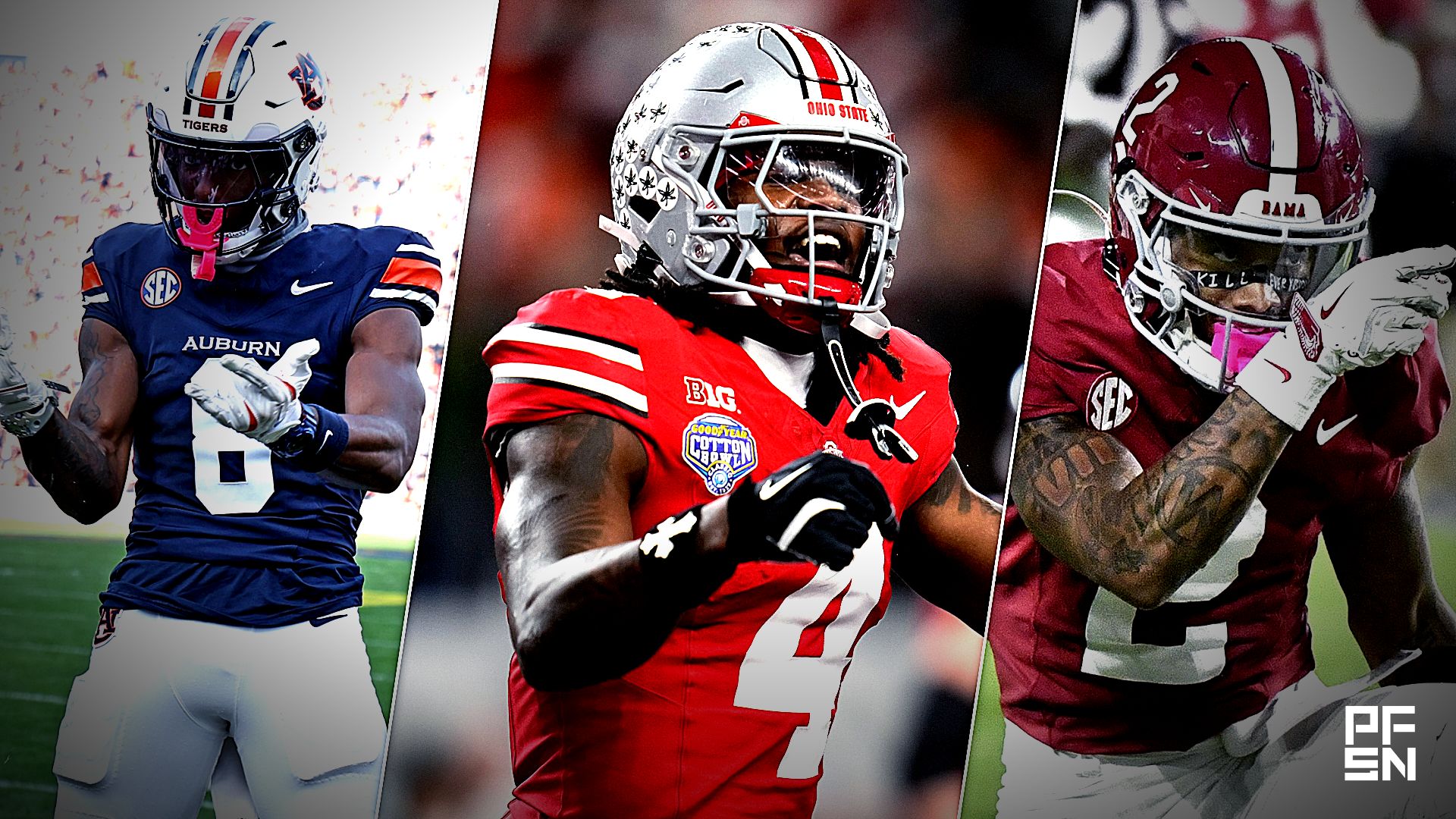
The 2026 NFL Draft wide receiver class wasn’t bad by any stretch, but the 2027 NFL Draft group of WRs has a chance to be truly special.
Already, there’s a bounty of depth and mid-round potential in the group of WR returners, but the game-changing upside rests at the top, where Jeremiah Smith headlines a star-studded cast of pedigree players, blue-blood heroes, and transfer gems.
Where do players like Charlie Becker, Cam Coleman, Mario Craver, and Ryan Coleman-Williams settle in at this stage in the 2027 NFL Draft cycle? It’s still very early, but here’s how the top WR prospects in the 2027 NFL Draft class rank for me after initial viewings.

10) Ryan Coleman-Williams, Alabama
Ryan Coleman-Williams was a freshman phenom in 2024, who now enters his first year of NFL Draft eligibility with very real early-round aspirations, but also more left to prove.
A five-star recruit who elicited comparisons to former Alabama great DeVonta Smith out of high school, Coleman-Williams joined the Crimson Tide and became an instant star, amassing 865 yards and 8 touchdowns on 48 catches, while also accruing 2.69 yards per route run.
In 2025, expectations were high for Coleman-Williams, but a hard hit in Week 1 gave him a concussion and seemed to set the tone for what was an up-and-down sophomore campaign.
Coleman-Williams battled injuries and rarely looked comfortable, and the result was a downturn in production and PFSN WR Impact efficiency, as well as a staggering 13.6% drop rate.
The hope is that Coleman-Williams’ 2025 campaign was an aberration, but even so, the former five-star has work to do before any Round 1 aspirations can become a reality.
There is this we can say about Coleman-Williams: He’s immensely talented. With a 10.49 personal best 100-meter dash time, his long-strider explosiveness and speed are verified, along with his short-area quickness, hip fluidity, and body control.
On his best plays, he can dice up defenders with ruthless angle and throttle manipulation, make high-difficulty catch-point adjustments, then weave around tacklers like a ballerina.
But one thing that made Smith different was, in spite of his size, he was an assassin, and had ice in his veins in clutch and contact situations. Coleman-Williams can’t say the same just yet.
While Coleman-Williams can make sound technique catches, drops remain a major issue for him, and there’s a level of physicality he can’t match with his build.
If Coleman-Williams’ hands can improve, a Round 1 ascent is possible, as his ability as a mover, separator, and RAC weapon is special. But catch-point conversion is an essential component, and it’s one he needs to address.
9) Eric Singleton Jr., Florida
Eric Singleton Jr. is a potential early-round WR prospect in the 2027 NFL Draft, who hasn’t let QB inconsistency keep him out of the Top 10 conversation.
Though Singleton was only a three-star recruit, he accounted for almost 25% of Georgia Tech’s receiving volume as a true freshman, while reaching the end zone six times. He achieved a career-high 754 receiving yards in 2024, but transferred to Auburn in hopes of catalyzing an NFL ascent in 2025.
Instead, poor QB play hampered his production, and he again transferred in 2026, this time to Florida. Set to be a four-year starter, there’s a sense Singleton has left production on the table in spite of his early breakout, but he nonetheless has a compelling NFL Draft profile as it stands.
At 5’10”, 182 pounds, Singleton is below average size, without a wide catch radius, but he specializes as an electric mover with tantalizing upside as both a separator and a RAC threat.
While his size and lacking mass can be a deterrent against press coverage, he’s a zone coverage gasher with a unique blend of short-area twitch, suddenness, hip sink, post-break explosion, and long-strider range.
He can create ample separation out of breaks with that long-strider field coverage, and he has the throttle control to freeze defenders in space and capitalize. Meanwhile, as a RAC threat, either on designed touches or on short and intermediate completions, that same suddeness, control, vision, and seam-splicing burst can be lethal.
Singleton doesn’t have elite long speed relative to his size, and he’ll never be a domineering catch-point controller, but he is quietly competent at the catch. For two straight seasons, he’s secured a drop rate below 5.6%, and on targets both deep and over the middle of the field, he showcases impressive focus and composure versus impending contact.
Singleton’s uncertain press projection may limit him to a hybrid slot role, but in that role, he has quality WR2 or WR3 upside.
8) Junior Sherrill, Vanderbilt
Junior Sherrill is a mid-round WR prospect with early-round upside in the 2027 NFL Draft. He originally joined the Vanderbilt Commodores as a three-star recruit, but made an instant impact as a rotational pass-catcher as a true freshman in 2023, hauling in 20 passes for 293 yards and 3 scores.
Each year since then, Sherrill has steadily increased his output. 2025 was his best season yet; as one of Diego Pavia’s primary targets, Sherrill accumulated 784 yards and 7 touchdowns on 54 catches, earning a PFSN WR Impact score of 77.9.
Though he’ll aim to cut down a 6.3% drop rate in the action yet to come, Sherrill did register an 11% catch rate over expectation, and generated almost 6 yards of RAC per reception.
MORE: Top 10 2027 NFL Draft QB Prospects
Archetypally, Sherrill is one of the more well-rounded three-level threats in the 2027 WR class. At 5’11”, 200 pounds, he’s close to average size, but is lean, dense, and compact, with a compelling athletic profile.
While he doesn’t quite have elite field-stretching speed, he’s a stacking threat that demands respect, and in the short and intermediate ranges, he’s explosive, twitched-up, and relatively fluid, with a tantalizing blend of reactive athleticism, sudden stride retraction, and acute angle freedom.
As a route operator, he’s still growing; he can be prone to upfield drift both heading into and heading out of breaks, and while he brings the desired physical disposition, he can be more consistent working through contact, both at stems and at the catch.
Having said all this, Sherrill is an alignment-versatile slasher with a functional route tree and release package, proactive hand technique, and dynamic RAC ability, and a quality starter outcome as a secondary option and NFL movement-Z is in the cards.
7) Nick Marsh, Indiana
Nick Marsh is a potential early-round WR prospect in the 2027 NFL Draft, who joins Charlie Becker as a top-flight talent in a dynamic Indiana offense.
A four-star recruit out of high school, Marsh signed with Michigan State and made an immediate impact in a light depth chart, accruing 41 catches for 649 yards and three touchdowns as a true freshman.
In 2025, while the Spartans’ QB inconsistency remained, Marsh still proved productive, logging 59 catches for 662 yards and six scores, as well as a PFSN WR Impact grade of 76.1. Marsh parlayed that performance into an opportunity with the defending champion Indiana Hoosiers.
At 6’3″, 213 pounds, Marsh is well-built, with excellent lean mass, good proportional length, and great functional athleticism.
While he doesn’t quite have elite explosiveness or long speed, he’s quick and twitched-up, with brisk strider speed on upfield advances, and he’s flexible for his size, with the ability to bend on curved route transitions and cut tight angles without losing pace.
Marsh has the versatility to line up outside or in the slot, and his hip fluidity, combined with his ability to stack quick motions in rapid succession, grants him the potential to run a full route tree, with a working release package.
He’s also shown he can effectively use his size and length to compound separation at stems, and he’s a dynamic RAC threat with size-defying elusive ability and prying contact balance.
A 7.2% drop rate hints at a focus drop issue that Marsh will need to whittle down, and he can still be a bit more consistent controlling catch-point positioning with size and timing.
Nevertheless, with more growth as a catch-point operator and more advancement with route efficiency, Marsh can be an early-round pick with compelling three-level threat utility as a starting movement-Z.
6) Wyatt Young, Oklahoma State
Wyatt Young is a potential 2027 NFL Draft riser, contingent on his ability to prove himself at the Power Four level.
Young signed with Eric Morris’ 2024 recruiting class at North Texas, and brought glimpses of promise as a true freshman. As a true sophomore, he was the favorite target of emergent star QB Drew Mestemaker, and in the process emerged as a star himself.
Across 14 games, Young amassed 1,264 yards and 10 touchdowns on 70 catches, and added an 11th score on the ground. He earned first-team All-American honors for his performance, and took home the highest PFSN WR Impact score in the entire nation, with a figure of 87.5.
Alongside that Impact number, he also registered 4.07 yards per route run, an 11.5% catch rate over expectation, and 6.75 yards of RAC over expectation, the highest in the league among WRs with at least 80 targets.
Simply put, Young’s production and efficiency were elite in 2025, and at Oklahoma State, he’ll have the chance to replicate that success against greater competition, and solidify early-round standing in the process.
At 6’0″, 199 pounds, Young’s three-level threat framework is extremely compelling. As a separator and operator, he’s exceedingly versatile, with universal alignment versatility, a rapidly expanding route tree, good release skills against press, vertical stem IQ, and targeted physicality.
At the catch, while he’s relatively short-armed, he’s a capable contortionist with superb tracking and hand strength in contact situations, and his RAC dynamism is platinum certified: A product of fast-striding mobility, vision, reactive quickness, cutting flexibility, and strong contact balance.
The biggest question mark for Young, beyond his acclimation to superior competition, is his athletic profile. He’s fleet-footed and fluid, but doesn’t have elite burst or speed. Additionally, while his hands are very good, focus drops can be a minor issue at times.
Nevertheless, Young fits the mold of Cooper Kupp with his universal usage versatility and utility, stem IQ, play strength, and RAC value, and has impact starter upside as a movement-Z.
5) Mario Craver, Texas A&M
Mario Craver is a potential first-round WR prospect in the 2027 NFL Draft. A four-star recruit, Craver posted a 10.74 100-meter dash in high school, and first took his speed and raw athletic talent to Mississippi State.
After eclipsing 20 yards per catch on 17 receptions as a freshman, Craver transferred to Texas A&M for the 2025 season, where he became one half of a dynamic tandem alongside future first-round pick KC Concepcion.
Playing in 12 games, Craver amassed 59 catches for 917 yards and 4 touchdowns, while also logging 11 carries for 81 yards and a TD. His PFSN WR Impact score of 84.7 was seventh in the nation, ranked over Concepcion, Carnell Tate, and Omar Cooper Jr.
MORE: Latest NFL Mock Draft
Listed at 5’9″, 165 pounds, Craver’s undersized frame does affect his consistency against second-level and catch-point physicality. That said, Craver’s profile as a separator and after-catch creator is inherently dynamic, and bodes well for his future.
Craver is a RAC monster; his 5.22 yards of RAC over expectation were near the 99th percentile in 2025, and placed just second among WRs with over 70 targets. That efficiency is a function of his hyper-elite short-range and long-track explosiveness, twitch, spatial IQ, and size-defying contact balance.
Craver isn’t just a schemed touch savant, however. There are very real glimpses of separation upside on film, and while he has room to improve his press-and-retract efficiency, as well as his sharpness on corner routes and blaze outs, he’s an uber-explosive slasher with keen stem and zone IQ, smooth tempo control and modulation ability, acute angle freedom, endless lower-body flexibility, and a working release arsenal.
Craver can still add more mass to his frame, but as a dynamic movement-Z with a trump card as a RAC threat, impact starter upside is present.
4) Omarion Miller, Arizona State
Omarion Miller is quietly a first-round sleeper in the early 2027 NFL Draft class. A former four-star recruit, Miller broke out in 2025 with 45 catches for 808 yards and eight touchdowns, in spite of inconsistent QB play for the Colorado Buffaloes. Along the way, he achieved a solid PFSN WR Impact grade of 79.1.
Now, he’s transferred to Arizona State, where he’ll have a chance to compound that momentum in Kenny Dillingham’s offense.
At a listed 6’2″, 210 pounds, Miller has great height and mass to go along with decent proportional length, but even more potent is his athleticism.
Miller boasts elite explosiveness, short-area agility, and foot speed, to go along with rare hip fluidity, impressive angle freedom on sharper route breaks, and smooth ankle mobility on curved transitions.
His burst, bend, and play strength make him a venerable RAC threat, as evidenced by his 6.4 YAC per reception figure in 2025, which featured over 2 whole yards of RAC beyond expectation. But he’s also a budding separator with an inspiring foundation, route tree, and release arsenal.
Miller does need to improve at the catch point. While he flashes quality reaction speed and extension ability, his 7.8% drop rate was too high in 2025, and he isn’t the most consistent at playing catch-point positioning, using timing and angles to create late-snap spacing for himself.
Still, if Miller can reach his ceiling, Round 1 capital is on the table, as a dynamic movement-Z with three-level threat appeal.
3) Cam Coleman, Texas
Cam Coleman is a former five-star recruit who has been impacted by poor QB play through the first two years of his career, but has nonetheless put up film worthy of first-round consideration.
At around 6’3″, 200 pounds, with near-33″ arms, Coleman has the build of an X-receiver, and the athletic profile of one, too. He’s a venerable long-strider on the vertical plane, but is also an impressive short-area athlete with excellent short-area quickness, twitch, deceleration capacity, and hip fluidity for his size.
That athletic profile imbues him with a high degree of route-running upside. He’s admirable for his intentionality in attempting to manipulate route leverage with stem work and throttle control, and he has a natural instinct for getting defenders to freeze before quickly regaining his stride.
He’s still learning how to be his most efficient self as a separator, with later hip tells and less upfield drift at route breaks. And as a near-7% drop rate in 2025 indicates, Coleman does have room to be a bit more consistent in preventing passes from entering his body over the middle of the field.
Nevertheless, Coleman is a high-level athletic talent with a compelling size profile, a swarming catch radius on high-difficulty throws, flashes of vice-grip hand strength through contact, and a natural feel for space creation in the separation phase.
At his maximum, Coleman can be a blue-chip WR1. And in 2025, catching passes from heavily anticipated first-round prospect Arch Manning, we’ll get to see Coleman in his best situation yet, by a landslide.
2) Charlie Becker, Indiana
Charlie Becker was one of the unexpected heroes of Indiana’s National Championship campaign in 2025 and returns as a potential first-round riser in the 2027 NFL Draft.
In high school, he won Tennessee state championships in the 110-meter and 300-meter hurdles, but took home only a three-star recruit billing. After playing as a special teams contributor in his true freshman season, Becker began the 2025 campaign behind Omar Cooper Jr., Elijah Sarratt, and E.J. Williams on the depth chart.
Sarratt’s midseason injury would thrust Becker into the spotlight, and he took advantage with a difference-making outing against Penn State. From that point onward, Becker became indispensable to the Hoosiers’ offense.
In the final seven games, he amassed 27 catches for 522 yards and 3 touchdowns. His efforts culminated in a PFSN WR Impact score of 83.9 that was ninth in the entire FBS. His 26.11% catch rate over expectation rivaled Carnell Tate. His 1.27 EPA per target was best in the nation, and his 3.77 yards per route run was third.
We still need to see Becker operate with consistent WR1 volume, but the advanced metrics are glowing, and so too is the film.
At 6’4″, 207 pounds, Becker is long and explosive, with gliding vertical athleticism and dangerous deep speed. But he’s also uniquely quick and fluid at his size, with excellent short-area twitch, foot speed, and the curvilinear acceleration to sustain pacing through route transitions.
Even this early in his career, he’s shown great promise as a route runner, with an expanding route tree, acute angle freedom and deceptive tendencies, throttle control, and a full release package.
As an added bonus, Becker is also an elite utility player and blocker with universal alignment versatility. Becker possesses impact starter upside, and can be a dynamic movement-Z with an unrelenting affinity for separation and catch-point conversion.
1) Jeremiah Smith, Ohio State
Jeremiah Smith is the early top overall prospect in the 2027 NFL Draft, and is a favorite to be one of the first players selected next April.
In fact, Smith has been anticipated as a potential top-three pick since high school, when he was a five-star recruit and the No. 1 overall talent in the nation.
Through his first two collegiate seasons, Smith has totaled 163 catches for 2,558 yards and 27 touchdowns. In 2025, his PFSN WR Impact score of 85.1 was fifth-highest among FBS players at his position.
At 6’3″, 223 pounds, Smith has the size, length, and frame density to echo the brawling X-receivers of a WR era long past. He’s strong, explosive, physical, and an absolute hoss at the catch point, with an inherently proactive catch-point style that yields a near-20% catch rate over expectation.
Past the domineering surface-level skill set, however, Smith is quietly a complete WR. He has a high level of deceptive intelligence and footwork efficiency as a route runner, which he weaponizes through a solid release package and route tree.
He’s impressively fluid and sudden for his size, with a natural nuance and feel for spatial manipulation that exceeds his years. And on sharper redirections and multi-layered routes, he displays a level of size-adjusted flexibility and sustained acceleration that hasn’t been seen since the days of Julio Jones.
Smith isn’t as consistent as a RAC threat and there’s still room to reach a higher echelon as an intermediate stem artist on comebacks and curls, but he looks born to be a true WR1, offensive alpha, and blue-chip weapon in the NFL.
Honorable Mentions
- Tre Richardson, Louisville
- T.J. Moore, Clemson
- Bryant Wesco Jr., Clemson
- Ryan Wingo, Texas
- Cooper Barkate, Miami (FL)
- Ian Strong, California
- Braylon Staley, Tennessee
- Mike Matthews, Tennessee
- Nyziah Hunter, Nebraska
- Nyckoles Harbor, South Carolina