
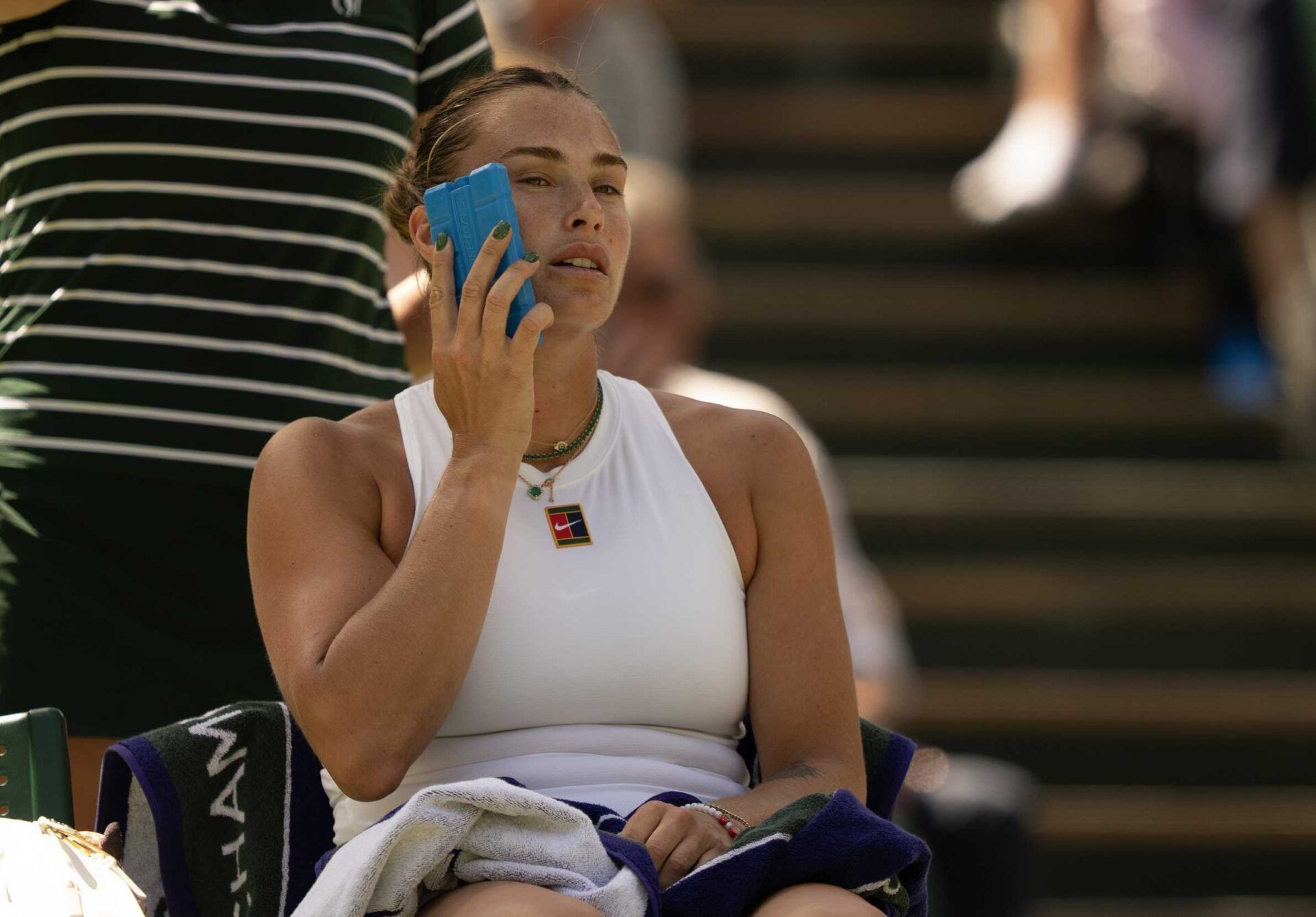
World No. 1 Aryna Sabalenka squared off against Amanda Anisimova for a place in her first Wimbledon final. As the duo slugged it out on the tennis court, the attention of fans was drawn to Anisimova’s nationality popping up on the scorebug, while the area next to Sabalenka’s nationality was blank.
Ever since Russia launched its invasion of Ukraine, Russian and Belarusian players have competed as neutrals without their flags or country displayed. However, Anisimova’s nationality raised eyebrows as Wimbledon had not added country names to the scorebug in previous matches.
How Fans Have Reacted to ‘Nationality’ Controversy on Wimbledon SF Day
A user on X said he found it “strange” that Anisimova’s nationality showed in the television scorecard, as the nations of the players weren’t previously mentioned in previous matches.
“It’s strange that everyone in the previous game didn’t have to mark their nationality,” the fan wrote.
It’s strange that everyone in the previous game didn’t have to mark their nationality.
— 程雷 (@chenglei1995) July 10, 2025
Ben Rothenberg, a noted tennis journalist, who had previously written about “scorebug oddities” in the early rounds of Wimbledon, noted that the major began adding country codes “suddenly on semifinal day.”
I wrote about #Wimbledon scorebug oddities early in the tournament.
Suddenly on semifinal day, they’ve begun adding country codes. https://t.co/F4HwzDQ0RZ pic.twitter.com/inHMJvOh4Z
— Ben Rothenberg (@BenRothenberg) July 10, 2025
“I don’t like the sudden country code there,” read a reaction to Rothenberg’s post on X. “I also don’t understand why there is any need to add a country code to the score bug at the semi finals stage of the tournament?,” added another fan.
I don’t like the sudden country code there. I also don’t understand why there is any need to add a country code to the score bug at the semi finals stage of the tournament?
— Lachlan Hall (@lhall98) July 10, 2025
“Is there any reason why they’re showing Anisimova’s country in the scoreboard when they haven’t been doing this all tournament?,” asked another tennis fan. “See the Novak (Djokovic) demon (Alex de Minaur) game where it didn’t have it…. strange.”
Another fan suggested that the change was made to make it clear “it’s not two Russians in their (Wimbledon’s) semis.”
Making it clear it’s not two Russians in their semis
— Jan (@chipNJan) July 10, 2025
Despite representing the U.S., Anisimova has Russian roots. Her parents, Olga Anisimova and Konstantin Anisimov, emigrated from Russia to the United States a few years before she was born.
Another fan wrote, “Players names always sufficed. Why discriminate in favour of or against a player or a country? Tennis has been corrupted by political motives.”
Players names always sufficed. Why discriminate in favour of or against a player or a country?
Tennis has been corrupted by political motives.
— ecojag (@ecojag) July 10, 2025
“Is there any reason why they’re showing Anisimova’s country in the scoreboard when they haven’t been doing this all tournament??? See the Novak demon game where it didn’t have it…. strange.”
Is there any reason why they’re showing Anisimova’s country in the scoreboard when they haven’t been doing this all tournament??? See the Novak demon game where it didn’t have it…. strange pic.twitter.com/YeiltSGY05
— liv (@kokinakkis2) July 10, 2025
“Yeah I’m watching this match and I was watching another doubles match yesterday and it didn’t have their countries,” wrote another confused fan. “Wonder why they started doing it in the middle of the tourney.”
yeah im watching this match and i was watching another doubles match yesterday and it didn’t have their countries Wonder why they started doing it in the middle of the tourney….. pic.twitter.com/TF0Xpt79em
— dassi ❤︎ (@bublikism) July 10, 2025
Continued Evolution and Criticism of Wimbledon’s Neutral Player Policy (2023-2025)
Following the 2022 ban and the subsequent removal of ranking points by the ATP, WTA, and ITF, Wimbledon reversed its decision in 2023.
The All England Lawn Tennis Club (AELTC) announced that Russian and Belarusian players could compete as “neutrals,” provided they signed personal declarations confirming they do not support the invasion of Ukraine, do not represent Russia or Belarus, and are not funded by those states or state-linked entities.
This aligned with policies at other Grand Slams like the US Open and Australian Open, which had allowed neutral participation from the outset.
The policy carried over unchanged into 2024 and 2025, enabling players such as Aryna Sabalenka (Belarus) and Daniil Medvedev (Russia) to participate without national flags, anthems, or identifiers on scoreboards, player listings, or official broadcasts. In practice, this means their nationalities are often left blank, as seen in the 2025 semifinals, to emphasize their neutral status.
However, the approach has faced criticism for becoming increasingly symbolic. Some observers argue that the initial “principled stand” against using sport to promote the Russian regime has faded into “small, meaningless gestures,” such as merely omitting flags, while allowing strong representation from these players — evident in 2025’s women’s draw, where multiple Russian and Belarusian athletes reached the quarterfinals.
Critics contend this reflects broader trends in sports prioritizing financial interests and global participation over sustained political accountability. Despite this, the AELTC has not issued a new statement for 2025, indicating continuity with the 2023 framework.
