
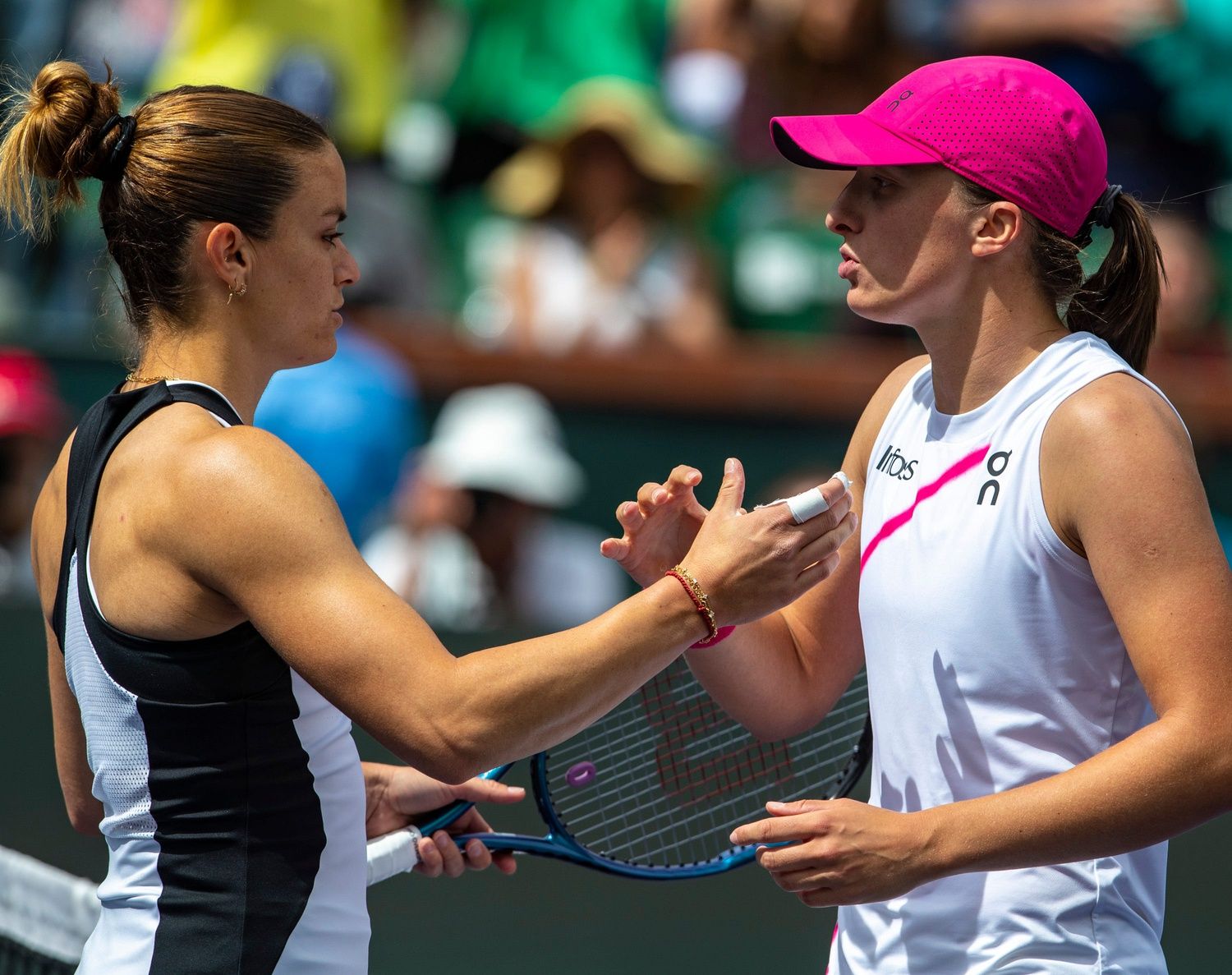
Renowned coach Brad Gilbert, former World No. 9 Andrea Petkovic, and former US Open semifinalist CoCo Vandeweghe each offered a candid take on the double-bounce controversy that shaped Maria Sakkari’s quarterfinal upset of Iga Świątek at the 2026 Qatar Open in Doha.

A Closer Look at Maria Sakkari’s Stunning Comeback Against Iga Świątek in Doha
Sakkari entered Doha ranked No. 52 in the world, far from her peak but steadily rebuilding. Awaiting her in the quarterfinals was World No. 2 Świątek, a player who had beaten Sakkari four straight times without dropping a set. Few expected the script to change. Yet Sakkari battled back from a 2-6 first set to win 6-4, 7-5, becoming the first player ever to defeat Świątek in a WTA 1000 match after losing the opening set.
The turning point arrived late in the third set with Sakkari serving at 5-3. During a tense rally, Świątek chased down a ball that appeared to bounce twice before she made contact. Play continued, and Świątek won the point, but Sakkari immediately called for a review.
The rarely used video review system was activated. Slow-motion replay showed the ball had indeed hit the court twice before Świątek’s return. The chair umpire overturned the call and awarded the point to Sakkari.
The incident sparked debate, and during a Tennis Channel segment, Gilbert, Petkovic, and Vandeweghe made their positions clear. Coco Gauff’s former coach, Gilbert, acknowledged the emotional intensity of competition but stressed the broader principle at stake.
“99% of the time, the player knows. Maybe you thought you got it, but very often it’s not even close. You know you didn’t get it, or you know you got it and they said you didn’t,” he said. “I want to say that good sportsmanship is paramount, but obviously in the heat of the moment, players will do some strange things.”
Petkovic took a more reflective tone, suggesting that players should think about the long-term impact of their actions. “Sportsmanship should be No. 1. And I do think that when you look back on your career after you have retired and you have called a few of these things, you will feel terrible about yourself and your character and nobody wants that,” she said.
Vandeweghe framed it in simpler, almost philosophical terms. “Karma is real. You want good karma. Otherwise, like it’s ball don’t lie. You’re going to lose if you don’t give yourself good karma,” she said.
How Did Sakkari Defend the Role of Video Review in Tennis?
In a post-match interview with Tennis.com, Sakkari focused less on the controversy and more on the system that clarified it. “It’s great that we have it, because imagine if we didn’t have it today,” she said.
MORE: ‘I Didn’t Know’ — Iga Świątek Defends Herself After Tense Maria Sakkari Double Bounce Drama in Doha
She acknowledged the difficulty of the umpire’s task in real time. “I feel like it’s, you know, it’s very tough also for the umpire to see because you don’t know how they put the racquet. And they’re not, you know, robots, they’re human beings, and they can lose the balance with their vision. It’s the first time I’ve used it, and I’m happy that it exists.”
When asked whether players can sense a double bounce themselves, she offered a balanced view. “I feel like you do,” she said. “Sometimes maybe you’re confused. I’m not saying that she knew or anything, of course, but sometimes I feel like you know. But you can also, you know, be a little bit, ‘I’m not so sure, I’m unsure about how the bounce was.'”
Sakkari advanced to the semifinals, where she lost 3-6, 6-4, 6-1 to the 14th seed, Karolína Muchová.
