
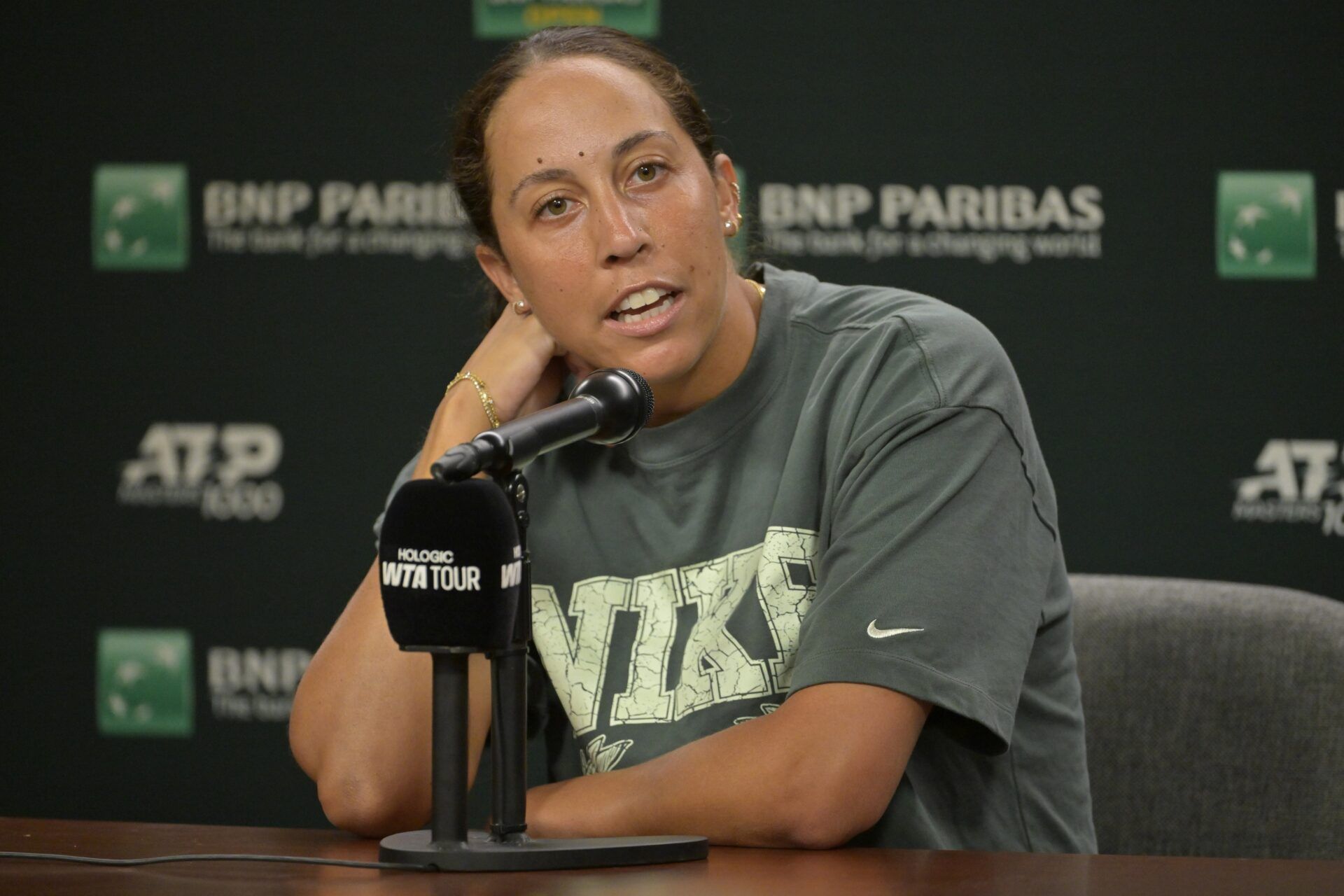
Players often withdraw from tournaments for various reasons, including injuries, schedule changes, and personal matters. This year, during the Middle East swing, particularly at the Dubai Tennis Championships, over 15 WTA players withdrew. In light of this, Madison Keys and Jessica Pegula discussed the realities of withdrawing from tournaments.

Jessica Pegula and Madison Keys Open Up About the Consequences of Withdrawing From Tournaments
Keys withdrew from the 2026 Qatar Open and the Dubai Tennis Championships, citing a lack of rest after the Australian Open and a leg injury, respectively. Pegula withdrew from Doha and the ATX Open due to insufficient recovery time after the Melbourne Major and a left knee injury.
In a recent episode of “The Player’s Box” podcast, Keys explained that players are allowed two withdrawals per year without incurring a fine. She clarified that if players stay within this limit, they will not face penalties.
“You are allowed two withdrawals per year with no fine, but if it’s a mandatory event, you still get the zero. And if you don’t play your required amount of 500s and you’re pulling out of another one, that’s also a zero. For a 250 if it is in your allowed withdrawals, you don’t get a fine, and there’s no zero,” Keys said.
The former Australian Open champion mentioned that if a player exceeds two withdrawals in a year, they will be fined. The fine amount is determined by a player’s ranking and the total number of tournaments they have withdrawn from. For example, if a player ranked in the top 10 makes their sixth withdrawal of the year, then they are fined “a lot of money.”
“But if you go over two withdrawals a year, you get fined, and it changes based on your ranking and how many you’ve subsequently pulled out of. So, if it’s like your sixth withdrawal of the year and you’re in the top 10, it’s a lot of money.
It’s a lot of money. You have to have a reason. It can be if you have an injury, you obviously have to send in like proof of injury and stuff like that, but you can also do personal reasons, and also schedule change,” she added.
Keys’ co-host, Pegula, reiterated that the fines can indeed be very significant. She also noted that if players withdraw “continuously” – meaning they pull out of a tournament due to an injury and then also withdraw from the subsequent tournament for the same injury – it is counted as a single withdrawal rather than two.
“It’s a lot of money. You can use continuous ones. For example, let’s say I pull out of Madrid with an injury. I used one of my excuses, but I sent it in as an injury. Send in my doctor’s note.
If you pull out of Rome for the following tournament, you can use that as a continuous injury withdrawal, and it will only count as one, and you can use that, I think, as many times as you want. I think it’s two on-site prize money withdrawals. It’s not easy like to keep track of,” Pegula said.
Looking ahead, Keys and Pegula are scheduled to compete at the 2026 BNP Paribas Open at Indian Wells, which will take place from March 4 to March 15, 2026. The main draw matches will be held on the outdoor hard courts at the Indian Wells Tennis Garden.
