
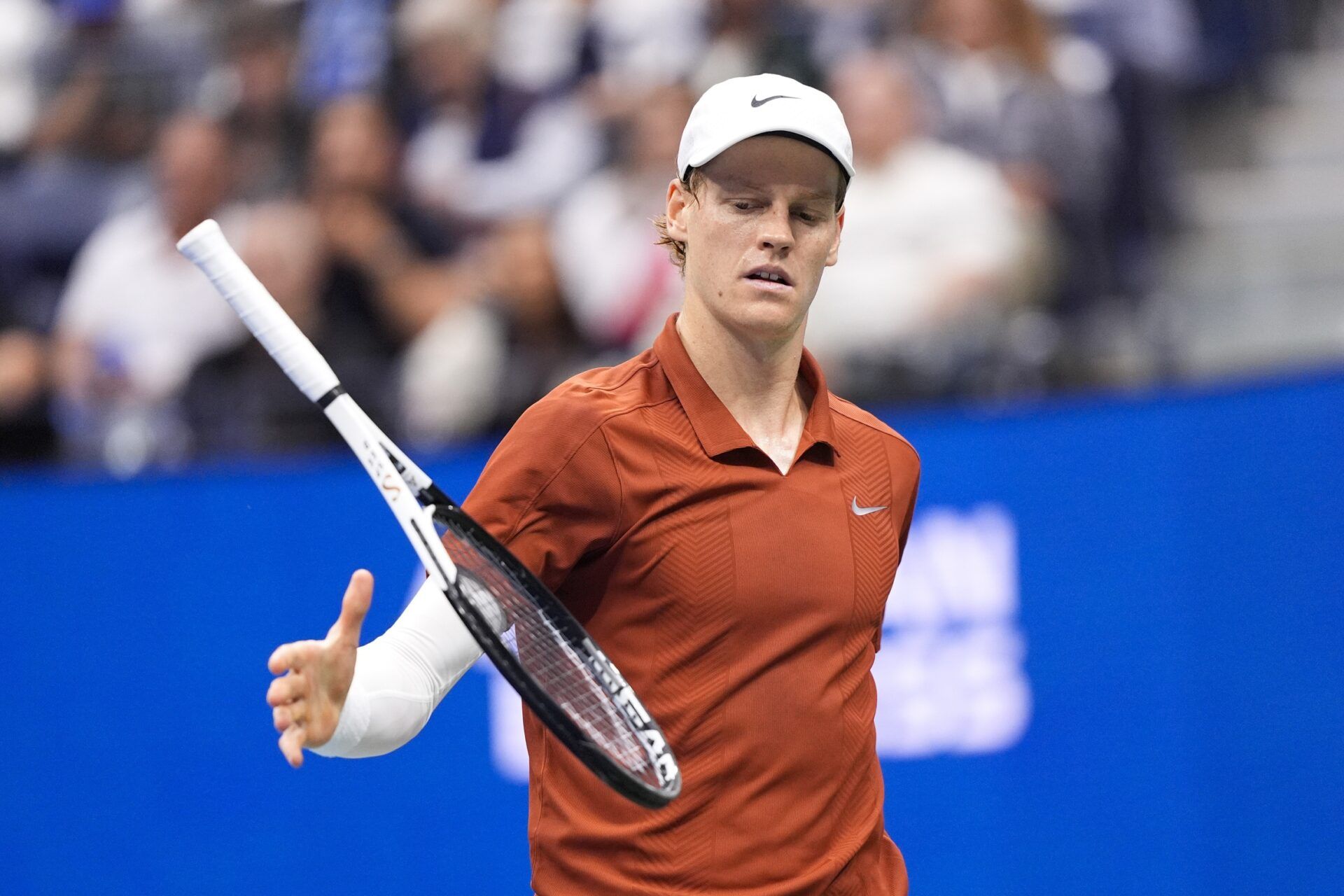
Jannik Sinner voiced clear frustration with the ATP’s fully automated shot clock system during his 2026 Miami Open semifinal win. Fresh off a title run at Indian Wells, the World No. 2 extended his remarkable Masters 1000 streak to 32 consecutive sets without dropping one, surpassing Novak Djokovic’s previous mark of 24. Yet even amid this historic stretch, Sinner found himself echoing concerns earlier raised by Carlos Alcaraz, turning attention away from results and toward the sport’s evolving rules.

Jannik Sinner Questioned the Automated Shot Clock at the Miami Open
The debate surrounding the shot clock has quietly intensified in 2026, particularly with the ATP’s shift to a fully automated 25-second timer that begins almost immediately after a point ends. Unlike the previous system, where chair umpires exercised discretion and often waited for players to reset at the baseline, the new format removes human judgment entirely. That change has created friction, especially for players adapting their styles.
Sinner’s increasingly aggressive approach, featuring more net play and serve-and-volley patterns, has made him particularly vulnerable to the tighter timing constraints. The issue first gained traction earlier in the season when World No. 1 Alcaraz questioned a time violation call during his Qatar Open quarterfinal match against Karen Khachanov, signaling a growing concern among top players.
Sinner’s own flashpoint came during his semifinal against Alexander Zverev, a match he ultimately won 6-3, 7-6(4) to reach the final. Early in the opening set at 2-1, after a series of physically demanding points that ended at the net, Sinner struggled to reset before the countdown expired. With the clock starting just three seconds after each rally, he was left with only a handful of seconds upon returning to the baseline.
His frustration boiled over during a changeover as he challenged chair umpire Greg Allensworth. “How is it possible to finish the point at the net? I go back, it’s five, three seconds,” Sinner said, pointing out the impracticality of the rule.
MORE: Jannik Sinner vs Jiří Lehečka Final Preview: Head-to-Head, Prediction for Miami Open 2026
When told the system was automatic, he replied that he understood the mechanism but took issue with the lack of flexibility, adding that players cannot even request a reasonable reset. Broadcast commentators noted that under previous officiating norms, players were often granted extra time in such scenarios, a buffer that no longer exists.
Despite the disruption, Sinner maintained composure and closed out the match, continuing his pursuit of the coveted Sunshine Double.
The Italian will now face the 21st seed, Jiří Lehečka, in the championship match. This is going to be their fourth meeting on the ATP Tour, with the Italian holding a dominant 3-0 lead in their head-to-head record.
SEE ALSO: Jiří Lehečka’s Girlfriend Lucka Moved to Tears As He Storms Into Landmark Miami Final
How the Automated Shot Clock Frustrated Carlos Alcaraz in Doha
Alcaraz’s earlier exchange in Doha offered a striking parallel. During a tense quarterfinal against Karen Khachanov, the Spaniard was hit with a time violation after a grueling rally at 4-4, 40-40. Having finished the point at the net with a delicate drop shot, he rushed to retrieve his towel before preparing to serve, only to be penalized.
Alcaraz questioned chair umpire Marija Čičak about the timing of the clock, prompting a lengthy discussion. Even Khachanov appeared to intervene, seemingly urging reconsideration of the call.
