
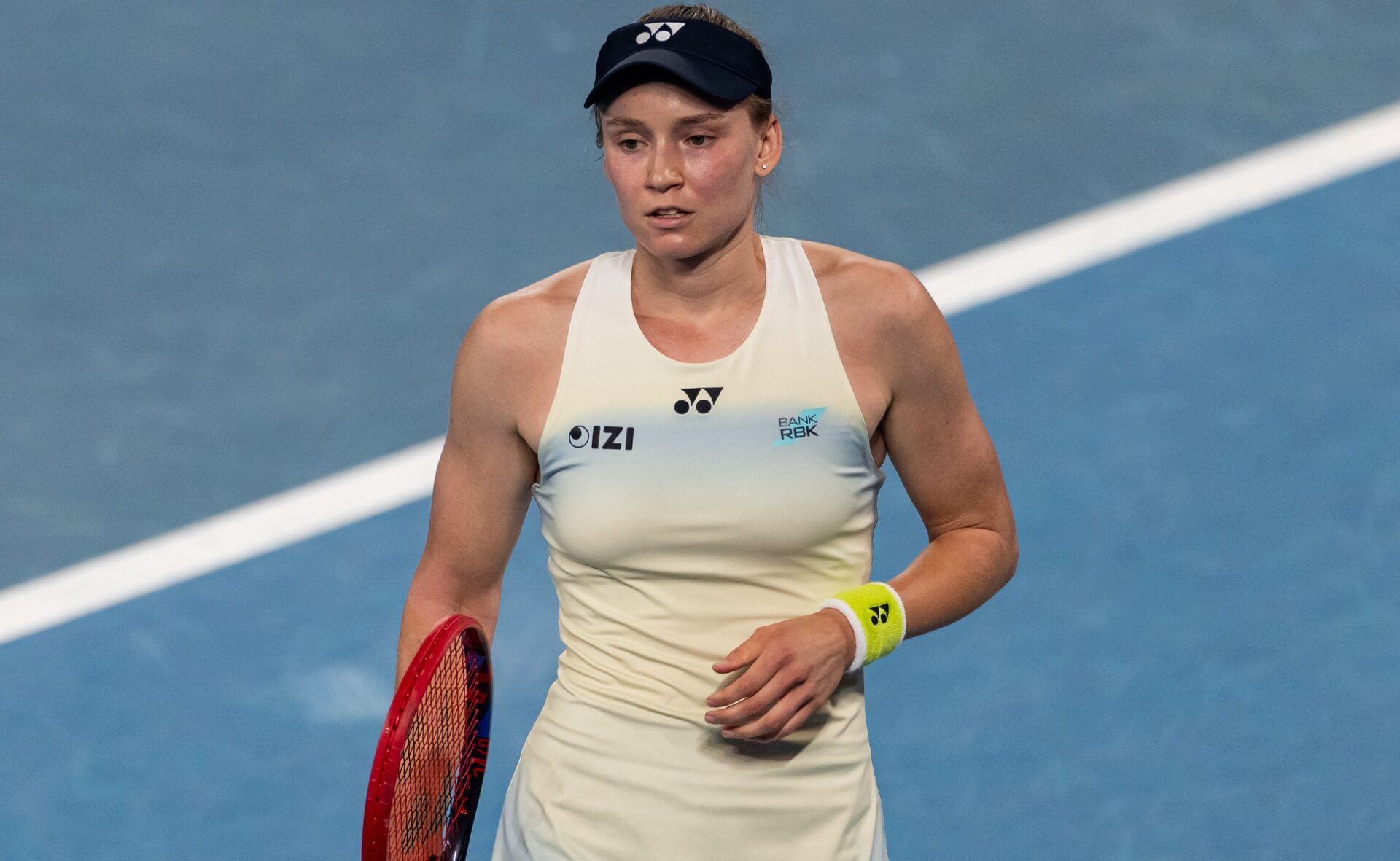
As Elena Rybakina’s career began to gather momentum, the rise did not come without quiet friction behind the scenes. Evgenia Kulikovskaya, one of Rybakina’s first coaches, has now shared a candid account of how Stefano Vukov initially reacted when Rybakina sought to reconnect with figures from her past. According to Kulikovskaya, Vukov was uneasy about the attention that followed Rybakina’s early results and feared that success could tempt others to step in.

Stefano Vukov’s Early Concerns Over Elena Rybakina Reconnecting With Her Past
Asked whether Rybakina had ever contacted or visited her, Kulikovskaya explained that the answer was not straightforward at first. “At first, Stefano was against it,” she said in an interview with Russian outlet Championat. “He was very worried that now that she had started getting good results, someone might want to take her away.”
Former player & one of Elena Rybakina’s first coaches Evgenia Kulikovskaya says Stefano Vukov was worried she might leave him for another coach, so initially he was against Lena visiting her but “calmed down” once he realized she had no such plans.
source: intw for Championat pic.twitter.com/VYeo7HjRvR
— til polarity’s end 🎾⚡#SpallettiEra⚡⚫⚪ (@lildarkcage) February 10, 2026
That concern lingered until a joint visit to Moscow, where Rybakina and Vukov came together for a training session. “Later the two of them came to us together for a training session in Moscow, and Stefano and I had a talk,” Kulikovskaya recalled. “When he realized that I wasn’t thinking of taking Lena back or interfering in the training process, he calmed down.”
Kulikovskaya also described the personal contrast between herself and Vukov, and how Rybakina had to adjust to a very different coaching style. “I don’t talk much, while Stefano talks a lot. So it took Lena some time to get used to him. She was accustomed to my temperament, and Stefano is a bit more excitable,” Kulikovskaya said with a smile.
Despite those differences, Kulikovskaya said she encouraged Rybakina to stay the course. “But I told her back then: ‘Lena, hang in there. No matter how difficult this coach feels for you right now, you’re getting good results with him.’”
Over time, that advice seemed to align with Rybakina’s actual progress. Kulikovskaya later recalled another visit that underscored the shift in the dynamic. “Some time later, she came for another visit and told me that Stefano himself had advised her to go see me,” she said.
Throughout her remarks, Kulikovskaya was careful to draw clear boundaries around her role. “I don’t have the right to interfere in another coach’s work,” she said. “That player is no longer my charge. And I don’t have the right to talk too much, even if I don’t agree with something.”
How Did Rybakina’s Coaching Situation Become a Major Talking Point on Tour?
Kulikovskaya’s perspective carries weight because she worked closely with Rybakina before the Kazakh star became a fixture at the top of women’s tennis. That early foundation makes her observations especially relevant now, as Rybakina’s coaching arrangements have drawn sustained public scrutiny in recent years.
Rybakina and Vukov separated briefly before the 2024 US Open, prompting a WTA investigation into alleged Code of Conduct violations. Vukov was provisionally suspended in early 2025, sidelining him from tournaments amid claims of abusive behavior and abuse of authority, which he denied.
During his absence, Rybakina had a short-lived coaching stint with Goran Ivanišević, Novak Djokovic’s former coach, at the 2025 Australian Open. Vukov later won an appeal, returned as her full-time coach in August 2025, and has since overseen major successes, including Rybakina’s titles at the 2025 WTA Finals and the 2026 Australian Open.
