
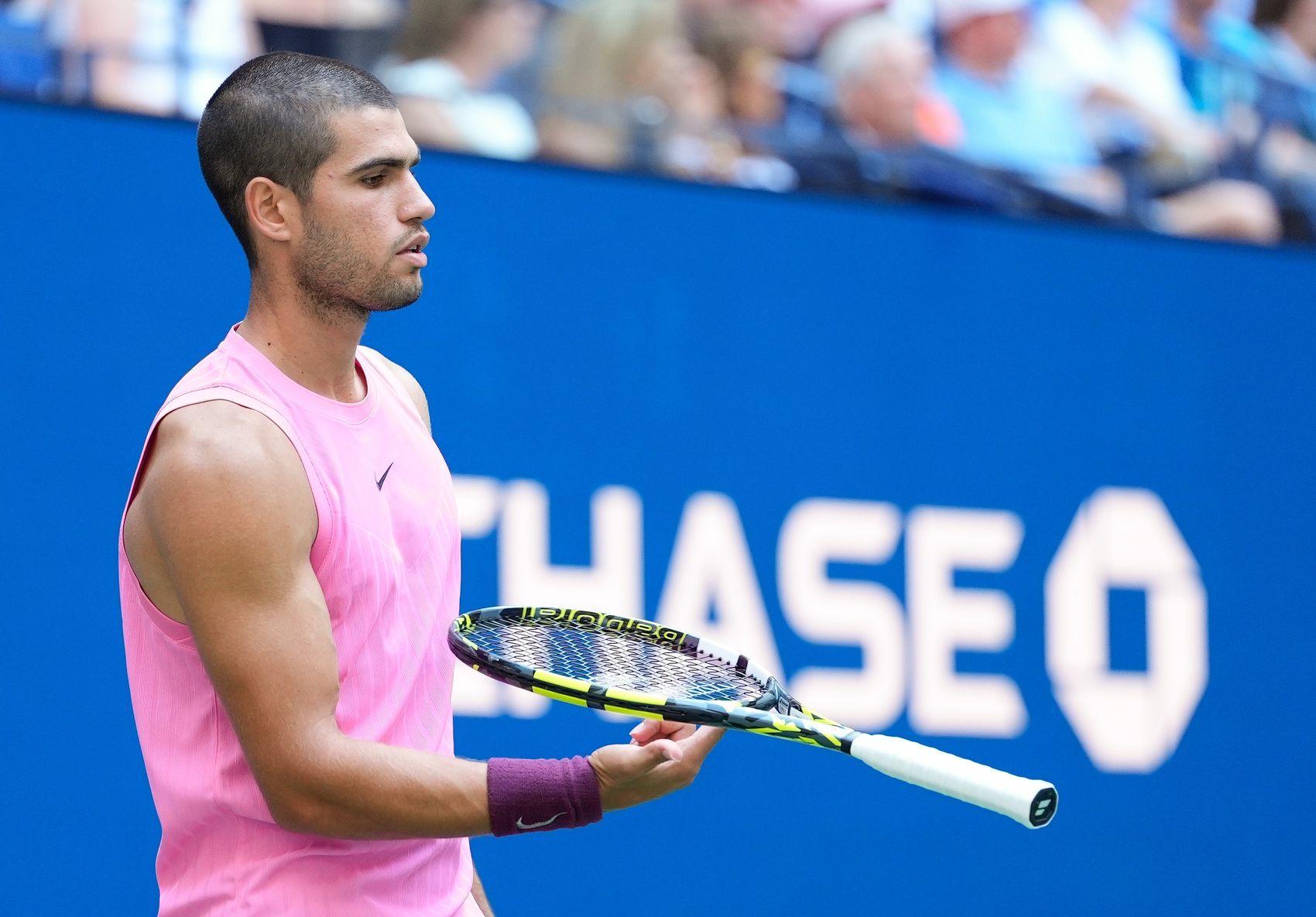
Carlos Alcaraz has become one of tennis’s biggest names at 22. Born in El Palmar, Murcia, Spain, on May 5, 2003, the young Spaniard has won five Grand Slam titles and held the World No. 1 ranking.
While his rise might seem meteoric to casual observers, the story behind his success reveals a carefully orchestrated journey involving family sacrifice, strategic planning, and key relationships that transformed a talented kid from a small Spanish town into a global tennis superstar.

How Did Carlos Alcaraz Transform from Small-Town Kid to Tennis Superstar?
Alcaraz grew up in a tennis family where the sport was woven into daily life. His father, Carlos Alcaraz González, worked as a tennis coach and club administrator at the Real Sociedad Club de Campo de Murcia. His mother, Virginia Garfia Escandón, worked as a sales assistant at IKEA, providing the family’s primary income while Carlos Sr. focused on tennis development.
At age four, Alcaraz picked up his first racket at his father’s tennis club. However, his father’s tennis journey ended abruptly as a teenager when financial constraints forced him to abandon his playing dreams. This painful experience shaped how the family approached Carlos’s tennis development. They understood both the potential rewards and the significant challenges that lay ahead.
The family’s careful approach paid off, but the real turning point required outside recognition. When Alcaraz was just 11 years old, Albert Molina, a sports agent who had worked with established Spanish players like David Ferrer and Nicolás Almagro, noticed the young player at a tournament. Molina saw something extraordinary in the skinny kid from Murcia that set him apart from other junior players.
Molina approached the family with a comprehensive development plan that would change everything for the Alcaraz family.
“I started talking to Carlos Sr. because Carlitos was a child. I began to approach him, telling him that his son was very talented and that one of the things I would like to do would be to start working with him. At first, I had doubts; he was surprised to have a 12-year-old manager… But in the end, his father was convinced by the project,” he once told Relevo.
What Made Albert Molina Believe in an 12-Year-Old Player?
Molina faced significant obstacles in his mission to develop Alcaraz. Convincing IMG, one of the world’s biggest sports agencies, to sign a 12-year-old was difficult. Most agents focus on proven commodities, not elementary school kids with potential. But Molina’s conviction ran deep, and he pushed hard for the partnership, spending eight months watching the young player before making his decisive move.
This patience and careful evaluation proved crucial. By age 16, another pivotal decision needed to be made. Molina recognized that Alcaraz needed a top-level coach to reach his full potential. He arranged for former world no. 1 Juan Carlos Ferrero to watch Alcaraz play at a Futures tournament in Murcia. That meeting changed both their lives forever.
Ferrero immediately saw what Molina had recognized years earlier. Alcaraz possessed something different from other young players. While most teenagers could execute a few skills well, Alcaraz demonstrated variety in his game that was exceptionally rare for his age. The partnership between player and coach began, creating the foundation for unprecedented success.
“I had a 14-year-old boy who I saw as different. And we talked about how to gradually introduce Carlos to the academy because it would be a plus in terms of training and coaching.”
How Did Juan Carlos Ferrero Shape Alcaraz’s Championship Path?
The transition to Ferrero’s academy in Villena was handled with remarkable care. Rather than uprooting Alcaraz completely, they implemented a gradual approach. Alcaraz would train at the academy for two days and spend the rest of his time in Murcia with his family. Over time, as his game developed and his comfort level increased, he spent more days at the academy.
This thoughtful strategy helped maintain Alcaraz’s connection to his roots while giving him access to professional coaching and training facilities. The balance proved essential for his mental and emotional development during crucial teenage years.
Ferrero made a significant personal commitment to Alcaraz’s development, fully understanding that immediate financial returns were not guaranteed. The former champion saw extraordinary potential and was willing to invest in long-term goals rather than quick profits.
“When he accepts and starts working with Carlos, he knows he’s not going to earn or be paid like Ferrero, like a top-flight coach. Juan Carlos invests in the future.”
This investment philosophy proved transformative. Today, Alcaraz has captured 22 ATP singles titles, including five Grand Slam championships that have established him among tennis’s elite. He became the youngest man to reach World No. 1 in 2022 at age 19, shattering previous records and expectations.
MORE: ‘We Don’t Have To Obsess Over Novak Djokovic’ – Carlos Alcaraz’s Coach Ahead of US Open Match
His remarkable success demonstrates that the early investments and careful planning by his family, agent, and coach created the perfect environment for a champion to emerge. Each decision, from Molina’s initial leap of faith to Ferrero’s gradual development approach, contributed to building not just a tennis player, but a complete competitor ready for the sport’s biggest stages.
🔜🔜🔜SEMIS! @usopen pic.twitter.com/iBF6zrIU2G
— Carlos Alcaraz (@carlosalcaraz) September 2, 2025
As of now, Alcaraz is set to face Novak Djokovic in the semifinals of the 2025 US Open, where Djokovic seeks his record 25th Grand Slam title. The matchup represents another chapter in Alcaraz’s continuing story, one that began with a four-year-old boy picking up a racket and has evolved into one of tennis’s most compelling rivalries.
