
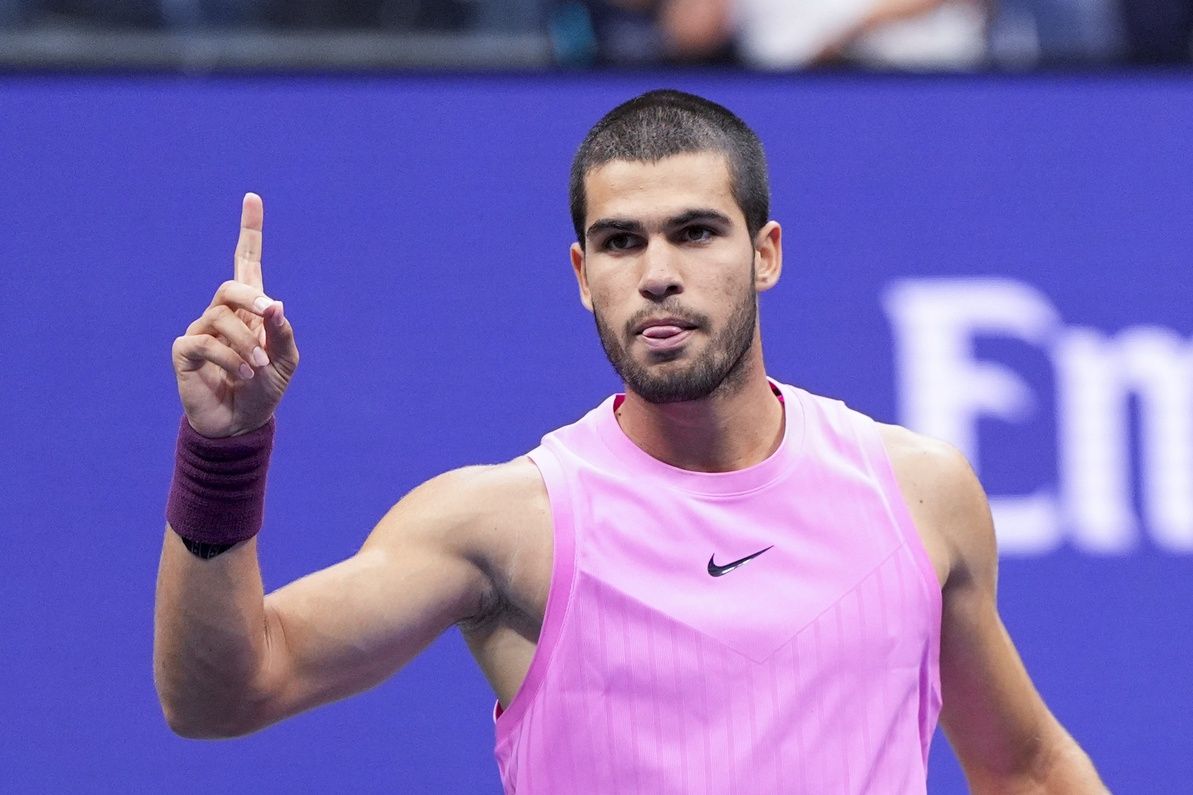
World No. 1 Carlos Alcaraz has responded to critics who question his participation in exhibition events, noting that the official tour calendar is becoming increasingly crowded.
Speaking ahead of the Six Kings Slam, the Spaniard argued that exhibitions demand far less physical and mental focus than two-week tour tournaments, and that critics misunderstand the difference between the formats.

What Did Carlos Alcaraz Say About Playing in the Six Kings Slam?
Earlier this season, Alcaraz lent his support to fellow world No. 2 Iga Świątek by calling out the “really tight” nature of the tour schedule and urging organizers to ease the load on players. He warned that too many mandatory tournaments in a row leave no room for choice or recovery, and hinted he might skip events to protect his health and form.
At the Barcelona Open, he went further, declaring that the traditional one-week Masters format is “better” since two-week events offer no real rest despite the extra days.
Those comments drew criticism when Alcaraz signed up for high-profile exhibitions, such as the Six Kings Slam, with critics branding him hypocritical for questioning the calendar’s demands while accepting lucrative appearances.
Addressing the issue ahead of his second appearance at the Saudi Arabian exhibition, Alcaraz told the PA news agency that exhibitions and official tournaments are “completely different” in format and intensity. He explained,
“How tight it is with a lot of tournaments and the tournaments of two weeks, and then making some, I’m going to say, excuses with exhibitions, how players are complaining about the calendar, and then playing some exhibitions.”
“All I can say is it’s a really different format, different situation playing exhibitions than the official tournaments, having 15, 16 days in a row, having such a high focus and demanding physically,” Alcaraz explained.
He also talked about the reason why players do not usually skip the exhibition-style tournaments, saying, “Because we’re just having fun for one or two days and playing some tennis, and I think that’s great, and I think that’s why we choose sometimes the exhibitions.”
Carlos Alcaraz practicing ahead of the Six Kings Slam.
He will face the winner of Zverev vs. Fritz tomorrow in the semifinals. pic.twitter.com/C3eClg5VMr
— José Morgado (@josemorgado) October 15, 2025
He added, “I understand the criticism, but sometimes people don’t understand our opinions.” The Spaniard acknowledged that playing exhibitions can invite raised eyebrows, yet maintained that these lighter formats are chosen precisely to manage workload and preserve enjoyment.
The Impact of the Demanding Tennis Schedule
The updated tennis calendar now spans around an entire year of official competition, including four Grand Slams, with seven of nine Masters 1000 events expanded to 12-day draws featuring 96 players.
This overhaul, aimed at boosting revenues and giving more players financial opportunities, has stretched both the physical and mental limits of top-flight athletes.
Several players have voiced concerns: Jannik Sinner discussed the loss of clarity in final scheduling and the fading excitement of early rounds in extended events. Novak Djokovic admitted he is “not a fan” of most Masters being two-week events, warning of potential fatigue before Grand Slams.
In response, the ATP has pointed to increased prize money and pension support for a broader player base. Yet many athletes, led by Świątek and Alcaraz, insist that without calendar reform, shorter tournaments and fewer mandatory commitments, the sport risks more injuries and eroded performance levels.
