
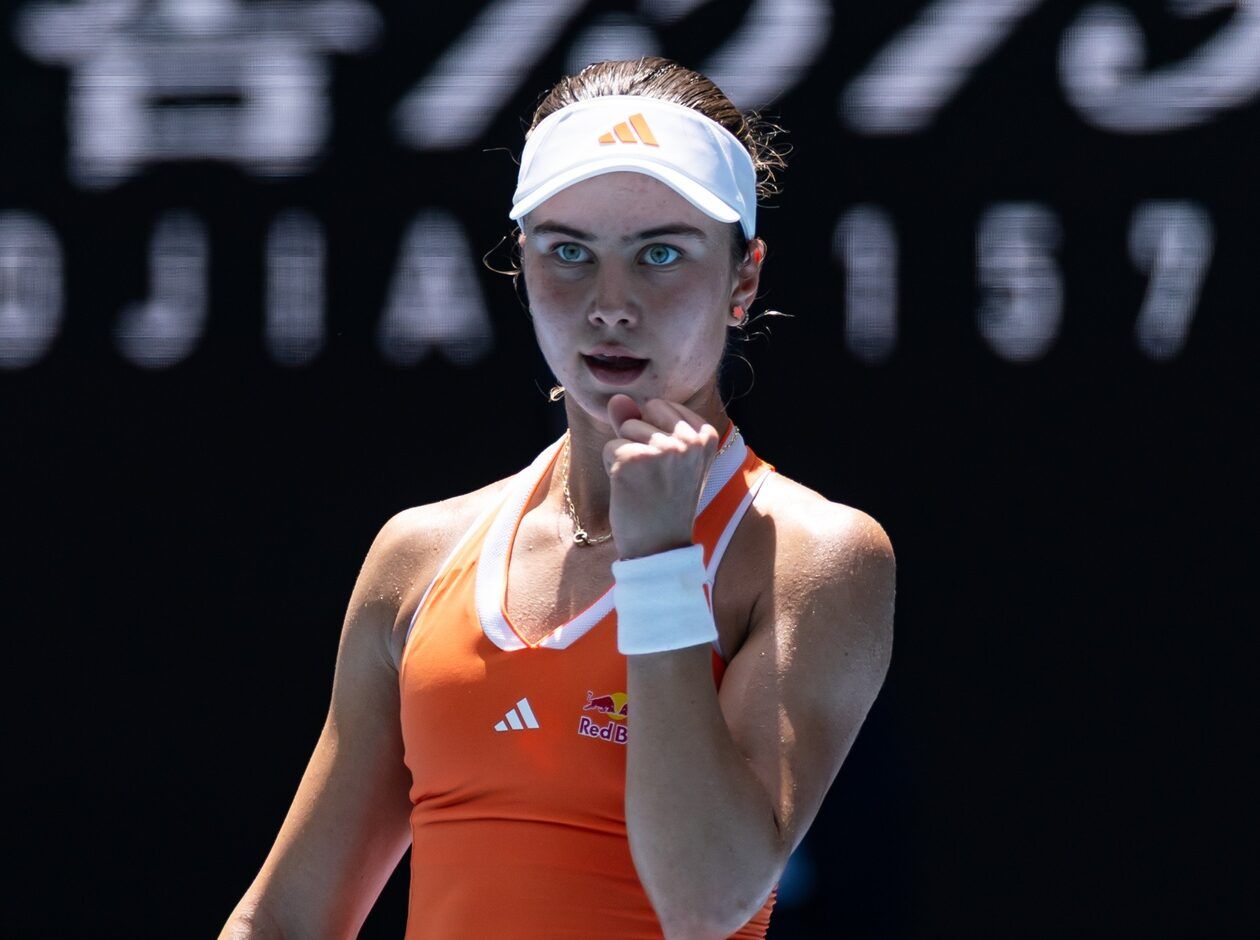
Lindsay Davenport did not frame Iva Jović’s Australian Open quarterfinal run as a sudden surprise or a fleeting hot streak. Instead, the former world No. 1 described it as the result of deliberate, measurable progress, particularly in power and physical strength.
Speaking ahead of Jović’s first-ever Grand Slam quarterfinal against top seed Aryna Sabalenka, Davenport laid out exactly how the American teenager has evolved and why this matchup represents a defining test of whether those improvements can hold up against the heaviest hitter in women’s tennis.

Lindsay Davenport Weighs Iva Jović’s Development Before the Aryna Sabalenka Clash
Davenport’s comments aired during a Tennis Channel segment in Melbourne as Jović prepared for her Australian Open quarterfinal. Jović reached the last eight by defeating compatriot Katie Volynets, Australian wildcard Priscilla Hon, seventh seed Jasmine Paolini, and Yulia Putintseva to secure her maiden Grand Slam quarterfinal appearance.
She is set to face two-time Melbourne champion Sabalenka in their first meeting on the WTA Tour, with a semifinal berth against either third seed Coco Gauff or 12th seed Elina Svitolina awaiting the winner.
Davenport’s assessment focused squarely on the challenge young players face as they move from junior dominance to success against elite professionals. “One of the biggest challenges for a player who is a good junior player and is still a teenager is: can you combat your game with the power that you’re going to face on the other side of the net? How are you going to finish points?” Davenport said.
From #191 to #20 😮
A lot has changed in just one year for Iva Jovic ➡️ pic.twitter.com/SSbwYpcWoa
— Tennis Channel (@TennisChannel) January 25, 2026
She pointed to measurable physical improvements as evidence that Jović is answering those questions. “And one thing that Eva’s been able to do is, physically, she’s gotten a lot stronger. Her shots, her miles per hour, are way up from the U.S. Open in 2025. Eva Jovic’s first-serve average is up 10 miles per hour. That is an incredible job to get that shot faster. Backhand up six miles per hour, and the forehand up five miles per hour.”
Davenport stressed that the gains have come without compromising aggression or positioning. “So every single shot across the board, she’s managed to add some miles per hour without giving up where she’s standing on the court either. If you watch her play, she hugs that baseline, and she’s still able to get her power.”
Still, Davenport made clear that Sabalenka represents a unique and unforgiving benchmark. “Now, this is going to be a humongous test to face Sabalenka, because nobody hits shot for shot harder and deeper in the court than Sabalenka. What is that going to do to Eva’s pace, and what is that going to do to her court positioning in that matchup?”
MORE: Iva Jović’s Stellar Australian Open Rise Reminds Lindsay Davenport of Madison Keys’ Breakthrough
What Did Jović’s Junior Success Reveal About Her Long-Term Potential?
Jović’s development has been years in the making, beginning with a standout junior career that hinted at her long-term potential. The Southern California native captured the 2024 Australian Open and Wimbledon girls’ doubles titles alongside Tyra Caterina Grant and finished runner-up at Roland Garros, establishing herself as one of the most consistent juniors of her generation.
That confidence carried over to the professional tour, where she won her first ITF title in Charlottesville before claiming a WTA 125 trophy in Ilkley in 2025. Her steady accumulation of Grand Slam second-round appearances helped build match toughness, setting the stage for a breakthrough in Guadalajara, where she lifted her first WTA Tour title.
That victory made her the youngest player to win a WTA title that season and the youngest American to do so since Coco Gauff in 2021. Earlier this year, she added another step forward by reaching the Hobart International final.
