
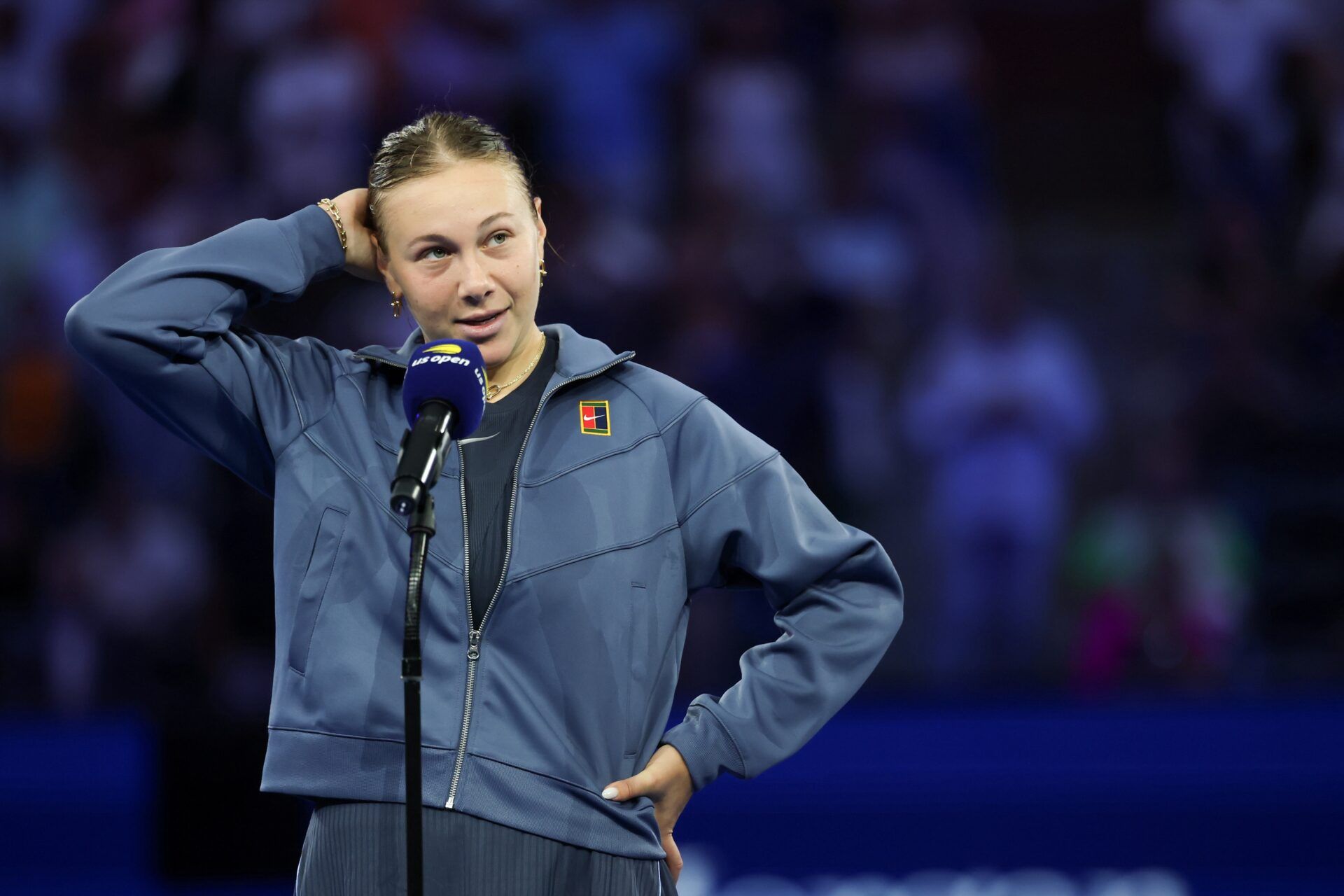
Saturday’s US Open final had all the drama you’d expect from a Grand Slam championship match, but not the kind Amanda Anisimova was hoping for. The American found herself battling more than just Aryna Sabalenka’s powerful groundstrokes as unexpected lighting conditions turned what should have been her moment into a frustrating struggle she couldn’t overcome.
What Bothered Amanda Anisimova During Her US Open Loss to Aryna Sabalenka?
Backed by a roaring Arthur Ashe crowd, Anisimova fought hard against the defending champion. However, Sabalenka’s dominance proved unassailable as she captured the first set 6-3. Despite some resistance from Anisimova in the second set, Sabalenka closed out the match 7-6(3) to successfully defend her title and claim her fourth Major championship.
ARYNA 2ABALENKA 🏆🏆 pic.twitter.com/5SSodcYtAW
— The Tennis Letter (@TheTennisLetter) September 6, 2025
Rain forced the match under Arthur Ashe Stadium’s closed roof with artificial lights, creating conditions that severely disrupted Anisimova’s serving rhythm. The lighting situation became a major factor that affected her ability to track the ball during her service motion.
“Well, I haven’t played on the court during the day with the roof closed, and it was literally like white, and I couldn’t see the ball when I was serving, like the whole match. I think, starting from the warm-up, I was like this is really going to be a problem for me. I didn’t know what to do,” she said in her post-match press conference.
Anisimova’s comments highlight how sudden, unforeseen changes in playing conditions can severely affect even the most experienced players. The challenge becomes even more daunting when facing the immense pressure of a Grand Slam final, where every point carries heightened significance.
This marked the third consecutive US Open final featuring an American woman. Coco Gauff claimed the title in 2023, while World No. 4 Jessica Pegula fell to Sabalenka in last year’s championship match.
How Does Anisimova Plan To Learn From This ‘Frustrating’ US Open Experience?
The World No. 9 made it clear that the poor visibility during her service games disrupted her entire approach and made holding serve nearly impossible. While the experience proved extremely frustrating, Anisimova views it as valuable preparation for handling similar conditions in future tournaments.
“There was no way of adjusting because I couldn’t see the ball when I was serving and that was a huge shock to my system because I knew if I can’t hold my serve it was going to be very tough to stay in the match.
“Now I know that, and it’s something I can bring into other tournaments or when I have to experience that again, but it was extremely frustrating for me. I was not expecting that at all, and that made my serving today very difficult,” she added.
Beyond the lighting issues, Anisimova’s struggles were compounded by 29 unforced errors compared to just 22 winners in front of her home crowd. Sabalenka, meanwhile, maintained better control with 13 winners against 15 unforced errors.
The victory allowed Sabalenka to avenge her 2025 Wimbledon semifinal loss to Anisimova and narrow their head-to-head record to 4-6. Additionally, Sabalenka became the first woman since Serena Williams (2012-14) to win back-to-back US Open titles. Her championship performance earned her $5 million in prize money.
