
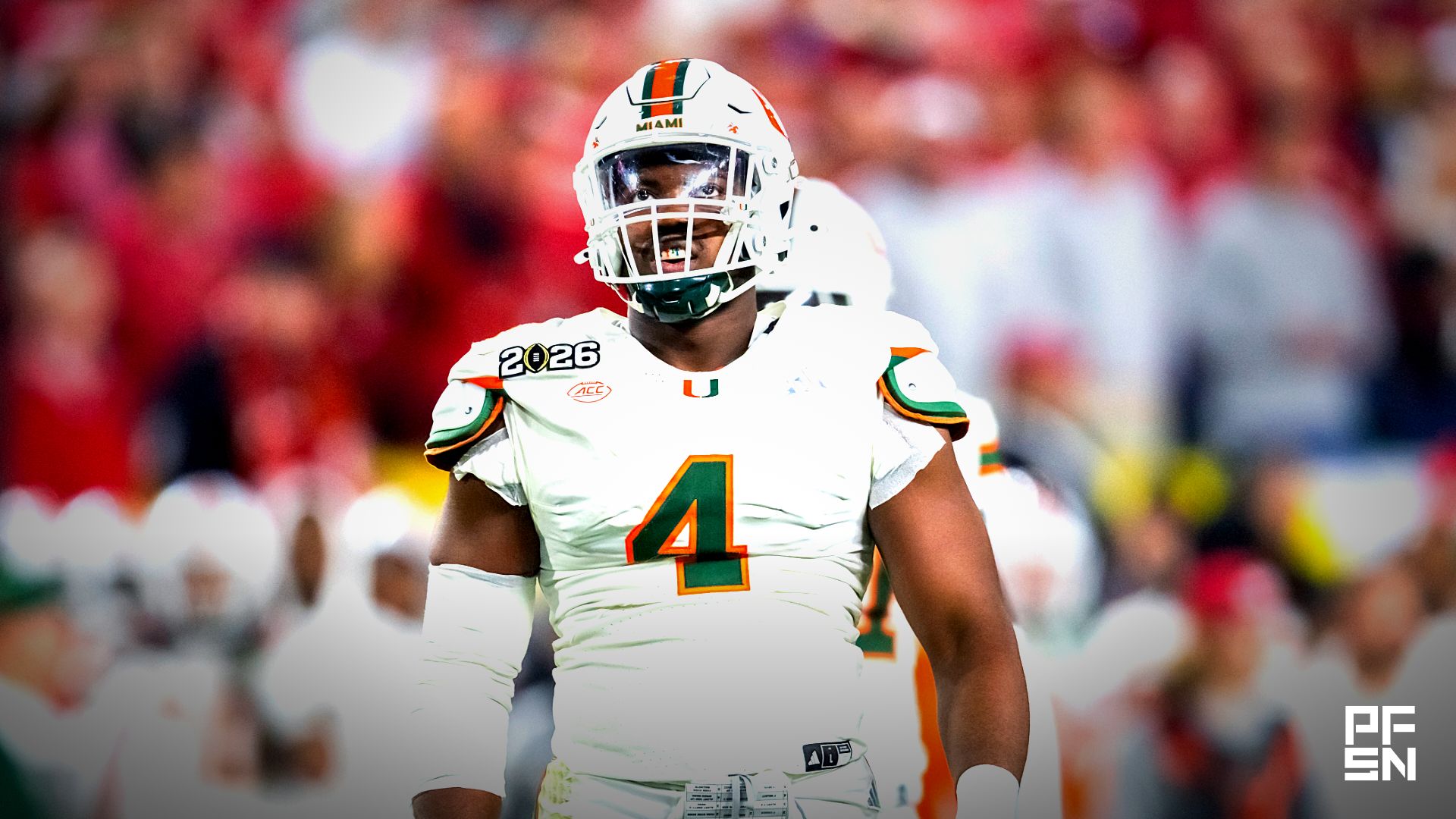
The measurement dropped at the 2026 NFL Combine, and the argument started immediately. Rueben Bain Jr.’s arms measured 30 and 7/8 inches in Indianapolis, first percentile among edge defenders and defensive linemen since at least 2010, and tied for the third-shortest recorded by an edge rusher since 1999.
The debate that followed was mostly heat and not much light. Here is what the tape, the numbers, and the history actually say.

Why Arm Length Actually Matters for Pass Rushers
Arm length is genuinely consequential for edge defenders, and for specific reasons that go beyond generic size metrics.
When an edge rusher engages an offensive tackle, arm length determines who controls the leverage battle at contact. Longer arms allow a defender to establish hand position first, preventing the offensive lineman from locking out at the chest or reaching the body. A pass rusher who can extend and separate wins the leverage battle before the footwork and power phase even begins. A shorter-armed rusher has to beat the tackle to the punch every single rep, against every tackle he faces.
The hand-fighting stage is where arm length shows up most concretely. A defender trying to convert speed into power around the edge needs to anchor and redirect against a tackle with two leverage points: his own body position and, critically, his reach. Shorter arms tighten that margin. Against NFL-caliber tackles, who are bigger, stronger, and more technically advanced than anything Bain faced in college, those margins get compressed further.
Bain knows the argument, and he answered it by using the example of Mike Tyson.
“Like Mike Tyson,” he told NFL Network’s Cameron Wolfe at his Miami pro day, “He wasn’t the tallest guy. He wasn’t the longest-limbed guy. But when you felt him, you felt him. You kept your distance.” At the combine, he added: “None of the teams seem to be too concerned with it. I will just talk the talk and walk the walk.”
The problem with the arm-length critique applied specifically to Bain is that the tape directly challenges the projection.
In 2025, Bain led all FBS players with 83 total pressures, including the postseason. He finished with 9.5 sacks and 15.5 tackles for loss, earning ACC Defensive Player of the Year, the Ted Hendricks Award, and consensus All-American recognition. He finished the year with an 82.7 College Football Impact Score (B-).
Across his three seasons at Miami, he recorded 20.5 sacks, 132 pressures, and 33.5 tackles for loss in 38 games.
Five of those 9.5 sacks came in the College Football Playoff. Against Texas A&M in the first round, he produced three sacks alone. He added another against Ohio State in the Cotton Bowl, and closed the run with a sack on eventual No. 1 overall prospect Fernando Mendoza in the national championship game against Indiana.
Bain’s production at Miami was built on hand technique and strength, not arm length advantages. His rip move is advanced. His inside counter is effective enough that scouts have discussed his viability as an interior pass rusher. His 30.3 percent win rate on true pass sets, a percentage that strips away coverage sacks and other noise, ranked among the best in the country. He doesn’t win with length. He wins with timing, leverage, and power.
The question is whether those tools translate when NFL tackles are 10 to 15 pounds heavier, technically superior, and specifically prepared for exactly the moves he’s showing on film.
The Comp History (And Its Limits)
For Bain, the comparisons most frequently deployed in this debate are Aaron Donald and George Karlaftis.
Donald’s arms measured 32 5/8 inches at the 2014 combine, and scouts noted the concern. He went on to earn three Defensive Player of the Year awards, eight first-team All-Pro selections, and was widely considered the most dominant interior defender in NFL history. His case is real, and it is also the extreme outlier on one end of the spectrum.
Karlaftis, whom the Chiefs signed to a four-year, $88 million extension in July 2025, measured 32 5/8 inches at the 2022 combine, identical to Donald. His arm length was a pre-draft concern as well. He produced 10.5 sacks and 8 sacks in back-to-back seasons in Kansas City (2023 and 2024).
Bain’s 30 7/8 inches is nearly two full inches shorter than either Donald or Karlaftis. That’s not a minor distinction. It’s the difference between a player operating at the edge of the historical success band and one operating outside it. The Donald and Karlaftis comps are encouraging, but they don’t map perfectly. Both of those players had meaningfully more length than Bain does.
What Bain has that neither Donald nor Karlaftis possessed coming out of college is a more refined hand-fighting arsenal at 263 pounds. His combination of body weight and technique gives him multiple leverage paths that don’t depend on arm extension. Whether that translates into sustained NFL success as an edge rusher or translates better in a hybrid interior role is the legitimate question teams are trying to answer.
Where Rueben Bain Jr. Could Up and What It Resolves
The draft picture shifted on April 18 when the New York Giants traded three-time Pro Bowl defensive tackle Dexter Lawrence to the Cincinnati Bengals in exchange for the No. 10 overall pick, giving the Giants two selections inside the top 10 and moving Cincinnati out of the first round entirely.
Bain had been projected to the Bengals at that spot before the trade. Now the Giants, picking fifth and 10th, are the team most directly positioned to take him. Multiple pre-trade mock drafts had placed Bain between picks 7 and 12.
BE AN NFL GM: PFSN’s Ultimate GM Simulator
At 263 pounds, Bain is heavier than a traditional pure edge rusher, which creates possibilities. A defense willing to use him as a hybrid, lining him up at the edge in sub-packages and kicking him inside against heavier offensive line sets, could maximize his hand technique while managing the arm length exposure. His production grade says he’s already doing that at the college level.
The arm length concern is legitimate, but so is his production. Teams are right to be divided as the data says one thing, and the tape says another. For the third-shortest arms among edge rushers since 1999 to be attached to an FBS-leading 83 pressures, that split is exactly what you’d expect.