
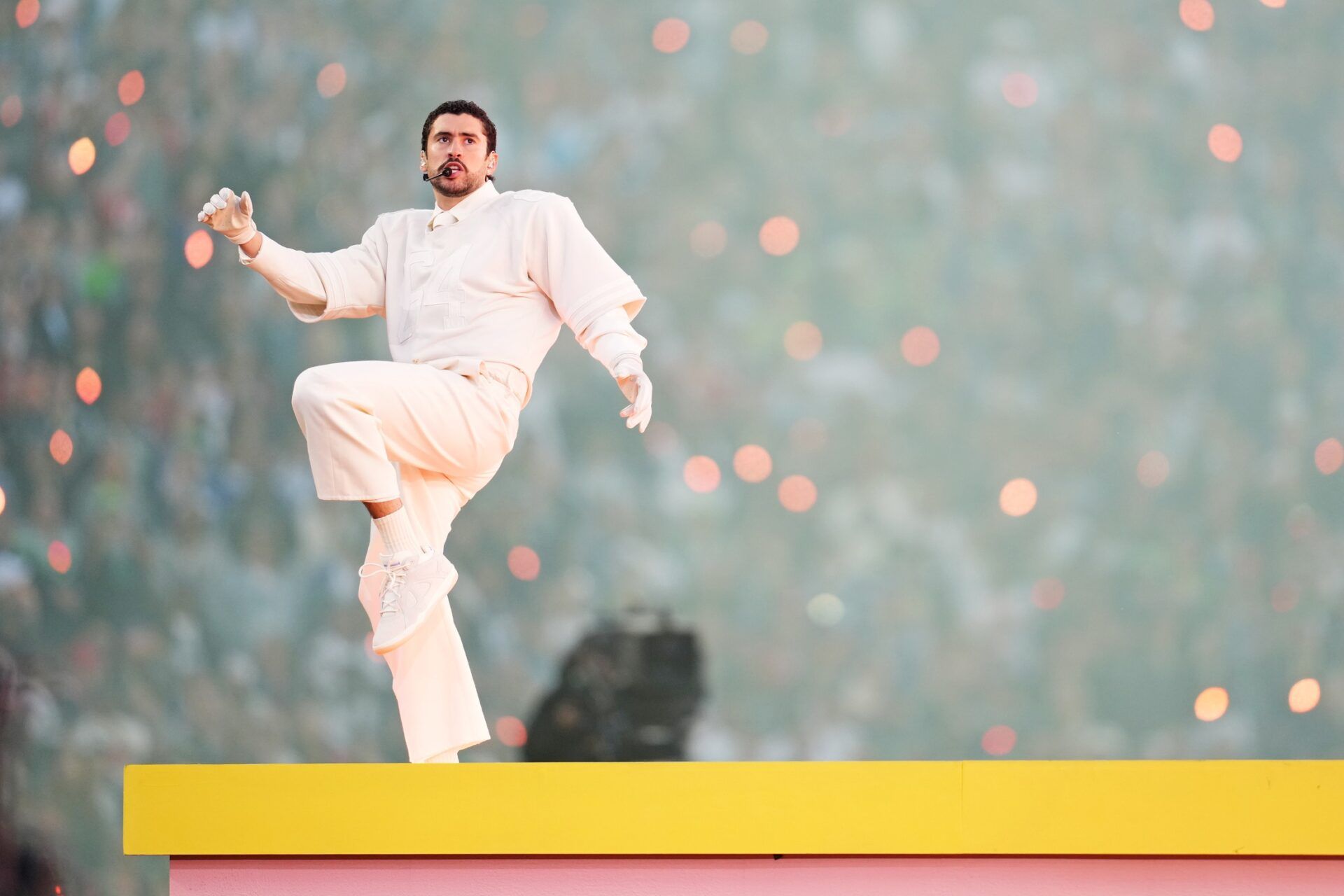
The NFL’s choice of Bad Bunny to headline the Super Bowl 60 halftime show at Levi’s Stadium came with weeks of scrutiny and debate. The Puerto Rican superstar arrived on one of the sport’s largest stages as the first Latino solo artist to lead the show, performing primarily in Spanish before a global television audience.
NFL Commissioner Roger Goodell Hugs Bad Bunny After Super Bowl Halftime Show
By the time the New England Patriots and Seattle Seahawks returned from the locker room for the second half, one brief off-camera encounter between the artist and the league’s top executive had become an unexpected focal point of the night.
Shortly after Bad Bunny left the field on Sunday, cameras captured him and Goodell meeting in a Levi’s Stadium hallway. The footage showed the two embracing warmly, hugging several times, speaking quietly, posing together for a photo, and then heading off in opposite directions.
Bad Bunny appeared to tell Goodell that he was “really grateful” during the exchange, underscoring the moment’s significance for both the performer and the league. The NFL later posted the clip on its official social channels with the caption “Commish 🤝 Benito,” turning a private hallway interaction into one of the night’s defining viral images.
Commish 🤝 Benito#AppleMusicHalftime @sanbenito pic.twitter.com/DetIOgJrDa
— NFL (@NFL) February 9, 2026
Fans quickly seized on the scene as a symbol of gratitude and unity amid a high-stakes, heavily scrutinized entertainment event. Commenters praised Goodell for standing by the decision to feature Bad Bunny despite intense criticism, while others focused on the importance of seeing Puerto Rican culture and Spanish-language music showcased on such a visible stage.
The hug also capped a high-energy set in which Bad Bunny delivered hits including “Tití Me Preguntó” and other chart-topping tracks, incorporating elaborate visuals, surprise celebrity appearances, and cultural imagery.
The show concluded with a message of inclusion as he and his dancers moved across the field with flags representing countries across the Americas, reinforcing themes that had already been central to the debate around his selection.
What’s The Controversy Around Bad Bunny’s Super Bowl Halftime Show?
Bad Bunny’s halftime booking drew criticism long before kickoff. Detractors objected to his Spanish-language catalog, explicit lyrics, and outspoken political stances, particularly his past comments opposing ICE and his broader critiques of U.S. immigration policy.
Some conservative voices questioned whether a performer who sings almost entirely in Spanish fit their idea of an “American” show, even though Puerto Rico is a U.S. territory and Bad Bunny is a U.S. citizen.
Those tensions escalated in the week leading up to the game, as politicians and commentators publicly denounced the choice and called for a different kind of act. Former president Donald Trump erupted after the performance, labeling the show “disgusting” and “the worst ever” while complaining that viewers “do not understand a word this guy is saying.”
Other critics pushed for a more traditional, English-language headliner and framed the halftime slot as a battleground in a broader culture war. Throughout the backlash, Goodell consistently defended both the selection and the artist.
In October, he emphasized that every halftime choice draws objections but called Bad Bunny one of the world’s great artists and said the league believed he understood the responsibility of the platform.
In a later media availability, Goodell expanded on that theme, saying, “One thing I know Bad Bunny can do is that he can all make us tap our feet and shake our booties. I want him to go out there and unite people with music. Music we can all dance to it and enjoy. So, I’m looking forward to the performance. I’m not worried about the politics.”
He then pointed out, “I’m not worried about any statements. Just have a good time and do what you’re supposed to do, uniting the world around something that is eternal. Music is the heartbeat of the world.”
The post-show hug, widely shared by the league itself, appeared to reflect that stance in real time, turning a night framed by controversy into a moment many viewers interpreted as genuine appreciation and support.
