
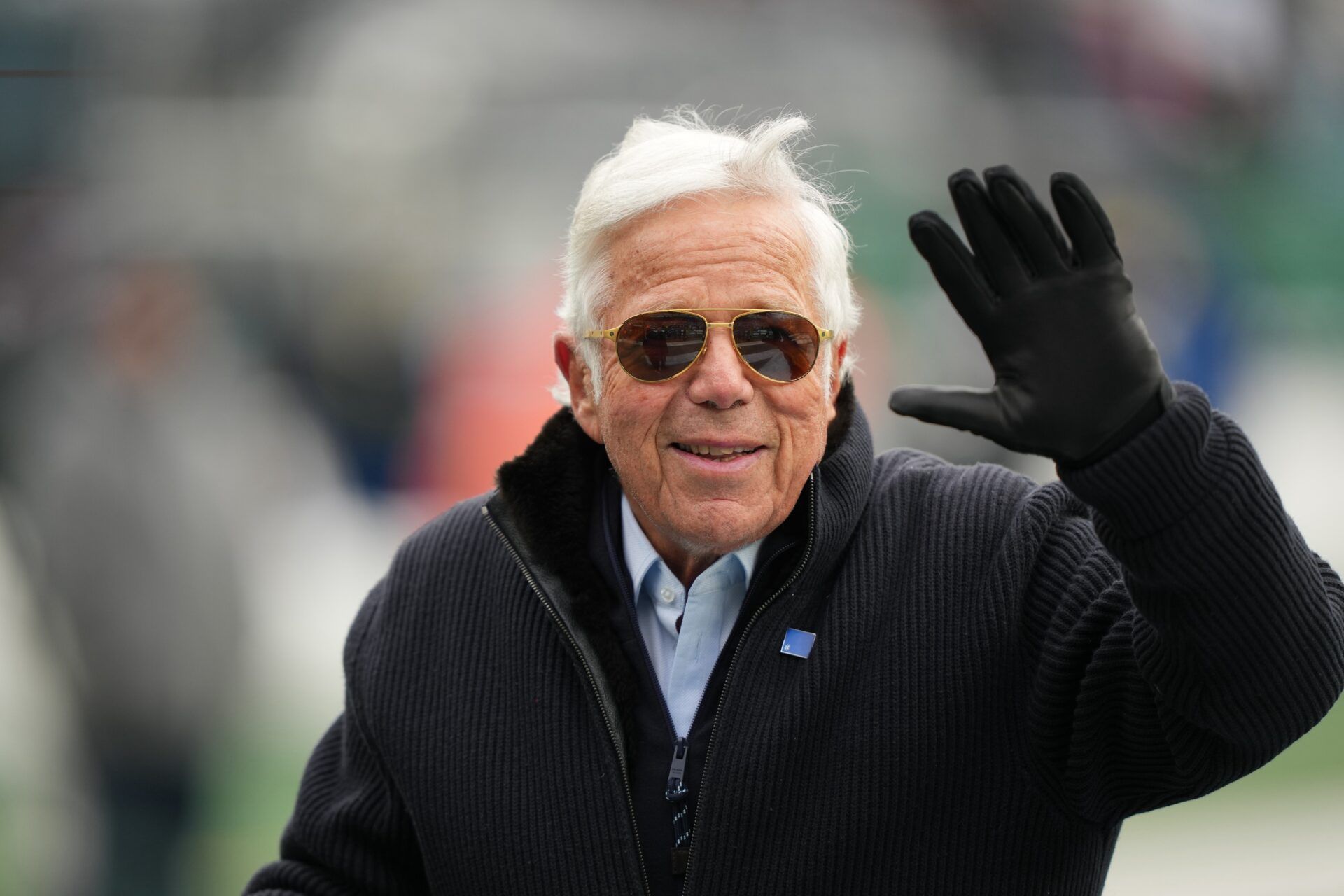
Robert Kraft’s path from paper and packaging executive to billionaire NFL owner runs parallel to the New England Patriots’ transformation from struggling franchise to modern dynasty.
Before Tom Brady, Bill Belichick, and six Lombardi Trophies, Kraft spent decades building a business portfolio that allowed him to buy a team that was flirting with relocation and turn it into one of the league’s most valuable clubs.
With New England back in the Super Bowl and the franchise now valued in the billions, his financial story is central to the Patriots’ path to this point.
How Did Robert Kraft Make His Money?
Kraft’s business career started long before he entered the NFL. After graduating from Columbia University in 1963 and earning an MBA from Harvard in 1965, he briefly worked in politics before joining his father‑in‑law’s company, Rand‑Whitney Group, a Worcester‑based packaging business.
Kraft became president of Rand‑Whitney in 1968 and remains chairman, using the firm as a foundation for his broader business interests.
In 1972, he founded International Forest Products, a company focused on trading physical paper commodities. The business grew into a major player in the export and import markets; by 1997, it ranked among the top 100 U.S. exporters/importers, and by 2001, it ranked seventh on the Journal of Commerce’s list of exporters and importers.
The success of Rand‑Whitney and International Forest Products provided significant wealth and cash flow, positioning Kraft to pursue larger investments.
Kraft also moved into media. He invested in New England Television Corp., which gained control of Boston’s Channel 7 license in 1982. He served on the board, became president in 1986, and sold his shares in 1991 for an estimated $25 million. That exit, combined with his existing businesses, added to the capital base he would eventually use in sports.
His route to NFL ownership began with the Patriots’ real estate rather than the team itself. In 1985, Kraft purchased Foxboro Raceway, gaining control of the land and parking around the stadium. He later acquired the stadium itself out of bankruptcy for about $25 million.
When previous owner Billy Sullivan defaulted on loans tied to the surrounding lots, Kraft’s position tightened. By 1994, he bought the Patriots franchise for $172 million, then a record price for an NFL team. That deal kept the team in New England and set the stage for the run of success that followed.
Patriots Owner Kraft’s Net Worth in 2026
Decades after those initial moves in packaging, paper trading, media, and stadium control, Kraft ranks among the NFL’s richest owners.
According to Forbes figures cited in recent reporting, Kraft’s net worth in 2026 is $13.8 billion. That total places him among the wealthiest individuals in the league’s ownership ranks and reflects both his core business holdings and the Patriots franchise’s massive appreciation.
Kraft’s primary business umbrella today is the Kraft Group, formed in 1998 as a collection of privately held companies with assets in manufacturing, real estate development, and professional sports.
READ MORE: Super Bowl 60 Predictions: Predicting the Winner, Final Score, MVP, and More
The Kraft Group encompasses his long‑standing stakes in Rand‑Whitney and International Forest Products as well as his sports properties, including the Patriots and Major League Soccer’s New England Revolution.
The Revolution also plays at Gillette Stadium, with separate plans underway for a dedicated 24,000‑seat soccer venue in Everett, Massachusetts.
On the team side, the Patriots have grown from a financially shaky club in the early 1990s into one of the NFL’s most valuable franchises. Forbes values the Patriots at approximately $9 billion, ranking them among the league’s most profitable organizations.
That valuation reflects sustained on‑field success, a strong regional fan base, long‑term stadium control in Foxborough, and the financial impact of six Super Bowl titles from the 2001 to 2018 seasons.
Kraft has remained the team’s owner throughout that entire period. He purchased the Patriots in 1994, saw them reach a Super Bowl by the 1996 season, and then oversaw the dynasty era that began with the 2001 championship.
By the time New England returned to the Super Bowl in 2026 under head coach Mike Vrabel and quarterback Drake Maye, the franchise’s value had climbed into the upper tier of global sports assets.
Taken together, Kraft’s 13.8‑billion‑dollar net worth and the Patriots’ roughly 9‑billion‑dollar valuation trace back to the same set of decisions: building profitable packaging and paper‑trading businesses, leveraging media investments, securing stadium and land rights, and ultimately buying and holding a team that evolved into one of the NFL’s signature brands.
