
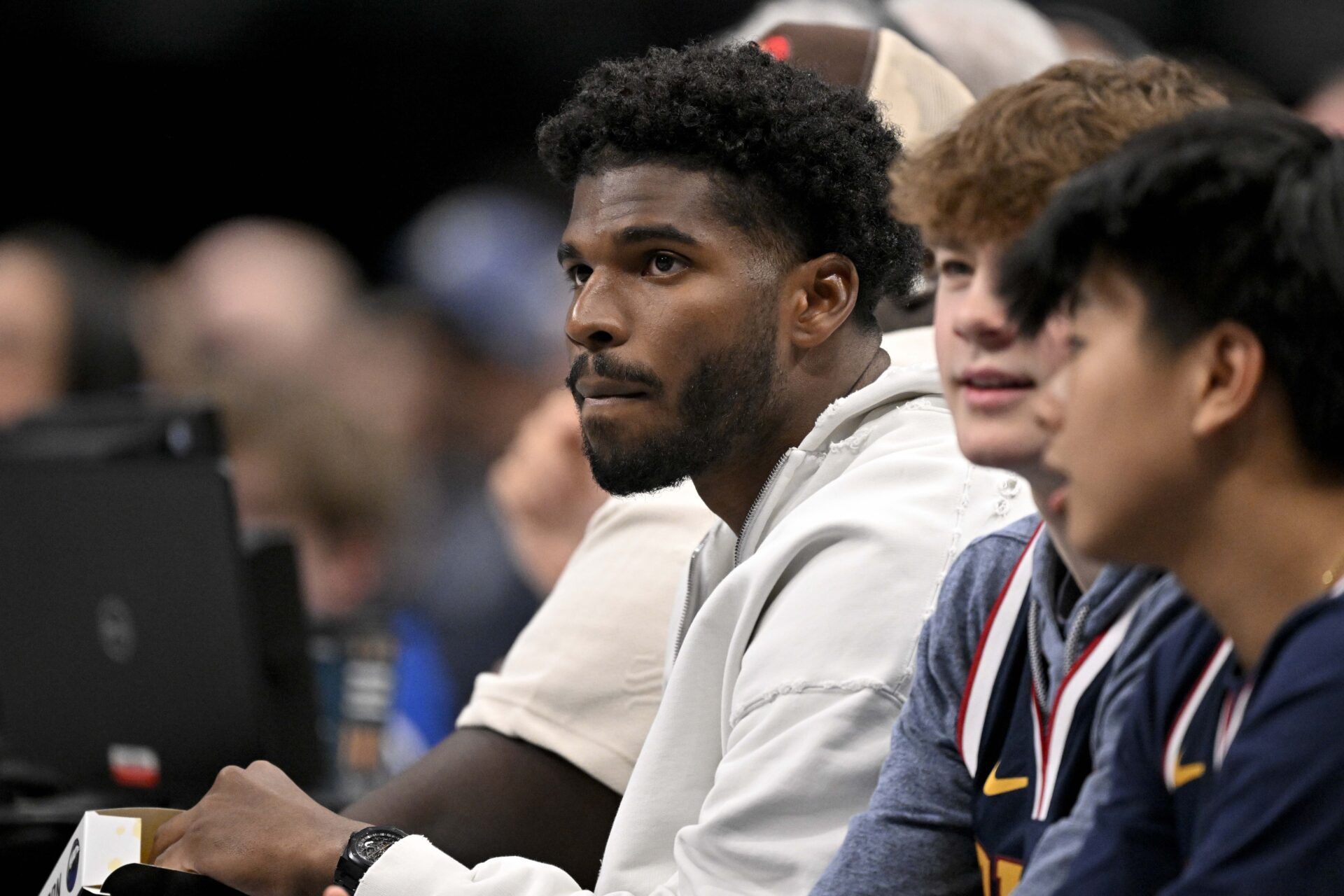
The biggest storyline of the NFL offseason has centered around Colorado Buffaloes quarterback Shedeur Sanders. The son of Deion Sanders has seen his draft stock take a steep dive. Once considered a potential top-10 pick, there’s now a real possibility Sanders might not even be selected in the first round of the 2025 NFL Draft.
So what’s behind this dramatic fall in the rankings? Why has the perception around Sanders shifted so drastically over the past two months?
Potential Reasons Why Shedeur Sanders’ Draft Stock Is Falling
Below-Average Athletic Traits
Perhaps the biggest reason Sanders is slipping in the eyes of NFL evaluators is his athletic toolbox. While traits like processing speed, system fit, and mechanical issues can be improved with coaching, there’s concern that he might always be limited by his physical traits.
Sanders stands around 6-foot-2, which is only average for the NFL prototype at the position. And when watching his tape, his ability to extend plays or create outside of structure isn’t particularly impressive — nor is his arm strength.
That doesn’t mean he needs to have a rocket arm like Josh Allen or Justin Herbert. In fact, Sanders projects more in the Brock Purdy mold when it comes to physical traits. As Purdy has shown, success is still possible, but it places limitations on what a quarterback can do when things break down around him.
Poor Interviews and Perceived Arrogance
One major factor tied to Sanders’ drop on draft boards is how teams have perceived him during interviews. The Colorado QB openly stated that he approached interviews with NFL teams the same way they approached him, essentially turning the tables in the process. Sanders even acknowledged that some teams didn’t appreciate his attitude.
One NFL assistant coach said his interview with Sanders was the worst he’s ever had, highlighting how much these interactions may have impacted his evaluation among front offices, coming off as arrogant.
“The worst formal interview I’ve ever been in in my life. He’s so entitled. He takes unnecessary sacks. He never plays on time. He has horrible body language. He blames teammates. … But the biggest thing is, he’s not that good,” said the anonymous coach, via Pelissero.
Average Floor, Low Ceiling
Sanders is widely regarded as a quarterback who processes the game well, reads coverages effectively, and can make tight-window throws. Those are all essential traits for a passer to find success in the NFL. When it comes to distributing the ball and executing within structure, he gets the job done.
The issue lies in what he brings beyond that. Under pressure, Sanders struggled, and his 74% completion rate masks some of those problems because he was frequently throwing behind the line of scrimmage on screen plays.
Sanders often took unnecessary sacks by failing to get rid of the ball on his hot reads and tried to extend plays without the athletic tools to do so, exposing his physical limitations.
Make no mistake, Sanders is still considered the second-best QB in this class due to the stability he offers compared to his peers. But that level of safety may not be enough for teams to fall in love with him and spend premium draft capital.
The Rise of Jaxson Dart and Jalen Milroe
While Sanders offers more security than his direct competition, the upside of other quarterbacks in the class may outweigh that. And for some teams, the difference in reliability might not matter.
Jaxson Dart brings added value as a creator outside the pocket. He’s a more physical runner who can make plays with his legs, and although his passing game has some inconsistencies, it’s not a significant drop-off from Sanders — certainly not enough to make the Colorado QB a clear-cut favorite across all boards.
Jaxson Dart (-125) has passed Shedeur Sanders (-120) as the favorite to be the 2nd QB selected in the NFL Draft 👀 pic.twitter.com/uNRY8eFwE3
— ESPN BET (@ESPNBET)
Jalen Milroe, on the other hand, is a much more limited passer, but he boasts the best raw physical tools of any quarterback in the draft. He reportedly ran a 4.40 in the 40-yard dash, making him one of the fastest players at the position entering the NFL, and he pairs that speed with a cannon for an arm.
Those traits give Milroe the ability to mask early struggles in adjusting to the pro game, buying time for a team to develop him while tapping into his high ceiling.
QB-Needy Teams Choosing To Prioritize Other Positions
In a draft class that lacks elite top-end talent, it’s easy to mistake the board for being weak, but that’s not the case. While there may not be many projected superstars, the 2025 NFL Draft is expected to produce a strong crop of solid starters, especially throughout the first three rounds.
Because of this, teams in need of a quarterback might choose to prioritize positions with higher developmental returns, such as edge rusher, defensive tackle, and cornerback — all of which have quality talent scattered across the board.
Adding to that, the New York Giants, who hold the third overall pick and have been linked to Sanders, signed two quarterbacks in free agency. The Tennessee Titans are expected to go with Cam Ward at No. 1, and the Cleveland Browns, who hold the first pick of Round 2, might not feel the pressure to reach for a quarterback early.
The New Orleans Saints, picking at No. 9, are a potential landing spot for Sanders, but they also have needs at premium positions on defense. That could push the Saints away from a quarterback.
As for the Pittsburgh Steelers at No. 21, they remain the most logical and ideal fit for Sanders. However, if a high-value prospect unexpectedly falls, Pittsburgh could pivot to another position.
So while Sanders is certainly an intriguing prospect with a strong NFL lineage, it’s understandable why teams are approaching his draft stock with caution.
At this point, it wouldn’t be a shock to see him still on the board at the start of Day 2, and maybe not even the second quarterback taken. Then again, the NFL Draft always delivers surprises, and nothing can truly be ruled out.
