
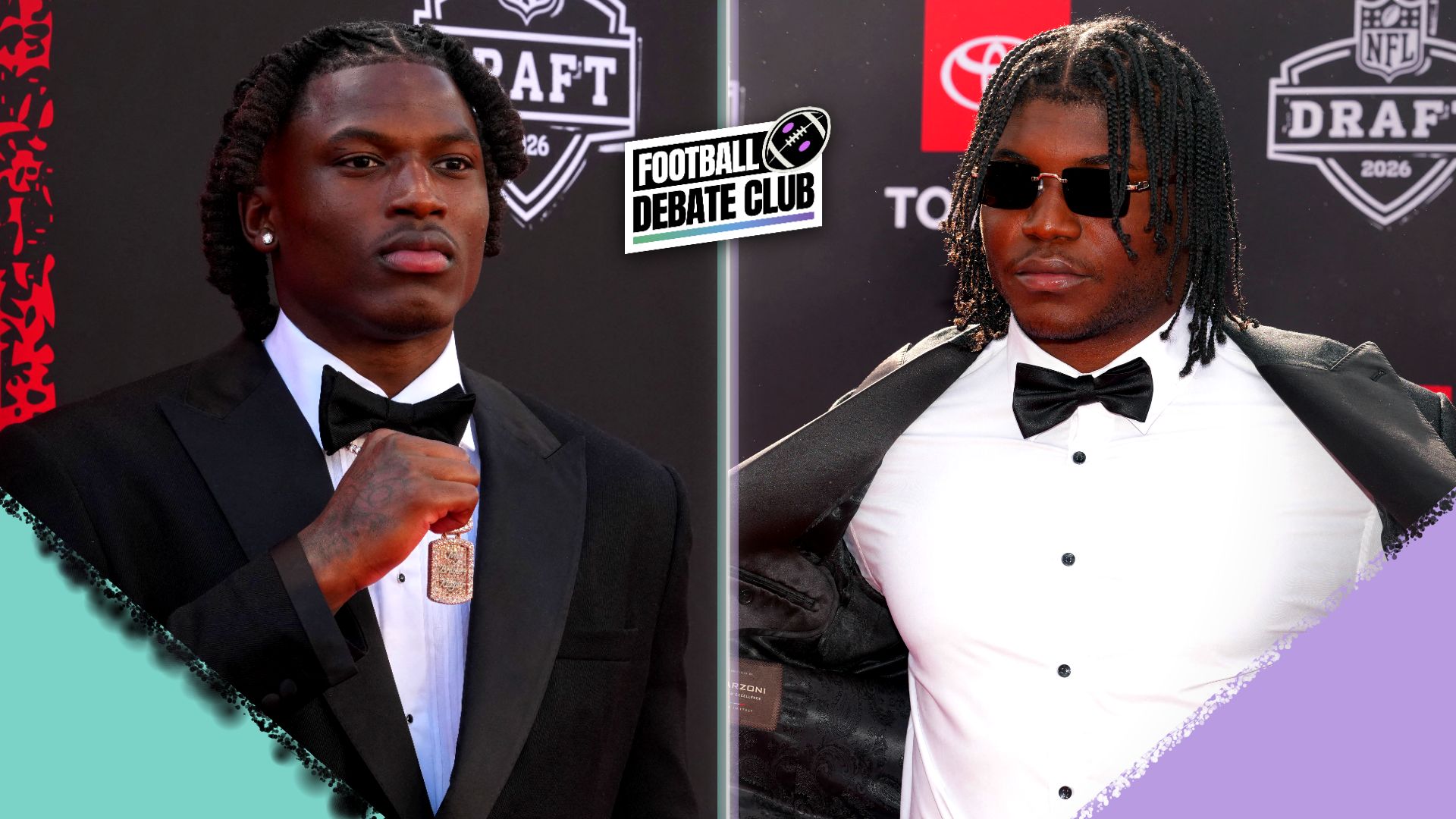
Prior to the 2026 NFL Draft, the consensus big board had Arvell Reese second overall and David Bailey seventh. The Jets took Bailey at No. 2.
On PFSN’s “Football Debate Club,” PFSN’s Ian Cummings argued the pick was needs-based while Dalton Wasserman insisted it was the best player available.
Why Ian Cummings Called the Jets’ David Bailey Pick Needs-Based Over Arvell Reese
“It’s splitting hairs, and there’s going to be differences across every board, but I think this leaned a little bit more toward a needs-based pick,” Cummings said. “David Bailey felt like the guy who was a full-time edge, and he gives you a little bit more security if you’re Aaron Glenn looking for an instant impact player at that position. To me, Arvell Reese was the higher player on my board and the consensus board, which I know was a big topic after the draft.”
Reese sitting at No. 2 on the consensus board while Bailey was No. 7 is significant.
Reese projects as an off-ball linebacker with edge versatility. Bailey is a pure edge rusher with elite first-step explosion. Edge rushers occupy one of the most expensive positions in football. Off-ball linebackers do not. When the broader market has a slightly higher-graded LB and a slightly lower-graded edge available at the same pick, no team takes the LB. The positional value math always points to the edge.
The Jets did not pick Bailey because he was unambiguously the best player on every board. They picked him because, factoring in positional value, the math at No. 2 always pointed to the edge.
However, Wasserman argued that Bailey was the best player available.
“I think he was arguably BPA,” Wasserman said. “I do think there is something to the security aspect that Ian mentioned there. And he was the most proven pass rusher in college football over the last two years amongst this class. I would have been good with even a Rueben Bain Jr. or a Caleb Downs as well. I had Bailey one spot ahead of Reese on my board. I think he brings natural pass rush juice that this team needs.”
Bailey’s production profile was impressive. Bailey posted 14.5 sacks at Texas Tech in 2025, tying for the FBS lead, plus 19.5 tackles for loss (second-most in FBS) and 81 quarterback pressures.
New York generated just 26 total sacks in 2025, among the lowest in the league, and Will McDonald IV led the team with eight. No other defender hit five.
“I’m curious to see where this leaves Will McDonald IV in the long term as well, because you do have kind of similar players,” Wasserman said. “So there’s some issues on early downs you’re going to have to figure out.”
McDonald and Bailey are both pass-rushing specialists with run-defense questions. Pairing them gives Aaron Glenn his bookend pass rush. It also leaves the early-down identity of the front, especially against the AFC East ground games the Jets see twice each, for Glenn to figure out.
BE AN NFL GM: PFSN’s Ultimate GM Simulator
The deeper takeaway from the debate is that BPA versus need is the wrong axis. Bailey was a higher-rated player than Reese on the Jets’ board and on Wasserman’s board, and a lower-rated player than Reese on the consensus board. The Jets made a positional value call between two players the rest of the league had close on talent. That is not a home-run swing. It is the boring, optimal answer at No. 2.
Whether McDonald gets squeezed out is the next debate.