
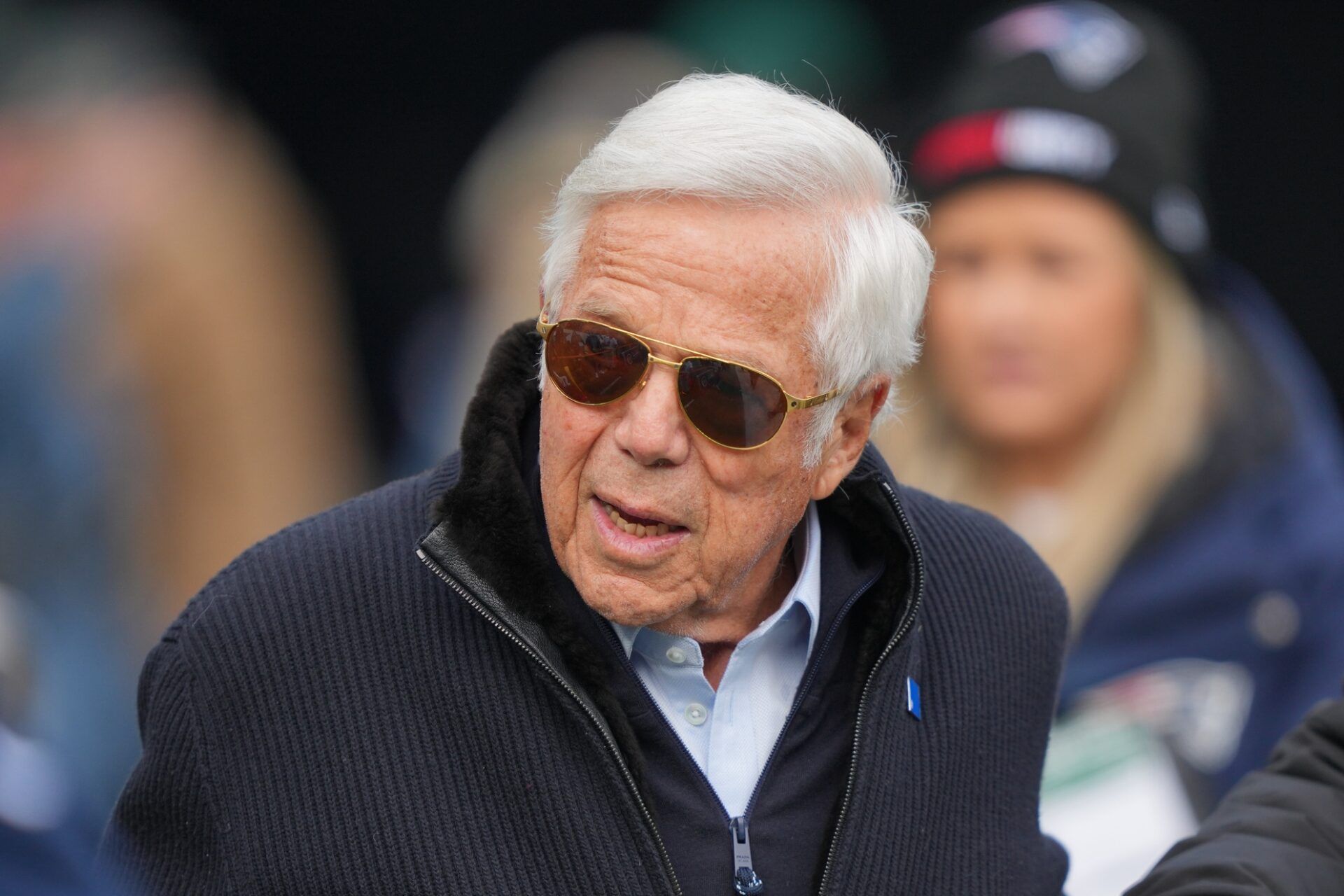
The Pro Football Hall of Fame’s contributor ballot produced another major surprise ahead of Super Bowl 60, as New England Patriots owner Robert Kraft reportedly failed to secure enough votes for induction.
Kraft, who was a first-time finalist in the contributors and seniors category, joined former Patriots head coach Bill Belichick on the outside looking in for the 2026 class despite their six Super Bowl titles together in New England. The result keeps the Hall’s list of inducted owners at 15, even as debate grows over how Kraft’s resume compares to those already in Canton.
Patriots Owner Robert Kraft Snubbed Hall Of Fame Spot Days After Belichick Decision
Reports that Belichick did not reach the 40-of-50 vote threshold required for induction surfaced first, triggering widespread reaction about how one of the NFL’s most decorated coaches could be denied induction in his first year of eligibility.
Days later, ESPN’s Adam Schefter reported that Kraft also fell short of the same benchmark in the contributors and seniors vote, leaving both pillars of the Patriots’ dynasty out of the 2026 class.
Voters in that category were choosing among five finalists: Kraft, Belichick, Roger Craig, Ken Anderson, and L.C. Greenwood, with up to three candidates eligible for selection if they reached 40 votes.
According to reports, Kraft failed to secure at least 40 votes from the 50-person committee and did not meet the threshold for enshrinement. That outcome means at least 11 voters left his name off their three-man ballot in a year when only contributors and senior players were under consideration in that lane.
Patriots owner Robert Kraft, like his former head coach Bill Belichick, was not selected for entry into this year’s Pro Football Hall of Fame class, sources told ESPN.
The Class of 2026 will be revealed Thursday at NFL Honors in San Francisco, but it will not include Kraft. pic.twitter.com/W0YBwnxsq8
— Adam Schefter (@AdamSchefter) February 3, 2026
A separate report noted that only one of Craig, Anderson, or Greenwood had to exceed 40 votes to gain entry, and at least one from that trio will now be in the 2026 class.
Kraft publicly downplayed the snub when asked about it on CNBC’s “Squawk Box” ahead of Super Bowl week. “What matters to me is we win Sunday,” Kraft told CNBC.
He added that he would not speculate on the decision-making process that led to his exclusion. “I can’t speak on issues where other people are voting or doing things,” Kraft said on Tuesday, emphasizing that his focus is on the Patriots’ attempt to secure a seventh Lombardi Trophy against the Seattle Seahawks rather than on individual recognition.
READ MORE: Top 100 2026 NFL Free Agent Rankings
Under Kraft’s ownership since 1994, New England has captured six Super Bowl titles, 11 AFC championships, and 20 AFC East crowns (including this season), while the franchise’s valuation has surged from a $172 million purchase price to an estimated multibillion-dollar figure.
Those credentials have fueled expectations that he will eventually join the list of Hall of Fame owners, even though 2026 did not bring the anticipated first-ballot induction.
List Of All NFL Owners In The Hall Of Fame
Fifteen primary owners are currently enshrined in the Pro Football Hall of Fame. Many combined on-field success with major contributions to league growth, television deals, or structural changes that shaped the modern NFL. Kraft’s omission keeps this group unchanged for now, a key reference point for comparisons.
Tim Mara: Giants, 1963
Tim Mara founded the New York Giants in 1925 and helped stabilize the fledgling NFL in a major market. His stewardship turned the Giants into one of the league’s flagship franchises and was recognized with induction in the Hall’s inaugural class of owners in 1963.
Bert Bell: Eagles, 1963
Bert Bell owned the Philadelphia Eagles and later became the NFL commissioner. He was instrumental in creating the league’s draft system to promote competitive balance and played a central role in guiding the NFL through periods of financial uncertainty, earning induction into the Hall of Fame as part of the Hall’s early classes.
George Preston Marshall: Commanders, 1963
George Preston Marshall owned the Washington franchise and oversaw its move to the nation’s capital, where it became a major draw. His tenure included multiple championships in the pre-Super Bowl era, and he was enshrined in 1963 for his role in expanding the league’s footprint, despite a legacy also marked by significant controversy.
Art Rooney: Steelers, 1964
Art Rooney founded the Pittsburgh Steelers and presided over the club’s rise from a longtime struggler to an eventual powerhouse. His family’s stewardship of the franchise became a model of stability, and he was inducted into the Hall of Fame in 1964 as one of the NFL’s founding owners.
Charles Bidwill: Cardinals, 1967
Charles Bidwill owned the Chicago Cardinals and built one of the league’s early championship teams, which won the NFL title in 1947. Though he died before that title run, his impact on the franchise and league was recognized with a Hall of Fame induction in 1967.
Dan Reeves: Rams, 1967
Dan Reeves, not to be confused with the later head coach of the same name, owned the Cleveland/Los Angeles Rams. Under his leadership, the team became the first NFL franchise on the West Coast, helping drive the league’s postwar expansion and earning him a place in Canton.
Lamar Hunt: Chiefs, 1972
Lamar Hunt founded the American Football League and the Kansas City Chiefs, playing a pivotal role in the AFL-NFL merger that shaped modern professional football. He also helped coin the term “Super Bowl,” and his broad influence on the sport was recognized with his induction into the Hall of Fame in 1972.
Tex Schramm: Cowboys, 1991
Tex Schramm served as president and general manager of the Dallas Cowboys and is credited with many innovations, including instant replay and advanced scouting and analytics. His work alongside owner Clint Murchison Jr. turned Dallas into “America’s Team,” leading to his induction as a contributor in 1991.
Al Davis: Raiders, 1992
Al Davis was the owner, general manager, and sometimes head coach of the Raiders. A forceful advocate for franchise control and league-wide change, he won three Super Bowls and helped popularize the vertical passing game. His impact on both competitive success and league politics secured his Hall of Fame spot in 1992.
Wellington Mara: Giants, 1997
Wellington Mara, Tim Mara’s son, co-owned the Giants and was central to the league’s revenue-sharing model for television rights. His influence on competitive balance, combined with multiple championships under Giants ownership, led to his induction in 1997.
Dan Rooney: Steelers, 2000
Dan Rooney guided the Steelers through their most successful era, with six Super Bowl titles, tying the NFL record. He was also instrumental in establishing the “Rooney Rule,” which requires teams to interview minority candidates for key jobs, and was inducted into the Hall in 2000 for his dual on-field and policy impact.
Ralph Wilson: Bills, 2009
Ralph Wilson founded the Buffalo Bills and was a key figure in the AFL’s survival by financially supporting struggling franchises, paving the way for the AFL-NFL merger. His Bills reached four consecutive Super Bowls, earning him induction in 2009.
Eddie DeBartolo Jr.: 49ers, 2016
Eddie DeBartolo Jr. owned the San Francisco 49ers during a run that produced five Super Bowl titles in 22 years. Under his leadership, the 49ers posted the league’s best winning percentage across the 1980s and 1990s, and he was inducted as a contributor in 2016 despite off-field legal issues.
Jerry Jones: Cowboys, 2017
Jerry Jones bought the Cowboys in 1989 and serves as owner, president, and general manager. He oversaw three Super Bowl wins in the 1990s and dramatically expanded team and league revenues through sponsorships and stadium deals, helping reshape NFL business practices and earning induction in 2017.
Pat Bowlen: Broncos, 2019
Pat Bowlen owned the Denver Broncos during an era that included seven Super Bowl appearances and three championships. As chair of key TV and labor committees, he was central to landmark broadcast deals and the growth of “Sunday Night Football,” leading to his posthumous induction into the Hall of Fame in 2019.
