
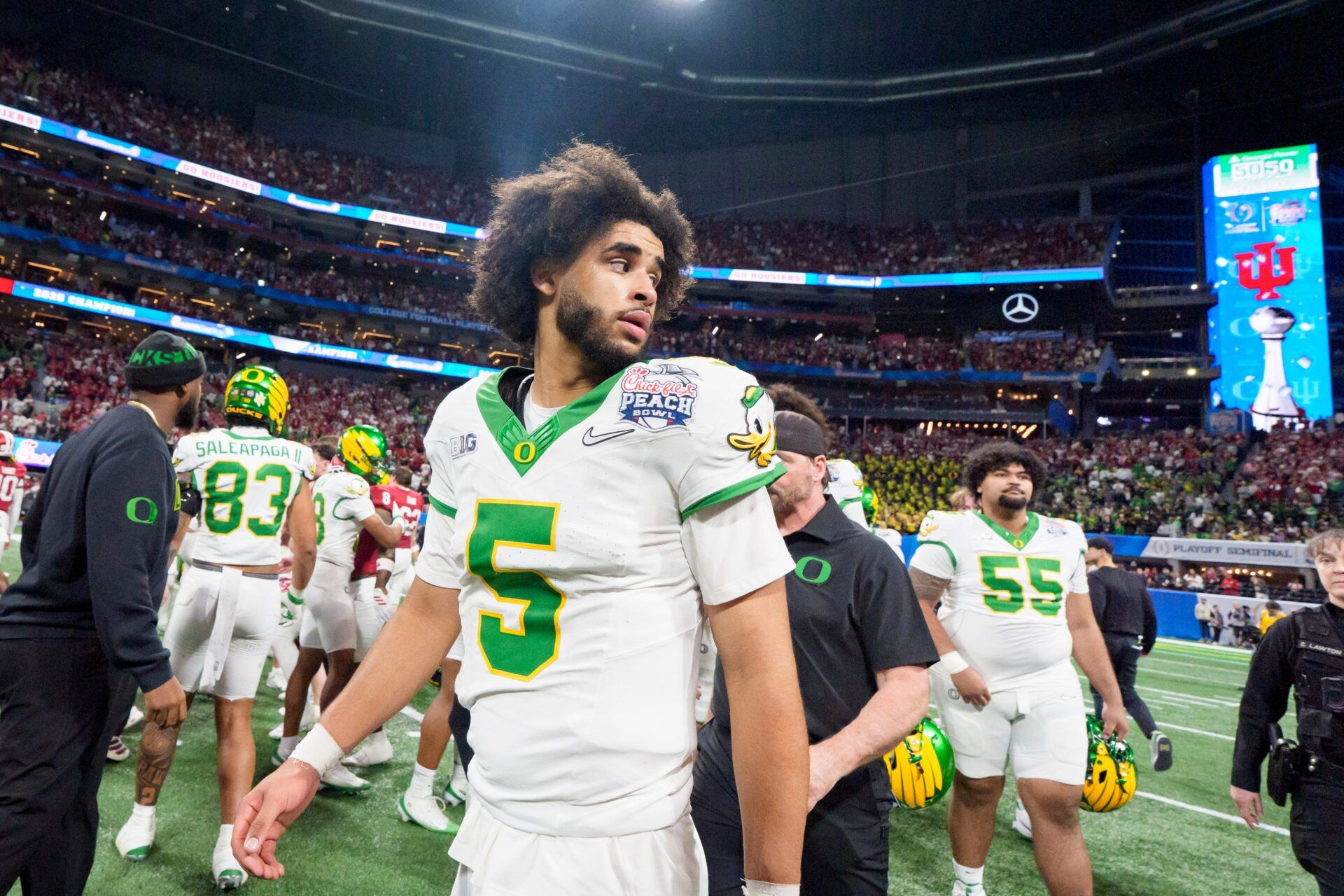
Oregon Ducks’ season ended in emphatic fashion, and not the kind Ducks fans envisioned. A stunning 56–22 semifinal loss to the Indiana Hoosiers has ignited a broader debate, one that goes far beyond a single game.
At the center of it all is the Ducks quarterback Dante Moore and a looming, franchise-altering decision: declare for the 2026 NFL Draft or return to Eugene with two full years of eligibility remaining.
Dante Moore’s Draft Stock Looks Better on Paper Than on Film
On paper, the choice looks deceptively simple. Moore is widely regarded as a potential top 5–10 NFL Draft pick if he enters the draft now. Quarterback demand is relentless, the upcoming draft class lacks elite certainty at the position, and Moore’s physical traits are exactly what NFL evaluators covet. But context matters, and when you zoom out, this becomes one of the more fascinating quarterback dilemmas in recent memory.
Moore is, in many ways, a victim of circumstance. He possesses elite talent and even greater potential, yet he’s being elevated to the top tier of quarterback discussions partly by default. The positional scarcity in this draft class magnifies what Moore could become rather than what he consistently is right now.
That gap shows up in the data. According to Pro Football Sports Network (PFSN), Moore finished the season with a CFB QB Impact Grade of 85.9, ranking 22nd nationally. That’s a strong number, but not an elite one. It suggests a quarterback who flashes brilliance but hasn’t fully ironed out the nuances of the position.
Statistically, Moore averaged 237.7 passing yards per game, ranking 53rd in the country, while throwing 30 touchdown passes. Numbers don’t tell the full story, but they reinforce the same theme: good production, not dominant. There were a few games, especially against high-end competition, where Moore controlled the contest from opening kickoff to final whistle in the way other top collegiate quarterbacks have.
That context matters even more when considering the Ducks’ schedule. Despite playing in the Big Ten, the Ducks’ overall strength of schedule ranked just 68th nationally per PFSN. Moore faced some quality defenses, but not the kind of weekly gauntlet that mirrors what he’ll encounter at the NFL level.
From a developmental standpoint, Moore still has room to grow. Consistently handling pressure, making advanced pre-snap adjustments, and improving week-to-week consistency remain areas for improvement. He’s only 20 years old and hasn’t yet reached the informal “starts threshold” NFL scouts like to see, typically 25 but closer to 30 collegiate starts, before trusting a young quarterback with franchise responsibility.
Returning to the Ducks offers an increasingly rare luxury: time and money. NIL has fundamentally changed the calculus. Moore can continue developing at a powerhouse program, refine his weaknesses, and still be compensated handsomely while doing so. For a quarterback with his tools, 6’3” size, elite arm talent, accuracy, and mobility, the upside of returning could be massive.
Returning to School Could Be the Biggest Risk Facing Moore
Of course, staying isn’t without risk, especially for quarterbacks. College football history is littered with examples of highly regarded passers who returned to school only to see their draft stock collapse. Recent cases, such as Cade Klubnik (Clemson) and Drew Allar (Penn State), loom large in this discussion.
Both entered the 2025 season with immense hype and strong analytical backing. Klubnik ranked top 10 in QB Impact Grade in 2024, only to fall to 67th in 2025. Allar dropped from 20th to 71st over the same span. Football is a team sport, and regression is rarely one player’s fault, but perception is everything in draft evaluation. Once the shine fades, it’s difficult to regain it.
Moore has to wonder if the same fate could befall him. Quarterback evaluation windows can be brutally short. Right now, his age, traits, and projection work in his favor. Teams are willing to bet on what he might become, especially in a weaker quarterback class. Waiting another year or two opens the door to injury, scheme changes, roster turnover, or simply a season where things don’t click.
There’s also the financial reality. Draft position directly impacts rookie contracts, endorsements, and long-term security. Striking while the iron is hot has proven to be the safer play for many quarterbacks, even those who weren’t fully polished prospects.
Ultimately, there’s no wrong answer, only risk management. Returning to the Ducks offers Moore the chance to evolve from a tantalizing projection into a complete, dominant quarterback. Declaring for the draft capitalizes on current momentum and positional demand before anything can derail it.
What’s clear is this: Moore is a special talent facing a decision that could define not only his career, but the trajectory of Oregon football heading into 2026. In an era reshaped by NIL, development timelines, and quarterback scarcity, his choice will serve as a fascinating case study for the modern college-to-NFL pipeline.
No matter the path he chooses, the football world will be watching closely.
