
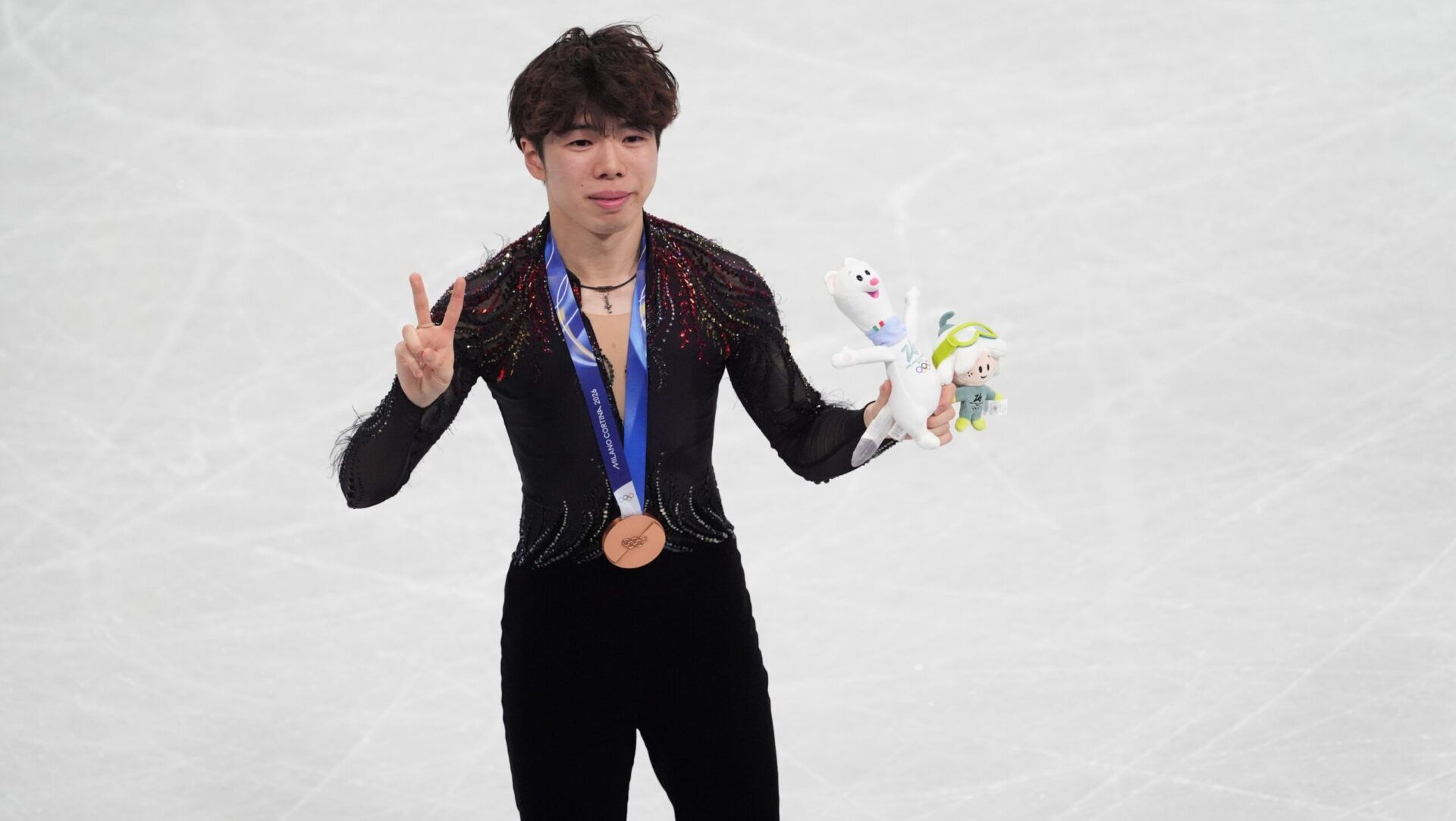
In one of the most talked-about men’s figure skating finals in Olympic history, Japan completed a remarkable two–three finish behind a surprise champion at the Milano Cortina 2026 Winter Games. Yuma Kagiyama secured silver, and Shun Sato secured a bronze medal, climbing from a ninth-rank finish, as pre‑event favorite Ilia Malinin committed errors in the free skate.
However, Sato’s coach’s reaction after the match was what caught the Olympic world’s attention, not the surprising results.
Shun Sato’s Coach Tadao Kusaka’s Ringside Joy Catches the Olympic World’s Attention
After Sato’s total of 274.90 points was confirmed for bronze, his long‑time coach, Tadao Kusaka, had the most striking reaction. In the viral video clips, Kusaka can be seen shouting, jumping, and pumping his fists in the air as the standings reshuffled and Sato secured a podium finish. When the result finally came, he broke into a small dance and rushed to embrace the skater, stealing the show from the bronze medallist himself.
Kusaka’s exuberant celebration left a lasting impression on viewers because of the story behind it. He has coached Sato since 2019 and has developed a reputation as a skater himself, reportedly working close to 300 pairs of skates a year.
That expertise proved crucial after the team event, when a rough podium surface at the Milano Ice Skating Arena chipped the blades of skaters from all three medal‑winning teams, prompting an apology from organizers.
According to Japanese media, Kusaka took charge of repairing the damaged blades for Sato, Kagiyama, and other Japanese skaters in the tight window before the men’s short program and free skate. He travelled with his own tools and repaired the damage so that the athletes could showcase their full potential at the biggest stage.
Sato entered the free skate program after finishing ninth with 88.70 due to his errors and needed a near-perfect performance. However, his excellence wasn’t enough; the leaders had to commit significant mistakes to secure a podium finish. Trusting his training and determination, Sato delivered an astonishing performance, earning 186.20 in the free and a total of 274.90.
Kazakhstan’s Mikhail Shaidorov stood at the top of the rankings, delivering the performance of his career, scoring 198.64 in the free for a 291.58 total. This marked the country’s first Olympic figure skating gold, whereas Kagiyama, who had been second after the short program, struggled for silver with 280.06.
Malinin, the two‑time world champion and short‑program leader with 108.16 points, dropped to eighth overall on 264.49 after multiple jump errors left him only 15th in the free skate.
This performance marked an impressive Olympic debut by the Japanese bronze medalist. Earlier that week, he had already helped Japan to silver in the team event by finishing second behind Malinin, contributing vital points as the US took gold and Italy claimed bronze.
