
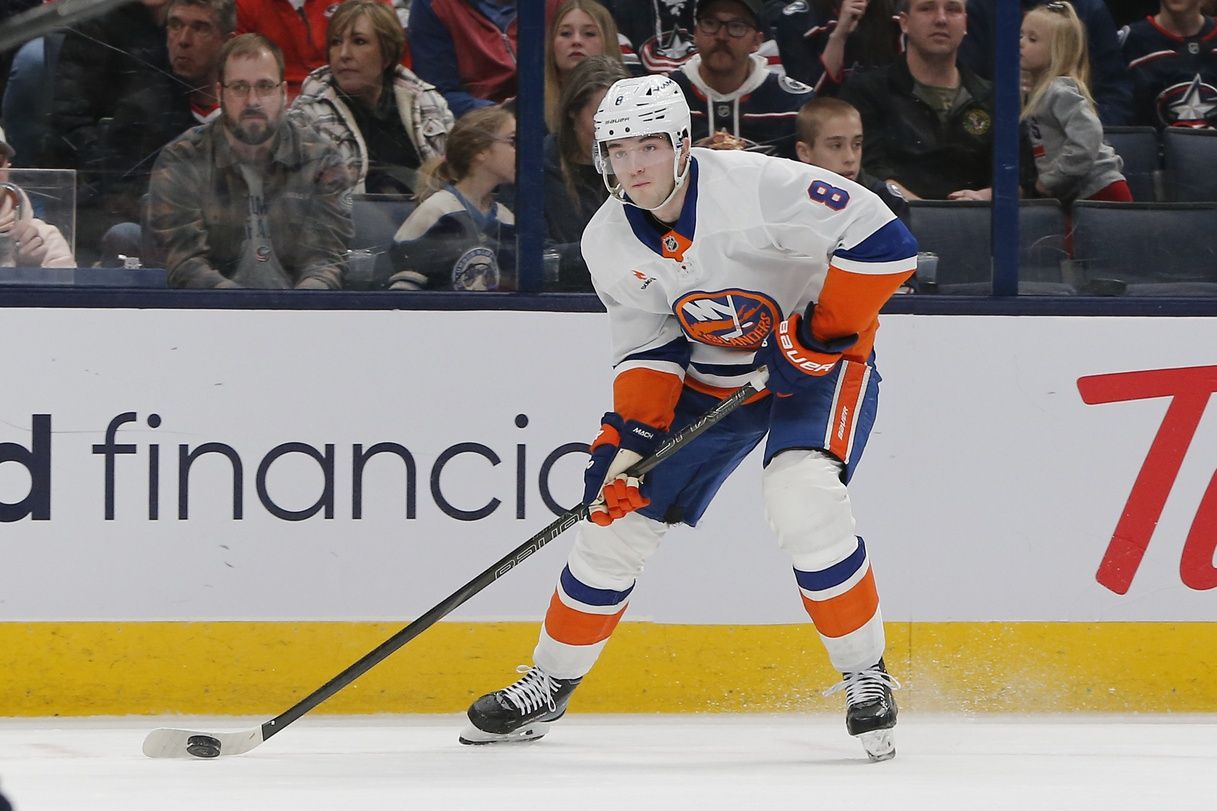
Just before the first round of the NHL Draft, a blockbuster trade reshaped expectations: the Montreal Canadiens acquired defenseman Noah Dobson from the New York Islanders. What caught everyone’s attention was the cost, no. 16th and 17th overall picks, plus Swedish depth forward Emil Heineman.
Reports also confirm Montreal will extend Dobson eight years at $9.5 million per season. While Montreal gains a young, skilled blue-liner, the Islanders gain ammunition to pursue elite draft prospects. But why did Montreal feel the need to give up two top-20 picks?

Montreal Eye Long-Term Stability in Landing Noah Dobson
Dobson, still just 25 years old, had a disappointing 39-point season but remains a proven talent with a 70-point campaign on his resume. His age, experience, and positional value made him an attractive target for a team like Montreal that’s trying to accelerate its return to playoff contention.
The Canadiens likely recognized that their mid-round first-round picks wouldn’t offer a player ready to step in and contribute immediately. In contrast, Dobson brings stability, mobility, and offensive upside from the blue line, qualities that Montreal desperately needs.
WHAT A TRADE 🔁
The @CanadiensMTL have acquired Noah Dobson from the Islanders! pic.twitter.com/siYF3iSFca
— NHL (@NHL) June 28, 2025
Another major factor in this decision was the contract extension. The Canadiens weren’t just trading for a one-year rental. The eight-year deal at $9.5 million annually signaled their long-term commitment to building around Dobson.
It’s a hefty investment, but one that reflects confidence in his ability to anchor the defense for nearly a decade. Such long-term security, combined with Dobson’s upside, helps explain why Montreal was willing to part with not one but two valuable draft assets.
On the Islanders’ side, the deal reflects a turning point. Contract talks with Dobson had stalled, and management appeared unwilling to meet the financial expectations tied to his next deal. Rather than lose him for nothing or force a strained extension, they capitalized on his trade value. The return, two first-round picks, and a young forward, gives them the flexibility to reshape the roster.
Montreal’s decision to sacrifice those picks also reveals something else: a shift in their approach. Instead of relying purely on future talent, the Canadiens chose to secure a proven NHL defenseman who can contribute right away. With three gold medals in the past year and playoff experience, Dobson checks a lot of boxes, even if his most recent campaign wasn’t his best.
Ultimately, the Canadiens gave up two first-round picks because they believed Dobson provides a level of immediate impact and long-term value that no mid-round selection could guarantee. It was a calculated risk, but one that could pay off if Dobson becomes the anchor of Montreal’s blue line for years to come.
