
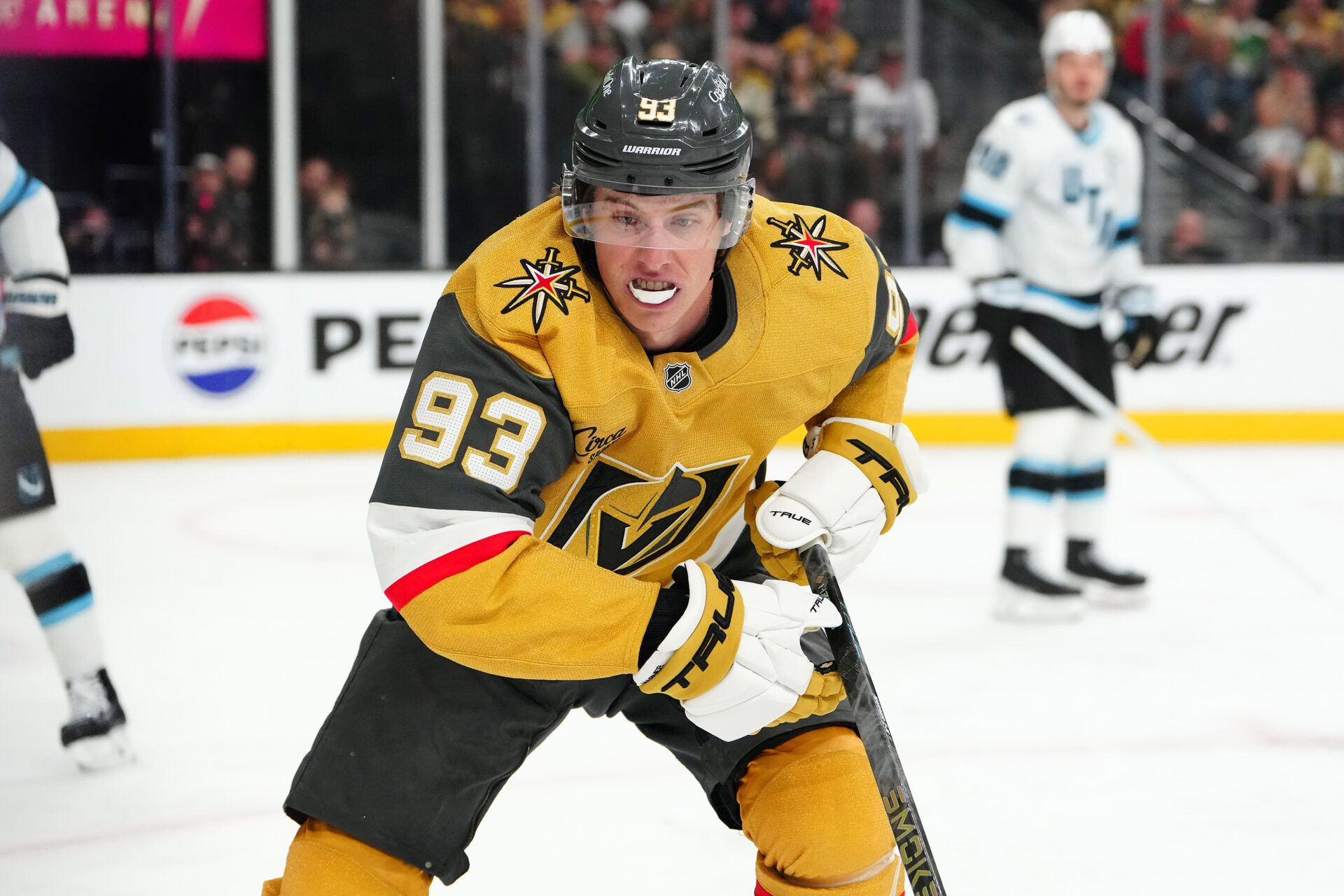
The Vegas Golden Knights are in a tight first-round series after splitting the first two games against the Utah Mammoth. Game 2 slipped away late and evened the series, erasing the progress. Now the focus is on adjustments, and forward Mitch Marner has become an important part of that process. He is drawing from his years of experience playing alongside Auston Matthews to bring structure and balance to his game.
As the series heads to Salt Lake City, that experience is starting to shape how he handles the crucial moments on both sides of the puck.
Mitch Marner Leans on Auston Matthews Experience As Golden Knights Search For an Edge
Marner has settled into his playmaking role for Vegas, and his game reflects habits built during his time playing alongside Auston Matthews in Toronto. Now in a different system, he is being asked to handle multiple responsibilities, balancing offensive creativity with defensive awareness in a series that has already tested the team’s structure.
Marner pointed to that past partnership with Auston Matthews when explaining his approach. “Whenever one of us were low, we trusted that guy low, and then if we had to switch up, we’d do it,” he said, via NHL.
This understanding allowed for quick adjustments on the ice, and it is something he has carried into his current role with the Golden Knights.
His usage through the first two games highlights that flexibility. He started Game 1 on a line with Jack Eichel and Mark Stone but moved to another combination in Game 2. Marner is now centering the second line with Brett Howden and Pavel Dorofeyev. Even with those changes, his presence on both special teams units has remained, showing how much trust the staff places in his all-around game.
Game 2 also exposed areas Vegas needs to address. The team opened with control and grabbed an early lead, but Utah pushed back with two goals. Ivan Barbashev brought the game level late in the second period, yet defensive breakdowns in the third proved costly. Logan Cooley’s winner came off a rebound, a moment that showed issues in front of the net.
Despite the result, Marner’s role did not waver. He continues to support play deep in the defensive zone and transition quickly up ice, mirroring the habits he described.
He added, “I think it’s pretty easy to adjust to play low in our (defensive) zone just to help out (defense), try to get the puck in hands low in support and try to work up the ice with my head up, trying to make plays, trying to find guys, hit the middle or easy enough to find them over the blue line.”
This speaks to how naturally Marner fits into these situations.
Even with a dip in scoring compared to last season, his impact remains clear. He helps maintain possession, supports structure, and creates options in tight spaces. Those details matter more in a series where small moments are deciding games.
There is also a wider backdrop to his presence in Vegas. Toronto moved on from Marner as part of a larger shift, and the team promptly missed the playoffs. Now in a new environment, he has a chance to redefine his playoff impact within a system that values adaptability.
ALSO READ: Maple Leafs HC Addresses If Mitch Marner’s Exit Doomed Toronto’s Season
