
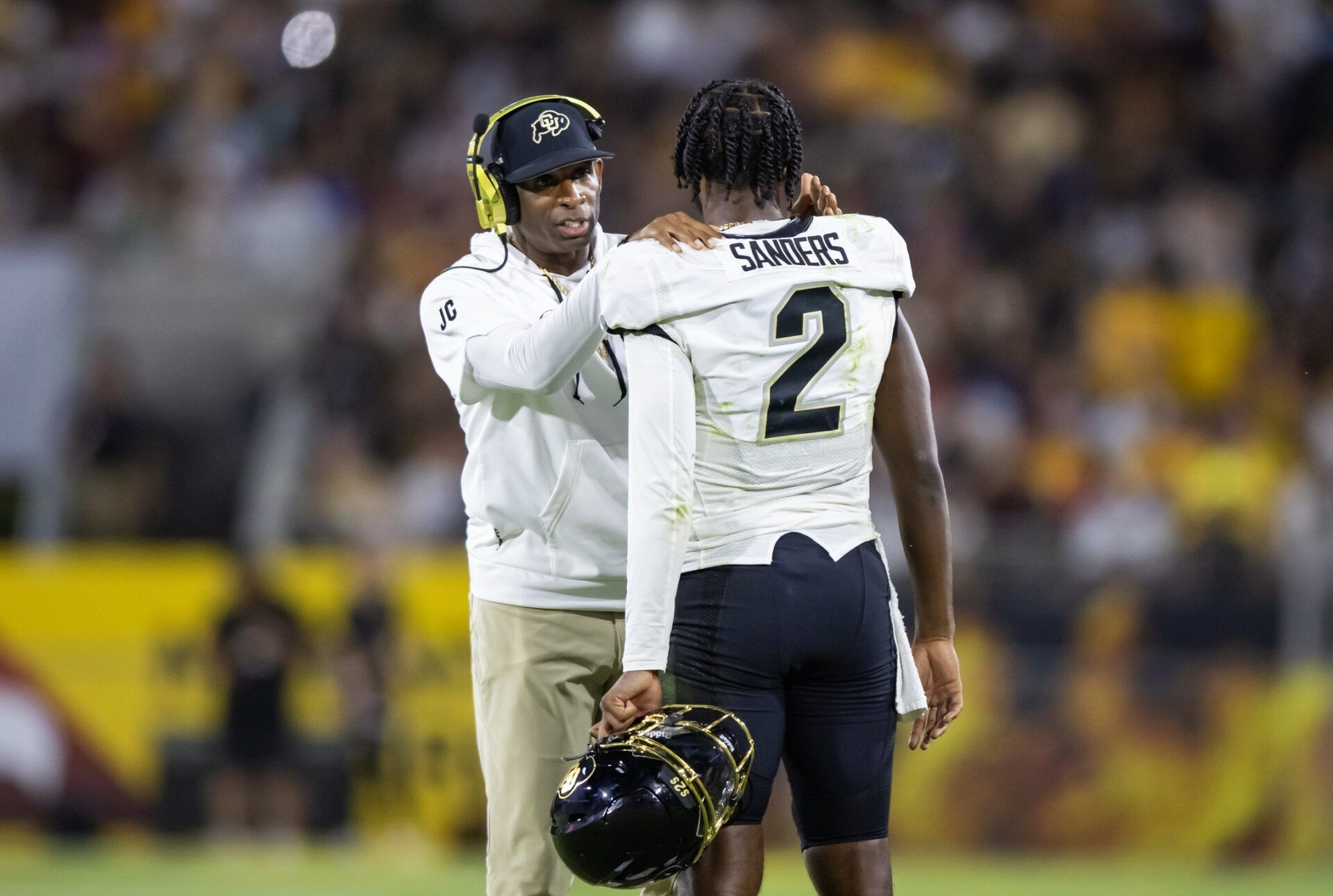
The time has come – it’s time to finally put these high-pedigree college players inside a professional organization. These are young kids with a wide range of outcomes, and while it’s easy to highlight the positives, there are two sides to that coin.
Here’s a look at some of the NFL Draft bust candidates entering the first round, understanding that team fit would impact the trajectory of specific players more than others.
Shedeur Sanders, QB, Colorado
Is it possible that no player in the draft is more ready for the draft process to be over than Shedeur Sanders?
An NFL assistant coach reportedly did not enjoy Shedeur Sanders' interview.
“He takes unnecessary sacks. He never plays on time. He has horrible body language. He blames teammates, but the biggest thing is, he’s not that good.”
(via @TomPelissero ) pic.twitter.com/TFb0V5xeof
— PFSN (@PFN365)
The book on him is pretty straightforward – he will go as far as his accuracy will carry him early in his career, and we know this is a quick-moving business that can end a QB if they aren’t impacting winning at a high level in short order.
Josh Allen is the reigning MVP after the best TD/INT season of his career, while Lamar Jackson, Jared Goff, and Jalen Hurts (all top-5 in yards per attempt this season) had Super Bowl aspirations at one time or another. The efficiency that Sanders figures to carry with him from the college game to the pros is valuable, but there are major concerns within his profile that could prove prohibitive based on how the position is played in 2025.
Sanders is an average athlete, and that ties him to the pocket more than most. As mentioned with Goff, that style of play can still work, but it requires a very specific situation (solid coaching staff and a versatile offense filled with playmakers that can do the heavy lifting), and that situation isn’t going to present itself in a ready made situation for 2025.
The QBs of the ilk of Sanders who excel are masters of execution. They embody the “you don’t go broke making a profit” mindset and that allows them to maximize a skill set that is at risk of going the way of the dinosaur.
Does Sanders have that in him? Consecutive seasons with 40+ sacks hints that he may not and while some of those numbers point to an offensive line issue, Sanders is going to need to overcome iffy play around him if he is drafted by a team that expects him to step into the starting job this fall.
For me, “risk” is pretty easy to identify at the QB position. True game managers don’t carry much because they’ll take their medicine, and this wave of dual-threat QBs don’t carry much because their physical gifts allow them to overachieve in chaotic situations.
I’m not sold that Sanders has either of those traits, and if he’s asked to elevate a lesser roster, the risk profiles as more likely than the potential reward.
Writing in an April 24 edition of “The McShay Report,” NFL insider Todd McShay explained why the New York Giants are expected to pass on Sanders.
“A few months ago, the idea that Shedeur Sanders could fall out of the top 10 seemed inconceivable,” McShay wrote. “But with just a few hours until the draft kicks off in Green Bay, league sources I’ve spoken to are expecting him to slide. … I’ve heard from two different sources that his visit with head coach Brian Daboll did not go particularly well.”
He added, “The friction centered on some frustration between the two regarding Sanders’ preparation of an install package. It seems the interview process as a whole — beginning in Indianapolis, as I reported a few days after the Combine — has negatively affected the leaguewide perception of Sanders during the lead-up to this year’s draft.”
Drafting a QB isn’t picking up produce where you can live with ordinary — it’s picking a spouse and the dating market has clearly cooled on this profile, both on and off the field.
Jaxson Dart, QB, Ole Miss
As is the case with Sanders and any of the quarterbacks drafted early, the landing spot is going to matter in a big way. Jaxson Dart is the type of athlete who has every chance to succeed at a high level in the professional game, but his scouting reports all carry some of the same concerns.
- Timing issues
- Anticipation concerns
The physical profile is sound, and the growth as a passer is certainly encouraging (61.9% complete in his lone season at USC before improving annually at Ole Miss (62.4% in 2022, 65.1% in 2023, and 69.3% in 2024). He has ties to the Manning family through school, and that further elevates his upside, but we just aren’t sure about his processing speed right now, and that puts his development in serious question should he land behind a bad offensive line.
Does Dak Prescott (another state of Mississippi prep) have a different career arc if not opening his career behind a strong offensive line (rookie season: third most blitzed QB but a lower-than-league-average sack rate)?
Does David Carr’s career look different if given even a little time to read coverages?
There are chaos-proof QBs who can transcend these concerns, but Dart doesn’t project as that. Of course, that doesn’t mean he can’t succeed, but given the thirst of NFL teams to get this position right, quarterbacks are often drafted with an eye on only the upside and down the downside these days.
Dart could well have a lengthy NFL career and win a lot of games – the concern is that we don’t get a real chance to see that if the wrong team were to trade up for his services and cut out the legs of a developmental process that he needs to go through.
Matthew Golden, WR, Texas
The highlight reel for Matthew Golden is intoxicating, and that could well result in a team paying up for a profile that does have some holes in it.
The physical profile (5’11”, 191) doesn’t overwhelm, and with route quality being a concern, Golden’s NFL trajectory is more of a receiver that will work around a system as opposed to having a system shaped to what he does well.
That may sound like a minor distinction, but if he’s not being specifically schemed looks (17.0 yards per catch last season with some YAC upside), asking him to consistently beat NFL corners who continue to get bigger/faster is a tough sell.
The Longhorns played nine games, including the playoffs, against ranked opponents last season. When the lights were brightest and the competition its greatest in those contests, Golden led Texas in receiving yards three times and receptions only once (the double overtime win in Arizona State and even in that game, Quinn Ewers hit four different players on his five completions during the end of regulation drive that could/should have won the game).
A receiver with first-round upside should at least be able to separate from his collegiate teammates as a true alpha in these valuable spots, no?
The receiver position is one gaining in value, and that puts Golden in the first-round conversation. He might have a good pro career, but at his projected price, it’s going to take more than that. Annually we see receivers that get plenty of April hype ultimately fall flat (N’Keal Harry, Jalen Reagor, Kadarius Toney, Jahan Dotson, and Treylon Burks come to mind as recent examples) and while that isn’t what I’m suggesting happens here, there are enough red flags and depth at the position in this draft to land a player like Golden on a list like this.
Mike Green, EDGE, Marshall
The collegiate production jumps off the page at you (17.8% pressure rate in 2024) and it doesn’t take long in watching the film to identify his relentless approach to the game as rare.
There’s a lot to like in Green, but his size (251 pounds) and arm length (32 inches) don’t traditionally translate cleanly to the professional game. The concern here is two-fold when it comes to his bull-rushing style: (1) can he overcome the size limitations to stay on an NFL field, and (2) when he is on the field, does his one-directional aggression compromise the integrity of the entire defense when it comes to misdirection plays.
Green could be an NFL starter in the right situation, but how he plays makes him a swing for the fences. If his tenacity does translate well, he’ll prove to be a bargain at his projected price, but this profile doesn’t set up for an average outcome – he’s either making a splash in a major way or setting a franchise back a year as they just spent a first round selection on an undersized specialist in an era of versatility.
Shemar Stewart, EDGE, Texas A&M
A great air conditioner was critical when my wife and I were house shopping. She doesn’t do well in the heat, and I don’t do well when she’s not doing well.
We bought a house without AC installed, but the place we landed on checked all the other boxes and came with the potential to make the addition.
Shemar Stewart is an air conditioning unit in that, on the surface, having him is of interest to everyone. No house on the East Coast is going to lose value because it comes preloaded with AC, but do you have the infrastructure to make it work?
Stewart posted a perfect RAS (Raw Athletic Score) at the combine and has every physical tool you could possibly ask for. He’s run fast, jumps high, and has the type of length that projects as a problem for 99% of linemen. On paper, he’s a can’t-miss profile, but just 4.5 sacks across three collegiate seasons?
Is there a motor issue here? Will Stewart’s football savvy ever match up with his God given tools?
It’s impossible to know that for a kid who turned 21 years old on Wednesday. The drafting of a raw prospect like this requires a strong organizational infrastructure, and we know that, at best, half the teams in this league are lacking in that area.
Our latest mock draft had him calling Detroit home, and that’d be a great fit. But what if the Falcons have him as the second-best EDGE on their board? Or what if he falls to the Jaguars in the second round? Or an unknown team trades up for the rights to draft this athletic marvel?
There are a wide range of outcomes for Stewart, and if this air conditioner lands on the doorstep of a house that doesn’t have the right foundation for it, we could be looking at a poor usage of resources.