
The United States, along with co-hosts Canada and Mexico, will stage the largest FIFA World Cup in tournament history. It will begin on June 11, with 48 nations competing across 16 venues in three countries.
All 11 stadiums in America are homes of NFL teams, and each has undergone transformations to meet FIFA’s requirements, from replacing artificial turf with natural grass to removing thousands of corporate logos. The stadium names NFL fans have known for years are gone, too, at least temporarily.
FIFA’s Clean Site Policy Made NFL Teams Change Their Stadium Names
Sports business content creator Tyler Webb, who has more than 225,000 subscribers on YouTube, recently broke down the mechanism behind the rebranding of NFL stadiums.
“Why are the Kansas City Chiefs being forced to change the name of their stadium?” Webb said. “Well, the short answer is because of the World Cup, but the real answer actually reveals one of the most expensive loopholes in all of sports.”
Webb noted that while NFL stadiums regularly host offseason events from concerts to monster truck tours, World Cup requirements are far more demanding. NFL fields are nearly 20 meters narrower than a regulation pitch, and seven of the 11 U.S. venues have replaced their artificial turf with natural grass. However, the off-field changes arguably dwarf the on-field ones.
“Still, even all that pales in comparison to what each stadium is required to do off the field,” he continued. “See, part of agreeing to be a World Cup host stadium means agreeing to FIFA’s clean site policy, which demands that all stadiums remove or cover up all advertising in and around the venue.”
“This request is meant to protect FIFA’s exclusive sponsorships, which are estimated to be worth over $2.8 billion dollars in 2026 alone,” Webb added. “However, for the staff at these stadiums, it also means covering up over 2,000 individual logos, both inside and out, including the literal name of the venue.”
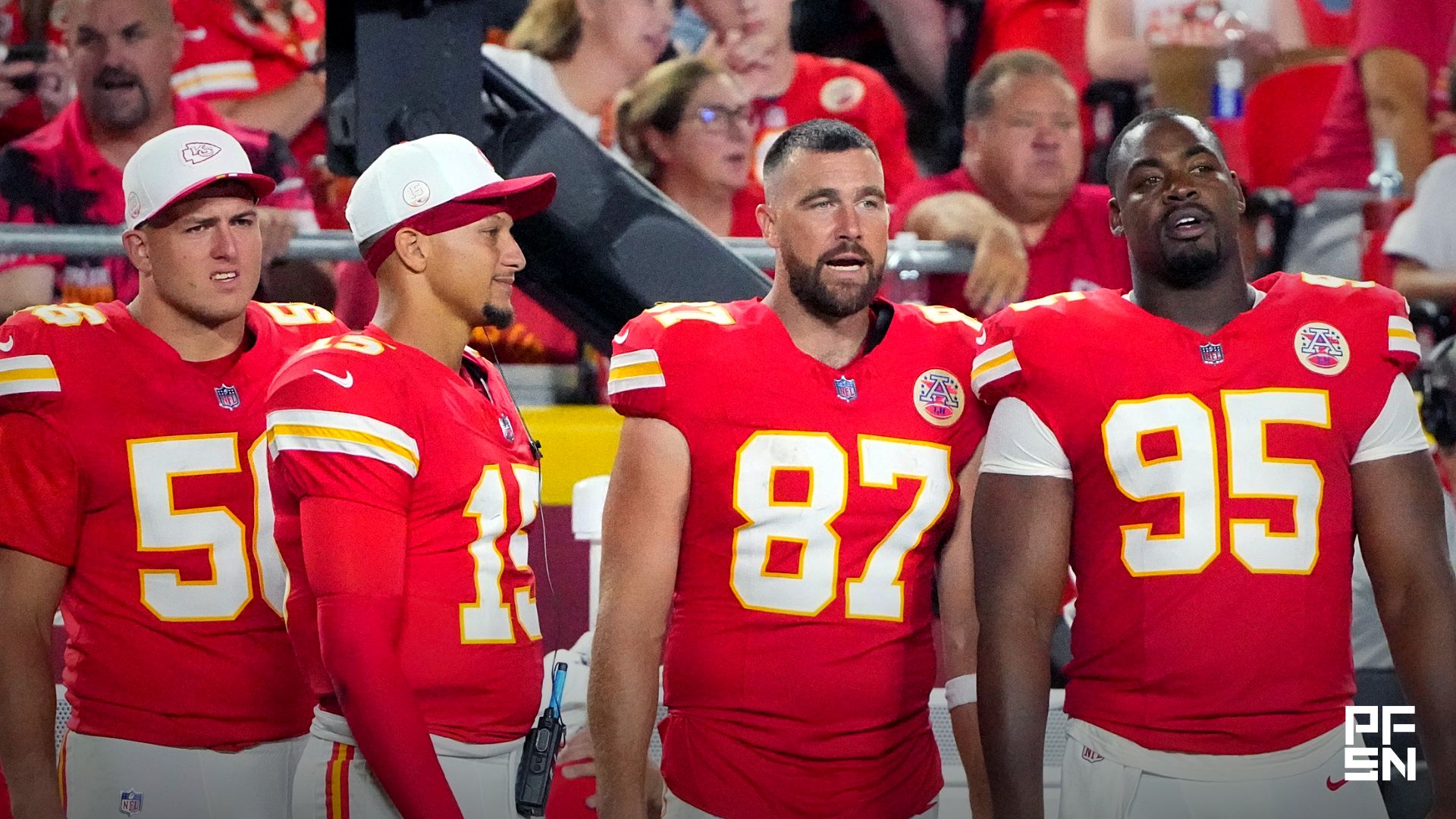
Webb pointed to Kansas City as a prime example, noting that GEHA had its logo removed from what will now simply be called Kansas City Stadium. However, he mentioned that not every venue has followed the same path. In Atlanta, removing the giant Mercedes-Benz star built into the stadium’s $1.6 billion retractable roof would have risked structural damage.
After roughly 18 months of negotiation, FIFA agreed to let the logo remain, though broadcasts are under strict orders not to show it.
BE AN NFL GM: PFSN’s Ultimate GM Simulator
Here is the full list of temporary FIFA names for all 11 host stadiums in America:
- Mercedes-Benz Stadium becomes Atlanta Stadium
- Gillette Stadium becomes Boston Stadium
- AT&T Stadium becomes Dallas Stadium
- NRG Stadium becomes Houston Stadium
- GEHA Field at Arrowhead Stadium becomes Kansas City Stadium
- SoFi Stadium becomes Los Angeles Stadium
- Hard Rock Stadium becomes Miami Stadium
- MetLife Stadium becomes New York-New Jersey Stadium
- Lincoln Financial Field becomes Philadelphia Stadium
- Levi’s Stadium becomes San Francisco Bay Area Stadium
- Lumen Field becomes Seattle Stadium
Despite the temporary loss of corporate branding, hosting World Cup matches represents a significant economic opportunity for each city. Kansas City, the smallest of the 11 American host markets, projects 650,000 visitors and a direct economic impact of more than $653 million during the tournament window, according to KC2026, the local organizing committee.
Securing World Cup matches was a highly competitive process, and cities understood the trade-off.
