
The New Orleans Saints have two additional 2026 NFL Draft picks after trading Rashid Shaheed to the Seattle Seahawks. Kellen Moore and Mickey Loomis will be tasked with using those picks effectively, and they can target these prospects to do so.
New Orleans Saints 2026 NFL Draft Picks Headlined by Early Day 3 Volume
The New Orleans Saints got in on the trade deadline action on Tuesday, sending wide receiver Rashid Shaheed to the Seattle Seahawks in exchange for a fourth-round pick and a fifth-round pick. The move was reported by NFL insider Adam Schefter.
Trade compensation: Seahawks are sending 2026 fourth- and fifth-round picks to the Saints in exchange for WR Rashid Shaheed. https://t.co/xBiuK4c7sK
— Adam Schefter (@AdamSchefter) November 4, 2025
Before today, the Saints — a team in desperate need of reset-accelerating capital — only had five picks in the 2026 NFL Draft. They traded their original fourth-round pick to the Broncos in exchange for WR Devaughn Vele, and traded their seventh-round pick for defensive tackle Davon Godchaux.
With these additions from the Seahawks, however, New Orleans once again has a full seven-pick slate for the 2026 NFL Draft, and all of those picks are projected to be within the Top 200.
Here’s what the Jets’ current 2026 NFL Draft slate looks like:
- Round 1
- Round 2
- Round 3
- Round 4 (via SEA)
- Round 5
- Round 5 (via SEA)
- Round 6
The Saints don’t have the roster talent to upgrade their treasure chest in the early rounds, but this move at the very least improves their ability to infuse roster depth. And in a best-case scenario, New Orleans’ additional dart throws could secure them a late-round gem.
Both the Saints’ early-round and middle-round picks will count big in 2026. Here are some prospects they can target with those selections.
2026 NFL Draft Prospects the New Orleans Saints Could Target
Fernando Mendoza, QB, Indiana
Every week, it’s been something different Mendoza does on tape that earns the allure of NFL Draft minds. In his outing against Illinois, it was his timeliness and ability to distribute efficiently.
Against Iowa, it was his ability to rebound from a tough late-game interception to throw the game-winning touchdown pass with pressure bearing down. Against Oregon, it was his unflinching consistency driving the ball outside the numbers with anticipation. And against Michigan State, it was his effortless deep touch and layering on boundary fades.
Put it all together, and you have a staggeringly complete 2026 NFL Draft prospect: At 6’5″, 225 pounds, Mendoza has the prototypical frame, along with the requisite athleticism to create when needed. But ultimately, he depends on his passing ability first, and it’s easy to see why.
Mendoza has stellar pocket depth discipline and navigation ability, he’s a quick processor who stays on-schedule, he can deliver throws with sharp situational precision, and he has the rifle arm to drive high-level velocity and hit tight windows.
Dante Moore, QB, Oregon
You want to see QBs deliver in high-pressure situations, and Moore has shown glimpses of that verifiable clutch gene. He was ice-cold against Penn State through four quarters and overtime. And though a forced throw doomed him late against Indiana, he rebounded and showed resolve with a dominant performance against Rutgers the following week.
Mendoza’s out-dueling of Moore reflects a bigger truth at bird’s-eye view: Mendoza has slightly outplayed the 20-year-old in the QB1 fight. But Moore is still a very viable candidate.
At 6’3″, 208 pounds, Moore has nimble athleticism, easy arm talent and velocity generation, effortless layering ability, accuracy, and an efficient distributing mentality.
So many aspects of Moore’s game — from his physical framework, to his adherence to pocket play over creation, to his age-defying field vision — are reminiscent of 2023 second overall pick C.J. Stroud, and Moore has the ability to make a similar impact as a franchise QB.
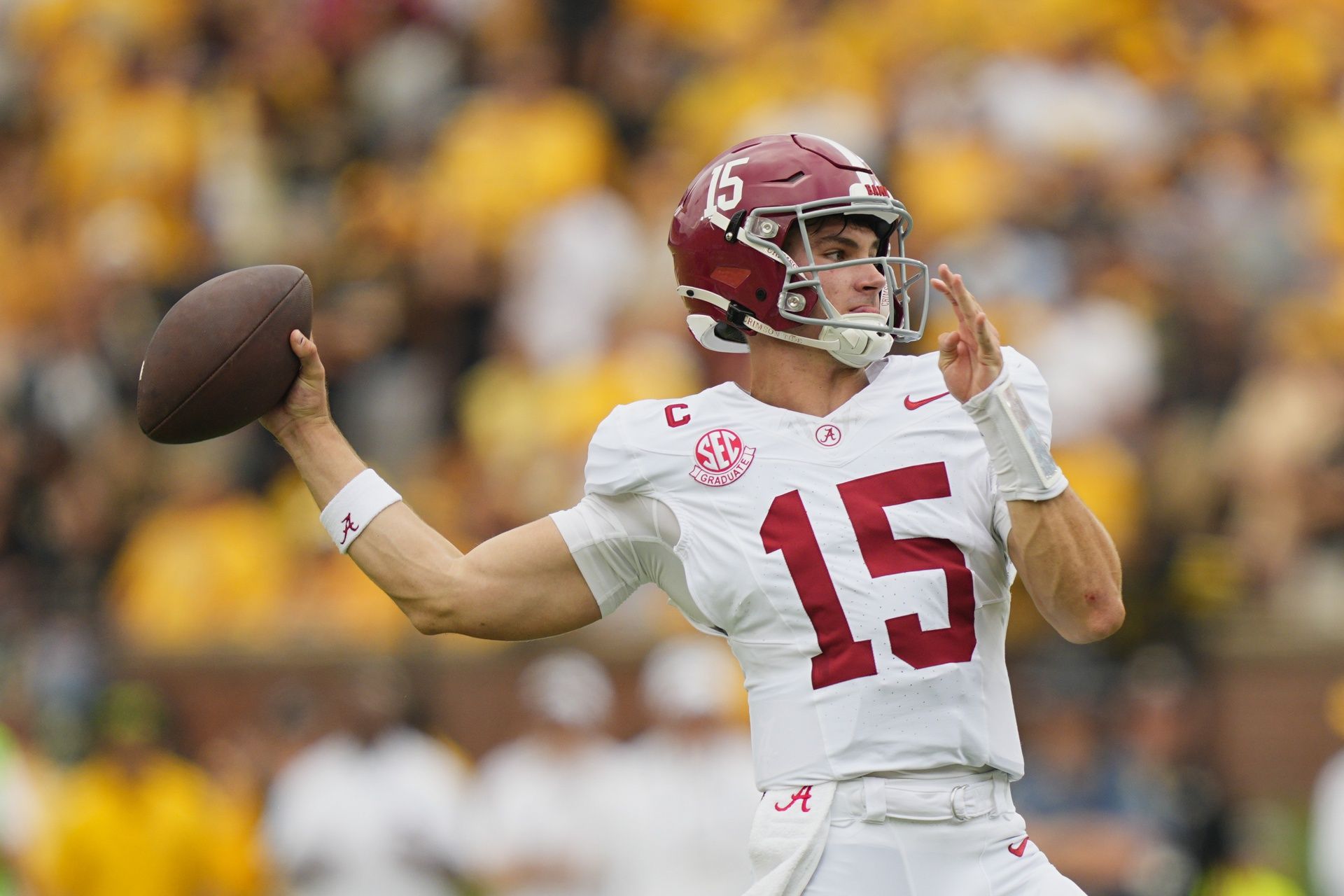
Ty Simpson, QB, Alabama
One-year starters don’t have an inspiring track record as early-round NFL Draft picks, but Simpson is giving evaluators every reason to believe he’ll be an exception to the rule.
Despite his closer-to-average size, Simpson has a fairly strong and elastic arm, and he’s a jittery, agile athlete with supreme creative instincts and extension ability both in and out of structure.
Simpson doesn’t rely on his athleticism as a crutch; he exhausts all options in the pocket, and can even move the pocket to nullify pressure threats with his spatial feel and eye discipline, and he has the strong processing ability to read and anticipate windows over the middle.
All this, and Simpson’s greatest strength can’t always be quantified: It’s his clutch gene, and his ice-cold nature in high-pressure situations. On “need to have it” downs, Simpson’s laser focus, mechanical discipline, and accuracy win time and time again. He’s closed the gap between himself and the top two, and could win the Saints over down the line.
KC Concepcion, WR, Texas A&M
KC Concepcion combines explosive, twitched-up, fleet-footed athleticism and hip fluidity with sharp angle IQ, spatial awareness, and manipulative instinct. He can be schemed targets in countless ways, and in 2025, his body control and hand-eye coordination — once viewed as question marks — have been undeniable strengths relative to his size.
He’s beefed up to 190 pounds and has the play strength to scrape through arm tackles, he has the speed to stretch seams and generate big plays, and he has the quickness to contend outside against press.
Against LSU, Concepcion caught three passes for 45 yards and a touchdown, and ran back a punt return for a TD, and still, that doesn’t adequately convey how dominant he was. Concepcion won against press coverage, worked back to the ball in cluttered catch situations, and overall proved his mettle as a complete early-round WR prospect.
In New Orleans, Concepcion would be a dynamic presence at WR2 with RAC chops, innate separation ability, and size-defying play strength and reliability.
Eric Singleton Jr., WR, Auburn
In PFSN’s CFB WRi database, Singleton has a healthy score of 78.1, and his RAC numbers in particular are strong. Per TruMedia, he’s averaging six yards of RAC per reception, and a full yard of RAC over expectation per catch. Those numbers track with what he showed at Georgia Tech.
While quarterback play has never been on Singleton’s side, he’s proven himself to be a universally alignment-versatile weapon with high value on schemed touches, drag routes, crossers, and slants on must-have downs.
At 5’10”, 180 pounds, Singleton is undersized, with lacking mass and length — but he compensates with electric short-area athleticism and quickness, along with blistering speed and explosiveness.
Not only is that supercharged athleticism an asset after the catch, but Singleton has also proven he can use it to offset defenders and explode off breaks in man coverage, as well as carve into open zones. And while his play strength at the catch isn’t high-end, he’s flashed rare contortion and body control on high-difficulty attempts.
Julian Neal, CB, Arkansas
At 6’2″, 208 pounds, Neal has the size, length, and lean mass NFL teams look for on the boundary, and he passes the desired athletic threshold as well.
He might not have quantifiably elite burst or speed, but he’s still a compelling size-speed CB whose superpower is his exceptional short-area quickness, twitch, reactive athleticism, and mirror-motor ability at his size. He’s sudden and springy, but also fluid and controlled in zone coverage and side-saddle, where he’ll play often with Brandon Staley.
Despite his clear playmaking ability, Neal’s best trait might be his utility in run support. He hasn’t missed a single tackle in 2025 — a byproduct of his ultra-consistent tackling technique, angle IQ, and ability to break down and recalibrate his base at a moment’s notice with his short-area energy.
That same short-area quickness also enables Neal to quickly adjust his base when engaging run blocks. He’s physical, but also knows how to apply that physicality to control the boundary and make stops.