
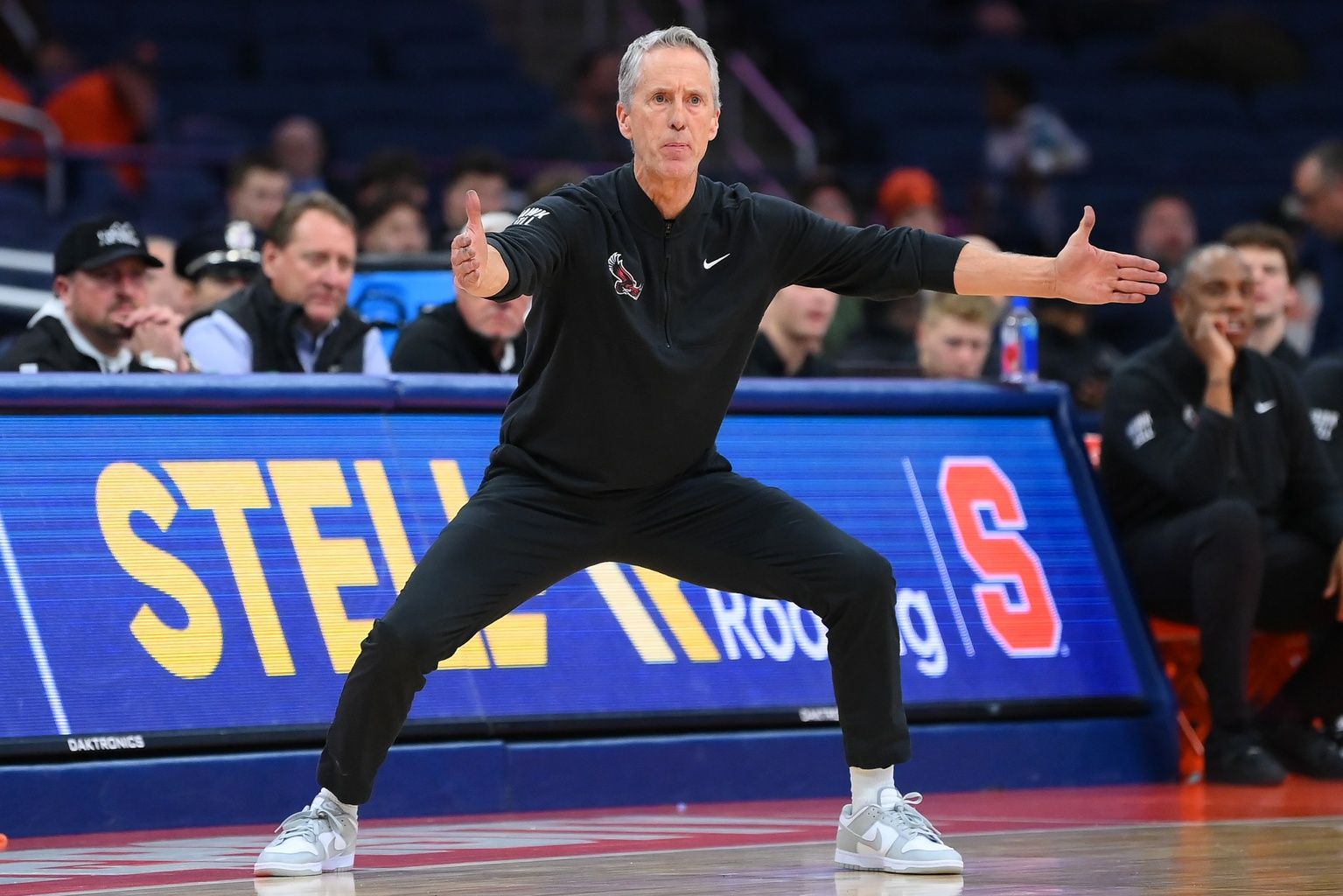
Saint Joseph’s head coach Steve Donahue has thrust his program into the national spotlight with a pointed defense of Atlantic 10 basketball. As the NCAA Tournament picture sharpens and Selection Sunday approaches, Donahue questioned the narrative that separates his league from the Big East.
Speaking after a decisive home win, he argued that the gap between the conferences is overstated and that the A-10 warrants stronger consideration for multiple tournament bids.

Steve Donahue Challenges Narrative That Atlantic 10 Is a One-Bid League
Donahue’s comments came after Saint Joseph’s rolled past George Mason 81–63 at Hagan Arena in Philadelphia. The victory moved the Hawks to 18–10 overall and 10–5 in Atlantic 10 competition, while George Mason slipped to 21–7 and 9–6 in league play. Beyond the box score, however, the coach used the moment to advocate for his conference’s standing.
In a clip circulated by The Field of 68 on X, Donahue made his position clear. “We’re the 7th-best league in the country and people only talk about one team going to the tournament. The numbers don’t allow it to look like it, but I’m telling you, there’s not that much difference between the Big East and the A-10.”
Steve Donahue 👀
“We’re the 7th-best league in the country and people only talk about one team going to the tournament. The numbers don’t allow it to look like it, but I’m telling you, there’s not that much difference between the Big East and the A-10″pic.twitter.com/sfNEFp3Grc
— The Field of 68 (@TheFieldOf68) February 26, 2026
His statement directly challenged the common perception that the Atlantic 10 is limited to a single automatic NCAA Tournament berth. While national metrics often shape that narrative, Donahue suggested those measurements fail to reflect the depth and competitiveness within the league.
Late February traditionally carries weight for teams hovering around the NCAA Tournament bubble, and conference reputation can influence how resumes are evaluated. Donahue’s public stance underscored how much is riding on that perception, not just for his program but for the Atlantic 10 as a whole.
At 18–10, Saint Joseph’s continues to build its case, while its 10–5 conference mark keeps it competitive near the top tier of the standings. George Mason, despite the loss, remains a strong presence at 21–7 overall. Those records illustrate the league’s balance, reinforcing Donahue’s assertion that the separation from the Big East may be narrower than commonly portrayed.
Selection committee discussions frequently lean on tools such as NET rankings to compare teams across conferences. Donahue acknowledged that those figures may not favor the A-10, yet he maintained that on-court performance tells a different story.
By publicly voicing that argument, he positioned himself as an advocate for his league during a stretch when every win and every narrative can matter.
As the tournament field begins to take shape, the Atlantic 10’s evaluation could have direct consequences for Saint Joseph’s and its peers. Donahue’s message was unmistakable: the A-10 belongs in the national conversation alongside the Big East, and he intends to make sure that belief is heard.
