
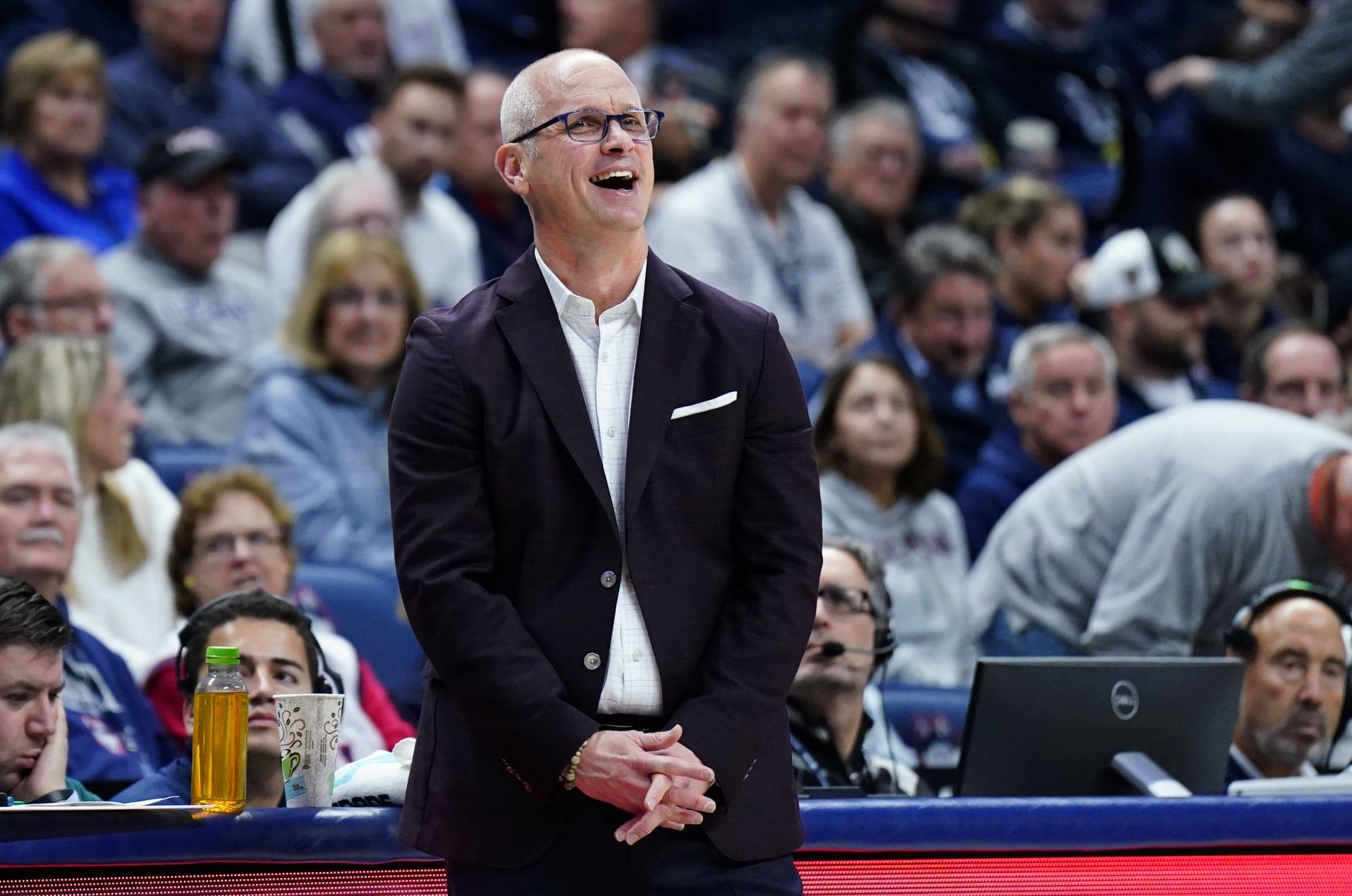
As the UConn Huskies prepare to face No. 7 BYU Cougars, head coach Dan Hurley voiced his frustration with the NCAA’s new coach’s challenge rule, calling it an unnecessary complication to an already demanding sport. The NCAA Playing Rules Oversight Panel approved the rule for the 2025–26 season, affecting the rhythm and decision-making process that coaches rely on in high-pressure moments.
Dan Hurley Sounds Off on NCAA’s New Rule Shift Before UConn’s BYU Battle
As UConn readies for its early-season test against No. 7 BYU, head coach Hurley didn’t hold back his opinion on one of the most talked-about updates in college basketball. The 2024 defending national champion coach voiced his opinion on the NCAA’s new coach’s challenge rule.
During his press conference, Hurley shared how the new feature played out in real time.
“It was a strange time to do it,” he said after attempting his first challenge. “But I wanted to get one under my belt and I don’t know I gave the right signal. I think I did the European.”
When asked whether he liked the change, he admitted,
“Yeah, I do. Um you know uh well I mean no not really. We don’t want anything else to have to think about like turning around and looking at the video people because you’re not even sure what you know we don’t have the NBA quality of video.”
He added bluntly, “The replays we’re getting is not the replays that the Knicks are getting or the Celtics are getting. So it’s a crapshoot over there.”
Hurley’s candid comments underline a broader unease among coaches about adding another in-game responsibility. For him, the challenge rule may enhance fairness in theory, but without professional-level replay systems, it risks creating confusion rather than clarity.
What Does the New NCAA Coach’s Challenge Rule Mean for College Basketball?
Beginning in the 2025–26 season, the NCAA Playing Rules Oversight Panel approved the introduction of coaches’ challenges, allowing head coaches to contest specific calls for the first time in men’s basketball history.
Under the new structure, coaches can challenge plays involving out-of-bounds decisions, basket interference or goaltending, and restricted-area positioning on block/charge calls.
Each team will be granted one challenge per game and must have a timeout to use it. If the review overturns the call, the team keeps its timeout and earns a second challenge. If unsuccessful, the team loses both. The design mirrors systems used in professional leagues like the NBA and NFL, giving college coaches more control over game-altering situations.
However, the rule also limits who can initiate reviews in late-game moments. In the final two minutes and overtime, officials can still review goaltending or restricted-area plays, but out-of-bounds checks can only be triggered by a coach’s challenge.
Standard fouls cannot be reviewed unless a coach contests whether a defender’s feet were inside the restricted circle, which could change the nature of the foul call.
The NCAA also implemented additional tweaks, including a modification to the flagrant foul rule, allowing referees to assign a Flagrant 1 for contact to the groin, previously an automatic Flagrant 2.
The panel noted that there is “positive momentum” toward exploring quarters instead of halves, although issues surrounding media breaks and broadcast timing still require discussion.
